Thank you for visiting SNEWPapers!
Sign up free
Editorial
August 1, 1808
Portland Gazette, And Maine Advertiser
Portland, Cumberland County, Maine
What is this article about?
A pseudonymous letter published in the Albany Crisis criticizes Thomas Jefferson's administration for partisan favoritism in appointments, appeasement of France, failure to confront Britain over the Chesapeake incident, and the economically ruinous Embargo, contrasting it favorably with Federalist policies under Washington and Adams.
Clipping
OCR Quality
95%
Excellent
Full Text
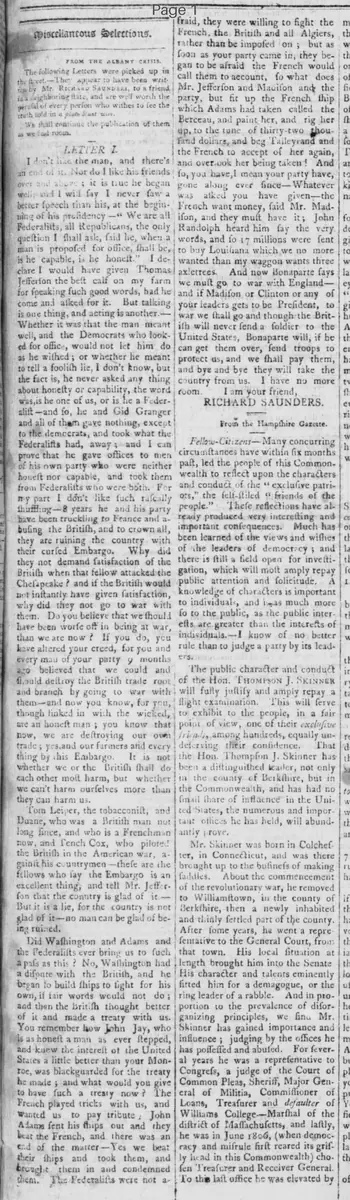
MISCELLANEOUS SELECTIONS.
FROM THE ALBANY CRISIS.
The following Letters were picked up in the street. They appear to have been written by Mr. Richard Saunders, to a friend in a neighboring state, and are well worth the perusal of every person who wishes to see the truth told in a plain blunt way.
We shall continue the publication of them as we find room.
LETTER I.
I don't like the man, and there's an end of it. Nor do I like his friends over and above; it is true he began well and I will say I never saw a better speech than his, at the beginning of his presidency—'We are all Federalists, all Republicans, the only question I shall ask, said he, when a man is proposed for office, shall be, is he capable, is he honest.' I declare I would have given Thomas Jefferson the best calf on my farm for speaking such good words, had he come and asked for it. But talking is one thing, and acting is another.
Whether it was that the man meant well, and the Democrats who looked for office, would not let him do as he wished; or whether he meant to tell a foolish lie, I don't know, but the fact is, he never asked any thing about honesty or capability, the word was, is he one of us, or is he a Federalist—and so, he and Gideon Granger and all of them gave nothing, except to the democrats, and took what the Federalists had, away; and I can prove that he gave offices to men of his own party who were neither honest nor capable, and took them from Federalists who were both. For my part I don't like such rascally shuffling—8 years he and his party have been truckling to France and abusing the British, and to crown all, they are ruining the country with their cursed Embargo. Why did they not demand satisfaction of the British when that fellow attacked the Chesapeake? and if the British would not instantly have given satisfaction, why did they not go to war with them. Do you believe that we should have been worse off in being at war, than we are now? If you do, you have altered your creed, for you and every man of your party 7 months ago believed that we could and should destroy the British trade root and branch by going to war with them—and now you know, for you, though linked in with the wicked, are an honest man; you know that now, we are destroying our own trade; yes, and our farmers and every thing by his Embargo. It is not whether we or the British shall do each other most harm, but whether we can't harm ourselves more than they can harm us.
From Leister, the tobacconist, and Duane, who was a British man not long since, and who is a Frenchman now, and French Cox, who piloted the British in the American war, against his countrymen—these are the fellows who say the Embargo is an excellent thing, and tell Mr. Jefferson that the country is glad of it—But it is a lie, for the country is not glad of it—no man can be glad of being ruined.
Did Washington and Adams and the Federalists ever bring us to such a pass as this? No, Washington had a dispute with the British, and he began to build ships to fight for his own, if fair words would not do: and then the British thought better of it and made a treaty with us.
You remember how John Jay, who is as honest a man as ever stepped, and knew the interest of the United States a little better than your Monroe, was blackguarded for the treaty he made; and what would you give to have such a treaty now? The French played tricks with us, and wanted us to pay tribute; John Adams sent his ships out and they beat the French, and there was an end of the matter—Yes we beat their ships and took them, and brought them in and condemned them. The Federalists were not afraid, they were willing to fight the French, the British and all Algiers, rather than be imposed on; but as soon as your party came in, they began to be afraid the French would call them to account. So what does Mr. Jefferson and Madison and the party, but fit up the French ship which Adams had taken called the Berceau, and paint her, and rig her up, to the tune of thirty-two thousand dollars, and beg Talleyrand and the French to accept of her again, and overlook her being taken! And so, you have, I mean your party have, gone along ever since—Whatever was asked you have given—the French want money, and Mr. Madison, and they must have it; John Randolph heard him say the very words, and so 17 millions were sent to buy Louisiana which we no more wanted than my waggon wants three axletrees. And now Bonaparte says we must go to war with England—and if Madison or Clinton or any of your leaders gets to be President, to war we shall go and though the British will never send a soldier to the United States, Bonaparte will, if he can get them over, send troops to protect us, and we shall pay them, and bye and bye they will take the country from us. I have no more room.
I am your friend,
RICHARD SAUNDERS.
FROM THE ALBANY CRISIS.
The following Letters were picked up in the street. They appear to have been written by Mr. Richard Saunders, to a friend in a neighboring state, and are well worth the perusal of every person who wishes to see the truth told in a plain blunt way.
We shall continue the publication of them as we find room.
LETTER I.
I don't like the man, and there's an end of it. Nor do I like his friends over and above; it is true he began well and I will say I never saw a better speech than his, at the beginning of his presidency—'We are all Federalists, all Republicans, the only question I shall ask, said he, when a man is proposed for office, shall be, is he capable, is he honest.' I declare I would have given Thomas Jefferson the best calf on my farm for speaking such good words, had he come and asked for it. But talking is one thing, and acting is another.
Whether it was that the man meant well, and the Democrats who looked for office, would not let him do as he wished; or whether he meant to tell a foolish lie, I don't know, but the fact is, he never asked any thing about honesty or capability, the word was, is he one of us, or is he a Federalist—and so, he and Gideon Granger and all of them gave nothing, except to the democrats, and took what the Federalists had, away; and I can prove that he gave offices to men of his own party who were neither honest nor capable, and took them from Federalists who were both. For my part I don't like such rascally shuffling—8 years he and his party have been truckling to France and abusing the British, and to crown all, they are ruining the country with their cursed Embargo. Why did they not demand satisfaction of the British when that fellow attacked the Chesapeake? and if the British would not instantly have given satisfaction, why did they not go to war with them. Do you believe that we should have been worse off in being at war, than we are now? If you do, you have altered your creed, for you and every man of your party 7 months ago believed that we could and should destroy the British trade root and branch by going to war with them—and now you know, for you, though linked in with the wicked, are an honest man; you know that now, we are destroying our own trade; yes, and our farmers and every thing by his Embargo. It is not whether we or the British shall do each other most harm, but whether we can't harm ourselves more than they can harm us.
From Leister, the tobacconist, and Duane, who was a British man not long since, and who is a Frenchman now, and French Cox, who piloted the British in the American war, against his countrymen—these are the fellows who say the Embargo is an excellent thing, and tell Mr. Jefferson that the country is glad of it—But it is a lie, for the country is not glad of it—no man can be glad of being ruined.
Did Washington and Adams and the Federalists ever bring us to such a pass as this? No, Washington had a dispute with the British, and he began to build ships to fight for his own, if fair words would not do: and then the British thought better of it and made a treaty with us.
You remember how John Jay, who is as honest a man as ever stepped, and knew the interest of the United States a little better than your Monroe, was blackguarded for the treaty he made; and what would you give to have such a treaty now? The French played tricks with us, and wanted us to pay tribute; John Adams sent his ships out and they beat the French, and there was an end of the matter—Yes we beat their ships and took them, and brought them in and condemned them. The Federalists were not afraid, they were willing to fight the French, the British and all Algiers, rather than be imposed on; but as soon as your party came in, they began to be afraid the French would call them to account. So what does Mr. Jefferson and Madison and the party, but fit up the French ship which Adams had taken called the Berceau, and paint her, and rig her up, to the tune of thirty-two thousand dollars, and beg Talleyrand and the French to accept of her again, and overlook her being taken! And so, you have, I mean your party have, gone along ever since—Whatever was asked you have given—the French want money, and Mr. Madison, and they must have it; John Randolph heard him say the very words, and so 17 millions were sent to buy Louisiana which we no more wanted than my waggon wants three axletrees. And now Bonaparte says we must go to war with England—and if Madison or Clinton or any of your leaders gets to be President, to war we shall go and though the British will never send a soldier to the United States, Bonaparte will, if he can get them over, send troops to protect us, and we shall pay them, and bye and bye they will take the country from us. I have no more room.
I am your friend,
RICHARD SAUNDERS.
What sub-type of article is it?
Partisan Politics
Foreign Affairs
Economic Policy
What keywords are associated?
Jefferson Criticism
Embargo Policy
Federalist Defense
France Appeasement
British Relations
Partisan Appointments
What entities or persons were involved?
Thomas Jefferson
Gideon Granger
George Washington
John Adams
John Jay
James Madison
Talleyrand
Bonaparte
Editorial Details
Primary Topic
Criticism Of Jefferson's Administration And The Embargo
Stance / Tone
Strongly Anti Jeffersonian And Pro Federalist
Key Figures
Thomas Jefferson
Gideon Granger
George Washington
John Adams
John Jay
James Madison
Talleyrand
Bonaparte
Key Arguments
Jefferson's Appointments Favored Party Loyalty Over Honesty And Capability
Administration Truckled To France While Abusing Britain
Embargo Is Ruining American Trade And Farmers More Than It Harms Britain
Failed To Demand Satisfaction Or Go To War After Chesapeake Attack
Contrasts With Federalists' Firm Stance Against Britain And France
Returned Captured French Ship Berceau To Appease France
Paid 17 Million For Unnecessary Louisiana Purchase
Risk Of War With England Under Democratic Leadership Leading To French Domination