Thank you for visiting SNEWPapers!
Sign up free
Literary
November 20, 1893
The Beatrice Daily Express
Beatrice, Gage County, Nebraska
What is this article about?
An essay explaining boiling points of liquids, how they vary with pressure and substance, with examples like water boiling at lower temperatures on mountains or in vacuum, comparisons to alcohol and ether, and the liquefaction of gases like oxygen and nitrogen, culminating in the liquefaction of air.
Clipping
OCR Quality
98%
Excellent
Full Text
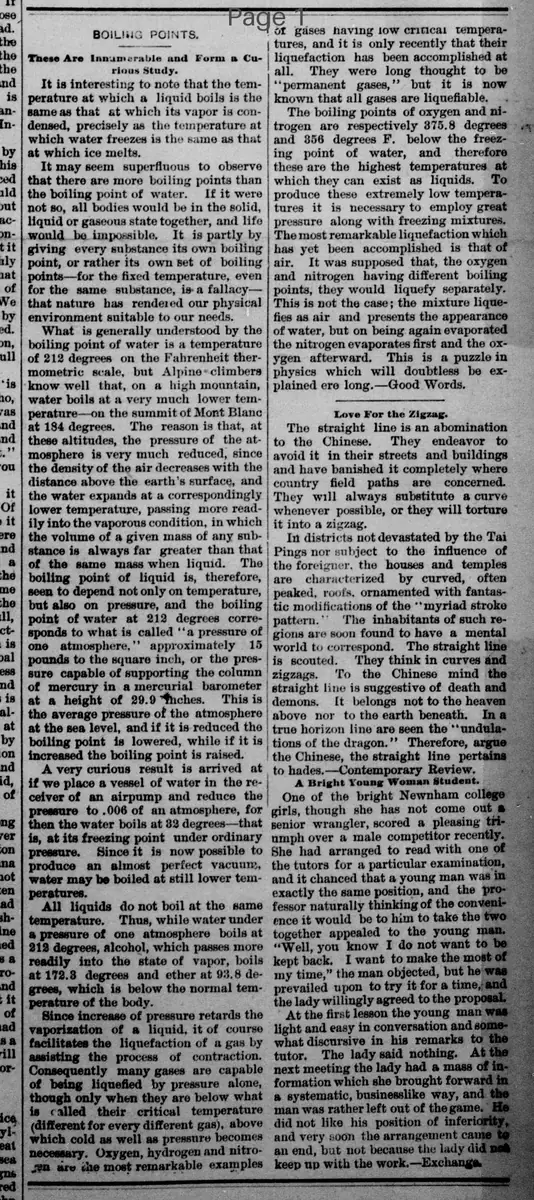
BOILING POINTS.
These Are Innumerable and Form a Curious Study.
It is interesting to note that the temperature at which a liquid boils is the same as that at which its vapor is condensed, precisely as the temperature at which water freezes is the same as that at which ice melts.
It may seem superfluous to observe that there are more boiling points than the boiling point of water. If it were not so, all bodies would be in the solid, liquid or gaseous state together, and life would be impossible. It is partly by giving every substance its own boiling point, or rather its own set of boiling points-for the fixed temperature, even for the same substance, is a fallacy that nature has rendered our physical environment suitable to our needs.
What is generally understood by the boiling point of water is a temperature of 212 degrees on the Fahrenheit thermometric scale, but Alpine climbers know well that, on a high mountain, water boils at a very much lower temperature-on the summit of Mont Blanc at 184 degrees. The reason is that, at these altitudes, the pressure of the atmosphere is very much reduced, since the density of the air decreases with the distance above the earth's surface, and the water expands at a correspondingly lower temperature, passing more readily into the vaporous condition, in which the volume of a given mass of any substance is always far greater than that of the same mass when liquid. The boiling point of liquid is, therefore, seen to depend not only on temperature, but also on pressure, and the boiling point of water at 212 degrees corresponds to what is called "a pressure of one atmosphere," approximately 15 pounds to the square inch, or the pressure capable of supporting the column of mercury in a mercurial barometer at a height of 29.9 inches. This is the average pressure of the atmosphere at the sea level, and if it is reduced the boiling point is lowered, while if it is increased the boiling point is raised.
A very curious result is arrived at if we place a vessel of water in the receiver of an airpump and reduce the pressure to .006 of an atmosphere, for then the water boils at 33 degrees-that is, at its freezing point under ordinary pressure. Since it is now possible to produce an almost perfect vacuum, water may be boiled at still lower temperatures.
All liquids do not boil at the same temperature. Thus, while water under a pressure of one atmosphere boils at 212 degrees, alcohol, which passes more readily into the state of vapor, boils at 172.3 degrees and ether at 93.8 degrees, which is below the normal temperature of the body.
Since increase of pressure retards the vaporization of a liquid, it of course facilitates the liquefaction of a gas by assisting the process of contraction. Consequently many gases are capable of being liquefied by pressure alone, though only when they are below what is called their critical temperature (different for every different gas), above which cold as well as pressure becomes necessary. Oxygen, hydrogen and nitrogen are the most remarkable examples
of gases having low critical temperatures, and it is only recently that their liquefaction has been accomplished at all. They were long thought to be "permanent gases," but it is now known that all gases are liquefiable. The boiling points of oxygen and nitrogen are respectively 375.8 degrees and 856 degrees F. below the freezing point of water, and therefore these are the highest temperatures at which they can exist as liquids. To produce these extremely low temperatures it is necessary to employ great pressure along with freezing mixtures.
The most remarkable liquefaction which has yet been accomplished is that of air. It was supposed that, the oxygen and nitrogen having different boiling points, they would liquefy separately. This is not the case: the mixture liquefies as air and presents the appearance of water, but on being again evaporated the nitrogen evaporates first and the oxygen afterward. This is a puzzle in physics which will doubtless be explained ere long.-Good Words.
These Are Innumerable and Form a Curious Study.
It is interesting to note that the temperature at which a liquid boils is the same as that at which its vapor is condensed, precisely as the temperature at which water freezes is the same as that at which ice melts.
It may seem superfluous to observe that there are more boiling points than the boiling point of water. If it were not so, all bodies would be in the solid, liquid or gaseous state together, and life would be impossible. It is partly by giving every substance its own boiling point, or rather its own set of boiling points-for the fixed temperature, even for the same substance, is a fallacy that nature has rendered our physical environment suitable to our needs.
What is generally understood by the boiling point of water is a temperature of 212 degrees on the Fahrenheit thermometric scale, but Alpine climbers know well that, on a high mountain, water boils at a very much lower temperature-on the summit of Mont Blanc at 184 degrees. The reason is that, at these altitudes, the pressure of the atmosphere is very much reduced, since the density of the air decreases with the distance above the earth's surface, and the water expands at a correspondingly lower temperature, passing more readily into the vaporous condition, in which the volume of a given mass of any substance is always far greater than that of the same mass when liquid. The boiling point of liquid is, therefore, seen to depend not only on temperature, but also on pressure, and the boiling point of water at 212 degrees corresponds to what is called "a pressure of one atmosphere," approximately 15 pounds to the square inch, or the pressure capable of supporting the column of mercury in a mercurial barometer at a height of 29.9 inches. This is the average pressure of the atmosphere at the sea level, and if it is reduced the boiling point is lowered, while if it is increased the boiling point is raised.
A very curious result is arrived at if we place a vessel of water in the receiver of an airpump and reduce the pressure to .006 of an atmosphere, for then the water boils at 33 degrees-that is, at its freezing point under ordinary pressure. Since it is now possible to produce an almost perfect vacuum, water may be boiled at still lower temperatures.
All liquids do not boil at the same temperature. Thus, while water under a pressure of one atmosphere boils at 212 degrees, alcohol, which passes more readily into the state of vapor, boils at 172.3 degrees and ether at 93.8 degrees, which is below the normal temperature of the body.
Since increase of pressure retards the vaporization of a liquid, it of course facilitates the liquefaction of a gas by assisting the process of contraction. Consequently many gases are capable of being liquefied by pressure alone, though only when they are below what is called their critical temperature (different for every different gas), above which cold as well as pressure becomes necessary. Oxygen, hydrogen and nitrogen are the most remarkable examples
of gases having low critical temperatures, and it is only recently that their liquefaction has been accomplished at all. They were long thought to be "permanent gases," but it is now known that all gases are liquefiable. The boiling points of oxygen and nitrogen are respectively 375.8 degrees and 856 degrees F. below the freezing point of water, and therefore these are the highest temperatures at which they can exist as liquids. To produce these extremely low temperatures it is necessary to employ great pressure along with freezing mixtures.
The most remarkable liquefaction which has yet been accomplished is that of air. It was supposed that, the oxygen and nitrogen having different boiling points, they would liquefy separately. This is not the case: the mixture liquefies as air and presents the appearance of water, but on being again evaporated the nitrogen evaporates first and the oxygen afterward. This is a puzzle in physics which will doubtless be explained ere long.-Good Words.
What sub-type of article is it?
Essay
What themes does it cover?
Nature
What keywords are associated?
Boiling Points
Vaporization
Pressure Effects
Liquefaction
Gases
Critical Temperature
Air Liquefaction
Literary Details
Title
Boiling Points.
Subject
These Are Innumerable And Form A Curious Study.
Key Lines
It Is Interesting To Note That The Temperature At Which A Liquid Boils Is The Same As That At Which Its Vapor Is Condensed, Precisely As The Temperature At Which Water Freezes Is The Same As That At Which Ice Melts.
The Boiling Point Of Liquid Is, Therefore, Seen To Depend Not Only On Temperature, But Also On Pressure
All Gases Are Liquefiable.
The Most Remarkable Liquefaction Which Has Yet Been Accomplished Is That Of Air.