Thank you for visiting SNEWPapers!
Sign up free
Letter to Editor
June 5, 1849
The Daily National Whig
Washington, District Of Columbia
What is this article about?
A Virginian responds to Judge Lane's letter, praising his honest political stance and decision to decline nomination in favor of a Taylor Democrat. Advocates for moderate men across parties to support Taylor's administration, equal office distribution, and criticizes the Union newspaper's editors for hypocrisy and prejudice.
Clipping
OCR Quality
80%
Good
Full Text
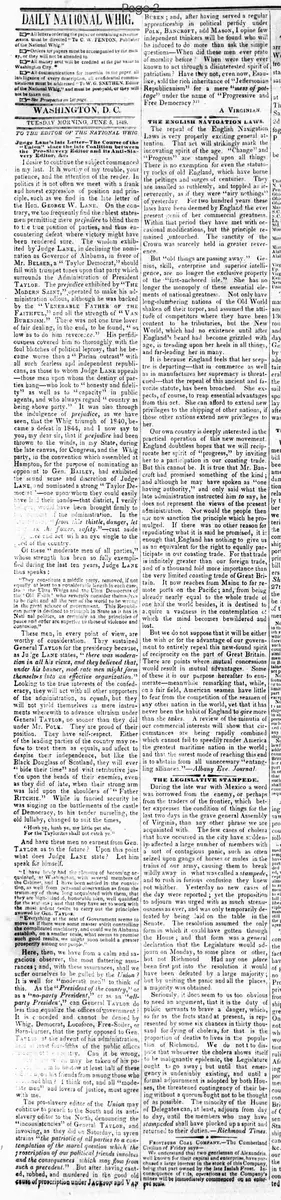
TO THE EDITOR OF THE NATIONAL WHIG.
Judge Lane's Late Letter—The Course of the "Union" since the late Coalition between the Pro-Slavery Editor and its Anti-Slavery Editor, &c.
I desire to continue the subject commenced in my last. It is worthy of my trouble, your patience, and the attention of the reader. In politics it is not often we meet with a frank and honest expression of position and principle, such as we find in the late letter of the Hon. George W. Lane. On the contrary, we too frequently find the ablest statesmen permitting mere prejudice to blind them to the true position of parties, and thus encountering defeat where victory might have been rendered sure. The wisdom exhibited by Judge Lane, in declining the nomination as Governor of Alabama, in favor of Mr. Belser, a "Taylor Democrat," should fall with trumpet tones upon that party which surrounds the Administration of President Taylor. The prejudice exhibited by "THE Modern Saint," operated to make his administration odious, although he was backed by the "VENERABLE FATHER OF THE FAITHFUL," and all the strength of "VAN Burenism." There was not one true lover of fair dealing, in the end, to be found, "so low as to do him reverence." His perfidiousness covered him so thoroughly with the foul blotches of political leprosy, that he became worse than a "Parian outcast" with all such fearless and independent republicans, as those to whom Judge Lane appeals—those men upon whom the destiny of parties hang—who look to "honesty and fidelity" as well as to "capacity" in public agents, and who always regard "country as being above party." It was also through the indulgence of prejudice, as we have seen, that the Whig triumph of 1840, became a defeat in 1844, and I now say to you, my dear sir, that if prejudice had been thrown to the winds, in my State, during the late canvas, for Congress, and the Whig party, in the convention which assembled at Hampton, for the purpose of nominating an opponent to Gen. Baylor, had exhibited the sound sense and discretion of Judge Lane, and nominated a strong "Taylor Democrat"—one upon whom they could easily have laid their hands—that district, I verily would have been brought firmly to the administration. In the ... Out of this nettle, danger, we pluck this flower, safety."—cast aside prejudice and act with an eye single to the good of the country.
Of these "moderate men of all parties," whose strength has been so fully exemplified during the last ten years, Judge Lane thus speaks:
"They constitute a middle party, removed, if not equally at least to a considerable length in each case, from the Ultra Whigs and the Ultra Democrats of the "Old Faith" who severally consider themselves to be right and all the rest of the world to be wrong! in the great science of government. This Republican party is destined to triumph in State as it has in National politics, as certainly as the principles of peace and order are superior to those of violence and confusion."
These men, in every point of view, are worthy of consideration. They sustained General Taylor for the presidency because, as Judge Lane states, "there was moderation in all his views, and they believed that under his banner, moderate men might form themselves into an effective organization."
Looking to the true interests of the confederacy, they will act with all other supporters of the administration, as equals, but they will not yield themselves as mere instruments wherewith to advance ultraism under General Taylor, no sooner than they did under Mr. Polk. They are proud of their position. They have self-respect. Either of the leading parties of the country may refuse to treat them as equals, and affect to despise their independence, but like the Black Douglass of Scotland, they will ever "bide their time" and visit retributive justice upon the heads of their enemies, even as they did of late, when their strong arm was laid upon the shoulders of "Father Ritchie." While in fancied security he was singing on the battlements of the castle of Democracy, to his tender nurseling, the old lullaby, changed to suit the times,
"Hush ye, hush ye, my little pet she
For the Taylorites shall not catch ye."
And have these men no earnest from Gen. Taylor as to the future? Upon this point what does Judge Lane state? Let him speak for himself.
"I have lately had the pleasure of becoming acquainted, at Washington, with several members of the Cabinet, and I have been settled in the conviction, as well from personal observation as from the testimony of those long acquainted with them, that they are high-minded, honorable men, well qualified for the stations; and that they have set to work with the most ardent desire to carry out the principles avowed by Gen. Taylor.
"Everything at the seat of Government seems to move as if there were some master spirit controlling the complicated machinery, and could we in Alabama establish, on a smaller scale, what seems to promise such good results, we might soon behold a greater prosperity among our people."
Here, then, we have from a calm and sagacious observer, the most flattering assurances; and, with these assurances, shall we suffer ourselves to be gulled by the Union?
It is well for "moderate men" to think of this. As the "President of the country," or as a "no-party President," or as an "all-party President," can General Taylor do less than equalize the offices of government?
It is conceded and cannot be denied by Whig, Democrat, Locofoco, Free-Soiler, or Barn-burner, that the party opposed to Gen. Taylor at the advent of his administration, filled at least four-fifths of the public offices. Can it be wrong, etc. may be taken of his policy to bestow at least half of these upon his friends from among those who elected him? I think not, and all "moderate men" and lovers of justice, must agree with me.
The pro-slavery editor of the Union may continue to preach to the South and its anti-slavery editor to the North, denouncing the "inconsistencies" of General Taylor, and invoking, as they did on Saturday, in syren strains "the patriotic of all parties to a contemplation of the moral question which the proscription of our political friends involves and the consequences which may flow from such a precedent." But after having cant- ed, robbed, and murdered in the good old cause of proscription under Jackson and Van Buren; and, after having served a regular apprenticeship in political perfidy under Polk, Bancroft, and Mason, I opine few independent thinkers will be found who will be induced to do more than ask the simple questions—When did these men ever prate of morality before? When were they ever known to act through a disinterested spirit of patriotism? Have they not, even now, Esau- like, sold the rich inheritance of "Jeffersonian Republicanism" for a mere "mess of pottage" under the name of "Progressive and Free Democracy?"
A VIRGINIAN
Judge Lane's Late Letter—The Course of the "Union" since the late Coalition between the Pro-Slavery Editor and its Anti-Slavery Editor, &c.
I desire to continue the subject commenced in my last. It is worthy of my trouble, your patience, and the attention of the reader. In politics it is not often we meet with a frank and honest expression of position and principle, such as we find in the late letter of the Hon. George W. Lane. On the contrary, we too frequently find the ablest statesmen permitting mere prejudice to blind them to the true position of parties, and thus encountering defeat where victory might have been rendered sure. The wisdom exhibited by Judge Lane, in declining the nomination as Governor of Alabama, in favor of Mr. Belser, a "Taylor Democrat," should fall with trumpet tones upon that party which surrounds the Administration of President Taylor. The prejudice exhibited by "THE Modern Saint," operated to make his administration odious, although he was backed by the "VENERABLE FATHER OF THE FAITHFUL," and all the strength of "VAN Burenism." There was not one true lover of fair dealing, in the end, to be found, "so low as to do him reverence." His perfidiousness covered him so thoroughly with the foul blotches of political leprosy, that he became worse than a "Parian outcast" with all such fearless and independent republicans, as those to whom Judge Lane appeals—those men upon whom the destiny of parties hang—who look to "honesty and fidelity" as well as to "capacity" in public agents, and who always regard "country as being above party." It was also through the indulgence of prejudice, as we have seen, that the Whig triumph of 1840, became a defeat in 1844, and I now say to you, my dear sir, that if prejudice had been thrown to the winds, in my State, during the late canvas, for Congress, and the Whig party, in the convention which assembled at Hampton, for the purpose of nominating an opponent to Gen. Baylor, had exhibited the sound sense and discretion of Judge Lane, and nominated a strong "Taylor Democrat"—one upon whom they could easily have laid their hands—that district, I verily would have been brought firmly to the administration. In the ... Out of this nettle, danger, we pluck this flower, safety."—cast aside prejudice and act with an eye single to the good of the country.
Of these "moderate men of all parties," whose strength has been so fully exemplified during the last ten years, Judge Lane thus speaks:
"They constitute a middle party, removed, if not equally at least to a considerable length in each case, from the Ultra Whigs and the Ultra Democrats of the "Old Faith" who severally consider themselves to be right and all the rest of the world to be wrong! in the great science of government. This Republican party is destined to triumph in State as it has in National politics, as certainly as the principles of peace and order are superior to those of violence and confusion."
These men, in every point of view, are worthy of consideration. They sustained General Taylor for the presidency because, as Judge Lane states, "there was moderation in all his views, and they believed that under his banner, moderate men might form themselves into an effective organization."
Looking to the true interests of the confederacy, they will act with all other supporters of the administration, as equals, but they will not yield themselves as mere instruments wherewith to advance ultraism under General Taylor, no sooner than they did under Mr. Polk. They are proud of their position. They have self-respect. Either of the leading parties of the country may refuse to treat them as equals, and affect to despise their independence, but like the Black Douglass of Scotland, they will ever "bide their time" and visit retributive justice upon the heads of their enemies, even as they did of late, when their strong arm was laid upon the shoulders of "Father Ritchie." While in fancied security he was singing on the battlements of the castle of Democracy, to his tender nurseling, the old lullaby, changed to suit the times,
"Hush ye, hush ye, my little pet she
For the Taylorites shall not catch ye."
And have these men no earnest from Gen. Taylor as to the future? Upon this point what does Judge Lane state? Let him speak for himself.
"I have lately had the pleasure of becoming acquainted, at Washington, with several members of the Cabinet, and I have been settled in the conviction, as well from personal observation as from the testimony of those long acquainted with them, that they are high-minded, honorable men, well qualified for the stations; and that they have set to work with the most ardent desire to carry out the principles avowed by Gen. Taylor.
"Everything at the seat of Government seems to move as if there were some master spirit controlling the complicated machinery, and could we in Alabama establish, on a smaller scale, what seems to promise such good results, we might soon behold a greater prosperity among our people."
Here, then, we have from a calm and sagacious observer, the most flattering assurances; and, with these assurances, shall we suffer ourselves to be gulled by the Union?
It is well for "moderate men" to think of this. As the "President of the country," or as a "no-party President," or as an "all-party President," can General Taylor do less than equalize the offices of government?
It is conceded and cannot be denied by Whig, Democrat, Locofoco, Free-Soiler, or Barn-burner, that the party opposed to Gen. Taylor at the advent of his administration, filled at least four-fifths of the public offices. Can it be wrong, etc. may be taken of his policy to bestow at least half of these upon his friends from among those who elected him? I think not, and all "moderate men" and lovers of justice, must agree with me.
The pro-slavery editor of the Union may continue to preach to the South and its anti-slavery editor to the North, denouncing the "inconsistencies" of General Taylor, and invoking, as they did on Saturday, in syren strains "the patriotic of all parties to a contemplation of the moral question which the proscription of our political friends involves and the consequences which may flow from such a precedent." But after having cant- ed, robbed, and murdered in the good old cause of proscription under Jackson and Van Buren; and, after having served a regular apprenticeship in political perfidy under Polk, Bancroft, and Mason, I opine few independent thinkers will be found who will be induced to do more than ask the simple questions—When did these men ever prate of morality before? When were they ever known to act through a disinterested spirit of patriotism? Have they not, even now, Esau- like, sold the rich inheritance of "Jeffersonian Republicanism" for a mere "mess of pottage" under the name of "Progressive and Free Democracy?"
A VIRGINIAN
What sub-type of article is it?
Persuasive
Political
Reflective
What themes does it cover?
Politics
Morality
What keywords are associated?
Taylor Administration
Judge Lane
Moderate Men
Political Prejudice
Whig Party
Union Newspaper
Taylor Democrat
Alabama Politics
What entities or persons were involved?
A Virginian
The Editor Of The National Whig
Letter to Editor Details
Author
A Virginian
Recipient
The Editor Of The National Whig
Main Argument
judge lane's letter exemplifies honest politics; moderate men should support taylor's administration by nominating cross-party candidates and equalizing offices, rejecting prejudice and the hypocritical union editors.
Notable Details
Quotes Judge Lane On Moderate Men And Cabinet
References Shakespeare: 'Out Of This Nettle, Danger, We Pluck This Flower, Safety'
Criticizes Van Buren, Polk Administrations
Mentions Alabama Nomination, Hampton Convention