Thank you for visiting SNEWPapers!
Sign up free
Editorial
October 20, 1804
Norfolk Gazette And Publick Ledger
Norfolk, Virginia
What is this article about?
An editorial criticizes President Jefferson's administration for removing numerous Federalist officeholders, contradicting his inaugural speech. It lists specific removals in Virginia, attributes the policy to partisan pressures, and urges other Federalist papers to compile similar lists to expose the truth.
Clipping
OCR Quality
98%
Excellent
Full Text
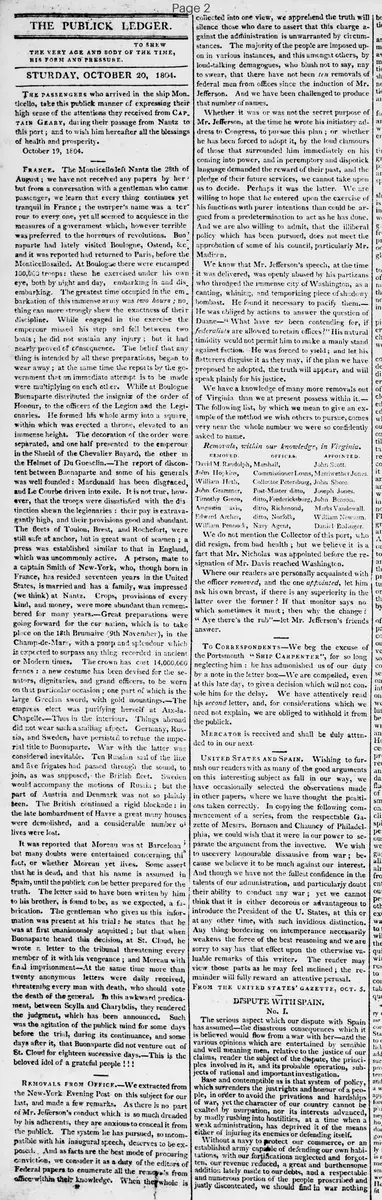
REMOVALS FROM OFFICE. We extracted from the New-York Evening Post on this subject for our last, and made a few remarks. As there is no part of Mr. Jefferson's conduct which is so much dreaded by his adherents, they are anxious to conceal it from the publick. The system he has pursued, so incompatible with his inaugural speech, deserves to be exposed. And as facts are the best mode of procuring conviction, we consider it as a duty of the editors of Federal papers to enumerate all the removals from office within their knowledge. When the whole is collected into one view, we apprehend the truth will silence those who dare to assert that this charge against the administration is unwarranted by circumstances. The majority of the people are imposed upon in various instances, and this amongst others, by loud-talking demagogues, who blush not to say, nay to swear, that there have not been ten removals of federal men from offices since the induction of Mr. Jefferson. And we have been challenged to produce that number of names.
Whether it was or was not the secret purpose of Mr. Jefferson, at the time he wrote his initiatory address to Congress, to pursue this plan; or whether he has been forced to adopt it, by the loud clamours of those that surrounded him immediately on his coming into power, and in peremptory and despotic language demanded the reward of their past, and the pledge of their future services, we cannot take upon us to decide. Perhaps it was the latter. We are willing to hope that he entered upon the exercise of his functions with purer intentions than could be argued from a predetermination to act as he has done. And we are also willing to admit, that the illiberal policy which has been pursued, does not meet the approbation of some of his council, particularly Mr. Madison.
We know that Mr. Jefferson's speech, at the time it was delivered, was openly abused by his partizans who thronged the immense city of Washington, as a canting, whining, and temporizing piece of shadowy bombast. He found it necessary to pacify them. He was obliged by actions to answer the question of Duane- "What have we been contending for, if federalists are allowed to retain offices?" His natural timidity would not permit him to make a manly stand against faction. He was forced to yield; and let his flatterers disguise it as they may, if the plan we have proposed be adopted, the truth will appear, and will speak plainly for his justice.
We have a knowledge of many more removals out of Virginia than we at present possess within it. The following list, by which we mean to give an example of the method we wish others to pursue, comes very near the whole number we were so confidently asked to name.
Removals, within our knowledge, in Virginia.
REMOVED. OFFICES. APPOINTED.
David M. Randolph, Marshall, John Scott.
John Hopkins, Commissioner of Loans, Merriwether Jones.
William Heath, Collector Petersburg, John Shore.
John Grammer, Post-Master ditto, Joseph Jones.
Timothy Green, ditto, Fredericksburg, John Benson.
Augustin Davis, ditto, Richmond, Marks Vandewall.
Edward Archer, ditto, Norfolk, William Newsum.
William Pennock, Navy Agent, Daniel Bedinger.
We do not mention the Collector of this port, who did resign, from bad health: but we believe it is a fact that Mr. Nicholas was appointed before the resignation of Mr. Davis reached Washington.
Where our readers are personally acquainted with the officer removed, and the one appointed, let him ask his own breast, if there is any superiority in the latter over the former? If that monitor says no which sometimes it must; then why the change? "Aye there's the rub"-let Mr. Jefferson's friends answer.
Whether it was or was not the secret purpose of Mr. Jefferson, at the time he wrote his initiatory address to Congress, to pursue this plan; or whether he has been forced to adopt it, by the loud clamours of those that surrounded him immediately on his coming into power, and in peremptory and despotic language demanded the reward of their past, and the pledge of their future services, we cannot take upon us to decide. Perhaps it was the latter. We are willing to hope that he entered upon the exercise of his functions with purer intentions than could be argued from a predetermination to act as he has done. And we are also willing to admit, that the illiberal policy which has been pursued, does not meet the approbation of some of his council, particularly Mr. Madison.
We know that Mr. Jefferson's speech, at the time it was delivered, was openly abused by his partizans who thronged the immense city of Washington, as a canting, whining, and temporizing piece of shadowy bombast. He found it necessary to pacify them. He was obliged by actions to answer the question of Duane- "What have we been contending for, if federalists are allowed to retain offices?" His natural timidity would not permit him to make a manly stand against faction. He was forced to yield; and let his flatterers disguise it as they may, if the plan we have proposed be adopted, the truth will appear, and will speak plainly for his justice.
We have a knowledge of many more removals out of Virginia than we at present possess within it. The following list, by which we mean to give an example of the method we wish others to pursue, comes very near the whole number we were so confidently asked to name.
Removals, within our knowledge, in Virginia.
REMOVED. OFFICES. APPOINTED.
David M. Randolph, Marshall, John Scott.
John Hopkins, Commissioner of Loans, Merriwether Jones.
William Heath, Collector Petersburg, John Shore.
John Grammer, Post-Master ditto, Joseph Jones.
Timothy Green, ditto, Fredericksburg, John Benson.
Augustin Davis, ditto, Richmond, Marks Vandewall.
Edward Archer, ditto, Norfolk, William Newsum.
William Pennock, Navy Agent, Daniel Bedinger.
We do not mention the Collector of this port, who did resign, from bad health: but we believe it is a fact that Mr. Nicholas was appointed before the resignation of Mr. Davis reached Washington.
Where our readers are personally acquainted with the officer removed, and the one appointed, let him ask his own breast, if there is any superiority in the latter over the former? If that monitor says no which sometimes it must; then why the change? "Aye there's the rub"-let Mr. Jefferson's friends answer.
What sub-type of article is it?
Partisan Politics
What keywords are associated?
Office Removals
Jefferson Administration
Federalist Dismissals
Partisan Appointments
Virginia Officials
Inaugural Speech Contradiction
What entities or persons were involved?
Mr. Jefferson
Mr. Madison
Duane
David M. Randolph
John Hopkins
William Heath
John Grammer
Timothy Green
Augustin Davis
Edward Archer
William Pennock
Editorial Details
Primary Topic
Removals Of Federalist Officeholders Under Jefferson
Stance / Tone
Critical Of Jefferson's Partisan Policy
Key Figures
Mr. Jefferson
Mr. Madison
Duane
David M. Randolph
John Hopkins
William Heath
John Grammer
Timothy Green
Augustin Davis
Edward Archer
William Pennock
Key Arguments
Jefferson's Removals Contradict His Inaugural Speech
Adherents Conceal The Extent Of Removals
Federalist Editors Should List All Known Removals
Jefferson Yielded To Partisan Pressures Despite Initial Intentions
Removals Driven By Demands For Rewards And Pledges
List Of Eight Removals In Virginia Provided As Example
No Superiority In Appointees Over Removed Officials