Thank you for visiting SNEWPapers!
Sign up free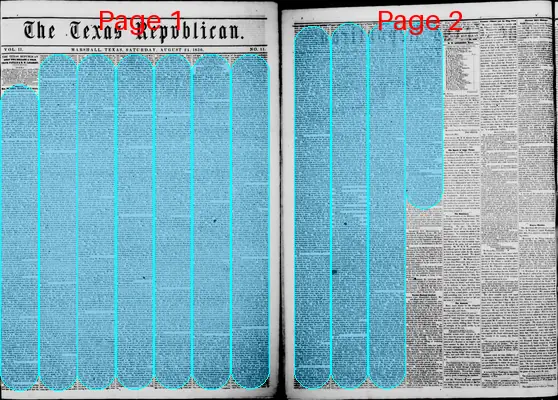
The Texas Republican
Marshall, Harrison County, Texas
What is this article about?
Hon. Beverly Tucker's speech at the Nashville Convention in 1850 defends Southern rights against Northern aggression, criticizes compromises like the Wilmot Proviso and California bill, argues for potential peaceful secession if needed, and warns against fear-mongering by leaders like Clay, Webster, and Cass, emphasizing Virginia's resolve for equality or independence.
Merged-components note: These two components form a single continuous narrative: the full speech by Hon. Beverly Tucker before the Nashville Convention, spanning pages 1 and 2 with sequential reading order and coherent text flow.
Clippings
1 of 2
OCR Quality
Full Text
BEFORE THE NASHVILLE CONVENTION.
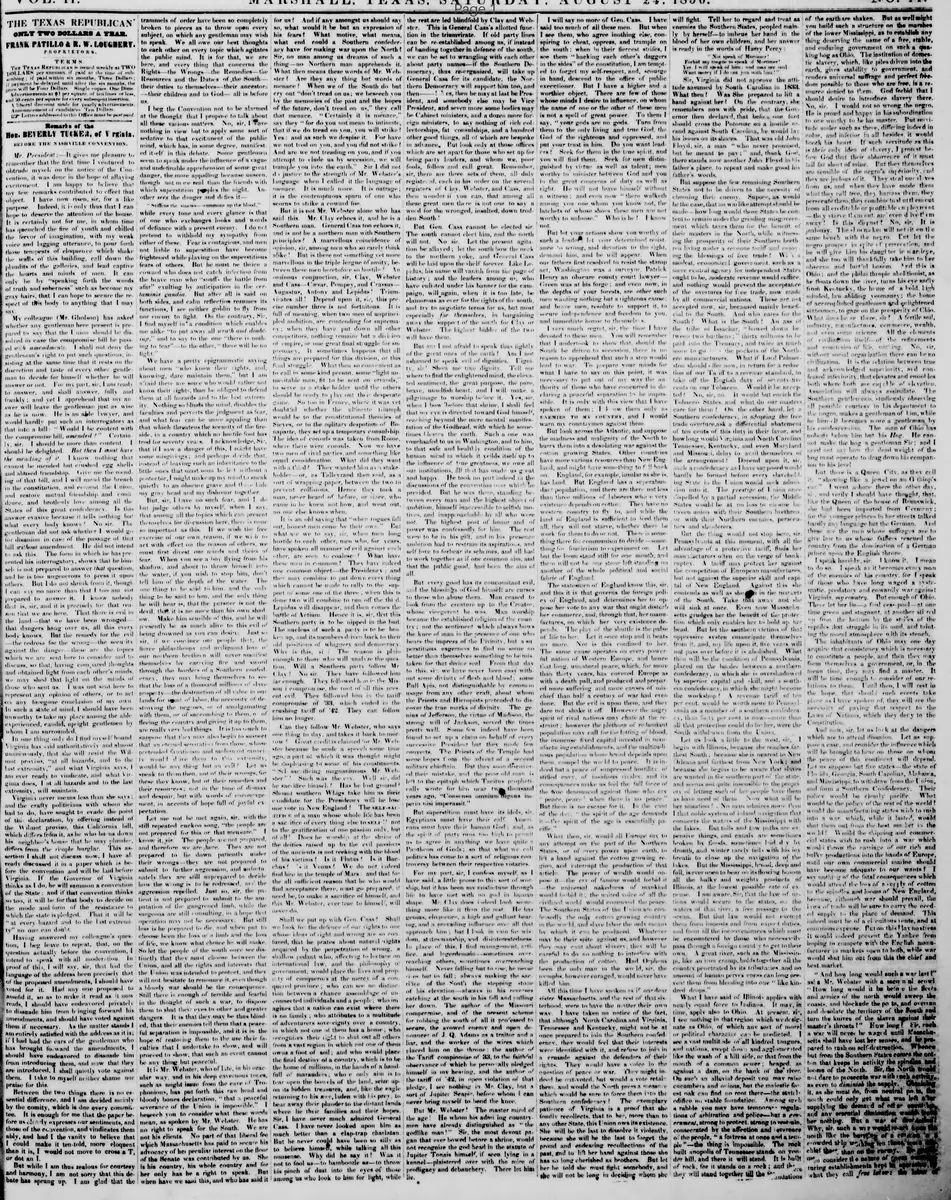
Mr. President: It gives me pleasure to remember that the first time I ventured to obtrude myself on the notice of the Convention, it was done in the hope of allaying excitement. I am happy to believe that my few remarks contributed to effect that object. I have now risen, sir, for a like purpose. Indeed, it is only thus that I can hope to deserve the attention of the house. It is certainly not for me, in whom time has quenched the fire of youth and chilled the fervor of imagination, with my weak voice and lagging utterance, to pour forth those tempests of eloquence which shake the walls of this building, call down the plaudits of the galleries, and lead captive the hearts and minds of men. It can only be by "speaking forth the words of truth and soberness" such as become my gray hairs, that I can hope to secure the respect of this body to anything that I may say.
My colleague (Mr. Gholson) has asked whether any gentleman here present is prepared to say that the Union should be dissolved in case the compromise bill be passed with amendments. I shall not deny the gentleman's right to put such questions, insisting at the same time that it rests on the discretion and taste of every other gentleman to decide for himself whether he will answer or not. For my part, sir, I am ready to answer, and shall answer, fully and frankly: and yet I apprehend that my answer will leave the gentleman just as wise as he is now. He is an able lawyer, and would hardly put such an interrogatory as that into a bill: "Would I be content with the compromise bill, amended?" Certainly, sir. I should be more than content. I should be delighted. But then I must have the mending of it. I know nothing that cannot be mended but crushed egg shells and abused friendship. Give me the mending of that bill, and I will mend the breach in the constitution, and cement the Union and restore mutual friendship and confidence, and brotherly love among all the States of this great confederacy. Is this answer evasive because it tells nothing but what every body knows? No sir. The gentleman did not ask whether I would go for disunion in case of the passage of that bill without amendment. He did not intend to ask this. The form in which he has presented his interrogatory, shows that he himself is not prepared to answer that question, and he is too ungenerous to press it upon others. But I do not shrink from it, though I can say no more than that I too am not prepared to answer it. I know nobody that is, sir, and it is precisely for that reason that we are here. That there is evil in the land-that we have been wronged-that dangers hang over us, all this every body knows. But the remedy for the evil—the redress for the wrong—the security against the danger—these are the topics which we are sent here to consider and to discuss, so that, having compared thoughts and obtained light from each other's minds, we may shed that light on the minds of those who sent us. I was not sent here to represent any opinion of others, or to act on any foregone conclusion of my own. In such a state of mind, I should have been unworthy to take my place among the able experienced, candid, upright gentlemen by whom I am surrounded.
In one thing only do I find myself bound. Virginia has said authoritatively and almost unanimously, that she will resist the Wilmot proviso, "at all hazards, and to the last extremity." And what Virginia says, I am ever ready to vindicate, and what Virginia does, I at all hazards and to the last extremity, will maintain. Virginia never means less than she says and the crafty politicians with whom she had to do, have sought to evade the point of this declaration, by offering instead of the Wilmot proviso, this California bill, which differs from it, as he who burns down his neighbor's house that he may plunder, differs from the simple burglar. This assertion I shall not discuss now, I have already discussed it in a paper which is before the convention and will be laid before Virginia. If the Governor of Virginia thinks as I do, he will summon a convention of the State; and if that convention thinks so too, it will be for that body to decide on the mode and form of the resistance to which the state is pledged. That it will be "at every hazard and to the last extremity" no one can doubt.
Having answered my colleague's question, I beg leave to repeat, that, on the question actually before the convention, I intend to speak with all moderation. In proof of this, I will say, sir, that had the language of the address been precisely that of the proposed amendments, I should have voted for it. Had any one proposed to amend it, so as to make it read as it now reads, I should have endeavored privately to dissuade him from bringing forward his amendments, and should have voted against them if necessary. As the matter stands I am entirely satisfied with the address as it is; if I had had the ears of the gentleman who has brought forward the amendments, I should have endeavored to dissuade him from introducing them, and now that they are introduced, I shall quietly vote against them. I take to myself neither shame nor praise for this. Between the two things there is no essential difference, and I am decided mainly by the comity, which is due every committee. It is enough for me that the paper before us clearly expresses our sentiments, and those of the convention, and vindicates them ably, and had I the vanity to believe that I could make it ten-fold more eloquent than it is, I would not move to cross a T or dot an I.
But while I am thus zealous for courtesy and harmony, I am not sorry that this debate has sprung up. I am glad that the trammels of order have been so completely broken to pieces as to throw open every subject, on which any gentleman may wish to speak. We all owe our best thoughts to each other on every topic which agitates the public mind. It is for that, we are here, and every thing that concerns the Rights—the Wrongs—the Remedies—the Resources and the Duties of the South—their duties to themselves—their ancestors—their children and to God—all is before us.
I beg the Convention not to be alarmed at the thought that I propose to talk about all these various matters. No, sir, I have nothing in view but to apply some sort of sedative to that excitement of the public mind, which has, in some degree, manifested itself in this debate. Some gentlemen seem to speak under the influence of a vague and indefinable apprehension of some great danger, the more appalling because unseen, though not more unreal than the fiends with which superstition peoples the night. Another sees the danger and defies it—"Stiffens the sinews... summons up the blood." while every tone and every glance is that of one who exchanges looks and words of defiance with a present enemy. I do not pretend to withhold my sympathy from either of these. Fear is contagious, and men not liable to superstition have become frightened while playing on the superstitious fears of others. But he must be thrice a coward who does not catch infection from the brave man who "snuffs the battle from afar" exulting by anticipation in the certain gaudia certaminis. But after all is said on both sides, and calm reflection resumes its functions, I see neither goblin to fly from nor enemy to fight. On the contrary, Sir, I find myself in a condition which enables me alike "to put away all wrath and doubting," and to say to the one "there is nothing to fear"—to the other, "there will be no fight."
We have a pretty epigrammatic saying about men "who know their rights, and, knowing, dare maintain them." but I am afraid there are some who would rather not know their rights, than be obliged to defend them at all hazards and to the last extremity. Nothing so blinds the mind, disables the faculties and perverts the judgment as fear. And what fear can be more appalling than that which threatens the security of the fireside, in a country which no hostile foot has trod for seventy years. I acknowledge, Sir, that if I saw a danger of this, I might have some misgivings; and perhaps decide that, instead of leaving such an inheritance to the little ones that must soon be left without a protector, I might make up my mind to sneak quietly to an obscure grave and hide my gray head and my dishonor together. But, sir, I have no such fear, and I do but judge others by myself, when I say, that among all the topics which can present themselves for discussion here, there is none so important as this. If we wish the free exercise of our own reason, if we wish to act with effect on the reason of others, we must first divest our minds and theirs of fear. When you see a boy flying from his shadow, and about to throw himself into the water, if you wish to stop him, don't tell him of the depth of the water. The one thing to be said to him, and the only thing he will hear is, that the pursuer is not the devil, that it is no more than his own shadow. Make him sensible of this, and he will presently be as much alive to this evil of being drowned as you can desire. Just so sir, if we convince our people that, the fierce philanthropy and malignant love of our northern brethren will never manifest themselves by carrying fire and sword through the borders of a Southern confederacy, they may bring themselves to see that the loss of a thousand millions of slave property—the destruction of all value in our lands for want of labor, the necessity of destroying the negroes, or of amalgamating with them, or of succumbing to them, or of fleeing the country and giving it up to them, are really very bad things. It is too much to suppose that they may also begin to suspect that an eternal separation from those, whose pretended fanaticism and malignant rancor would drive them to this extremity would be anything but an evil? Let us speak to them then, not of their wrongs, for these they know, but of their remedies and their resources: not in the tone of dismay and despair, but with words of encouragement, in accents of hope full of joyful expectation.
Let me not be met again, sir, with the still repeated cuckoo song, "the people are not prepared for this or that measure." I know it, sir. The people are not prepared, and therefore we are here. They are not prepared to lie down patiently under their wrongs—they are not prepared to submit to further aggression, and unfortunately they are still unprepared to decide how the wrong is to be redressed, and the aggression repelled. Just so, sir, the patient is not prepared to submit to the amputation of the gangrened limb, while the surgeons are still consulting, in a hope that operation may not be necessary. But still less is he prepared to die, and when put to choose between the loss of a limb and the loss of life, we know what choice he will make. So let the people of the south once see distinctly that they must choose between the Union, and all the rights and interests that the Union was intended to protect, and they will not hesitate to renounce it, even though a bloody war should be the consequence. Still there is enough of terrible and fearful in the thought of such a war, to dispose them to shut their eyes to other and greater dangers. It is that they may be thus blinded, that their enemies tell them that a peaceful separation is impossible, and it is in the hope of restoring them to the use their faculties that I undertake to show, and will proceed to show, that such an event cannot be anything but peaceful.
It is Mr. Webster, who of late, in his oracular way, and in his deep cavernous tones, such as might issue from the cave of Trophonius, has put forth this raw head and bloody bones declaration, "that a peaceful severance of the Union is impossible." I beseech you to consider what these words mean, as spoken by Mr. Webster. He has no right to speak for the South. We are not his clients. No part of that liberal fee which Massachusetts has paid to secure his advocacy of her peculiar interest on the floor of the Senate was contributed by us. She is his country, his whole country and for her only has he a right to speak. But when have we said this, and who has said it for us? And if any amongst us should say so, what would it be but an expression of his fears? What motive, what means, what end could a Southern confederacy have for making war upon the North? Sir, no man among us dreams of such a thing—no Northern man apprehends it. What then means these words of Mr. Webster? Are they anything but words of menace? When we of the South do but cry out "don't tread on us; we beseech you by the memories of the past and the hopes of the future, don't tread on us," they call that menace. "Certainly it is menace," say they "for do you not mean to intimate that if we do tread on you, you will strike?" Yes: and as such we despise it. For have we not trod on you, and you did not strike? And are we not treading on you, and if you attempt to elude us by secession, we will trample you into the earth." Sir I did not do justice to the strength of Mr. Webster's language when I called it the language of menace. It is much more It is outrage; it is the contemptuous spurn of one who scorns to strike a coward foe.
But it is not Mr. Webster alone who has said this. Mr. Clay echoes it, and he is a Southern man. General Cass too echoes it, and is not he a northern man with Southern principles? A marvellous coincidence of opinion, sir, among men who so rarely think alike! But is there not something yet more marvellous in the triple league of amity, between these men heretofore so hostile? An ominous conjunction, sir, Clay, Webster and Cass—(Caesar, Pompey, and Crassus—Augustus, Antony and Lepidus! Triumvirates all! Depend upon it, sir, this precise number three is not fortuitous. It is full of meaning, when two men of unprincipled ambition, are contending for supremacy: when they have put down all other competitors, nothing remains but a division of empire, or one great final struggle for supremacy. it sometimes happens that all things are prepared for this division, or this final struggle. What then so convenient as to call in some kind person, some "light unmeritable man, fit to be sent on errands," to serve as a stake holder until the others should be ready to play out their desperate game. So too in France, where it was yet doubtful whether the ultimate triumph would be to the constitutional theories of Sieyes, or to the military despotism of Bonaparte, they set up a temporary consulship. The idea of consuls was taken from Rome, where there were consuls. Now we have two men of rival parties, and something like equal consideration. What did they want with a third? They wanted him as a stake holder—or, as Talleyrand then said, as a sort of wrapping paper, between the two to prevent collisions. Hence they took a man, never heard of before, or since, who came in he knew not how, and went out, no one else knows when.
It is an old saying that "when rogues fall out, honest men come by their own." But what shall we say, sir, when men long hostile to each other, men who, for years, have spoken all manner of evil against each other, are seen to coalesce? What have these men in common? They have indeed one common object—the Presidency: and they may combine to put down every thing which cannot be made to rally to the support of some one of the three; when this is done two will combine to run off the third. Lepidus will disappear, and then comes the battle of Actium. Hence it is, sir, that this Southern party is to be nipped in the bud. The nucleus of such a party is to be broken up, and its members driven back to their old positions of whiggery and democracy. Why is this, sir? The reason is plain enough to those who will analyze the question. Will a Southern party follow Mr. Clay! No sir. They have followed him far enough. They followed him in the Missouri compromise, the root of all this present evil. They followed him in the tariff compromise of '33, which ended in the crushing tariff of '42. They can follow him no longer.
Can they follow Mr. Webster, who says one thing to-day, and takes it back to-morrow? Great credit is claimed for Mr. Webster because he made a speech some time ago, a part of which it was thought might be displeasing to some of his constituents "So see this magnanimous Mr. Webster!" Such was the cry. Well sir, did he sacrifice himself? Has he lost ground? Should southern Whigs take him as their candidate for the Presidency will he lose one vote in New England? The self-sacrifice of a man whose whole life has been a sacrifice of every thing else to self! not to the gratification of one passion only, but of all! Does he worship at the shrine of the deities raised up by the evil passions of the ancients is not reeking with the blood of his victims? Is it Plutus! Is it Bacchus? Is it Venus? We do not indeed find him in the temple of Mars: and that for the all sufficient reason that he who would find acceptance there, must go prepared, if need be, to make a sacrifice of himself, and this Mr. Webster, ever true to himself, will never do.
Shall we put up with Gen. Cass? Shall we look to the defence of our rights to one whose ideas of right and wrong are so confused, that he prates about natural rights acquired by the perpetration of wrong, a shallow redant who, affecting to lecture on international law, and the philosophy of government, would place the lives and property of conquerors at the mercy of a conquered province; who can see no distinction between a chance assemblage of unconnected individuals and a people; who imagines that a nation can exist where there is no family; who attributes to a multitude of adventurers sovereignty over a country, in which not one of them has a home; who recognizes their right to shut out all others from a vast region in which not one of them owns a foot of soil; and who would place the final destiny of a country, which is to be the home of millions, in the hands of a handful of marauders, whose only aim is to tear open the bowels of the land, seize upon its hidden treasures, and, like the eagle returning to his eyrie, laden with his prey, to bear away their plunder to the distant lands where lie their families and their hopes.
Sir, I have never much admired General Cass. I have never looked upon him as much better than a clap-trap charlatan. But he never could have been so silly as to believe himself, while talking all this nonsense. Why did he say it! Was it not to fool us—to bamboozle us—to throw his pinch of dust into the eyes of those among us who look to him for light, while the rest are led blindfold by Clay and Webster. This is General Cass's allotted function in the triumvirate. If old party lines can be re-established among us, if instead of banding together in defence of the south, we can be set to wrangling with each other about party names—if the Southern Democracy, thus re-organized, will take up General Cass for its candidate, the Northern Democracy will support him too, and then—! Yes, then he may at last be President, and somebody else may be Vice President, and seven more some bodies may be Cabinet ministers, and a dozen more foreign ministers, to say nothing of rich collectorships, fat consulships, and a hundred other good things, all of which are bespoke in advance. But look only at those offices which are set apart for those who set up for being party leaders, and whom we, poor fools, follow and call great. Remember, sir, there are three sets of them, all duly registered, each in his order on the several registers of Clay, Webster, and Cass, and then wonder if you can, that among all these great men there is not one to say a word for the wronged, insulted, down trodden South!
But Gen. Cass cannot be elected sir. The south cannot elect him, and the north will not. No sir. Let the present agitation be allayed; let the south bow the neck to the northern yoke, and General Cass will be laid upon the shelf forever. Like Lepidus, his name will vanish from the page of history: and the leaders among us, who have enlisted under his banner for the campaign, will again, when it is too late, be clamorous as ever for the rights of the south, and try to negotiate terms for us, but most especially for themselves, in bargaining away the support of the south for Clay or Webster. The highest bidder of the two will have them.
But am I not afraid to speak thus lightly of the great ones of the earth? Am I not ashamed to speak evil of dignities. Dignity, sir! Show me true dignity. Tell me where to find the enlightened mind, the elevated sentiment, the great purpose, the pure brave, unselfish heart, and I will make a pilgrimage to worship before it. Yes, sir when I bow "before that shrine, I shall feel that my eye is directed toward God himself reaching beyond the mere mental manifestation of the Godhead, with which he sometimes blesses the earth. Such a one was vouchsafed to us in Washington, and to him to that safe and healthy condition of the human mind in which it yields itself up to the influence of true greatness, we owe all our institutions, all that has made us great and happy. He took no part indeed in the discussions of the convention over which he presided. But he was there, standing between every man and the highest object of ambition, himself inaccessible to selfish motives, and inapproachable by all who were not. The highest post of honor and of power was confessedly for him. The rest were to be in his gift, and in his presence ambition had to restrain its aspirations, and self love to forbear its schemes, and all had to work together as if one common aim, and that the public good, had been the aim of all.
But every good has its concomitant evil, and the blessings of God himself are curses to those who abuse them. Man ceased to look from the creature up to the Creator whose vicegerent he was. Man worship became the established religion of the country; not the sentiment which always bows the knee of man in the presence of one who bears the impress of the Divinity, but a superstitious eagerness to find on some no better than themselves something to be mistaken for that divine genius. From that day to this, sir, we have never been easy without some divinity of flesh and blood; some Bull Apis, not distinguishable by common usage from any other calf, about whom the Priests and Hierophants pretended to discover the true marks of divinity. The genius of Jefferson, the virtue of Madison, the strong will of Jackson, served the times pretty well. Some few indeed have been found to set up a claim on behalf of every successive President but they made few converts. The Priests of the Temple had some hopes from the advent of a second military chieftain. But they soon discovered their mistake, and the poor old man is left to the epitaph which Tacitus prophetically wrote for him near two thousand years ago, "Consensus omnium dignus imperio nisi imperasset."
But superstition must have its idols, sir. Egyptians must have their calf Americans must have their human God: and, as the spirit of party runs too high to permit us to agree in anything we have quite a "Pantheon of Gods: so that what we call politics has come to a sort of religious controversy between their respective votaries. For my part, sir, I confess myself, as I have said, a little prone to this sort of worship, but it has been my misfortune through life to have met with no god in human shape. Mr. Clay does indeed look something more like it than the rest. He has genius, eloquence, a high and gallant bearing, and a prevailing influence over all that approach him: but I look in vain for wisdom, for statesmanship, and disinterestedness. In place of this, I find management, artifice, and legerdemain—sometimes overreaching others, sometimes overreaching himself. Never failing but to rise, he never rises but to fall: always making the same sacrifice of the South's the stepping stone of his elevation—always in his reverses catching at the south in his fall and pulling her down. The author of the Missouri compromise, and of the present scheme for robbing the south of all it professed to secure, the avowed enemy and open denouncer of J. Q. Adams as a traitor and a liar, and the worker of the wires which placed him on the throne: the author of the Tariff compromise of '33, to the faithful observance of which he personally pledged himself in my hearing, and the author of the tariff of '42, in open violation of that pledge, I see nothing in Mr. Clay, but a sort of Jupiter Tonans, before whom I can never bring myself to bend the knee.
But Mr. Webster! The master mind of the age! He whom his admiring countrymen, men have already distinguished as "the godlike man!" Sir, the most devout pagan that ever bowed before a shrine, would not recognize the god head in the statue of Jupiter Tonans himself, if seen lying in a kennel—plastered over with the mire of profligacy and debauchery. There let him lie.
I will say no more of Gen. Cass. I have said too much of all these men. But when I see them, who agree in nothing else, conspiring to cheat, oppress, and trample on the south: when in their fiercest strifes, I see them "hacking each other's daggers in the sides" of the constitution, I am tempted to forget my self-respect, and, scourge in hand, descend to the office of public executioner. But I have a higher and a worthier object. There are few of those whose minds I desire to influence, on whom the name of one or the other of these men is not a spell of great power. To them I say, "your gods are no gods. Turn from them to the only living and true God, the God of the righteous and oppressed, and put your trust in him. Do you want leaders? Seek for them in the true spirit, and you will find them. Seek for men distinguished by virtue as well as talent; men worthy to minister between God and you in the great concerns of duty as well as right. He will not leave himself without a witness: and even now "there walketh among you one whom you know not, the latchets of whose shoes these men are not worthy to unloose." Who is he I know not.
But let your actions show you worthy of such a leader. let your determined resistance to wrong, and devotion to the right, demand him, and he will appear. When our fathers first resolved to resist the stamp act, Washington was a surveyor. Patrick Henry an obscure county court lawyer—Green was at his forge; and even now, in the depths of your forests, are other such men wanting nothing but a righteous cause: and brave men, resolute to support it, to secure independence and freedom to you, and immediate honor to themselves.
I very much regret, sir, the time I have devoted to these men. You will remember that I undertook to show that, should the South be driven to secession, there is no reason to apprehend that such a step would lead to war. To prepare your minds for what I have to say on this point, it was necessary to put out of my way the authority of those who have concurred in declaring a peaceful separation to be impossible. It is only with this view that I have spoken of them: I know them only as ENEMIES TO MY COUNTRY, and I would warn my countrymen against them.
But look across the Atlantic, and suppose the madness and malignity of the North to hurry them into a desolating war against the cotton growing States. Other countries have more various resources than New England, and might have something to fall back on. England, for example, insular as she is has land. But England has a superabundant population, and there are there not less than three millions of laborers whose every existence depends on cotton. They have no western country to fly to, and while the land of England is sufficient to feed them all, they will not starve, whether there be work for them to do or not. There is something there for communism to divide—some thing for fourierism to experiment on. Let but the loom stand still for one month, and there will not be one stone left standing on another of the whole political and social fabric of England.
The statesmen of England know this, sir, and this it is that governs the foreign policy of England, and determines her to oppose her vote to any war that might disturb her commerce, and, through that, her manufactures, on which her very existence depends. The play of the shuttle is the pulse of life to her. Let it once stop and it beats no more. Nor is this confined to her. The same cause operates on every powerful nation of Western Europe, and hence that long, unnatural peace, which, for more than thirty years, has covered Europe as with a death pall, and produced and prepared more suffering and more causes of mischief than half a century of war had even done. But the evil is upon them, and they dare not shake it off. However the angry spirit of rival nations may chafe at the restraint: however the plethora of redundant population may call for the letting of blood, the immense fixed capital invested in manufacturing establishments, and the multitudinous population whose bread depends upon them, compel the world to peace. It is indeed but a peace of suppressed hostility, of stifled envy, of insidious rivalry, and its consequences make us feel the full force of the woe denounced against those who cry "peace, peace! when there is no peace."
But there is no escape for it. In the cant of the day, "the spirit of the age demands it—the spirit of the age is essentially pacific."
What then, sir, would all Europe say to any attempt on the part of the Northern States, or of every power upon earth, to lay a hand against the cotton growing region, and interrupt the production of that article. The power of wealth would oppose it—the cry of famine would forbid it—the universal nakedness of mankind would forbid it: the united voice of all the civilized world would command the peace. The Southern States of the Union are confessedly the only cotton growing country in the world, and slave labor the only means by which it can be produced. Whatever may be their spite against us, and however they may cant about slavery, they will be careful to do nothing to interfere with the production of cotton. Had Cephalus been the only man in the world, sir, the nymphs, however enraged, would never have killed him.
All this time I have spoken as if our dear sister, Massachusetts, and the rest of that sisterhood, were to have the matter their own way. I have taken no notice of the fact that although North Carolina and Virginia, Tennessee and Kentucky, might not be at once prepared to join the Southern confederacy, they would feel that their interests were identified with it, and refuse to join in a crusade against the defenders of their rights. They would have a voice in the question of peace or war. They might indeed be out-voted, but would a vote retain them, and would the North press a measure which would be sure to force them into the Southern confederacy? The exemplary patience of Virginia is a proof that she fondly recollects, that to her, more than to any other State, this Union owes its existence. She will be the last to dissolve it violently, because she will be the last to forget the proud and endearing recollections of the past, and to lift her hand against those she has so long cherished as brothers. But let her be told she must fight somebody, and she will not be long in deciding whom she will fight. Tell her to regard and treat as enemies the Southern States, peopled mainly by herself—to imbrue her hand in the blood of her own children, and her answer is ready in the words of Harry Percy:
"Not speak of Mortimer?
Forbid my tongue to speak of Mortimer?
Yes, I will speak of him: and may my soul want mercy if I do not join with him."
Sir, Virginia did not approve the attitude assumed by South Carolina in 1833. What then? Was she prepared to lift a hand against her? On the contrary, she remembers now with pride, that the Governor then declared, that before one foot should cross the Potomac on a hostile errand against South Carolina, he would lay his bones on its shores. That was old John Floyd, sir, a man "who never promised, but he meant to pay:" and, thank God, there stands now another John Floyd in his father's place, to repeat and make good his father's words.
But suppose the few remaining Southern States not to be driven to the necessity of choosing their enemy. Suppose, as would be the case, that no warlike attempt should be made—how long would those States be content to remain under the grinding misgovernment which taxes them for the benefit of their masters in the North, while witnessing the prosperity of their Southern brethren living under a revenue tariff and enjoying the blessings of free trade? With a modest, economical government, such as a mere central agency for independent States ought to be, a moderate revenue would suffice, and nothing would prevent the acceptance of the overtures for free trade, now made by all commercial nations. These are not accepted now, sir, because mainly beneficial to the South. And who cares for the South? What is the South? An ass of the tribe of Issachar, "bowed down between two burdens:" thirty millions to be paid into the Treasury, and twice as much more to go into the pockets of the Northern manufacturers. What if Lord Palmerston should offer now, in return for a reduction of our Tariff to a revenue standard, to take off the English duty of seventy-five cents on our Tobacco. Would it be accepted? No, sir, no. It would but enrich the Tobacco States, and what do our masters care for them? On the other hand, let a Southern confederacy, in adopting the free trade overture, ask a differential abatement of ten cents of this duty in their favor, and how long would Virginia and North Carolina Tennessee, Kentucky, and even Maryland and Missouri, delay to avail themselves of the arrangement! Depend upon it, sir, such a confederacy as I have supposed would hardly be formed before every slaveholding State in the Union would seek admission into it. The prestige of Union once dispelled by a partial secession, the Middle States would be at no loss to choose between union with their Southern brethren or with their Northern enemies, persecutors and slanderers.
But the thing would not stop here, sir. Pennsylvania at this moment, with all the advantage of a protective tariff, finds her manufacturers often on the verge of bankruptcy. A tariff may protect her against the competition of European manufactures but not against the superior skill and capital of New England. Against this she contends as well as she can in the markets of the South. Take that away and she will sink at once. Even now Massachusetts grudges her the benefit of the protection which only enables her to hold up her head. But let the southern victims of that oppressive system emancipate themselves from it, and, my life upon it, five years will not pass over before it is abolished. What then will be the condition of Pennsylvania, placed on the border between a northern confederacy, in which she is overshadowed by superior capital and skill, and a southern confederacy, in which she might become the workshop? A revenue tariff of ten per cent. would be worth more to Pennsylvania as a member of a southern confederacy than forty per cent is now—more than all that protection could do for her, were the South withdrawn from the Union.
Let us look a little to the west, sir. I begin with Illinois, because she reaches farthest South, because she is nearest to New Orleans and farthest from New York: and because she begins to be aware that slaves are wanted in the southern part of the state, and seems not quite insensible to the propriety of letting such of her people have them as have need of them. Now what will be her situation? No man admires more than I that noble system of inland navigation that connects the waters of the Mississippi with the lakes. But tolls and tow paths are expensive things, and canals are sometimes broken by floods, sometimes laid dry by drouth, and winter rarely fails with his icy breath to close up the navigation of the lakes. But the Mississippi, broad, deep and full, is ever open to bear on its flowing bosom all the bulky and weighty products of Illinois, at the lowest possible rate of expense. I am aware, Sir, that the law of nations would secure to the states, on the waters of that river, a free passage to the ocean. But that law would not exempt them from imposts and from export duties and from all the inconveniences which must be encountered by those who necessarily pass through a foreign country to get to their own. A great river, such as the Mississippi, like an iron cramp, holds together all the country penetrated by its tributaries and no amount of human perverseness can long prevent them from blending into one "like kindred drops."
What I have said of Illinois applies with nearly equal force to Indiana. It may, in time, apply also to Ohio. At present, sir, I see nothing in that region which we designate as Ohio, of which any sort of moral or political character can be predicted. I see a vast multitude of all kindred, tongues and nations, swept down and agglomerated like the wash of a hill side, or that from the mouth of a common sewer; heaped, as against a dam, on the bank of the river. On such an alluvial deposit you may raise cucumbers and onions, but the majestic forest oak can find no root there—the durable edifice no stable foundation. Among such a rabble you may have temporary regulations of arbitration and police—but a government, strong to protect, strong to restrain, consecrated by the affection and reverence of the people, "a fortress at once and a temple"—the thing is impossible. The rock built metropolis of Tennessee stand yonder hill, and there it will stand. It is built of rock, for it stands on a rock; and therefore they will stand together until the foundations of the earth are shaken. But as well might you build such a structure on the mergings of the lower Mississippi, as to establish anything deserving the name of a free, stable, and enduring government on such a quaking bog as Ohio. The institution of domestic slavery, which, like piles driven into the earth, gives stability to government, and renders universal suffrage and perfect freedom possible to those who are free, is a resource denied to them. God forbid that I should desire to introduce slavery there. No, sir. I would not so wrong the negro. He is proud and happy in his subordination to one worthy to be his master. But servitude under such as these, differing indeed in color, and inferior in all besides, it would break his heart. If such servitude as this is their only idea of slavery, I protest before God that their abhorrence of it must fall far short of mine. But they themselves are sensible of the negro's superiority, and they are jealous of it. They steal our slaves from us, and when they have made them what they call free, they harass them, they persecute them, they combine to shut them out from all creditable or profitable employment—they starve them out, and even drive them away! Is this disgust? No, sir. It is jealousy. The shoemaker will not sit on the same bench with the negro. But let the negro prosper in spite of persecution, and they will give him their daughter in marriage, and she too will thankfully take him to her obscene and lustful bosom. And this is Ohio: and the philanthropic abolitionist, as he floats down the river, turns his eye gladly from Kentucky, the home of a bold, high minded, law-abiding yeomanry: the home of accomplished gentlemen and enlightened statesmen, to gaze on the prosperity of Ohio. What does he see there, sir? A fertile soil, industry, manufactures, commerce, wealth, and even some science. All the elements of civilization itself—of the refinements and courtesies of life, nothing. No, sir, without social organization there can be no civilization. It is the relation between true and acknowledged superiority, and confessed inferiority, that elevates and ennobles both where both are capable of elevation. Association will always assimilate. The Southern gentleman, studiously observing all possible courtesy in his deportment to the negro, makes a gentleman of him, while he himself becomes more a gentleman by his condescension. The man of Ohio has nobody below him but his hog. He cannot make the hog a gentleman Sir: and I need not say how the dead weight of the bog must operate to drag down his companion to his level.
But there is a Queen City, as they call it, "shining like a jewel on an Ethiop's ear." I went ashore there the other day, sir, and verily I should have thought, that like the Queen of the house of Brunswick, she had been imported from Germany: for the younger princes in her streets talked hardly any language but the German. And these are the men whose suffrages are to give law to us whose fathers rescued the country from the domination of a German prince upon the English throne.
I speak harshly, sir. I know it. I mean to do so, I speak as it becomes every man of the enemies of his country, for I speak of those who have long waged a systematic, predatory and cowardly war against Virginia, my country. But enough of Ohio. There let her lie—a foul cess-pool—at one time green and stagnant, at another stirred up from the bottom by the sighs of the reptiles that struggle in its mud, and tainting the moral atmosphere with its stench. The inhabitants of Ohio may one day acquire that consistency which is necessary to constitute a people, and then they may form themselves a government, or, in the mean time, they may find a master. It will be time enough to consider of our relations to them. Until then, I will rest in the hope, that should such events take place as I have spoken of, they will see the necessity of paying that respect to the Laws of Nations, which they deny to the Constitution.
And now, sir, let us look at the dangers which are to attend disunion. Let us suppose a case, and consider the influence which will be brought to bear on those on whom the peace of this continent will depend. Let us suppose but five states—the state of Florida, Georgia, South Carolina, Alabama, and Mississippi, to withdraw from the Union, and form a Southern Confederacy. Their policy would be clearly pacific What would be the policy of the rest of the world? would the manufacturing states wish to rush into a war, which, while it lasted, would shut them out from the best market in the world? Would the shipping and commercial states wish to rush into a war which would throw the carriage of our rich and bulky productions into the hands of Europe until our own commercial marine should have become adequate to our wants! I say nothing of the fatal consequences which would attend the loss of a supply of cotton to the spindles and looms of New England because, although war should prevail, the laws of trade will be sure to carry the needed supply to the place of demand. This indeed must be of a circuitous route, and at enormous expense. But on this! lay no stress. It would indeed prevent the Yankee from hoping to compete with the English manufacturer in markets open to both, while war would shut him out from this the chief and best market.
"And how long would such a war last?" asks Mr. Webster with a scornful scowl "How long would it be before the fleets and armies of the north would sweep the coasts, and blockade the ports, and overrun and desolate the territory of the South and turn the knives of the slaves against their master's throats?" How long? Sir, such a war will never be waged until Massachusetts shall have lost her senses, and begun to prepare for self-destruction. Whence but from the Southern States comes the cotton of the North. Sir, the North wants that cotton that keeps in activity the spindles and looms of New England. She would not dare to prosecute war with such ruthlessness as even to diminish the supply of it, as she must do, from neutral ports. The north could only get what was left by England and any essential diminution would leave her nothing. But a war at any rate!
Why, sir, such a war would ravage the north like the bursting of a cauldron of hot water on a crowded ship welling ten times! There is no chief there than on Union consider the nature of manufacturing establishments kept up what they call free labor?
ment for a week, must starve, or beg, or rob
daily toil, and who, left without employ.
wretchedness which the failure of one cotton crop would produce. Universal bankruptcy-universal ruin-the prostration of
the wealthy, and the uprising of the masses.
gared employers a portion of the scanty rem.
ing mass, violently snatching from their beggars
naat of former abundance, to satisfy the
wants of nature. Sir, when the overwhelming
ing force of France threatened to invade
and memorable Holland, the Dutch cut their
dykes and let in the Ocean—the enemy
withdrew, and all thought of again invading
the soil of a people capable of defending
their liberty by such sacrifice was abandoned
forever. Here was a self-inflicted suffering which did but warn the enemy, without wounding him. But what if the people
of the southern states, goaded by insult
and wrong, should determine on a much
less sacrifice. What if, with one accord,
they should agree to make no cotton for a
year, and apply all their labour to laying up a
store of grain for another year! The south
could bear it sir. It would incommode
many. It would enrich some. It would
ruin nobody here. And what would be the
effect elsewhere? The mind of man can
not calculate it The imagination of man
cannot conceive it. Horresco referens
An earthquake shaking the continent from
the Potomac to the Lakes, swallowing up
the British Isles, and overturning all that
Revolution has left standing in France and
Germany, would be hardly more destructive.
Sir, the pillars of the world would be
shaken: and here stands the South grasping
them in her strong arm. Here she
stands like old blind Sampson, set to make
sport for these Philistines who mock her
degradation. Will she not make her prayer
to God, and bow herself in her might, not
like him, to die with the Philistines, but to
overwhelm them and stand unhurt amid the
ruins! No she will not. But this is always
in her power: and this she will do, if ever
her loathing detestation and scorn of her
oppressors equals in acrimony and malignity their fierce philanthropy and insidious
friendship.
Something like this would be the consequence to the North of any war with the
South. Worse if possible than this would
be the consequence of a war of desolation
and emancipation. In that case the mischief
would not be confined to the North. It
would overspread the civilized world, in as
aggravated horror. In New England we can
calculate it. The seven hundred millions
of which the south has been robbed by the
unequal operation of the federal government
has been realized, as they call it. It has
been built into ships and factories; it has
been paid out for barren lands at high prices
only justified by these establishments; it
has been built into palaces where merchant
princes and manufacturers dwell in marble
halls. There are no other objects of investment, and the boasted heaped up wealth of
New England is just that-no more. Now
take away the cotton and commerce of the
south, and what do you see? The ships lie
rotting at the wharves; the factories tumble
into ruins; and skulking in corners of their
marble palaces, the merchant princes, like
those of Venice, live meagerly on contributions levied on the curiosity of travelers.
As to the laboring classes, the far west is
open to them. What violence and rapine
they may practice for a while, under the
teachings of Communism, Fourierism, Agrarianism, and other isms of the family of
Abolitionism, it is not possible to say. But
they will soon see that Communism is of
little worth where there is nothing to divide
and that what they call the rights of labor
cannot be enforced against those who have
nothing to pay. They will be off to the
west, sir, there to found a new Ohio on the
banks of Wisconsin and Minnesota. And
Boston-? Look at Venice, sir. The history
of Boston is so far the history of Venice
Venice enriched herself by the oppression
and plunder of her subject provinces. Boston has done the same. Venice concentrated her ill-gotten wealth on the marshes of
the Adriatic. Boston has heaped up hers
upon a barren rock. The poisoned chalice
has been commended to the lips of Venice,
and she has in turn become the victim of
misgovernment, while the trade of the world
has found other channels-and behold she
is a wilderness of marble in a waste of
waters. Even such would be the mischief
which Boston would pull down upon herself
by the suicidal step of warring against the
south.
Mr. President, I hope I have said enough
to satisfy thinking men, that those frightful
consequences of disunion at the thought
of which the heart trembles and the cheek
turns pale will not follow disunion, should
the north be mad enough to drive us to
that extremity. If I have succeeded in this,
I have accomplished all I wished. I have
aimed at no more than to keep them from
being frightened out of their senses at the
bare thought of it I wish only to bring
them to hear reason, and having done this
I expect them to see at a glance that the
true way to preserve the Union is to let the
people of the North see that we all understand our true position, and all see the matter in this light Let them see that even
those among us (if there be any such) who
would surrender every right, sooner than
expose themselves to the horrors of war,
are sensible that there is no danger of war
and no reason why they should submit to
insult, outrage, and wrong, lest a worse
thing befall them. Let the North understand, sir. that such are the views and temper of the South, and the spirit of encroachment will stand rebuked, and the Statesmen
of the North will at once and with anxious
earnestness acknowledge our rights
and in good faith address themselves to
those who speak for us, not to cajole and
bribe them to betray us, but to ascertain
what will actually and permanently satisfy
us. By such means the Union may be
preserved, and if such a course is adopted
the Union is safe. This course of proceeding must begin with us. It must begin here.
and now. That is our business here, sir.
To save the Union, and to save it by showing the people of the North, that by persevering in their wanton, unjust, and mad
career they will destroy it. If it perishes
the act will be theirs-not ours.
Mr. President, I have worn out the patience of the Convention, exhausted my
strength and wasted my feeble voice without gaining the tenth part of what I had to
say. I have come here with my mind
charged to bursting with thoughts that vainly struggle for utterance. To " unpack my
heart with words " and give voice to all
would wish to say-I would as soon attempt to drain lake Erie through a goose.
I would speak of the magnificent future.
and glorious destiny of a Southern Confederacy. I would speak of the various and
ss resources of a country embracing
the noble Chesapeake and its waters,
wot. laradgdhonce le L Gulf, and from the
V gs the Bravo, comprehending an
apenseiendnt of all things needful for agriculture, manufactures, and commerce. I
point to the region of Iron, Coal, and
water power stretching from this spot to
the eastern foot of the Alleghany sloping
down in the east to the tide waters of the
Atlantic, in the west, to the rich plains that
border the Mississippi, while James River.
Potomac, and Ohio, stretch forth their arms
to encircle the whole in their embrace, and
bind together the three great interests of
civilization with a cord twisted by the hand
of Nature; in a union like that of the sexes:
a union of congenial not conflicting interests. No Menzentian marriage of the living with the dead; no compact between
power and weakness, simplicity and craft,
generosity and selfishness! No Compromise (') in which as in bargains with the
Devil, one party signs his name in his own
blood, which all the waters of Lethe will
not wash out, while the other uses a chemical compound of the newest Yankee invention, which disappears as soon as it is dry.
I would speak of the destiny and destination of the negro race—I would recite
the divine decree which mitigated the curse
of Canaan, by ordaining that in the tents
of Shem he should dwell with Japhet as
his servant, and in that school of civilization and christianity purge away his first
offence, and qualify himself to be restored
to his Maker's favor. These words so long
without any intelligible meaning, have found their interpretation and fulfilment here.
They indicate the task to be performed, and
designate us to perform it. Woe to us, if.
seeking rather the praise of man than the
honor that cometh from God, we shrink
from it. Let us rather be thankful that he
has made choice of us, unworthy as we
are, to be his instruments in this great
work. What have all the missionaries on
earth, since the days of the Apostles, done
for the spread of the Gospel among the
heathen, compared to what has been effected on behalf of the negro race in this
great school of domestic slavery ? The
success of the teacher has not been everywhere the same, because all were not equally competent and equally faithful. The
Frenchman who but taught his pupils to
sing and to dance, and to practice his old
abominations in a new way, was flogged
with his own birch and barred out. The
Englishman, in his serene self-complacency.
contemplating his own imaginary superiority over all others, set up at last for being wiser than God himself, broke up his
school and dismissed his pupils. So far
we have stood manfully to our post. We
have not indeed studied as we ought all the
duties of our position; but we are finding
them, and the improvement of the negro
physical, moral, and intellectual, is our witness that we have not been altogether unfaithful. In this connection, sir, I would
not speak of our interest in the matter. The
decree which appointed our task, appointed
our wages, and unless God be false, then
let us assure ourselves that so long as we
perform the one, we shall receive the other
I have no fears for the result while we are
true to ourselves and to Him. The institution of slavery is of his appointment, and
it will endure until it shall have accomplished that to which it was appointed. Sir.
I went on Sunday last to the Episcopal
Church, and there, in the psalm for the day.
I heard the voice of God, and he put a new
song into my mouth, a song of deliverance
and triumph:
"Thou art my king, O God! Send help
unto Jacob.
"Through thee will be overthrown our
enemies, and in thy name will we tread
them under who rise against us.
"For I will not trust in my bow: it is
not my sword that shall help me.
"But now thou art afar off, and puttest
us to confusion.
" Thou makest us to turn our backs upon
our enemies, so that they that hate us spoil
our goods.
"But although all this be come upon us
yet we do not forget thee.
"Up Lord! Why sleepest thou? Arise
and help us for thy mercy's sake.
" The Lord of Hosts is on our side
The God of Jacob is our refuge."
I am far from imagining, sir, that the benevolent purposes of the Creator in favor
of the African race, are limited to the small
number that have been brought over to us,
or that the slave trade will be continued
until all Africa is dispeopled. No sir. Civilization and Christianity must be sent to
those who cannot be brought to them. But
how? It has pleased the Almighty to envelope that continent with a pestilential atmosphere, which a white man cannot breathe
and live. The peculiar conformation of the
negro race fits him alone for it. and it is by
him that this work must be done. The Colonization Society is a feeble, premature, and
abortive attempt at this. The negro has as
yet learned but half the lesson necessary-to
qualify him for this task. But let a place be
found nearer home, where a colony of free
blacks may be established under a provincial government, protected, regulated, and controlled by a Southern confederacy ; open to
all who will go to it, and, from its proximity.
accessible to all. How long would it be
sir, before exercising in a limited degree
functions of self-government, they would
learn that other lesson which is necessary
to qualify them, not only for personal but
political freedom! Growing and flourishing under the paternal care of their former
masters, we might expect nothing but good
offices from them. Such a colony would
be no runaway's harbor, and a time would
come, (and it will come, sir,) which none
of us will live to see, when established in
complete independence, they will be in condition to go forth from this normal school.
and settle Colonies of their own on all the
coasts of Africa. But where is this place
near home? Sir, the folly and madness of
France have prepared it. "It is Hayti: and
were a Southern confederacy once formed,
five years would not elapse before a cession
would be obtained, there, or somewhere on
the Southern shores of the gulph, of territory sufficient for such a Colony.
I beg pardon, sir, for these speculations
This is a subject on which it is so much
the custom for those to talk most who think
least. that. a man who has made it the study
of his whole life is under some necessity
of apologizing for the expression of his
thoughts.
But all this is mere speculation, and
nothing but insane folly on the part of Northern men can make it more than speculation. It rests with them at any moment to
quiet all this agitation and restore tranquility, at least, though not harmony. Abused
confidence and insulted friendship can never
be restored. But equality between the
States can be restored, and the rights of all
parties being equally respected, and the interests of all parties equally cared for, a regard for these interests, the recollections of
the past. and the indisposition of mankind
to the sundering of old ties, and breaking
up the established order of things, may even
now preserve the Union. But depend upon it, that this in not to be effected by any
of those cheating compromises which " keep
the word of promise to the ear. and break
it to the hope." We have had enough of
these things, and the " alno juggling fiend"
who has so often arrayed himself in the
garb of an angel of light to palm them on
us can deceive us no more. We now
know him in his disguise, and will have no
more of his compromises. " Othello's occupation's gone.
He may tamper with
our representatives in Congress, and with
the letter writing loafers who hang about
the Treasury to negotiate Gaphin claims
and fraudulent contracts, but their day too
is gone as well as his. This battle is not to
be fought at Washington. We have changed our tactics, sir. We are tired of being
trampled down by the elephants and cavalry, who put themselves into the front of the
array, and at the first prick of the lance, or at the first fire, turn back and break through
the infantry, and throw everything into confusion, dismay, and rout. Henceforth, sir
we fight with the infantry in front, and shall not leave it to men whose valor all oozes
out at their fingers end between January
and April, to decide for us what we are to
do. We are sick of compromises, and as
to this thing they call a compromise what
is it! What was the matter in dispute?
What was the claim set up by the Yankees?
Nothing more nor less than to exclude us
from all the territory conquered by Southern arms and purchased with Southern money (for we pay all the taxes) from Mexico.
Well, sir, does this compromise propose to
let us in to equal participation with the
North! No such thing. Not a foot of all
our conquests is open to me; but then we
are gravely told that if we will give some
ten or fifteen millions more to bribe Texas
to give up a portion of her territory equal
to three large States, which, belonging to
her, is now actually open to us, they will
perhaps not exclude us from that. Smitten
on one cheek, we are to turn the other
And this is compromise!Is anything conceded to us? No. Is any demand of the
other party withdrawn? No. The proposed compromise urges new demands, and
they who pretend to speak for us, say that
the best thing we can do is to admit them.
But it seems sir, that Mr. Clay insists
that, although we cannot understand it, this
is a compromise, and, in proof of it, tells us.
that its advocates in the committee, that famous majority of eight, had great difficulty
in agreeing among themselves on its terms
I have little doubt of it, sir, for I can well
believe that these gentlemen were as careful of their own individual interests in the
matter, as they were indifferent to ours. I
have heard of such cases in other countries.
They happen every day in Spain.
A band of robbers when they set on a
traveler always compromise with him some
what in this way. He is told that if he
will lie on his face. put his hands behind
him, and submit to be rifled and stripped, they
will ask no more of him. I don't know
why they call this a compromise. But
if they did sir, the captain of the gang
might explain how, as plausibly as Captain
Clay himself. " Compromise!" says he
" certainly we had to compromise. Some
of us wished only to take the fellow's
money and leave him his clothes. Others
were for putting him to death : and we compromised on the middle ground, of taking
both money and clothes, and sparing his
life. And then when we were dividing the
spoil-good God! had I not to compromise
and content myself with only half. instead
of taking the whole to myself." This last
I suspect, sir was the great difficulty with
the committee. Mr. Webster and General
Cass doubtless thought that they had as
good a right as Mr. Clay to frame the bill
so as to make political capital for them-selves respectively. Mr. Foote probably
would have been glad to have it a little
more acceptable to the people of Mississippi. It may be doubted whether Mr. Clay
was inclined to admit these pretensions.
Is not Mr. Clay "THE GREAT PACIFICATOR? " Did he not give peace to the country in 1820, and 1833, and is he not the
sole inventor and manufacturer of the famous patent fresh salt to be sprinkled on the
tails of Southern Gulls and Boobies? Was
it not enough for Webster and Cass to be
admitted to the honor of co-operation with
him? And as to Mr. Foote. it ought to
satisfy his ambition to be allowed to take
the title of thO LITTLE PACIFICATOR. SO
be it. sir : worthily has he won it, and long
may he wear it. I am afraid indeed it may
cost him dear. Aesop tells us of an eagle,
that stooping from his lofty cliffs pounced
on a lamb, and bore it away; at the sight
of which the ambition of a crow was so
roused that he tried to do the like, and
lighting on the back of an old ram, tangled
his feet in the wool, and got his neck twisted by the shepherd. So we have all seen
how the strong talons and sweeping wing
of Mr. Clay bore away old Republican
Kentucky into the high latitudes of Federalism; but it requires no great foresight to
decide how Mr. Foote will fare in his attempt upon the tough old Ram of Mississippi. He may not care much about that,
for it is probably settled that in the next
Presidential race (horse-race no longer
sir.) he is to ride behind Mr. Clay as candidate for Vice Presidency. What light
Southern man is to ride en croupe behind
Mr. Webster; what Northern man with
Southern principles, or what Southern man
with Northern principles, behind Gen. Cass
I do not care to inquire. One thing-I do
know sir. Only one of the three can be
elected, all the five understrappers of that
committee will be provided for. What
then does Mr. Foote care for Mississippi?
About as much as she will henceforth care
for him.
But General Taylor's plan? Sir, don't
talk to me about Gen. Taylor. " What
portion have we in David? Neither have
we inheritance in the son of Jesse. To
your tents oh Israel! Now see to thine
own house David." General Taylor will
be pretty sure to see to that, and to his Sugar plantation too. Whatever else he neglects, he will spare no pains to prevent any
thing which may lead to the independence
of Cuba, to her admission into this Union,
and to the loss of two cents and half in the
pound, in the price of his sugar which he
must submit to, whenever the sugar of the
West Indies is admitted free of duty. To
a man like him, considerations of this sort,
are of more importance than all the rights
and all the wrongs of all the world beside.
But all that I have said. all the vast interests involved in this controversy are to
be disregarded, and stern realities are to be
dissipated into thin air, by the potent spell
of the magic word " Union." Sir, there is
no Southern man, whose heart has not felt
the power of that spell. In the South attachment to the Union is matter of sentiment In the North it is an affair of calculation. The conjuror, who uses the word
to blind the minds and palsy the limbs of
others. feels nothing of its power over him: self. Had the Union been to the North what it has been to us, the North would have
dissolved it fifty years ago. What has it
been to us? Sir, it is the old story of the
Giant and the Dwarf; a partnership in
which one gets all the profit, the other
nothing but dry blows. Who stormed the
walls of Monterey ? Who scaled the heights
of Cherubusco.? Whose blood enriched
the field of Buena Vista? South Carolina,
Georgia, Tennessee, Mississippi, Alabama,
Arkansas, and Texas, are here to answer
" Ours. " And the prize won by such
sacrifice: for whom is that? For those
who " kissed my Lady Peace at home, "
and blessed themselves that they were not
man slavers and cut throats. Judas gold
his master's blood, but could not keep the
wages of his crime. These men will shed
no blood; not they. But the price of
blood-they cannot find in their hearts to
refuse that. When we complain of this
they say, "are we not brethren! Let
there be no strife among us." Why do
they not go on with the words of Abraham?
"Go you to the right, and we will go to
the left, or go you to the left and we will
go to the right!" Why? Because of the
Bible, as of the constitution, they read just
as much as suits them, no more. Do we
still remonstrate? They become stern.
"Are we not stronger than you? Have
we not our foot upon your neck. Attempt
to withdraw it, and we will trample you into the earth. " In three victorious fights
the Giant gained for himself a castellated
palace, broad fertile lands, and a beautiful
wife; the Dwarf lost an eye, an arm and a
leg. " Come my little hero," says the
Giant, let us repose on our laurels; you can
sit and turn the spit at my kitchen fire, you
will find a warm bed in the ashes, and you
shall have a sop out of the dippingpan."
"That is hardly a fair division," says the
Dwarf. " It is the best you can get," says
the Giant coolly. " You'd better take it."
"No," says the Dwarf. "I will rather
drag my mangled carcase elsewhere, and
sooner depend upon the charity of strangers than on your justice." "Turn the spit
you maimed urchin." is the reply ; "if you
give your self any airs I will throw you behind the fire." The story is not exactly in
point, sir. In our case it is the Giant that
has been maimed and crippled, and the
Dwarf. taking advantage of his helpless
condition, has cheated him of the purchase
of his prowess and his blood.
No people ever existed more ready to
sacrifice to friendship or generosity than
Virginia. It is the character of individuals
and of the State. She will divide her bread
with the hungry : she will give her garment
to comfort the naked. She will strip herself to the shirt; but when you claim that
too, the instinct of self-respect, modesty, is
called up and supplies the place of a more
sordid feeling. She says no, to that Sir
It has been said of her " that there is no
more than the thickness of a bit of linen, between her and a down right fool " This
may be true. sir, but woe to him, with profane hand, who ventures to touch that last
safeguard of her stainless honor.
But who are we, a mere handful of deputies who presume to speak for Virginia?
Sir. we do not speak for her. She has
sent us here to confer with you, and to
speak to her and to the world." We speak
not for her : but we speak of her, as she is.
with filial reverence and admiring love.
" If we are marked to die, we are enough
To do our country loss, but if to live,
The fewer men the greater share of honour."
As for me, sir, I speak only for myself,
and shrink from no responsibility. Were
it tenfold more welcome. I wish none to
divide it with me.
" I would not lose so great an honour
As one man more methinks would share from me.
For the best hope I have. "
I have no fear sir, that Virginia will dis.
claim me. I know the dull ass will back
upon the spur, and throw and kick his rider. I know the dog that has no stomach
for the fight. will bite the hand that spurs
him on. But Virginia is no dull Ass. Virginia is no coward cur; and however reluctant to strike for sordid interests, she will
never disavow those who pledge her Honor. I thank God he has spared me to this
day. Equality or Independence is the
watchword of Virginia. One of these she
will have, and if I can be at all instrumental to such an achievement, I shall not have
lived in vain.
But if the heart of Virginia is dead within her: if that Spirit which has been to me
the breath of life. is fled ; if that fountain of just principles and elevated sentiments,
from which as from the milk of childhood.
my heart and mind have drawn their nourishment, is dried upthere is nothing left for
me, sir, but to lay my head on the cold bosom of my venerated and lamented mother
and to die there.
What sub-type of article is it?
What themes does it cover?
What keywords are associated?
What entities or persons were involved?
Where did it happen?
Story Details
Key Persons
Location
Nashville, Tennessee
Event Date
1850
Story Details
Beverly Tucker delivers a passionate speech at the Nashville Convention, responding to his colleague Gholson on the compromise bill, affirming Virginia's resistance to the Wilmot Proviso, criticizing Northern leaders Clay, Webster, and Cass as self-serving, arguing that peaceful secession is possible due to cotton's economic power, and envisioning a prosperous Southern Confederacy while defending slavery as divinely ordained.