Thank you for visiting SNEWPapers!
Sign up free
Story
January 28, 1948
Laurel Outlook
Laurel, Yellowstone County, Montana
What is this article about?
Army engineers at Fort Monmouth, N.J., announced ultrasonic sound waves that kill mice and insects via heating, tested at Penn State College for pest control potential, with effects on humans including dizziness.
Clipping
OCR Quality
98%
Excellent
Full Text
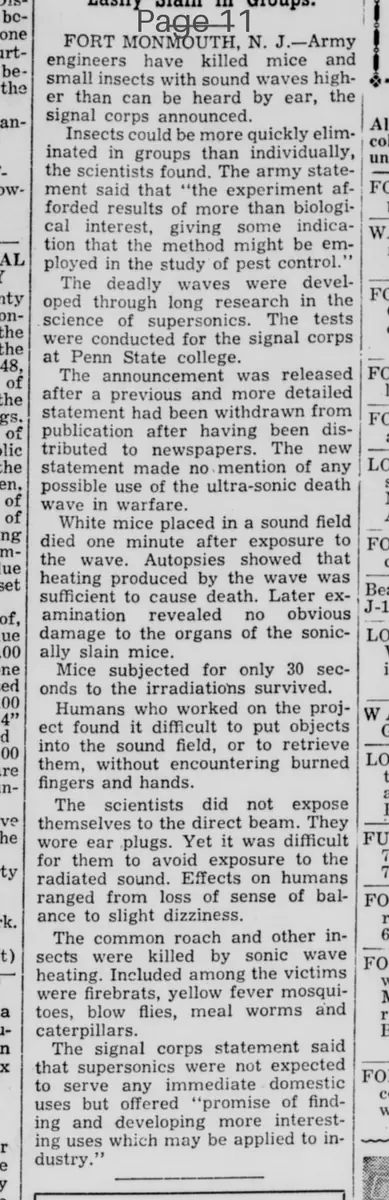
FORT MONMOUTH, N. J. - Army engineers have killed mice and small insects with sound waves higher than can be heard by ear, the signal corps announced.
Insects could be more quickly eliminated in groups than individually, the scientists found. The army statement said that "the experiment afforded results of more than biological interest, giving some indication that the method might be employed in the study of pest control."
The deadly waves were developed through long research in the science of supersonics. The tests were conducted for the signal corps at Penn State college.
The announcement was released after a previous and more detailed statement had been withdrawn from publication after having been distributed to newspapers. The new statement made no mention of any possible use of the ultra-sonic death wave in warfare.
White mice placed in a sound field died one minute after exposure to the wave. Autopsies showed that heating produced by the wave was sufficient to cause death. Later examination revealed no obvious damage to the organs of the sonically slain mice.
Mice subjected for only 30 seconds to the irradiations survived. Humans who worked on the project found it difficult to put objects into the sound field, or to retrieve them, without encountering burned fingers and hands.
The scientists did not expose themselves to the direct beam. They wore ear plugs. Yet it was difficult for them to avoid exposure to the radiated sound. Effects on humans ranged from loss of sense of balance to slight dizziness.
The common roach and other insects were killed by sonic wave heating. Included among the victims were firebrats, yellow fever mosquitoes, blow flies, meal worms and caterpillars.
The signal corps statement said that supersonics were not expected to serve any immediate domestic uses but offered "promise of finding and developing more interesting uses which may be applied to industry."
Insects could be more quickly eliminated in groups than individually, the scientists found. The army statement said that "the experiment afforded results of more than biological interest, giving some indication that the method might be employed in the study of pest control."
The deadly waves were developed through long research in the science of supersonics. The tests were conducted for the signal corps at Penn State college.
The announcement was released after a previous and more detailed statement had been withdrawn from publication after having been distributed to newspapers. The new statement made no mention of any possible use of the ultra-sonic death wave in warfare.
White mice placed in a sound field died one minute after exposure to the wave. Autopsies showed that heating produced by the wave was sufficient to cause death. Later examination revealed no obvious damage to the organs of the sonically slain mice.
Mice subjected for only 30 seconds to the irradiations survived. Humans who worked on the project found it difficult to put objects into the sound field, or to retrieve them, without encountering burned fingers and hands.
The scientists did not expose themselves to the direct beam. They wore ear plugs. Yet it was difficult for them to avoid exposure to the radiated sound. Effects on humans ranged from loss of sense of balance to slight dizziness.
The common roach and other insects were killed by sonic wave heating. Included among the victims were firebrats, yellow fever mosquitoes, blow flies, meal worms and caterpillars.
The signal corps statement said that supersonics were not expected to serve any immediate domestic uses but offered "promise of finding and developing more interesting uses which may be applied to industry."
What sub-type of article is it?
Curiosity
Extraordinary Event
What themes does it cover?
Triumph
What keywords are associated?
Ultrasonic Waves
Pest Control
Army Experiment
Sound Wave Killing
Insects Mice Death
Where did it happen?
Fort Monmouth, N.J.; Penn State College
Story Details
Location
Fort Monmouth, N.J.; Penn State College
Story Details
Army engineers developed ultrasonic sound waves that kill mice and insects through heating, tested at Penn State for the Signal Corps, showing potential for pest control but no immediate domestic or warfare uses mentioned.