Thank you for visiting SNEWPapers!
Sign up free
Editorial
June 26, 1790
Gazette Of The United States
New York, New York County, New York
What is this article about?
This editorial continuation discusses how legislators promote public good by prioritizing constituents' immediate interests, while noting challenges like acting against local opinions for true welfare and evaluating laws post-enactment via public opinion.
Clipping
OCR Quality
98%
Excellent
Full Text
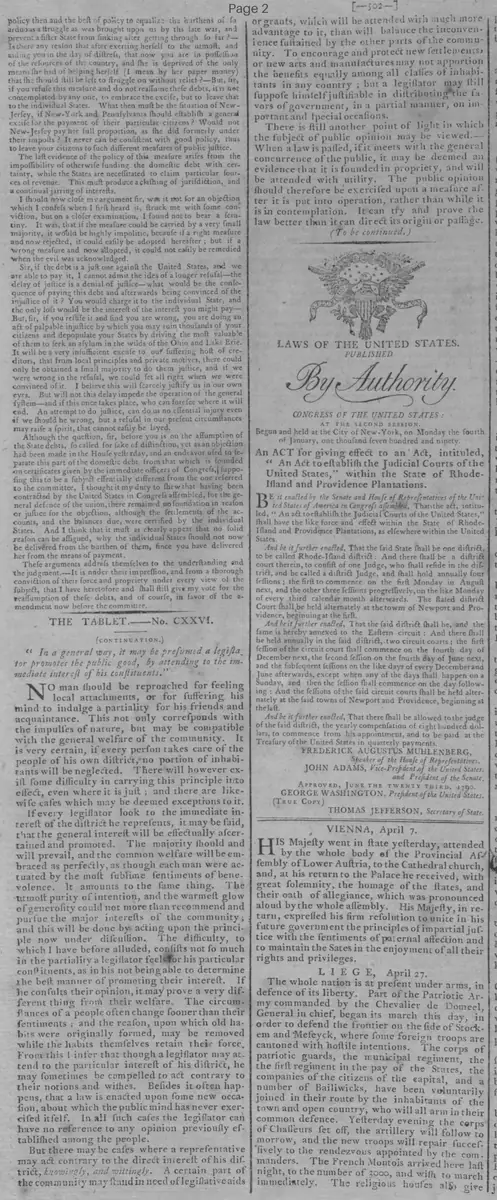
THE TABLET. No. CXXVI.
(CONTINUATION.)
In a general way, it may be presumed a legislator promotes the public good, by attending to the immediate interest of his constituents.
No man should be reproached for feeling local attachments, or for suffering his mind to indulge a partiality for his friends and acquaintance. This not only corresponds with the impulses of nature, but may be compatible with the general welfare of the community. It is very certain, if every person takes care of the people of his own district, no portion of inhabitants will be neglected. There will however exist some difficulty in carrying this principle into effect, even where it is just; and there are likewise cases which may be deemed exceptions to it.
If every legislator look to the immediate interest of the district he represents, it may be said, that the general interest will be effectually ascertained and promoted. The majority should and will prevail, and the common welfare will be embraced as perfectly, as though each man were actuated by the most sublime sentiments of benevolence. It amounts to the same thing. The utmost purity of intention, and the warmest glow of generosity could not more than recommend and pursue the major interests of the community; and this will be done by acting upon the principle now under discussion. The difficulty, to which I have before alluded, consists not so much in the partiality a legislator feels for his particular constituents, as in his not being able to determine the best manner of promoting their interest. If he consults their opinion, it may prove a very different thing from their welfare. The circumstances of a people often change sooner than their sentiments; and the reason, upon which old habits were originally formed, may be removed while the habits themselves retain their force.
From this I infer that though a legislator may attend to the particular interest of his district, he may sometimes be compelled to act contrary to their notions and wishes. Besides it often happens, that a law is enacted upon some new occasion, about which the public mind has never exercised itself. In all such cases the legislator can have no reference to any opinion previously established among the people.
But there may be cases where a representative may act contrary to the direct interest of his district, knowingly, and wittingly. A certain part of the community may stand in need of legislative aids or grants, which will be attended with much more advantage to it, than will balance the inconvenience sustained by the other parts of the community. To encourage and protect new settlers, or new arts and manufactures may not apportion the benefits equally among all classes of inhabitants in any country; but a legislator may still suppose himself justifiable in distributing the favors of government, in a partial manner, on important and special occasions.
There is still another point of light in which the subject of public opinion may be viewed.—When a law is passed, if it meets with the general concurrence of the public, it may be deemed an evidence that it is founded in propriety, and will be attended with utility. The public opinion should therefore be exercised upon a measure after it is put into operation, rather than while it is in contemplation. It can try and prove the law better than it can direct its origin or passage.
(To be continued.)
(CONTINUATION.)
In a general way, it may be presumed a legislator promotes the public good, by attending to the immediate interest of his constituents.
No man should be reproached for feeling local attachments, or for suffering his mind to indulge a partiality for his friends and acquaintance. This not only corresponds with the impulses of nature, but may be compatible with the general welfare of the community. It is very certain, if every person takes care of the people of his own district, no portion of inhabitants will be neglected. There will however exist some difficulty in carrying this principle into effect, even where it is just; and there are likewise cases which may be deemed exceptions to it.
If every legislator look to the immediate interest of the district he represents, it may be said, that the general interest will be effectually ascertained and promoted. The majority should and will prevail, and the common welfare will be embraced as perfectly, as though each man were actuated by the most sublime sentiments of benevolence. It amounts to the same thing. The utmost purity of intention, and the warmest glow of generosity could not more than recommend and pursue the major interests of the community; and this will be done by acting upon the principle now under discussion. The difficulty, to which I have before alluded, consists not so much in the partiality a legislator feels for his particular constituents, as in his not being able to determine the best manner of promoting their interest. If he consults their opinion, it may prove a very different thing from their welfare. The circumstances of a people often change sooner than their sentiments; and the reason, upon which old habits were originally formed, may be removed while the habits themselves retain their force.
From this I infer that though a legislator may attend to the particular interest of his district, he may sometimes be compelled to act contrary to their notions and wishes. Besides it often happens, that a law is enacted upon some new occasion, about which the public mind has never exercised itself. In all such cases the legislator can have no reference to any opinion previously established among the people.
But there may be cases where a representative may act contrary to the direct interest of his district, knowingly, and wittingly. A certain part of the community may stand in need of legislative aids or grants, which will be attended with much more advantage to it, than will balance the inconvenience sustained by the other parts of the community. To encourage and protect new settlers, or new arts and manufactures may not apportion the benefits equally among all classes of inhabitants in any country; but a legislator may still suppose himself justifiable in distributing the favors of government, in a partial manner, on important and special occasions.
There is still another point of light in which the subject of public opinion may be viewed.—When a law is passed, if it meets with the general concurrence of the public, it may be deemed an evidence that it is founded in propriety, and will be attended with utility. The public opinion should therefore be exercised upon a measure after it is put into operation, rather than while it is in contemplation. It can try and prove the law better than it can direct its origin or passage.
(To be continued.)
What sub-type of article is it?
Constitutional
What keywords are associated?
Legislative Representation
Public Good
Constituent Interests
Public Opinion
Government Favors
What entities or persons were involved?
Legislators
Constituents
Public
Editorial Details
Primary Topic
Legislators Attending To Constituent Interests For Public Good
Stance / Tone
Philosophical Advocacy For Balanced Representation
Key Figures
Legislators
Constituents
Public
Key Arguments
Attending To Local Interests Ensures No District Is Neglected And Promotes General Welfare
Legislators May Need To Act Against Constituents' Wishes If It Serves True Interest
Public Opinion On Laws Is More Reliable After Enactment Than Before
Partial Distribution Of Government Favors Can Be Justified For New Settlers Or Industries