Thank you for visiting SNEWPapers!
Sign up free
Editorial
January 7, 1811
Norfolk Gazette And Publick Ledger
Norfolk, Virginia
What is this article about?
Editorial criticizes Treasury Secretary Gallatin's proposal to deploy military force along the Canada border to enforce the non-intercourse law, drawing parallels to Bonaparte's tactics and British historical failures like Walpole's excise scheme and North's colonial taxation, arguing against violent revenue measures.
Clipping
OCR Quality
85%
Good
Full Text
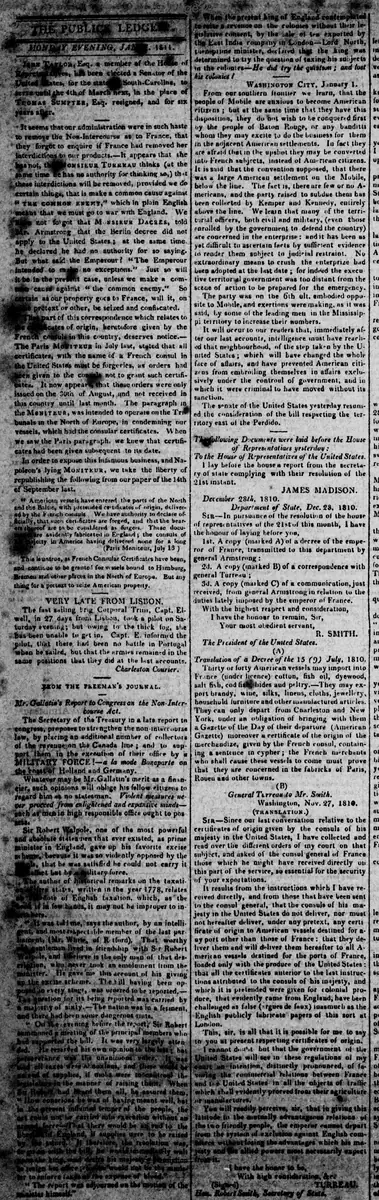
FROM THE FREEMAN'S JOURNAL.
Mr. Gallatin's Report to Congress on the Non-Intercourse is coarsely dictated.
The Secretary of the Treasury in a late report to congress, proposes to strengthen the non-intercourse law by placing an additional number of collectors of the revenue on the Canada line; and to support them in the execution of their office by a MILITARY FORCE!—a la mode Bonaparte on the coast of Holland and Germany.
Whatever may be Mr. Gallatin's merit as a financier such opinions will oblige his fellow citizens to regard him as no statesman. Violent measures never proceed from enlightened and expansive minds—such as men in high responsible office ought to possess. Sir Robert Walpole, one of the most powerful and absolute statesmen that ever existed, as prime minister in England, gave up his favorite excise scheme because it was so violently opposed by the people that he was satisfied he could not carry it without military force.
The author of historical remarks on the taxation, written in the year 1778, relates an anecdote of English taxation, which, as the history is in few hands, it may not be improper to insert. "I was told," says the author, by an intelligent and most respectable member of the last parliament (Mr. White of Ripford), "That worthy gentleman lived in friendship with Sir Robert Walpole and he is the only man of that description who never took an emolument from the ministers. He gave me this account of his giving up the excise scheme. The bill having been opposed violently, was ordered to be reported. The question on its being reported was carried by a majority of sixty. The nation was in a ferment, and there had been some dangerous riots. On the evening before the report Sir Robert summoned a meeting of the principal members who supported the bill. It was very largely attended. He reserved his own opinion to the last. He increased the unanimous vote in favor of the bill. He understood it and the supplies, if debts were to control it, the manner of raising them. Whereupon Sir Robert assured them that he was assured of having military force at command for it. It will be in the present inflamed temper of the people, the scheme could not be carried into execution without an army; for force would be soon put in motion the moment supplies were to be raised in England, if supplies were to be raised before, it the revolution was carried with destruction."
When the present King of England contemplated to raise a revenue on the colonies without their legislature consent by the sale of rum exported by the East India company in London, Lord North then prime minister, declared that the king was determined to try the question of taxing his subjects in the colonies. He did try the question; and lost his colonies.
Mr. Gallatin's Report to Congress on the Non-Intercourse is coarsely dictated.
The Secretary of the Treasury in a late report to congress, proposes to strengthen the non-intercourse law by placing an additional number of collectors of the revenue on the Canada line; and to support them in the execution of their office by a MILITARY FORCE!—a la mode Bonaparte on the coast of Holland and Germany.
Whatever may be Mr. Gallatin's merit as a financier such opinions will oblige his fellow citizens to regard him as no statesman. Violent measures never proceed from enlightened and expansive minds—such as men in high responsible office ought to possess. Sir Robert Walpole, one of the most powerful and absolute statesmen that ever existed, as prime minister in England, gave up his favorite excise scheme because it was so violently opposed by the people that he was satisfied he could not carry it without military force.
The author of historical remarks on the taxation, written in the year 1778, relates an anecdote of English taxation, which, as the history is in few hands, it may not be improper to insert. "I was told," says the author, by an intelligent and most respectable member of the last parliament (Mr. White of Ripford), "That worthy gentleman lived in friendship with Sir Robert Walpole and he is the only man of that description who never took an emolument from the ministers. He gave me this account of his giving up the excise scheme. The bill having been opposed violently, was ordered to be reported. The question on its being reported was carried by a majority of sixty. The nation was in a ferment, and there had been some dangerous riots. On the evening before the report Sir Robert summoned a meeting of the principal members who supported the bill. It was very largely attended. He reserved his own opinion to the last. He increased the unanimous vote in favor of the bill. He understood it and the supplies, if debts were to control it, the manner of raising them. Whereupon Sir Robert assured them that he was assured of having military force at command for it. It will be in the present inflamed temper of the people, the scheme could not be carried into execution without an army; for force would be soon put in motion the moment supplies were to be raised in England, if supplies were to be raised before, it the revolution was carried with destruction."
When the present King of England contemplated to raise a revenue on the colonies without their legislature consent by the sale of rum exported by the East India company in London, Lord North then prime minister, declared that the king was determined to try the question of taxing his subjects in the colonies. He did try the question; and lost his colonies.
What sub-type of article is it?
Economic Policy
Taxation
Partisan Politics
What keywords are associated?
Gallatin Report
Non Intercourse Law
Military Force
Revenue Collectors
Excise Scheme
Colonial Taxation
Sir Robert Walpole
Lord North
What entities or persons were involved?
Mr. Gallatin
Sir Robert Walpole
Mr. White Of Ripford
Lord North
King Of England
Editorial Details
Primary Topic
Criticism Of Gallatin's Military Enforcement Proposal For Non Intercourse Law
Stance / Tone
Strongly Opposed To Violent Revenue Measures
Key Figures
Mr. Gallatin
Sir Robert Walpole
Mr. White Of Ripford
Lord North
King Of England
Key Arguments
Gallatin's Report Proposes Military Force To Enforce Non Intercourse Law, Akin To Bonaparte's Methods
Such Violent Measures Indicate Lack Of Statesmanship
Walpole Abandoned Excise Scheme To Avoid Using Military Force Despite Opposition
Anecdote From 1778 Illustrates Risks Of Enforcing Taxation With Army Amid Public Ferment
Lord North's Attempt To Tax Colonies Without Consent Led To Their Loss