Thank you for visiting SNEWPapers!
Sign up free
The Intelligencer, & Petersburg Commercial Advertiser
Petersburg, Virginia
What is this article about?
Essay on crossing, breeding, and rearing turf horses, advocating remote crosses over inbreeding, drawing from English experience, and applying to Virginia's Sir Archie stock. Discusses principles for thoroughbred studs and rearing conditions.
Merged-components note: Continuation of the article 'Annals of the Turf' from page 2 to page 3, based on sequential reading order and textual flow on horse breeding and rearing.
Clippings
1 of 2
OCR Quality
Full Text
TUESDAY, JUNE 20, 1826.
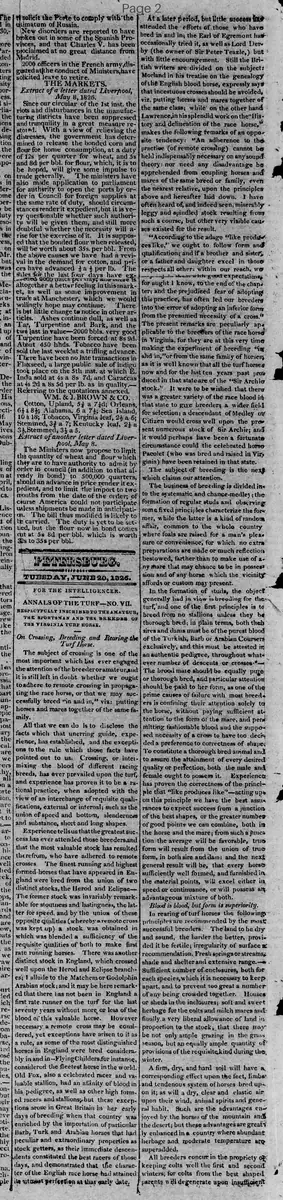
FOR THE INTELLIGENCER.
ANNALS OF THE TURF—No. VII.
RESPECTFULLY INSCRIBED TO THE AMATEUR, THE SPORTSMAN AND THE BREEDER OF THE VIRGINIA TURF HORSE.
On Crossing, Breeding and Rearing the Turf Horse.
The subject of crossing is one of the most important which has ever engaged the attention of the breeder or amateur, and it is still left in doubt whether we ought to adhere to remote crossing in propagating the race horse, or that we may successfully breed "in and in," viz: putting horses and mares together of the same family.
All that we can do is to disclose the facts which that unerring guide, experience, has established, and the exceptions to the rule which those facts have pointed out to us. Crossing, or intermixing the blood of different racing breeds, has ever prevailed upon the turf, and experience has proven it to be a rational practice, when adopted with the view of an interchange of requisite qualifications, external or internal; such as the union of speed and bottom, slenderness and substance, short and long shapes.
Experience tells us that the greatest success has ever attended those breeders, and that the most valuable stock has resulted therefrom, who have adhered to remote crosses. The finest running and lightest formed horses that have appeared in England were bred from the union of two distinct stocks, the Herod and Eclipse—The former stock was invariably remarkable for stoutness and lastingness, the latter for speed, and by the union of these opposite qualities (whereby a remote cross was kept up) a stock was obtained in which was blended a sufficiency of the requisite qualities of both to make first rate running horses. There was another distinct stock in England, which crossed well upon the Herod and Eclipse branches; I allude to the Matchem or Godolphin Arabian stock; and it may be here remarked that there has not been in England a first rate runner on the turf for the last seventy years without more or less of the blood of this valuable horse.
However necessary a remote cross may be considered, yet exceptions have arisen to it as a rule, as some of the most distinguished horses in England were bred considerably in and in—Flying Childers, for instance, considered the fleetest horse in the world. Old Fox, also a celebrated racer and valuable stallion, had an affinity of blood in his pedigree, as well as other high formed racers and stallions; but these exceptions arose in Great Britain in her early days of breeding when that country was enriched by the importation of particular Barb, Turk and Arabian horses that had peculiar and extraordinary properties as stock getters, as their immediate descendants constituted the best racers of those days, and demonstrated that the character of the English race horse had attained its utmost perfection at that early date.
At a later period, but little success has attended the efforts of those who have bred in and in; the Earl of Egremont has occasionally tried it, as well as Lord Derby (the owner of Sir Peter Teazle,) but with little encouragement. Still the British writers are divided on the subject: Morland in his treatise on the genealogy of the English blood horse, expressly says that incestuous crosses should be avoided, viz, putting horses and mares together of the same class; while on the other hand Lawrence, in his splendid work on the "History and delineation of the race horse," makes the following remarks of an opposite tendency: "An adherence to the practice (of remote crossing) cannot be held indispensably necessary on any sound theory: nor need any disadvantage be apprehended from coupling horses and mares of the same breed or family, even the nearest relative, upon the principles above and hereafter laid down. I have often heard of, and indeed seen, miserably leggy and spindled stock resulting from such a course, but other very visible causes existed for the result.
"According to the adage "like produces like," we ought to follow form and qualification; and if a brother and sister or a father and daughter excel in those respects all others within our reach, we have fair expectations for anything I know, to the end of the chapter; and the prejudiced fear of adopting this practice, has often led our breeders into the error of adopting an inferior form from the presumed necessity of a cross."
The present remarks are peculiarly applicable to the breeders of the race horse in Virginia, for they are at this very time making the experiment of breeding "in and in," or from the same family of horses, as it is well known that all the turf horses now and for the last ten years past produced in that state are of the "Sir Archie stock." It were to be wished that there was a greater variety of the race blood in that state to give breeders a wider field for selection; a descendant of Medley or Citizen would cross well upon the present numerous stock of Sir Archie; and it would perhaps have been a fortunate circumstance could the celebrated horse Pacolet (who was bred and raised in Virginia) have been retained in that state.
The subject of breeding is the next which claims our attention.
The business of breeding is divided into the systematic and chance-medley; the formation of regular studs and observing some fixed principles characterize the former, while the latter is a kind of random affair, common to the whole country where foals are raised for a man's pleasure or convenience, for which no extra preparations are made or much reflection bestowed, farther than to make use of any mare that may chance to be in possession and of any horse which the vicinity affords or custom may present.
In the formation of studs, the object generally had in view is breeding for the turf, and one of the first principles is to breed from no stallions unless they be thorough bred; in plain terms, both their sires and dams must be of the purest blood of the Turkish, Barb or Arabian Coursers exclusively, and this must be attested in an authentic pedigree, throughout whatever number of descents or crosses.
The brood mare should be equally pure or thorough bred, and particular attention should be paid to her form, as one of the prime causes of failure with most breeders is confining their attention solely to the horse, without paying sufficient attention to the form of the mare, and permitting fashionable blood and the supposed necessity of a cross to have too decided a preference to correctness of shape.
To constitute a thorough bred animal and to assure the attainment of every desired quality or perfection, both the male and female ought to possess it. Experience has proven the correctness of the principle that "like produces like"—acting upon this principle we have the best assurances to expect success from a junction of the best shapes, or the greater number of good points we can combine, both in the horse and the mare: from such a junction the average will be favorable, true form will result from the union of true form, in both sire and dam: and the next general result will be, that every horse sufficiently well formed, and furnished in the material points, will excel either in speed or continuance, or will possess an advantageous mixture of both.
Blood is blood, but form is superiority.
In rearing of turf horses the following principles are recommended by the most successful breeders. The land to be dry and sound, the harder the better, provided it be fertile; irregularity of surface a recommendation. Fresh springs or streams; shade and shelter and extensive range. Sufficient number of enclosures, both for each species, which it is necessary to keep apart, and to prevent too great a number of any being crowded together. Houses or sheds in the enclosures; soft and sweet herbage for the colts and milch mares and finally, a very liberal allowance of land in proportion to the stock; that there may be not only ample grazing in the grass season, but an equally ample quantity of provisions of the requisite kind during the winter.
A firm, dry, and hard soil will have a corresponding effect upon the feet, limbs, and tendinous system of horses bred upon it; as will a dry, clear and elastic air upon their wind, animal spirits and general habit. Such are the advantages enjoyed by the horses of the mountain and the desert; but these advantages are greatly enhanced in a country where abundant herbage and moderate temperature are superadded.
All breeders concur in the propriety of keeping colts well the first and second winters; for colts from the best shaped parents will degenerate upon insufficient food. Colts born in both States suffer from the pernicious effects of damp and cold in the winter if a comfortable and genial shelter is not allowed them. Good keep and warmth during the first and second years is indispensable, in order to invigorate the circulation of the animal's blood, to expand his frame, to plump up and enlarge his muscles, to encourage the growth of his bones, and to impart to them that solidity and strength which preserves them in the right line of symmetry.
* There is a practice in Virginia and N. Carolina, in giving the pedigree of a stallion--to name only one or two crosses, particularly on the dam's side, and then pronounce him 'the finest bred horse in the world.' Who can pronounce on a horse's good or bad blood unless we know the whole of it? He may trace to the common dray breed of the country for aught we know.
An Advocate for the Turf
[TO BE CONTINUED.]
What sub-type of article is it?
What themes does it cover?
What keywords are associated?
What entities or persons were involved?
Literary Details
Title
Annals Of The Turf—No. Vii. On Crossing, Breeding And Rearing The Turf Horse.
Author
An Advocate For The Turf
Subject
Respectfully Inscribed To The Amateur, The Sportsman And The Breeder Of The Virginia Turf Horse.
Form / Style
Prose Essay On Horse Breeding Principles.
Key Lines