Thank you for visiting SNEWPapers!
Sign up free
Gazette Of The United States, & Philadelphia Daily Advertiser
Philadelphia, Philadelphia County, Pennsylvania
What is this article about?
Editorial from Walpole, July 15, critiques democracy as a lowly 'grub' versus majestic monarchy as an 'eagle.' Includes anecdotes on republicanism, poet Shenstone's indolence, disdain for partisan presses, and a letter from Nashville on western confidence in government and mockery of Democrat Matthew Lyon.
Merged-components note: Continuation of the datelined political commentary from Walpole; opinionated tone on democracy and government fits editorial better than story or domestic_news.
Clipping
OCR Quality
Full Text
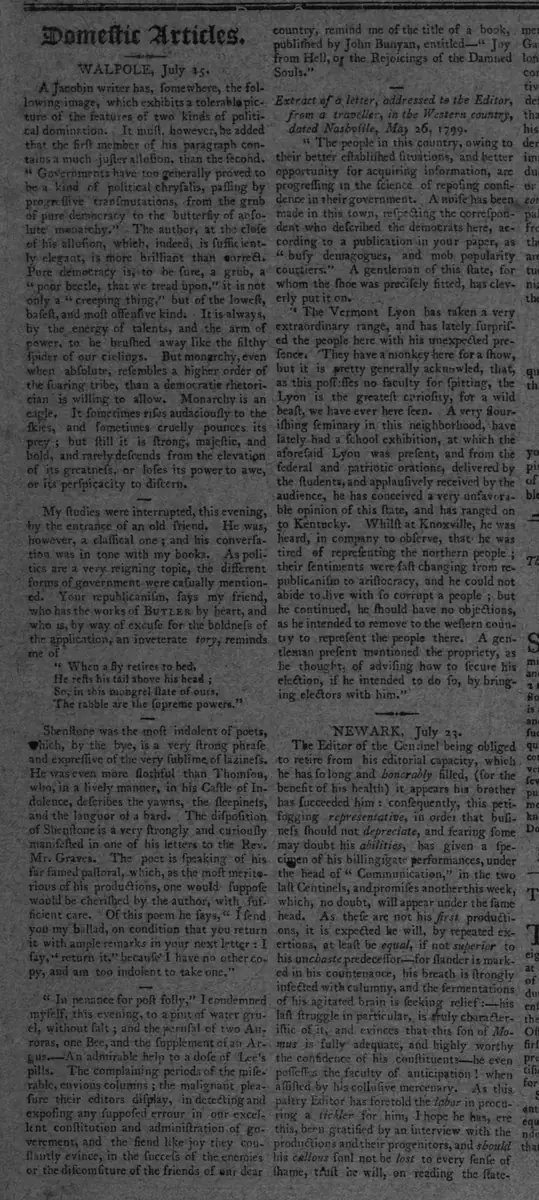
A Jacobin writer has, somewhere, the following image, which exhibits a tolerable picture of the features of two kinds of political domination. It must, however, be added that the first member of his paragraph contains a much juster allusion, than the second.
"Governments have too generally proved to be a kind of political chrysalis, passing by progressive transmutations, from the grub of pure democracy to the butterfly of absolute monarchy." The author, at the close of his allusion, which, indeed, is sufficiently elegant, is more brilliant than correct.
Pure democracy is, to be sure, a grub, a poor beetle, that we tread upon," it is not only a "creeping thing," but of the lowest, basest, and most offensive kind: It is always, by the energy of talents, and the arm of power, to be brushed away like the filthy spider of our ceilings. But monarchy, even when absolute, resembles a higher order of the soaring tribe, than a democratic rhetorician is willing to allow. Monarchy is an eagle. It sometimes rises audaciously to the skies, and sometimes cruelly pounces its prey; but it is strong, majestic, and bold, and rarely descends from the elevation of its greatness, or loses its power to awe, or its perspicacity to discern.
My studies were interrupted, this evening, by the entrance of an old friend. He was, however, a classical one; and his conversation was in tone with my books. As politics are a very reigning topic, the different forms of government were casually mentioned. Your republicanism, says my friend, who has the works of Butler by heart, and who is, by way of excuse for the boldness of the application, an inveterate tory, reminds me of
"When a fly retires to bed,
He rests his tail above his head:
So, in this mongrel state of ours,
The rabble are the supreme powers."
Shenstone was the most indolent of poets, which, by the bye, is a very strong phrase and expressive of the very sublime of laziness. He was even more slothful than Thomson, who, in a lively manner, in his Castle of Indolence, describes the yawns, the sleepiness, and the languor of a bard. The disposition of Shenstone is very strongly and curiously manifested in one of his letters to the Rev. Mr. Graves. The poet is speaking of his far famed pastoral, which, as the most meritorious of his productions, one would suppose would be cherished by the author, with sufficient care. Of this poem he says, "I send you my ballad, on condition that you return it with ample remarks in your next letter: I say, 'return it,' because I have no other copy, and am too indolent to take one."
"In penance for past folly," I condemned myself, this evening, to a pint of water gruel, without salt; and the perusal of two Auroras, one Bee, and the supplement of an Argus. An admirable help to a dose of Lee's pills. The complaining periods of the miserable, envious columns; the malignant pleasure their editors display, in detecting and exposing any supposed error in our excellent constitution and administration of government, and the fiend-like joy they cunningly evince, in the success of the enemies or the discomfiture of the friends of our dear
country, remind me of the title of a book published by John Bunyan, entitled "Joy from Hell, or the Rejoicings of the Damned Souls."
Extract of a letter, addressed to the Editor, from a traveller, in the Western country, dated Nashville, May 26, 1799.
"The people in this country, owing to their better established situations, and better opportunity for acquiring information, are progressing in the science of reposing confidence in their government. A noise has been made in this town, respecting the correspondent who described the democrats here, according to a publication in your paper, as "buy demagogues, and mob popularity courtiers." A gentleman of this state, for whom the shoe was precisely fitted, has cleverly put it on.
The Vermont Lyon has taken a very extraordinary range, and has lately surprised the people here with his unexpected presence. They have a monkey here for a show, but it is pretty generally acknowledged, that, as this possesses no faculty for spitting, the Lyon is the greatest curiosity, for a wild beast, we have ever here seen. A very flourishing seminary in this neighborhood, have lately had a school exhibition, at which the aforesaid Lyon was present, and from the federal and patriotic orations, delivered by the students, and applaudingly received by the audience, he has conceived a very unfavorable opinion of this state, and has ranged on to Kentucky. Whilst at Knoxville, he was heard, in company to observe, that he was tired of representing the northern people; their sentiments were fast changing from republicanism to aristocracy, and he could not abide to live with so corrupt a people; but he continued, he should have no objections, as he intended to remove to the western country to represent the people there. A gentleman present mentioned the propriety, as he thought, of advising how to secure his election, if he intended to do so, by bringing electors with him."
What sub-type of article is it?
What keywords are associated?
What entities or persons were involved?
Editorial Details
Primary Topic
Critique Of Democracy And Praise Of Monarchy
Stance / Tone
Anti Republican, Pro Federalist Satire
Key Figures
Key Arguments