Thank you for visiting SNEWPapers!
Sign up free
Literary
March 19, 1839
The New Hampshire Gazette
Portsmouth, Rockingham County, New Hampshire
What is this article about?
In ancient Rome under Marcus Aurelius, twin sisters Berenice and Veronica share deep affection. Berenice converts to Christianity via her slave Alce, faces persecution, and is nearly martyred. Her sister Veronica attempts to take her place, but a dove identifies Berenice. Emperor Commodus' ascension saves her; she marries Lucius, who converts, and they flee to a peaceful island with Veronica.
Clipping
OCR Quality
95%
Excellent
Full Text
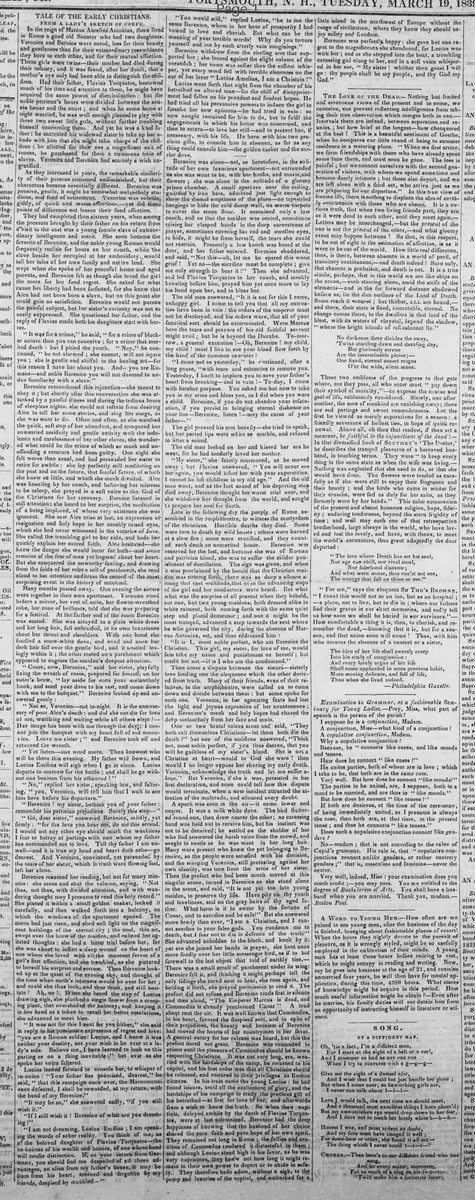
In the reign of Marcus Aurelius Antonius, there lived in Rome a good old Senator who had two daughters. Veronica and Bernice were noted, less for their beauty and gentleness than for their extraordinary resemblance they bore to each other, and for their mutual affection. These girls were twins—their mother had died during their infancy, and it was found, after her death, that a mother's eye only had been able to distinguish the children. Had their father, Flavius Torquatos, bestowed much of his time and attention to them, he might have acquired the same power of discrimination: but the noble patrician's hours were divided between the senate house and the court; and when he came home at night wearied, he was well enough pleased to play with these two sweet little girls, without further troubling himself concerning them. And yet he was a kind father: he entreated his widowed sister to take up her abode with him that she might take charge of the children; he allotted for their use a magnificent suit of rooms, he purchased for them a numerous train of slaves. Veronica and Berenice had scarcely a wish ungratified.
As they increased in years, the remarkable similarity of their persons remained undiminished, but their characters became essentially different. Berenice was pensive, gentle, it might be somewhat melancholy studious, and fond of retirement. Veronica was volatile, giddy, of quick and warm affections, yet did these points of difference not lessen their fond affection. They had completed their sixteen years, when among the presents brought by their father on his return from a visit to the east was a young female slave of extraordinary intelligence and merit. She soon became the favorite of Berenice, and the noble young Roman would frequently recline for hours on her couch, while the slave beside her occupied at her embroidery, would tell her tales of her own family and native land. She wept when she spoke of her peaceful home and aged parents, and Berenice felt as though she loved the girl the more for her fond regret. She asked for what cause her liberty had been forfeited, for she knew that Alce had not been born a slave, but on this point she could gain no satisfaction. Berenice would not pursue the painful subject, but her sister's curiosity was not so easily suppressed. She questioned her father, and the reply of Flavius made both his daughters start with horror.
"It was for a crime," he said, "for a crime of blacker nature than you can conceive; for a crime that merited death: but I pitied the youth." Nay," he continued, "be not alarmed; she cannot, will not injure you; she is gentle and skilful in the healing art—for this reason I have her about you. And— you are Romans—and noble Berenice you will not descend to undue familiarity with a slave."
Berenice remembered this injunction—she meant to obey it; but shortly after this conversation she was attacked by a painful illness and during the tedious hours of sleepless nights. she could not refrain from desiring Alce to tell her some stories, and sing her songs, as she was wont to do. Often and often, as she watched the quick, soft step of her attendant, and compared her unwearied assiduity and gentle activity with the indolence and carelessness of her other slaves, she wondered what could be the crime of which so meek and unoffending a creature had been guilty. One night she felt worse than usual, and had persuaded her sister to retire for awhile: she lay perfectly still meditating on the past and on the future, that fearful future, of which she knew so little, and which she much dreaded. Alce was kneeling by her couch, and believing her mistress to be asleep, she prayed in a soft voice to the God of the Christians for her recovery. Berenice listened in still attention; she heard to her surprise, the meditation of a being employed, of whose very existence she was ignorant. She saw Alce arise at last, an expression of resignation and holy hope in her meekly raised eyes, which she had never witnessed in the votaries of Jove. She called the trembling girl to her side, and bade her quickly explain her sacred faith. Alce hesitated—she knew the danger she would incur for both—and some remains of the fear of man yet lingered about her heart. But she conquered the unworthy feeling, and drawing from the folds of her robe a roll of parchment, she read aloud to her attentive mistress the record of the most surprising event in the history of mankind.
Many months passed away. One evening the sisters were together in their own apartment. Veronica stood before a mirror, her vest of satin, her flower-wreathed robe, her zone of brilliants, told that she was preparing for a festival. At the farther end of the room Berenice was seated. She was arrayed in a plain white dress and her long hair, fell unbraided, in its own luxuriance about her throat and shoulders. With one hand she fondled a snow-white dove, and ever and anon her dark hair fell over the gentle bird, and it nestled lovingly within it; the other rested on a parchment which appeared to engross the maiden's deepest attention.
"Come, now, Berenice," said her sister, playfully fixing the wreath of roses prepared for herself, on her sister's brow, "lay aside for once your melancholy book, and send your dove to his rest, and come down with me to the banquet." Berenice looked up and answered gently:
"Not so, Veronica—not to-night. It is the anniversary of poor Alce's death: and did she not die for love of me, watching and waiting while all others slept?— Her image has been with me through the day; I cannot join the banquet with my heart full of sad memories. Leave me sister;" and Berenice took off and returned the wreath.
"Yet listen—one word more. Thou knowest who will be there this evening. My father will frown, and Lucius Emilius will sigh when I go in alone. Lucius departs to-morrow for the battle; and shall he go without one benison from his affianced?"
"No," replied her sister, speaking low, and faltering, "you, Veronica, will tell him that I wait to see him here before his departure."
"Berenice! my sister, bethink you of your father: remember his patrician prejudices. Surely this step—"
"Go, dear sister," answered Berenice, mildly, yet firmly: "for the love you bear me, do me this errand. I would not any other eye should mark the weakness I fear to betray at parting with one whom my father has commanded me to love. Tell thy father I am unwell—and it is true my head and heart doth ache—go dearest." And Veronica, convinced, yet persuaded by the tears of her sister, which in truth were flowing fast, left her alone.
Berenice resumed her reading, but not for many minutes: she arose and shut the volume, saying, "Not thus, not thus, with divided attention, and with wandering thought may I presume to read this holy record." She placed it within a small golden casket, locked it carefully, and then walked forth into a balcony, on which the windows of the apartment opened. The moon had just risen, and shed soft light on the magnificent buildings of the eternal city; the cool, thin air, swept over the brow of the maiden, and calmed her agitated thoughts: she had a bitter trial before her, or she was about to inflict a deep wound on the heart of one whom she loved with all the innocent fervor of a girl's first affection, and she trembled, as she pictured to herself his surprise and sorrow. Then Berenice looked up at the quiet of the evening sky, and thought of the time when earth's interests would be over for her; and could she thus look, and thus think, and still hesitate? Ah, no! When she heard the step of Lucius drawing nigh, she plucked a single flower from a creeping plant, that overshadowed the balcony, and keeping it in her hand as a token to recall her better resolutions, she advanced to meet him.
"It was not for this I sent for you hither," she said in reply to his passionate expression of regret and love: "you are a Roman soldier: Lucius, and I know it was neither your destiny, nor your wish to be ever at a lady's side. Believe me, I have learned to look on this parting as on a thing inevitable:" but ever as she spoke her voice faltered.
Lucius leaned forward to console her. to whisper of re-union: "Your father has promised, dearest," he said, "that this campaign once over, the Marcomanni once defeated, I shall be rewarded, at my return, with the hand of my Berenice."
"It may be so," she answered sadly, "if you still wish it."
"If I still wish it! Berenice of what are you dreaming?"
"I am not dreaming, Lucius Emilius; I am speaking the words of sober reality. You think of me, as of the beloved daughter of Flavius Torquatos—the co-heiress of his wealth and honors, of one whose hand will confer distinction. If, on your return from Germany, you should find me despoiled of all these advantages, an alien from my father's house, it may be from his heart, scorned and forgotten by my friends, despised by mankind—"
"You would still," replied Lucius, "be to me the same Berenice, whom in her hour of prosperity I had vowed to love and cherish. But what can be the meaning of your terrible words? Why do you torture yourself and me. by such utterly vain imaginings."
Berenice withdrew from the encircling arm that supported her; she leaned against the slight column. of the verandah; her voice was softer than the softest whisper, yet every word fell with terrible clearness on the ear of her lover "Lucius Emilius, I am a Christian!"
Lucius went forth that night from the chamber of his betrothed an altered man—for the chill of disappointment had fallen on his proudest and fondest hopes. He had tried all his persuasive powers to induce the girl to forsake her new opinions—he had tried in vain: so now nought remained for him to do, but to fulfil the engagements in which his honor was concerned, and then to return—to love her still—and to protect her, if necessary, with his life. He bore with him two precious gifts, to console him in absence, as far as any thing could console him—the golden casket and the carrier dove.
Berenice was alone—not, as heretofore, in the solitude of her own luxurious apartment—not surrounded as she was wont to be, with her books, and music,and flowers; she was alone in the solitude of a gloomy prison chamber. A small aperture near the ceiling, guarded by iron bars, admitted just light enough to show the dismal emptiness of the place—no tapestried hangings to hide the cold damp wall, no warm carpets to cover the stone floor. It contained only a low couch, and on that the maiden was seated, sometimes raising her clasped hands in the deep earnestness of prayer, sometimes covering her red and swollen eyes, to hide, it might be from herself, the tears she could not restrain. Presently a low knock was heard at the door, and her father entered. Berenice shuddered, and said, "Not this—oh, let me be spared this worst grief! Yet no—the sacrifice must be complete; give me only strength to bear it!" Then she advanced. and led Flavius Torquatos to her couch, and meekly kneeling before him, prayed him yet once more to lay his hand upon her, and to bless her.
The old man answered, "It is not for this I come, unhappy girl. I come to tell you that all my entreaties have been in vain: the orders of the emperor must not be disobeyed, and his orders were, that all of your fanatical sect should be exterminated. Were Marcus here the tears and prayers of his old faithful servant might avail; but he is beyond the Danube. To-morrow, a general execution!—Oh, Berenice! my child. my child! must I live to see your blood flow forth by the hand of the common executor?
"I came not as yesterday," he continued, after a long pause, "with tears and entreaties to remove you. Yesterday, I knelt to implore you to save your father's heart from breaking—and in vain!—To-day, I come with harsher purpose. You asked me but now to take you in my arms and bless you, as I did when you were a child. Berenice, if you do not abandon your infatuation, if you persist in bringing eternal dishonor on your line—Berenice, listen!—may the curse of your father—''
The girl pressed his arm heavily—she tried to speak, but her parted lips were white as marble, and refused to utter a sound.
The old man looked on her and kissed her ere he went, for he had tenderly loved her mother.
"My sister," she faintly murmured, as he moved away; but Flavius answered, "You will never see her again, you would infect her with your superstition. I cannot be left childless in my old age." And the old man went, and as the last sound of his departing step died away, Berenice thought her worst trial over, and she withdrew her thought from the world, and sought to prepare her soul for death
Late in the following day the people of Rome assembled in the amphitheatre, to witness the martyrdom of the christians. Horrible deaths they died. Some were torn to death by wild beasts; others were burned at a slow fire; some were crucified, and they counted such death an unmerited honor. Berenice was reserved for the last, and because she was of Roman and patrician blood, she was to suffer the milder punishment of decollation. The sign was given, and when it was proclaimed by the herald that the Christian maiden was coming forth. there was so deep a silence among that vast multitude,that even the advancing steps of the girl and her conductors were heard. But what was the surprise of all present when they beheld, not one, but two young maidens, both dressed alike in white raiment, both coming forth with the same quiet step and placid demeanor; and one it might be the most tranquil, advanced a step towards the seat where he who governed the city, during the absence of Marcus Antonius, sat, and thus addressed him:
"It is I, most noble prefect, who am Berenice the Christian. This girl, my sister, for love of me, would fain take my name and punishment on herself; but credit her not—it is I who am the condemned."
Then arose a dispute between the sisters—sisterly love lending one the eloquence which the other derived from truth. Many of their friends, even of their relatives, in the amphitheatre, were called on to come down and decide between them: but some spoke for each one. Veronica, in her agonizing fears had lost the light and joyous expression of her countenance; and Berenice's meek and holy hopes had chased the deep melancholy from her face and mien.
One or two brutal voices arose and said, "They both call themselves Christians—let them both die the death!" but one of the maidens answered, "Think not, most noble prefect, if you thus decree, that you will be guiltless of my sister's blood. She is not a Christian at heart—would to God she were! then would I no longer oppose her sharing my early death. Veronica, acknowledge the truth and let me suffer alone." But Veronica, if she it was, persisted in her first declaration, and none could tell how this dispute would terminate, when a new incident attracted the attention of the multitude, and silenced every doubt.
A speck was seen in the air—it came lower and nearer. It was a milk white dove. The bird fluttered round one, then drew nearer the other; no caressing hand was held out to receive him, but his instinct was not to be deceived; he settled on the shoulder of her who had answered the harsh voice from the crowd, and sought to nestle as he was wont in her long hair.
Many were present who knew the pet belonging to Berenice, so the people were satisfied with his decision, and the weeping Veronica, still protesting against her own identity, was torn from the arms of her sister.
Then the prefect who had been much moved at this singular scene, turned to Berenice as she stood alone in the arena, and said, "It is not yet too late young maiden, to preserve thy life. Have pity on thy youth and loveliness, and on the gray hairs of thy aged father. What harm is it to swear by the fortune of Caesar, and to sacrifice and be safe?' But she answered more firmly than ever, "I am a Christian, and I cannot sacrifice to your false gods. You condemn me to death, but I fear not to die in defence of the truth."
She advanced unbidden to the block, and knelt by it: yet ere she joined her hands in prayer, she bent once more fondly over her little messenger bird, as if to bid farewell to the last object that told of earthly ties.— There was a small scroll of parchment under its wing: Berenice felt it, and thinking it might perhaps tell the only tidings she cared now to hear, she rose again, and holding it forth, she prayed permission to read it. The prefect did not refuse and Berenice reads first in silence and then aloud, "The Emperor Marcus is dead, and Commodus is already proclaimed Caesar" A loud shout rent the air. It was well known that Commodus, in his heart, favored the despised sect, and in spite of their prejudices, the beauty and heroism of Berenice had moved the hearts of her countrymen in her favor.
A general outcry for her release was heard, but this the prefect dared not grant. Berenice was remanded to prison until the pleasure of Commodus should be known respecting Christians. It was not very long, ere, wearied with the hardships of the camp, he returned to his capital, and his first order was that all Christians should be released, and restored to their privileges as Roman citizens. In his train came the young Lucius: he had found leisure, amid all the excitement of glory, and the hardships of his campaign to study the precious gift of his betrothed—at first for love of her, and afterwards from a wish to know the truth. So when their nuptials, delayed awhile by the death of Flavius Torquatos, were at last solemnized, Berenice had the deep happiness of knowing that the husband of her choice shared the sure faith and pure hope of her own spirit.
They remained not long in Rome; the follies and cruelties of Commodus rendered it distasteful to them; and although Lucius stood high in his favor, as he was very capricious, they knew not how long it might remain in their own power to depart or to abide in safety. They therefore bade adieu, without a sigh, to the pomp and luxuries of the capital, and embarked for a little island in the northwest of Europe without the range of civilization, where they knew they should enjoy safety and freedom.
Berenice was perfectly happy: she gave but one regret to the magnificence she abandoned, for Lucius was with her; and as she stepped into the boat, a trembling caressing girl clung to her, and in a soft voice whispered in her ear, "My sister! whither thou goest I will go: thy people shall be my people, and thy God my God."
As they increased in years, the remarkable similarity of their persons remained undiminished, but their characters became essentially different. Berenice was pensive, gentle, it might be somewhat melancholy studious, and fond of retirement. Veronica was volatile, giddy, of quick and warm affections, yet did these points of difference not lessen their fond affection. They had completed their sixteen years, when among the presents brought by their father on his return from a visit to the east was a young female slave of extraordinary intelligence and merit. She soon became the favorite of Berenice, and the noble young Roman would frequently recline for hours on her couch, while the slave beside her occupied at her embroidery, would tell her tales of her own family and native land. She wept when she spoke of her peaceful home and aged parents, and Berenice felt as though she loved the girl the more for her fond regret. She asked for what cause her liberty had been forfeited, for she knew that Alce had not been born a slave, but on this point she could gain no satisfaction. Berenice would not pursue the painful subject, but her sister's curiosity was not so easily suppressed. She questioned her father, and the reply of Flavius made both his daughters start with horror.
"It was for a crime," he said, "for a crime of blacker nature than you can conceive; for a crime that merited death: but I pitied the youth." Nay," he continued, "be not alarmed; she cannot, will not injure you; she is gentle and skilful in the healing art—for this reason I have her about you. And— you are Romans—and noble Berenice you will not descend to undue familiarity with a slave."
Berenice remembered this injunction—she meant to obey it; but shortly after this conversation she was attacked by a painful illness and during the tedious hours of sleepless nights. she could not refrain from desiring Alce to tell her some stories, and sing her songs, as she was wont to do. Often and often, as she watched the quick, soft step of her attendant, and compared her unwearied assiduity and gentle activity with the indolence and carelessness of her other slaves, she wondered what could be the crime of which so meek and unoffending a creature had been guilty. One night she felt worse than usual, and had persuaded her sister to retire for awhile: she lay perfectly still meditating on the past and on the future, that fearful future, of which she knew so little, and which she much dreaded. Alce was kneeling by her couch, and believing her mistress to be asleep, she prayed in a soft voice to the God of the Christians for her recovery. Berenice listened in still attention; she heard to her surprise, the meditation of a being employed, of whose very existence she was ignorant. She saw Alce arise at last, an expression of resignation and holy hope in her meekly raised eyes, which she had never witnessed in the votaries of Jove. She called the trembling girl to her side, and bade her quickly explain her sacred faith. Alce hesitated—she knew the danger she would incur for both—and some remains of the fear of man yet lingered about her heart. But she conquered the unworthy feeling, and drawing from the folds of her robe a roll of parchment, she read aloud to her attentive mistress the record of the most surprising event in the history of mankind.
Many months passed away. One evening the sisters were together in their own apartment. Veronica stood before a mirror, her vest of satin, her flower-wreathed robe, her zone of brilliants, told that she was preparing for a festival. At the farther end of the room Berenice was seated. She was arrayed in a plain white dress and her long hair, fell unbraided, in its own luxuriance about her throat and shoulders. With one hand she fondled a snow-white dove, and ever and anon her dark hair fell over the gentle bird, and it nestled lovingly within it; the other rested on a parchment which appeared to engross the maiden's deepest attention.
"Come, now, Berenice," said her sister, playfully fixing the wreath of roses prepared for herself, on her sister's brow, "lay aside for once your melancholy book, and send your dove to his rest, and come down with me to the banquet." Berenice looked up and answered gently:
"Not so, Veronica—not to-night. It is the anniversary of poor Alce's death: and did she not die for love of me, watching and waiting while all others slept?— Her image has been with me through the day; I cannot join the banquet with my heart full of sad memories. Leave me sister;" and Berenice took off and returned the wreath.
"Yet listen—one word more. Thou knowest who will be there this evening. My father will frown, and Lucius Emilius will sigh when I go in alone. Lucius departs to-morrow for the battle; and shall he go without one benison from his affianced?"
"No," replied her sister, speaking low, and faltering, "you, Veronica, will tell him that I wait to see him here before his departure."
"Berenice! my sister, bethink you of your father: remember his patrician prejudices. Surely this step—"
"Go, dear sister," answered Berenice, mildly, yet firmly: "for the love you bear me, do me this errand. I would not any other eye should mark the weakness I fear to betray at parting with one whom my father has commanded me to love. Tell thy father I am unwell—and it is true my head and heart doth ache—go dearest." And Veronica, convinced, yet persuaded by the tears of her sister, which in truth were flowing fast, left her alone.
Berenice resumed her reading, but not for many minutes: she arose and shut the volume, saying, "Not thus, not thus, with divided attention, and with wandering thought may I presume to read this holy record." She placed it within a small golden casket, locked it carefully, and then walked forth into a balcony, on which the windows of the apartment opened. The moon had just risen, and shed soft light on the magnificent buildings of the eternal city; the cool, thin air, swept over the brow of the maiden, and calmed her agitated thoughts: she had a bitter trial before her, or she was about to inflict a deep wound on the heart of one whom she loved with all the innocent fervor of a girl's first affection, and she trembled, as she pictured to herself his surprise and sorrow. Then Berenice looked up at the quiet of the evening sky, and thought of the time when earth's interests would be over for her; and could she thus look, and thus think, and still hesitate? Ah, no! When she heard the step of Lucius drawing nigh, she plucked a single flower from a creeping plant, that overshadowed the balcony, and keeping it in her hand as a token to recall her better resolutions, she advanced to meet him.
"It was not for this I sent for you hither," she said in reply to his passionate expression of regret and love: "you are a Roman soldier: Lucius, and I know it was neither your destiny, nor your wish to be ever at a lady's side. Believe me, I have learned to look on this parting as on a thing inevitable:" but ever as she spoke her voice faltered.
Lucius leaned forward to console her. to whisper of re-union: "Your father has promised, dearest," he said, "that this campaign once over, the Marcomanni once defeated, I shall be rewarded, at my return, with the hand of my Berenice."
"It may be so," she answered sadly, "if you still wish it."
"If I still wish it! Berenice of what are you dreaming?"
"I am not dreaming, Lucius Emilius; I am speaking the words of sober reality. You think of me, as of the beloved daughter of Flavius Torquatos—the co-heiress of his wealth and honors, of one whose hand will confer distinction. If, on your return from Germany, you should find me despoiled of all these advantages, an alien from my father's house, it may be from his heart, scorned and forgotten by my friends, despised by mankind—"
"You would still," replied Lucius, "be to me the same Berenice, whom in her hour of prosperity I had vowed to love and cherish. But what can be the meaning of your terrible words? Why do you torture yourself and me. by such utterly vain imaginings."
Berenice withdrew from the encircling arm that supported her; she leaned against the slight column. of the verandah; her voice was softer than the softest whisper, yet every word fell with terrible clearness on the ear of her lover "Lucius Emilius, I am a Christian!"
Lucius went forth that night from the chamber of his betrothed an altered man—for the chill of disappointment had fallen on his proudest and fondest hopes. He had tried all his persuasive powers to induce the girl to forsake her new opinions—he had tried in vain: so now nought remained for him to do, but to fulfil the engagements in which his honor was concerned, and then to return—to love her still—and to protect her, if necessary, with his life. He bore with him two precious gifts, to console him in absence, as far as any thing could console him—the golden casket and the carrier dove.
Berenice was alone—not, as heretofore, in the solitude of her own luxurious apartment—not surrounded as she was wont to be, with her books, and music,and flowers; she was alone in the solitude of a gloomy prison chamber. A small aperture near the ceiling, guarded by iron bars, admitted just light enough to show the dismal emptiness of the place—no tapestried hangings to hide the cold damp wall, no warm carpets to cover the stone floor. It contained only a low couch, and on that the maiden was seated, sometimes raising her clasped hands in the deep earnestness of prayer, sometimes covering her red and swollen eyes, to hide, it might be from herself, the tears she could not restrain. Presently a low knock was heard at the door, and her father entered. Berenice shuddered, and said, "Not this—oh, let me be spared this worst grief! Yet no—the sacrifice must be complete; give me only strength to bear it!" Then she advanced. and led Flavius Torquatos to her couch, and meekly kneeling before him, prayed him yet once more to lay his hand upon her, and to bless her.
The old man answered, "It is not for this I come, unhappy girl. I come to tell you that all my entreaties have been in vain: the orders of the emperor must not be disobeyed, and his orders were, that all of your fanatical sect should be exterminated. Were Marcus here the tears and prayers of his old faithful servant might avail; but he is beyond the Danube. To-morrow, a general execution!—Oh, Berenice! my child. my child! must I live to see your blood flow forth by the hand of the common executor?
"I came not as yesterday," he continued, after a long pause, "with tears and entreaties to remove you. Yesterday, I knelt to implore you to save your father's heart from breaking—and in vain!—To-day, I come with harsher purpose. You asked me but now to take you in my arms and bless you, as I did when you were a child. Berenice, if you do not abandon your infatuation, if you persist in bringing eternal dishonor on your line—Berenice, listen!—may the curse of your father—''
The girl pressed his arm heavily—she tried to speak, but her parted lips were white as marble, and refused to utter a sound.
The old man looked on her and kissed her ere he went, for he had tenderly loved her mother.
"My sister," she faintly murmured, as he moved away; but Flavius answered, "You will never see her again, you would infect her with your superstition. I cannot be left childless in my old age." And the old man went, and as the last sound of his departing step died away, Berenice thought her worst trial over, and she withdrew her thought from the world, and sought to prepare her soul for death
Late in the following day the people of Rome assembled in the amphitheatre, to witness the martyrdom of the christians. Horrible deaths they died. Some were torn to death by wild beasts; others were burned at a slow fire; some were crucified, and they counted such death an unmerited honor. Berenice was reserved for the last, and because she was of Roman and patrician blood, she was to suffer the milder punishment of decollation. The sign was given, and when it was proclaimed by the herald that the Christian maiden was coming forth. there was so deep a silence among that vast multitude,that even the advancing steps of the girl and her conductors were heard. But what was the surprise of all present when they beheld, not one, but two young maidens, both dressed alike in white raiment, both coming forth with the same quiet step and placid demeanor; and one it might be the most tranquil, advanced a step towards the seat where he who governed the city, during the absence of Marcus Antonius, sat, and thus addressed him:
"It is I, most noble prefect, who am Berenice the Christian. This girl, my sister, for love of me, would fain take my name and punishment on herself; but credit her not—it is I who am the condemned."
Then arose a dispute between the sisters—sisterly love lending one the eloquence which the other derived from truth. Many of their friends, even of their relatives, in the amphitheatre, were called on to come down and decide between them: but some spoke for each one. Veronica, in her agonizing fears had lost the light and joyous expression of her countenance; and Berenice's meek and holy hopes had chased the deep melancholy from her face and mien.
One or two brutal voices arose and said, "They both call themselves Christians—let them both die the death!" but one of the maidens answered, "Think not, most noble prefect, if you thus decree, that you will be guiltless of my sister's blood. She is not a Christian at heart—would to God she were! then would I no longer oppose her sharing my early death. Veronica, acknowledge the truth and let me suffer alone." But Veronica, if she it was, persisted in her first declaration, and none could tell how this dispute would terminate, when a new incident attracted the attention of the multitude, and silenced every doubt.
A speck was seen in the air—it came lower and nearer. It was a milk white dove. The bird fluttered round one, then drew nearer the other; no caressing hand was held out to receive him, but his instinct was not to be deceived; he settled on the shoulder of her who had answered the harsh voice from the crowd, and sought to nestle as he was wont in her long hair.
Many were present who knew the pet belonging to Berenice, so the people were satisfied with his decision, and the weeping Veronica, still protesting against her own identity, was torn from the arms of her sister.
Then the prefect who had been much moved at this singular scene, turned to Berenice as she stood alone in the arena, and said, "It is not yet too late young maiden, to preserve thy life. Have pity on thy youth and loveliness, and on the gray hairs of thy aged father. What harm is it to swear by the fortune of Caesar, and to sacrifice and be safe?' But she answered more firmly than ever, "I am a Christian, and I cannot sacrifice to your false gods. You condemn me to death, but I fear not to die in defence of the truth."
She advanced unbidden to the block, and knelt by it: yet ere she joined her hands in prayer, she bent once more fondly over her little messenger bird, as if to bid farewell to the last object that told of earthly ties.— There was a small scroll of parchment under its wing: Berenice felt it, and thinking it might perhaps tell the only tidings she cared now to hear, she rose again, and holding it forth, she prayed permission to read it. The prefect did not refuse and Berenice reads first in silence and then aloud, "The Emperor Marcus is dead, and Commodus is already proclaimed Caesar" A loud shout rent the air. It was well known that Commodus, in his heart, favored the despised sect, and in spite of their prejudices, the beauty and heroism of Berenice had moved the hearts of her countrymen in her favor.
A general outcry for her release was heard, but this the prefect dared not grant. Berenice was remanded to prison until the pleasure of Commodus should be known respecting Christians. It was not very long, ere, wearied with the hardships of the camp, he returned to his capital, and his first order was that all Christians should be released, and restored to their privileges as Roman citizens. In his train came the young Lucius: he had found leisure, amid all the excitement of glory, and the hardships of his campaign to study the precious gift of his betrothed—at first for love of her, and afterwards from a wish to know the truth. So when their nuptials, delayed awhile by the death of Flavius Torquatos, were at last solemnized, Berenice had the deep happiness of knowing that the husband of her choice shared the sure faith and pure hope of her own spirit.
They remained not long in Rome; the follies and cruelties of Commodus rendered it distasteful to them; and although Lucius stood high in his favor, as he was very capricious, they knew not how long it might remain in their own power to depart or to abide in safety. They therefore bade adieu, without a sigh, to the pomp and luxuries of the capital, and embarked for a little island in the northwest of Europe without the range of civilization, where they knew they should enjoy safety and freedom.
Berenice was perfectly happy: she gave but one regret to the magnificence she abandoned, for Lucius was with her; and as she stepped into the boat, a trembling caressing girl clung to her, and in a soft voice whispered in her ear, "My sister! whither thou goest I will go: thy people shall be my people, and thy God my God."
What sub-type of article is it?
Prose Fiction
What themes does it cover?
Religious
Moral Virtue
Love Romance
What keywords are associated?
Christian Conversion
Roman Persecution
Twin Sisters
Martyrdom
Sisterly Love
Ancient Rome
Religious Faith
Dove Symbol
Literary Details
Key Lines
"Lucius Emilius, I Am A Christian!"
"It Is I, Most Noble Prefect, Who Am Berenice The Christian. This Girl, My Sister, For Love Of Me, Would Fain Take My Name And Punishment On Herself; But Credit Her Not—It Is I Who Am The Condemned."
The Bird Fluttered Round One, Then Drew Nearer The Other; No Caressing Hand Was Held Out To Receive Him, But His Instinct Was Not To Be Deceived; He Settled On The Shoulder Of Her Who Had Answered The Harsh Voice From The Crowd, And Sought To Nestle As He Was Wont In Her Long Hair.
"I Am A Christian, And I Cannot Sacrifice To Your False Gods. You Condemn Me To Death, But I Fear Not To Die In Defence Of The Truth."
"My Sister! Whither Thou Goest I Will Go: Thy People Shall Be My People, And Thy God My God."