Thank you for visiting SNEWPapers!
Sign up free
Editorial
May 23, 1828
Winchester Virginia Republican
Winchester, Virginia
What is this article about?
Political editorial from Missouri Republican and Harrisburg Intelligencer criticizing General Jackson for claiming a simple farmer's life while drawing substantial military pay and charging lavish expenses, including for wines and servants, contradicting his letter to Samuel Swartwout.
Clipping
OCR Quality
95%
Excellent
Full Text
Political.
From the Missouri Republican.
GENERAL JACKSON.
In his letter to Samuel Swartwout, of the 22d February, 1825, General Jackson thus expresses himself:--
"The war over, and peace restored, I retired to my farm, to private life, where but for the call I received to the senate of the union, I should have contentedly remained --I have never sought office nor power, nor have I been willing to hold any post longer than I could be useful to my country, not myself, and I trust I never shall."
If the reader will contrast the above assertions of Gen. Jackson, with the facts presented in the following article he will at once see the propriety of that rule which prevents an individual from testifying in his own behalf.--This is not the only instance in which the general has been proved to have misstated the fact, in relation to himself. That he has also done it in relation to others, we instance his charges made against Mr. Clay, to Beverly.
From the Harrisburg Intelligencer
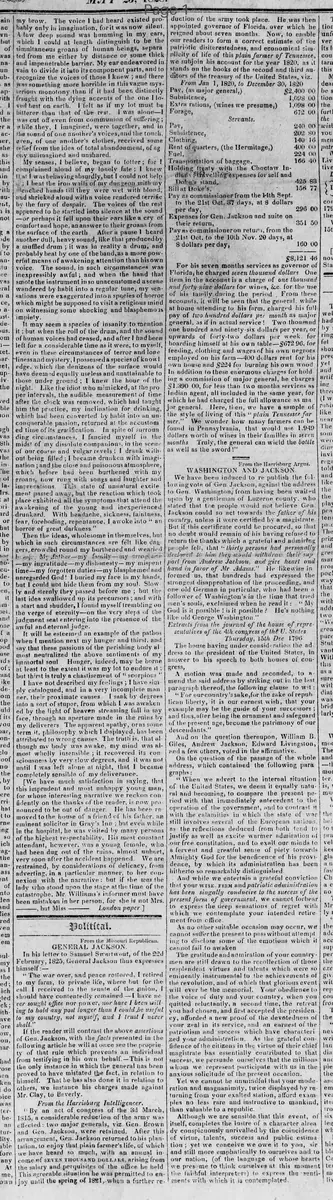
"By an act of congress of the 3d March, 1815, a considerable reduction of the army was effected: two major generals, viz. Gen. Brown and Gen. Jackson, were retained. After this arrangement, Gen. Jackson returned to his plantation, to enjoy that plain farmer's life, of which we have heard so much, with an annual income of SEVEN THOUSAND DOLLARS, arising from the salary and perquisites of the office he held This agreeable situation he was permitted to enjoy until the spring of 1818, when a further reduction of the army took place. He was then appointed governor of Florida. over which he reigned about seven months. Now, to enable our readers to form a correct estimate of the patriotic disinterestedness, and economical simplicity of life of this plain farmer of Tennessee, we subjoin his account for the year 1820, as it stands on the books of the second and third auditors of the treasury of the United States, viz.
From Jan 1, 1820, to December 30, 1820
Pay, (as major general,) $2,400 00
Subsistence, 1,098 00
Extra rations, (wines we presume,) 1,098 00
Forage, 672 00
Servants.
Pay, 240.00
Subsistence, 202 50
Clothing, 140 16
Rent of quarters, (the Hermitage,) 400 00
Fuel, 224 00
Transportation of baggage, 166 40
Holding treaty with the Choctaw Indians travelling expenses for self and suite to Doak's stand, 425 83
Bill at Doak's. 156 77
Pay as commissioner from the 1st Sept. to the 21st Oct. 37 days, at 8 dollars per day, 296 00
Expenses for Gen. Jackson and suite on their return, 351 50
Pay as commissioner on return, from the 21st Oct. to the 10th Nov. 20 days, at 8 dollars per day, 160 00
$8,121 46
For his seven months services as governor of Florida he charged seven thousand dollars One item in the account is a charge of one thousand and forty-nine dollars for wines, &c. for the use of his family during the period From these accounts. it will be seen that the general, while at home attending to his farm, charged his full pay of two hundred dollars per month as major general, as if in actual service! Two thousand one hundred and ninety-six dollars per year, or upwards of forty-two dollars per week. for boarding himself at his own table--$672 96, for feeding, clothing and wages of his own negroes employed on his farm--$400 dollars rent for his own house and $224 for burning his own wood In addition to these enormous charges for holding a commission of major general, he charges $1,390 00, for less than two months services as Indian agent, all included in the same year, for which he had charged the full allowance as major general. Here, then, we have a sample of the style of living of this "plain Tennessee farmer." We wonder how many farmers can be found in Pennsylvania, that would use 1,949 dollars worth of wines in their families in seven months Truly, the general can wield the bottle as well as the sword!"
From the Missouri Republican.
GENERAL JACKSON.
In his letter to Samuel Swartwout, of the 22d February, 1825, General Jackson thus expresses himself:--
"The war over, and peace restored, I retired to my farm, to private life, where but for the call I received to the senate of the union, I should have contentedly remained --I have never sought office nor power, nor have I been willing to hold any post longer than I could be useful to my country, not myself, and I trust I never shall."
If the reader will contrast the above assertions of Gen. Jackson, with the facts presented in the following article he will at once see the propriety of that rule which prevents an individual from testifying in his own behalf.--This is not the only instance in which the general has been proved to have misstated the fact, in relation to himself. That he has also done it in relation to others, we instance his charges made against Mr. Clay, to Beverly.
From the Harrisburg Intelligencer
"By an act of congress of the 3d March, 1815, a considerable reduction of the army was effected: two major generals, viz. Gen. Brown and Gen. Jackson, were retained. After this arrangement, Gen. Jackson returned to his plantation, to enjoy that plain farmer's life, of which we have heard so much, with an annual income of SEVEN THOUSAND DOLLARS, arising from the salary and perquisites of the office he held This agreeable situation he was permitted to enjoy until the spring of 1818, when a further reduction of the army took place. He was then appointed governor of Florida. over which he reigned about seven months. Now, to enable our readers to form a correct estimate of the patriotic disinterestedness, and economical simplicity of life of this plain farmer of Tennessee, we subjoin his account for the year 1820, as it stands on the books of the second and third auditors of the treasury of the United States, viz.
From Jan 1, 1820, to December 30, 1820
Pay, (as major general,) $2,400 00
Subsistence, 1,098 00
Extra rations, (wines we presume,) 1,098 00
Forage, 672 00
Servants.
Pay, 240.00
Subsistence, 202 50
Clothing, 140 16
Rent of quarters, (the Hermitage,) 400 00
Fuel, 224 00
Transportation of baggage, 166 40
Holding treaty with the Choctaw Indians travelling expenses for self and suite to Doak's stand, 425 83
Bill at Doak's. 156 77
Pay as commissioner from the 1st Sept. to the 21st Oct. 37 days, at 8 dollars per day, 296 00
Expenses for Gen. Jackson and suite on their return, 351 50
Pay as commissioner on return, from the 21st Oct. to the 10th Nov. 20 days, at 8 dollars per day, 160 00
$8,121 46
For his seven months services as governor of Florida he charged seven thousand dollars One item in the account is a charge of one thousand and forty-nine dollars for wines, &c. for the use of his family during the period From these accounts. it will be seen that the general, while at home attending to his farm, charged his full pay of two hundred dollars per month as major general, as if in actual service! Two thousand one hundred and ninety-six dollars per year, or upwards of forty-two dollars per week. for boarding himself at his own table--$672 96, for feeding, clothing and wages of his own negroes employed on his farm--$400 dollars rent for his own house and $224 for burning his own wood In addition to these enormous charges for holding a commission of major general, he charges $1,390 00, for less than two months services as Indian agent, all included in the same year, for which he had charged the full allowance as major general. Here, then, we have a sample of the style of living of this "plain Tennessee farmer." We wonder how many farmers can be found in Pennsylvania, that would use 1,949 dollars worth of wines in their families in seven months Truly, the general can wield the bottle as well as the sword!"
What sub-type of article is it?
Partisan Politics
Military Affairs
What keywords are associated?
Andrew Jackson
Political Attack
Military Pay
Lavish Expenses
Florida Governor
Indian Treaty
Simple Farmer Myth
What entities or persons were involved?
General Jackson
Samuel Swartwout
Mr. Clay
Gen. Brown
Choctaw Indians
Editorial Details
Primary Topic
Criticism Of General Jackson's Claims Of Simple Patriotic Life
Stance / Tone
Satirical Criticism
Key Figures
General Jackson
Samuel Swartwout
Mr. Clay
Gen. Brown
Choctaw Indians
Key Arguments
Jackson Claimed Retirement To Farm Life But Held Paid Military Positions
Received $7,000 Annual Income From Salary And Perquisites
Charged Full Major General Pay While At Home On Plantation
Lavish Expenses Including $1,049 For Wines In Seven Months
Billed For Servants, Rent Of Own House, And Fuel From Own Wood
Additional Charges For Indian Treaty And Florida Governorship
Contradicts Assertions Of Never Seeking Office Or Power