Thank you for visiting SNEWPapers!
Sign up free
Editorial
September 30, 1924
The Elkins Inter Mountain
Elkins, Randolph County, West Virginia
What is this article about?
Editorial defends the Fordney-McCumber Tariff Law against Democratic candidates Davis and Bryan's claims of misrepresentation, arguing it has not eliminated farmers' export markets and provides pre- and post-war export statistics to refute assertions of harm to agriculture.
Clipping
OCR Quality
95%
Excellent
Full Text
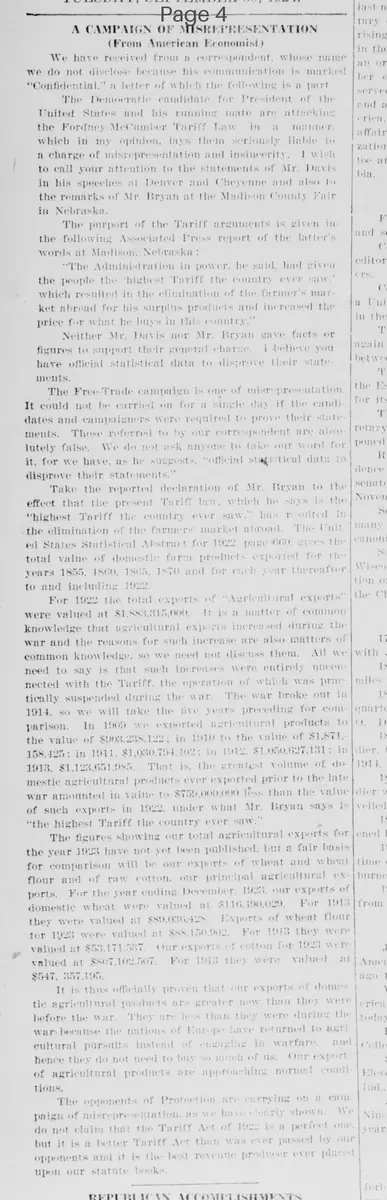
A CAMPAIGN OF MISREPRESENTATION
(From American Economist)
We have received from a correspondent, whose name we do not disclose because his communication is marked "Confidential," a letter of which the following is a part:
The Democratic candidate for President of the United States and his running mate are attacking the Fordney-McCumber Tariff Law in a manner which in my opinion, lays them seriously liable to a charge of misrepresentation and insincerity. I wish to call your attention to the statements of Mr. Davis in his speeches at Denver and Cheyenne and also to the remarks of Mr. Bryan at the Madison County Fair in Nebraska.
The purport of the Tariff arguments is given in the following Associated Press report of the latter's words at Madison, Nebraska:
"The Administration in power," he said, "had given the people the highest Tariff the country ever saw which resulted in the elimination of the farmer's market abroad for his surplus products and increased the price for what he buys in this country."
Neither Mr. Davis nor Mr. Bryan gave facts or figures to support their general charge. I believe you have official statistical data to disprove their statements.
The Free Trade campaign is one of misrepresentation. It could not be carried on for a single day if the candidates and campaigners were required to prove their statements. Those referred to by our correspondent are also absolutely false. We do not ask anyone to take our word for it, for we have, as he suggests, "official statistical data to disprove their statements."
Take the reported declaration of Mr. Bryan to the effect that the present Tariff law, which he says is "the highest Tariff the country ever saw," has resulted in the elimination of the farmers market abroad. The United States Statistical Abstract for 1923 page 680 gives the total value of domestic farm products exported for the years 1865, 1870, 1880, 1890 and for each year thereafter to and including 1922.
For 1922 the total exports of Agricultural exports were valued at $1,853,315,000. It is a matter of common knowledge that agricultural exports increased during the war and the reasons for such increase are also matters of common knowledge, so we need not discuss them. All we need to say is that such increases were entirely unconnected with the Tariff, the operation of which was practically suspended during the war. The war broke out in 1914, so we will take the five years preceding for comparison. In 1909 we exported agricultural products to the value of $903,238,122, in 1910 to the value of $1,871,158,425; in 1911, $1,030,704,102; in 1912, $1,050,627,131; in 1913, $1,123,651,955. That is, the greatest volume of domestic agricultural products ever exported prior to the late war amounted in value to $70,000,000 less than the value of such exports in 1922, under what Mr. Bryan says is "the highest Tariff the country ever saw."
The figures showing our total agricultural exports for the year 1923 have not yet been published, but a fair basis for comparison will be our export of wheat and wheat flour and of raw cotton, our principal agricultural exports. For the year ending December, 1923 our exports of domestic wheat were valued at $611,000,000. For 1913 they were valued at $500,112,000. Exports of wheat flour for 1923 were valued at $55,150,000. For 1913 they were valued at $53,171,587. Our exports of cotton for 1923 were valued at $847,109,507. For 1913 they were valued at $547,357,195.
It is thus officially proven that our exports of domestic agricultural products are greater now than they were before the war. They are less than they were during the war because the nations of Europe have returned to agricultural pursuits instead of engaging in warfare, and hence they do not need to buy so much of us. Our export of agricultural products are approaching normal conditions.
The opponents of Protection are carrying on a campaign of misrepresentation, as we have clearly shown. We do not claim that the Tariff Act of 1922 is a perfect one but it is a better Tariff Act than was ever passed by our opponents and it is the best revenue producer ever placed upon our statute book.
(From American Economist)
We have received from a correspondent, whose name we do not disclose because his communication is marked "Confidential," a letter of which the following is a part:
The Democratic candidate for President of the United States and his running mate are attacking the Fordney-McCumber Tariff Law in a manner which in my opinion, lays them seriously liable to a charge of misrepresentation and insincerity. I wish to call your attention to the statements of Mr. Davis in his speeches at Denver and Cheyenne and also to the remarks of Mr. Bryan at the Madison County Fair in Nebraska.
The purport of the Tariff arguments is given in the following Associated Press report of the latter's words at Madison, Nebraska:
"The Administration in power," he said, "had given the people the highest Tariff the country ever saw which resulted in the elimination of the farmer's market abroad for his surplus products and increased the price for what he buys in this country."
Neither Mr. Davis nor Mr. Bryan gave facts or figures to support their general charge. I believe you have official statistical data to disprove their statements.
The Free Trade campaign is one of misrepresentation. It could not be carried on for a single day if the candidates and campaigners were required to prove their statements. Those referred to by our correspondent are also absolutely false. We do not ask anyone to take our word for it, for we have, as he suggests, "official statistical data to disprove their statements."
Take the reported declaration of Mr. Bryan to the effect that the present Tariff law, which he says is "the highest Tariff the country ever saw," has resulted in the elimination of the farmers market abroad. The United States Statistical Abstract for 1923 page 680 gives the total value of domestic farm products exported for the years 1865, 1870, 1880, 1890 and for each year thereafter to and including 1922.
For 1922 the total exports of Agricultural exports were valued at $1,853,315,000. It is a matter of common knowledge that agricultural exports increased during the war and the reasons for such increase are also matters of common knowledge, so we need not discuss them. All we need to say is that such increases were entirely unconnected with the Tariff, the operation of which was practically suspended during the war. The war broke out in 1914, so we will take the five years preceding for comparison. In 1909 we exported agricultural products to the value of $903,238,122, in 1910 to the value of $1,871,158,425; in 1911, $1,030,704,102; in 1912, $1,050,627,131; in 1913, $1,123,651,955. That is, the greatest volume of domestic agricultural products ever exported prior to the late war amounted in value to $70,000,000 less than the value of such exports in 1922, under what Mr. Bryan says is "the highest Tariff the country ever saw."
The figures showing our total agricultural exports for the year 1923 have not yet been published, but a fair basis for comparison will be our export of wheat and wheat flour and of raw cotton, our principal agricultural exports. For the year ending December, 1923 our exports of domestic wheat were valued at $611,000,000. For 1913 they were valued at $500,112,000. Exports of wheat flour for 1923 were valued at $55,150,000. For 1913 they were valued at $53,171,587. Our exports of cotton for 1923 were valued at $847,109,507. For 1913 they were valued at $547,357,195.
It is thus officially proven that our exports of domestic agricultural products are greater now than they were before the war. They are less than they were during the war because the nations of Europe have returned to agricultural pursuits instead of engaging in warfare, and hence they do not need to buy so much of us. Our export of agricultural products are approaching normal conditions.
The opponents of Protection are carrying on a campaign of misrepresentation, as we have clearly shown. We do not claim that the Tariff Act of 1922 is a perfect one but it is a better Tariff Act than was ever passed by our opponents and it is the best revenue producer ever placed upon our statute book.
What sub-type of article is it?
Economic Policy
Agriculture
Trade Or Commerce
What keywords are associated?
Tariff Law
Agricultural Exports
Free Trade
Protectionism
Misrepresentation
Fordney Mccumber
What entities or persons were involved?
Mr. Davis
Mr. Bryan
Democratic Candidate
Fordney Mccumber Tariff Law
Editorial Details
Primary Topic
Defense Of Fordney Mccumber Tariff Law Against Democratic Misrepresentation
Stance / Tone
Pro Protectionist Critique Of Free Trade Campaign
Key Figures
Mr. Davis
Mr. Bryan
Democratic Candidate
Fordney Mccumber Tariff Law
Key Arguments
Democratic Candidates' Tariff Attacks Are Misrepresentations Without Facts
Agricultural Exports In 1922 Exceeded Pre War Highs
Wheat, Flour, And Cotton Exports Higher In 1923 Than 1913
Tariff Unconnected To War Time Export Increases
Free Trade Campaign Relies On Unproven Statements
1922 Tariff Act Is Best Revenue Producer