Thank you for visiting SNEWPapers!
Sign up free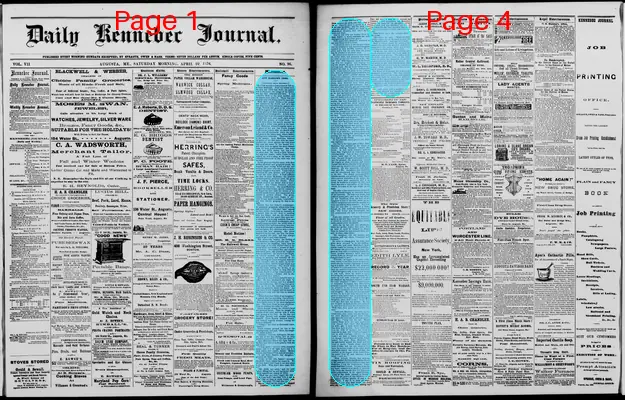
Literary
April 22, 1876
Daily Kennebec Journal
Augusta, Kennebec County, Maine
What is this article about?
In this Quaker family tale, Aunt Madeline endures the deaths of her children and rigid customs, finding solace in her marriage to Uncle Joseph. After losses including son Fred and daughter Eunice, willful Alice brings joy. Joseph's fatal accident leads to his deathbed reconciliation, allowing grave markers and affirming his love.
Merged-components note: Merged the story 'AUNT MADELINE'S CROSS' across pages 1 and 4, as indicated by the 'Concluded from first page' text, to form a single coherent literary component.
Clippings

1 of 2
OCR Quality
95%
Excellent
Full Text
Miscellaneous.
AUNT MADELINE'S CROSS.
[CONCLUDED FROM THURSDAY.]
In a few months a heavy sorrow fell upon Aunt Madeline. Fred, her eldest born, the first fair child that woke the mother love in her heart, the image of his father, and her idol, sickened and died. It was a terrible blow to the poor mother, and she almost sunk under it. There was one peculiar trial which bore heavily upon her.
With their seated dislike to the pomps and vanities of the world, and as a sign that they bore their testimony against such things, Friends had gone to the other extreme in regard to the burial of their dead, and the graves of their best beloved were unmarked and weed-grown. A little more leniency had been exercised of late by the more liberal ones, and small plain stones marked the graves of Uncle Fred. No weeds were there, but myrtle marked the spot, and a white rose grew at the head.
Aunt Madeline wished a similar stone at the grave of her son; but Uncle Joseph could see no reason why we should cling to the cast off tabernacle, when the spirit had gone to the better land, where fleshly feelings were unknown. That was an end of the matter. Aunt Madeline watered the grave of her first born with her tears, pressed her cheek against the cold stone that bore the name of her buried love, and wept with an agony the more intense from its very powerlessness. She went about her daily duties, her eye a little more dim, her cheek a little thinner, her step less elastic, while Uncle Joseph looked on with a pang at his heart, and redoubled kindness to the wife who was his idol.
In the glorious October days, with their golden sunshine and gorgeous forest, the peaceful haze toning wood and sky, and settling like balm over the mother's spirit another daughter was born. Uncle Joseph looked at the pale mother, and proposed to call the babe Alice. A flush suffused the face of Aunt Madeline: she pressed his hand and lay perfectly quiet, the great tears rolling down her cheeks. Uncle Joseph cleared his throat with so loud a "Hem!" that Cousin Patience ordered him out of the room. But Aunt Madeline clasped his hand firmly, and he remained.
He wiped his eyes with the corner of his red silk handkerchief, and communed with himself in perfect silence. The great, loving, blundering heart began to perceive it had made a mistake somewhere, and was blindly groping its way to the light.
Eunice was her father's counterpart; the quaintest, primmest, oddest little thing that ever lived. She said "thee" among her first words; wore drab as naturally as a mouse does its fur: went to meeting with her father, and sat the silent hour and a half with her grave blue eyes never winking, but roving sedately from one to another of the silent worshippers, occasionally peeping under the broad brim of her father's hat, and then settling into rest.
Over field through wood she followed him, and fed lambs and chickens with a motherliness that was amusing. She never strayed from his side, nor tore her dress, nor tangled her hair, and was always ready to go to bed when desired.
But Alice—the beauty, the darling of her brothers,—what a pest she was! The rosy cheeks, the laughing, black eyes the little rings of jet that nestled close to the pretty head, and made a picture of faultless beauty. She stained face and clothes with berry juice; she picked the brightest flowers and fruit; she selected the brightest colored animals for her pets; fell asleep in meeting and tumbled off the seat, startling the silent company with her shrill screams; and to make up for her sleepiness there, had her bright black eyes wide open at bed-time. She would walk into the stable among the horses, or go ankle-deep in the water to help Phil sail his boat, heedless of the remonstrance of the quiet Eunice, "Father will be displeased with the Alices"
But now it came Uncle Joseph's turn to suffer. He was awakened one night by the cries of his darling, and in a moment she was in his arms. The strong man grew faint as he felt the burning cheek, and heard the plaintive moan for water. An hour later, Uncle Joseph laid his hand on the doctor's arm and led him to another room,
"What does thee think of my daughter!" he asked, his lips twitching convulsively.
The gray-haired doctor shook his head: "It is scarlet fever of the most malignant type. The Lord Jesus be your physician. I can do nothing for either of you."
Uncle Joseph wrung the doctor's hand and groaned aloud. Then he sought the bedside of his child, and sat with a white face, gazing at his idol. So the day and the night passed, and another morning dawned. Little Eunice moaned faintly, and looked eagerly around, tossing her head in delirium.
"Father!" she cried in distressful tones. "father!"
Uncle Joseph pressed his lips to the burning brow, and said, "Here, my daughter, father is here."
"Father," cried the child again, the purple hue of her face fading, and an ashy paleness succeeding; "I can't see father."
Aunt Madeline turned the light full on his face and started at the ghastly look she saw there.
"I hear music," said the child, beautiful music; and it is all light here; but it is dark where thee stands, father. Mother is here, and Father Fred, and all but thee."
"I am here, Eunice my daughter." groaned the father.
…Come to this side, father." entreated the child, "here where the music is. We are here and I can't bear to see thee alone in the dark. Why don't thee come, father?"
"My child, my child," said the poor father, lifting her up and laying her white cheek against his, almost as white.
"Thee can get over," urged the child. "Oh, I see now," she cried with a smile, "thee has no harp to make music with. Here, take mine; I'll lead thee over."
She stretched out her arms and clasped
[Concluded on Fourth Page.]
Concluded from first page.
He threw the chain around his neck, and there was silence. Then he gave a groan as if his heart was breaking; laid his dead child upon the pillow; leaned his head upon Madeline's shoulder, and lifted up his voice and wept.
Side by side with her brother Fred lay little Eunice, a white rosebush the only distinguishing mark of her grave.
Once again Aunt Madeline ventured to say something about a stone.
"I should be sorry to see the spot where rest the remains of my departed daughter marked by such worldly vanities," he replied, and it was the only time for years that he alluded to his dead child.
He turned more and more to rosy-cheeked, wilful Alice, and patiently bore from her what no one else ventured to do. She said "you" with impunity, made the house ring with her laughter and singing, for sing she would, in spite of her mother's warning hush. She sat in her father's lap; brushed his hair in the most fashionable mode; stuck roses or pinks in his button hole, while he winked and pretended to be sleepy; held perfect carnival among the beds where carnations, sweet-williams and dahlias rivalled tulips and roses; and in winter made a hot-house of the old kitchen whose deep windows were filled with fuchsias, geraniums and verbenas. Nay, this grave man actually got out of his bed once or twice every cold night to put wood in the stove, for fear the milk would freeze, as he said apologetically to Aunt Madeline. Alice pretended not to know the care her father took of her flowers; but in his presence she was always in a state of wonder that they flourished so well, and laying her peach-like cheek against his wrinkled face, her glossy, black curls mingling with his gray locks, declared that it was his smile which made them grow; while the pleased and faded mother stood by, with the old smile almost renewed on her face. Uncle Joseph would look from one to the other and murmur, "The Lord is good, and greatly to be praised."
Then Alice would put on a jaunty little bonnet, tie a red scarf about her neck, and declaring that she was going to ride down hill with Walter, would invite her father or mother, or toothless Aunt Patience to go with her; and then dance out of the room, tossing her pretty head and pouting her rosy lips, pretending to be very angry at the refusal.
So the peaceful years passed, till Alice was eighteen.
One day in the latter part of May, Aunt Madeline was startled by the sound of wheels coming furiously toward the house. It was uncle Joseph's spirited team that, frightened at something, was running away. Just as they neared the house, some part of the harness gave way: the pole dropped and fastened itself into the ground; the momentum caused the wagon to pitch violently, and Uncle Joseph was thrown forcibly to the ground.
Alice and her mother were at his side in a moment. He was insensible, but there was still life. Assistance was obtained, and the unconscious man was conveyed to his bed. The doctor pronounced his injuries serious, and probably fatal. There was a severe contusion of the spine; the lower limbs were paralyzed, and if he lived, he would be a cripple for life; and there was also a concussion of the brain, which, in a man of his age, might prove fatal.
But after a time consciousness returned, and his friends began to entertain hopes of his recovery. He was very weak, and suffered much pain; and as he lay silent, his eye wandered from the face of his daughter to that of his wife, while an ineffable tenderness softened his usually serious and almost stern features. In a few days he was able to converse a little, though he was evidently disinclined to talk. The doctor was encouraged, but still pronounced the case a very critical one.
Some one, mother or Cousin Patience, spoke to the sick man about his recovery, at which he closed his eyes, and a tender smile played about his mouth.
Alice sat by his side one afternoon, while her mother took a little rest. For an hour or more he seemed to sleep. Then he turned his eyes toward Alice and said, in clear, calm tones:
"My daughter, call thy mother and brothers, and thy aunts, Catherine and Patience."
So calm, so strong was his tone, that Alice went joyously to do his bidding.
They came, and Aunt Madeline's heart almost ceased its beating at the indefinable change she perceived in his face. She gave an easy chair to tottering Cousin Patience, pressed mother's hand, then sat quietly down by the bed and took Uncle Joseph's hand in hers.
"Friends," he began in the same calm, clear tones, "it has been borne in upon my mind that my earthly pilgrimage is drawing to a close; and as the last moments of men's lives are sometimes clouded, and they are unable to express what they wish, I have thought it best to say a few words to you now, while my mind is clear.
Knowing the uncertainty of human life I made my will some years ago, soon after the death of my daughter, Eunice,"--here his voice trembled a little--"and I have no hesitation in saying that after a few personal bequests, I have left the bulk of my property to my beloved wife Madeline, such confidence have I in her worth and integrity. My sons, for you are mine in love, be as I can only bid you be, as good as your father was, as considerate of your mother's feelings. And to thee, my daughter, what shall I say? I see thee now as I first saw thy mother. Be like her in spirit as thou art like her outwardly, and thou shalt hear the blessed words: 'Well done, thou good and faithful servant.'
And now, Madeline, my wife, my beloved wife--nay, weep not, my darling," for Aunt Madeline's tears were falling fast upon the hand she so often pressed to her lips; "weep not for me. Would heaven these were the only tears I had ever caused thee shed! But Madeline, my wife, my, I have loved thee longer than thou hast known. Even while thou wert the wife of another, my heart so went out to thee that I had a struggle to still its wild beatings; and for six long years I left thee a lonely widow. And yet, though I loved thee so fondly, I have caused thee pain. Nay, Madeline, for she had fondly kissed his hand and was about to speak: "death clears away the mists of time, and the eye about to look upon the solemn truths of the other world sees more clearly the errors of this; for, touched by the fingers of the Lord Jesus, the scales drop off, and 'whereas I was blind, I now see.'"
"Bear witness, friends, that with my dying words I declare that Madeline Moore is the best and truest friend ever man had. Madeline, I beg thy forgiveness. I have made thee bear a cross. Let me, in my dying hour, remove it as much as possible. Take from the money thee will find in the black pocket-book in the upper left hand corner of my desk, enough to furnish a stone for the grave of thy children--thine and mine,--for the graves of any of thy dear ones. I say it in your presence, friends, so you may bear testimony, that after my death, as I do, that during my life this faithful wife never crossed my wishes. And sometimes, my Madeline, when thy tears fall on the graves of thy Frederick and thy children, let one or two drop for the later husband who loved thee, he sometimes feared almost to idolatry."
Sobs broke upon the solemn quiet of the room.
"Be calm," he said. "When the messenger comes let us be ready to hear the Master's will. And one word more."
Here a breeze shook the petals of the sweet briar under the window, and swept them across the room, while a bird on a tree near by broke into a rich carol.
"If we are too strict in rejecting outward ornaments may the Lord make us rich in spiritual graces. The father decks the lilies, and gives voice to the little birds: so Alice, my daughter, be not too grave when thy father is no more. The last words of my little Eunice were, that she would lend me her harp to come over to her. Now, friends, let us have a season of solemn silence."
The house of mourning was a house of chastened resignation. The sun slanted his setting rays into the room, and touched with a rosy light the white face of Uncle Joseph. His lips moved feebly, and Aunt Madeline bent down and kissed him.
"Madeline, my beloved wife, say with me, 'Not my will, but thine, O God, be done!'"
She bent over him a moment, then turned and clasped her daughter in her arms, and for the second time, Madeline Moore was a widow.--Galaxy.
AUNT MADELINE'S CROSS.
[CONCLUDED FROM THURSDAY.]
In a few months a heavy sorrow fell upon Aunt Madeline. Fred, her eldest born, the first fair child that woke the mother love in her heart, the image of his father, and her idol, sickened and died. It was a terrible blow to the poor mother, and she almost sunk under it. There was one peculiar trial which bore heavily upon her.
With their seated dislike to the pomps and vanities of the world, and as a sign that they bore their testimony against such things, Friends had gone to the other extreme in regard to the burial of their dead, and the graves of their best beloved were unmarked and weed-grown. A little more leniency had been exercised of late by the more liberal ones, and small plain stones marked the graves of Uncle Fred. No weeds were there, but myrtle marked the spot, and a white rose grew at the head.
Aunt Madeline wished a similar stone at the grave of her son; but Uncle Joseph could see no reason why we should cling to the cast off tabernacle, when the spirit had gone to the better land, where fleshly feelings were unknown. That was an end of the matter. Aunt Madeline watered the grave of her first born with her tears, pressed her cheek against the cold stone that bore the name of her buried love, and wept with an agony the more intense from its very powerlessness. She went about her daily duties, her eye a little more dim, her cheek a little thinner, her step less elastic, while Uncle Joseph looked on with a pang at his heart, and redoubled kindness to the wife who was his idol.
In the glorious October days, with their golden sunshine and gorgeous forest, the peaceful haze toning wood and sky, and settling like balm over the mother's spirit another daughter was born. Uncle Joseph looked at the pale mother, and proposed to call the babe Alice. A flush suffused the face of Aunt Madeline: she pressed his hand and lay perfectly quiet, the great tears rolling down her cheeks. Uncle Joseph cleared his throat with so loud a "Hem!" that Cousin Patience ordered him out of the room. But Aunt Madeline clasped his hand firmly, and he remained.
He wiped his eyes with the corner of his red silk handkerchief, and communed with himself in perfect silence. The great, loving, blundering heart began to perceive it had made a mistake somewhere, and was blindly groping its way to the light.
Eunice was her father's counterpart; the quaintest, primmest, oddest little thing that ever lived. She said "thee" among her first words; wore drab as naturally as a mouse does its fur: went to meeting with her father, and sat the silent hour and a half with her grave blue eyes never winking, but roving sedately from one to another of the silent worshippers, occasionally peeping under the broad brim of her father's hat, and then settling into rest.
Over field through wood she followed him, and fed lambs and chickens with a motherliness that was amusing. She never strayed from his side, nor tore her dress, nor tangled her hair, and was always ready to go to bed when desired.
But Alice—the beauty, the darling of her brothers,—what a pest she was! The rosy cheeks, the laughing, black eyes the little rings of jet that nestled close to the pretty head, and made a picture of faultless beauty. She stained face and clothes with berry juice; she picked the brightest flowers and fruit; she selected the brightest colored animals for her pets; fell asleep in meeting and tumbled off the seat, startling the silent company with her shrill screams; and to make up for her sleepiness there, had her bright black eyes wide open at bed-time. She would walk into the stable among the horses, or go ankle-deep in the water to help Phil sail his boat, heedless of the remonstrance of the quiet Eunice, "Father will be displeased with the Alices"
But now it came Uncle Joseph's turn to suffer. He was awakened one night by the cries of his darling, and in a moment she was in his arms. The strong man grew faint as he felt the burning cheek, and heard the plaintive moan for water. An hour later, Uncle Joseph laid his hand on the doctor's arm and led him to another room,
"What does thee think of my daughter!" he asked, his lips twitching convulsively.
The gray-haired doctor shook his head: "It is scarlet fever of the most malignant type. The Lord Jesus be your physician. I can do nothing for either of you."
Uncle Joseph wrung the doctor's hand and groaned aloud. Then he sought the bedside of his child, and sat with a white face, gazing at his idol. So the day and the night passed, and another morning dawned. Little Eunice moaned faintly, and looked eagerly around, tossing her head in delirium.
"Father!" she cried in distressful tones. "father!"
Uncle Joseph pressed his lips to the burning brow, and said, "Here, my daughter, father is here."
"Father," cried the child again, the purple hue of her face fading, and an ashy paleness succeeding; "I can't see father."
Aunt Madeline turned the light full on his face and started at the ghastly look she saw there.
"I hear music," said the child, beautiful music; and it is all light here; but it is dark where thee stands, father. Mother is here, and Father Fred, and all but thee."
"I am here, Eunice my daughter." groaned the father.
…Come to this side, father." entreated the child, "here where the music is. We are here and I can't bear to see thee alone in the dark. Why don't thee come, father?"
"My child, my child," said the poor father, lifting her up and laying her white cheek against his, almost as white.
"Thee can get over," urged the child. "Oh, I see now," she cried with a smile, "thee has no harp to make music with. Here, take mine; I'll lead thee over."
She stretched out her arms and clasped
[Concluded on Fourth Page.]
Concluded from first page.
He threw the chain around his neck, and there was silence. Then he gave a groan as if his heart was breaking; laid his dead child upon the pillow; leaned his head upon Madeline's shoulder, and lifted up his voice and wept.
Side by side with her brother Fred lay little Eunice, a white rosebush the only distinguishing mark of her grave.
Once again Aunt Madeline ventured to say something about a stone.
"I should be sorry to see the spot where rest the remains of my departed daughter marked by such worldly vanities," he replied, and it was the only time for years that he alluded to his dead child.
He turned more and more to rosy-cheeked, wilful Alice, and patiently bore from her what no one else ventured to do. She said "you" with impunity, made the house ring with her laughter and singing, for sing she would, in spite of her mother's warning hush. She sat in her father's lap; brushed his hair in the most fashionable mode; stuck roses or pinks in his button hole, while he winked and pretended to be sleepy; held perfect carnival among the beds where carnations, sweet-williams and dahlias rivalled tulips and roses; and in winter made a hot-house of the old kitchen whose deep windows were filled with fuchsias, geraniums and verbenas. Nay, this grave man actually got out of his bed once or twice every cold night to put wood in the stove, for fear the milk would freeze, as he said apologetically to Aunt Madeline. Alice pretended not to know the care her father took of her flowers; but in his presence she was always in a state of wonder that they flourished so well, and laying her peach-like cheek against his wrinkled face, her glossy, black curls mingling with his gray locks, declared that it was his smile which made them grow; while the pleased and faded mother stood by, with the old smile almost renewed on her face. Uncle Joseph would look from one to the other and murmur, "The Lord is good, and greatly to be praised."
Then Alice would put on a jaunty little bonnet, tie a red scarf about her neck, and declaring that she was going to ride down hill with Walter, would invite her father or mother, or toothless Aunt Patience to go with her; and then dance out of the room, tossing her pretty head and pouting her rosy lips, pretending to be very angry at the refusal.
So the peaceful years passed, till Alice was eighteen.
One day in the latter part of May, Aunt Madeline was startled by the sound of wheels coming furiously toward the house. It was uncle Joseph's spirited team that, frightened at something, was running away. Just as they neared the house, some part of the harness gave way: the pole dropped and fastened itself into the ground; the momentum caused the wagon to pitch violently, and Uncle Joseph was thrown forcibly to the ground.
Alice and her mother were at his side in a moment. He was insensible, but there was still life. Assistance was obtained, and the unconscious man was conveyed to his bed. The doctor pronounced his injuries serious, and probably fatal. There was a severe contusion of the spine; the lower limbs were paralyzed, and if he lived, he would be a cripple for life; and there was also a concussion of the brain, which, in a man of his age, might prove fatal.
But after a time consciousness returned, and his friends began to entertain hopes of his recovery. He was very weak, and suffered much pain; and as he lay silent, his eye wandered from the face of his daughter to that of his wife, while an ineffable tenderness softened his usually serious and almost stern features. In a few days he was able to converse a little, though he was evidently disinclined to talk. The doctor was encouraged, but still pronounced the case a very critical one.
Some one, mother or Cousin Patience, spoke to the sick man about his recovery, at which he closed his eyes, and a tender smile played about his mouth.
Alice sat by his side one afternoon, while her mother took a little rest. For an hour or more he seemed to sleep. Then he turned his eyes toward Alice and said, in clear, calm tones:
"My daughter, call thy mother and brothers, and thy aunts, Catherine and Patience."
So calm, so strong was his tone, that Alice went joyously to do his bidding.
They came, and Aunt Madeline's heart almost ceased its beating at the indefinable change she perceived in his face. She gave an easy chair to tottering Cousin Patience, pressed mother's hand, then sat quietly down by the bed and took Uncle Joseph's hand in hers.
"Friends," he began in the same calm, clear tones, "it has been borne in upon my mind that my earthly pilgrimage is drawing to a close; and as the last moments of men's lives are sometimes clouded, and they are unable to express what they wish, I have thought it best to say a few words to you now, while my mind is clear.
Knowing the uncertainty of human life I made my will some years ago, soon after the death of my daughter, Eunice,"--here his voice trembled a little--"and I have no hesitation in saying that after a few personal bequests, I have left the bulk of my property to my beloved wife Madeline, such confidence have I in her worth and integrity. My sons, for you are mine in love, be as I can only bid you be, as good as your father was, as considerate of your mother's feelings. And to thee, my daughter, what shall I say? I see thee now as I first saw thy mother. Be like her in spirit as thou art like her outwardly, and thou shalt hear the blessed words: 'Well done, thou good and faithful servant.'
And now, Madeline, my wife, my beloved wife--nay, weep not, my darling," for Aunt Madeline's tears were falling fast upon the hand she so often pressed to her lips; "weep not for me. Would heaven these were the only tears I had ever caused thee shed! But Madeline, my wife, my, I have loved thee longer than thou hast known. Even while thou wert the wife of another, my heart so went out to thee that I had a struggle to still its wild beatings; and for six long years I left thee a lonely widow. And yet, though I loved thee so fondly, I have caused thee pain. Nay, Madeline, for she had fondly kissed his hand and was about to speak: "death clears away the mists of time, and the eye about to look upon the solemn truths of the other world sees more clearly the errors of this; for, touched by the fingers of the Lord Jesus, the scales drop off, and 'whereas I was blind, I now see.'"
"Bear witness, friends, that with my dying words I declare that Madeline Moore is the best and truest friend ever man had. Madeline, I beg thy forgiveness. I have made thee bear a cross. Let me, in my dying hour, remove it as much as possible. Take from the money thee will find in the black pocket-book in the upper left hand corner of my desk, enough to furnish a stone for the grave of thy children--thine and mine,--for the graves of any of thy dear ones. I say it in your presence, friends, so you may bear testimony, that after my death, as I do, that during my life this faithful wife never crossed my wishes. And sometimes, my Madeline, when thy tears fall on the graves of thy Frederick and thy children, let one or two drop for the later husband who loved thee, he sometimes feared almost to idolatry."
Sobs broke upon the solemn quiet of the room.
"Be calm," he said. "When the messenger comes let us be ready to hear the Master's will. And one word more."
Here a breeze shook the petals of the sweet briar under the window, and swept them across the room, while a bird on a tree near by broke into a rich carol.
"If we are too strict in rejecting outward ornaments may the Lord make us rich in spiritual graces. The father decks the lilies, and gives voice to the little birds: so Alice, my daughter, be not too grave when thy father is no more. The last words of my little Eunice were, that she would lend me her harp to come over to her. Now, friends, let us have a season of solemn silence."
The house of mourning was a house of chastened resignation. The sun slanted his setting rays into the room, and touched with a rosy light the white face of Uncle Joseph. His lips moved feebly, and Aunt Madeline bent down and kissed him.
"Madeline, my beloved wife, say with me, 'Not my will, but thine, O God, be done!'"
She bent over him a moment, then turned and clasped her daughter in her arms, and for the second time, Madeline Moore was a widow.--Galaxy.
What sub-type of article is it?
Prose Fiction
What themes does it cover?
Death Mortality
Religious
Moral Virtue
What keywords are associated?
Quaker Family
Child Death
Grave Markers
Deathbed Confession
Forgiveness
Widowhood
Domestic Life
Literary Details
Title
Aunt Madeline's Cross.
Key Lines
"I Hear Music," Said The Child, Beautiful Music; And It Is All Light Here; But It Is Dark Where Thee Stands, Father. Mother Is Here, And Father Fred, And All But Thee."
"Thee Can Get Over," Urged The Child. "Oh, I See Now," She Cried With A Smile, "Thee Has No Harp To Make Music With. Here, Take Mine; I'll Lead Thee Over."
"Bear Witness, Friends, That With My Dying Words I Declare That Madeline Moore Is The Best And Truest Friend Ever Man Had. Madeline, I Beg Thy Forgiveness. I Have Made Thee Bear A Cross."
"If We Are Too Strict In Rejecting Outward Ornaments May The Lord Make Us Rich In Spiritual Graces. The Father Decks The Lilies, And Gives Voice To The Little Birds: So Alice, My Daughter, Be Not Too Grave When Thy Father Is No More."
"Madeline, My Beloved Wife, Say With Me, 'Not My Will, But Thine, O God, Be Done!'"