Thank you for visiting SNEWPapers!
Sign up free
Gazette Of The United States, & Philadelphia Daily Advertiser
Philadelphia, Philadelphia County, Pennsylvania
What is this article about?
A 1797 letter to the editor critiques Benjamin Latrobe's steam engine proposal for Philadelphia's water supply, highlighting fire hazards, costs, and unreliability from UK examples like Shadwell and Albion Mills, and promotes a canal and wheel engine alternative at Schuylkill Falls for pure water and navigation benefits. (248 characters)
Clipping
OCR Quality
Full Text
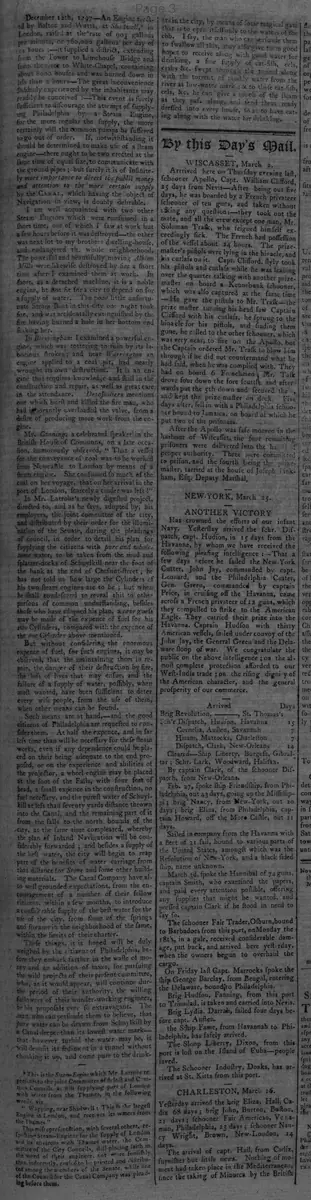
I am well acquainted with two other Steam Engines which were consumed in a short time, one of which I saw at work but a few hours before it was destroyed--the other was next lot to my brother's dwelling-house, and endangered the whole neighborhood. The powerful and beautifully moving Albion Mills were likewise destroyed by fire a short time after I examined them at work. In short, as a detached machine, it is a noble engine, but not fit for a city to depend on for a supply of water. The poor little unfortunate Steam Boat in this city one night took fire, and was accidentally extinguished by the fire having burned a hole in her bottom and sinking her.
In Birmingham I examined a powerful engine, which was tottering to ruin by its laborious strokes; and near Warrington an engine applied to a coal pit, had nearly wrought its own destruction. It is an engine that requires knowledge and skill in the construction and repair, as well as great care in the attendance. Desaguiliers mentions one which burst and killed the fire man, who had ignorantly overloaded the valve, from a desire of producing more work from the engine.
Mr. Canning, a celebrated speaker in the British House of Commons, on a late occasion, humorously observed, "That a vessel for the conveyance of coal was to be worked from Newcastle to London by means of a steam engine. She consumed so much of the coal on her voyage, that on her arrival in the port of London, scarcely a cinder was left!"
In Mr. Latrobe's newly digested project, directed to, and as he says, adopted by, his employers, the joint committee of the city, and distributed by their order for the illumination of the Senate, during the pleadings of council, in order to detail his plan for supplying the citizens with pure and wholesome water, to be taken from the mud and platter-docks of Schuylkill near the foot of the bank at the end of Chestnut-street; he has not told us how large the Cylinders of his two steam engines are to be; but when he shall condescend to reveal this to other persons of common understanding, besides those who have adopted his plan, a near guess may be made of the expense of fuel for his two Cylinders, compared with the expense of the one Cylinder above mentioned.
But without considering the enormous expense of fuel, for such engines, it may be observed, that the maintaining them in repair, the danger of their destruction by fire, the loss of lives that may ensue, and the failure of a supply of water, possibly, when most wanted, have been sufficient to deter every wise people, from the use of them, when other means can be found.
Such means are at hand,--and the good citizens of Philadelphia are requested to consider them. At half the expense, and in far less time than will be necessary for these steam works, even if any dependence could be placed on their being adequate to the end proposed, or on the experience and abilities of the projector, a wheel engine may be placed at the foot of the Falls, with four feet of head, a small expense in the construction, no fuel necessary, and the purest water of Schuylkill at less than seventy yards distance thrown into the Canal, and the remaining part of it from the falls to the north bounds of the city, at the same time completed, whereby the plan of Inland Navigation will be considerably forwarded; and besides a supply of the best water, the city will begin to reap part of the benefits of water carriage from that distance for Stone and some other building materials. The Canal Company have also well grounded expectations, from the encouragement of a number of their fellow citizens, within a few months, to introduce a considerable supply of the best water for the use of the city, from some of the springs and streams in the neighborhood of the same, within the limits of their charter.
These things, it is hoped will be duly weighed by the citizens of Philadelphia, before they embark farther in the waste of money and an addition of taxes, for pursuing the wild projects of their present committee, who, as it would appear, will continue during the period of their authority, the willing followers of their wonder-working engineer, be his proposals ever so extravagant. The man who can persuade them to believe, that pure water can be drawn from Schuylkill by a Canal deeper than its lowest water mark--that however turbid the water may be, it will deposit its sediment in a tunnel without choking it up, and come pure to the drinking--
This is the Steam-Engine which Mr Latrobe presents to the joint Committee of Select and Common Councils. as still supplying part of London and its environs with Thames water. the Committees of the City Councils, still placing faith in the word of their engineer. not more foolishly than indecently, caused to be printed and distributed, of the Council for the Canal Company was pleading before them.
What sub-type of article is it?
What themes does it cover?
What keywords are associated?
What entities or persons were involved?
Letter to Editor Details
Recipient
The Printer
Main Argument
the letter opposes using steam engines for philadelphia's water supply due to their high fuel costs, fire risks, maintenance issues, and unreliability, as evidenced by examples from london and elsewhere; it advocates instead for a more reliable and cheaper canal and wheel engine system at the schuylkill falls to provide pure water and advance inland navigation.
Notable Details