Thank you for visiting SNEWPapers!
Sign up free
Staunton Spectator
Staunton, Virginia
What is this article about?
A correspondent from Canton reports on March 10th about the advancing rebellion in China, rumored to have captured Nankin, led possibly by foreign influences like French Jesuits, threatening the Manchu Emperor and potentially revolutionizing trade policies.
Clipping
OCR Quality
Full Text
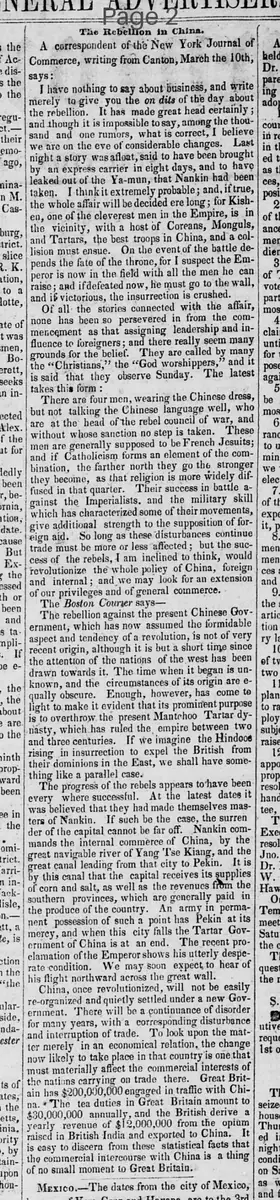
A correspondent of the New York Journal of
Commerce, writing from Canton, March the 10th
says:
I have nothing to say about business, and write
merely to give you the on dits of the day about
the rebellion. It has made great head certainly;
and though it is impossible to say, among the thousand
and one rumors, what is correct, I believe
we are on the eve of considerable changes. Last
night a story was afloat, said to have been brought
by an express carrier in eight days, and to have
leaked out of the Ya-mun, that Nankin had been
taken. I think it extremely probable; and, if true,
the whole affair will be decided ere long; for Kishen,
one of the cleverest men in the Empire, is in
the vicinity, with a host of Coreans, Monguls,
and Tartars, the best troops in China, and a collision
must ensue. On the event of the battle depends
the fate of the throne, for I suspect the Emperor
is now in the field with all the men he can
raise; and if defeated now, he must go to the wall,
and if victorious, the insurrection is crushed.
Of all the stories connected with the affair,
none has been so persevered in from the commencement
as that assigning leadership and influence
to foreigners; and there really seem many
grounds for the belief. They are called by many
the "Christians," the "God worshippers," and it
is said that they observe Sunday. The latest
takes this form :
There are four men, wearing the Chinese dress,
but not talking the Chinese language well, who
are at the head of the rebel council of war, and
without whose sanction no step is taken. These
men are generally supposed to be French Jesuits;
and if Catholicism forms an element of the combination,
the farther north they go the stronger
they become, as that religion is more widely diffused
in that quarter. Their success in battle against
the Imperialists, and the military skill
which has characterized some of their movements,
give additional strength to the supposition of foreign
aid. So long as these disturbances continue
trade must be more or less affected; but the success
of the rebels, I am inclined to think, would
revolutionize the whole policy of China, foreign
and internal; and we may look for an extension
of our privileges and of general commerce.
The Boston Courier says—
The rebellion against the present Chinese Government,
which has now assumed the formidable
aspect and tendency of a revolution, is not of very
recent origin, although it is but a short time since
the attention of the nations of the west has been
drawn towards it. The time when it began is unknown,
and the circumstances of its origin are equally
obscure. Enough, however, has come to
light to make it evident that its prominent purpose
is to overthrow the present Manchoo Tartar dynasty,
which has ruled the empire between two
and three centuries. If we imagine the Hindoos
rising in insurrection to expel the British from
their dominions in the East, we shall have something
like a parallel case.
The progress of the rebels appears to have been
every where successful. At the latest dates it
was believed that they had made themselves masters
of Nankin. If such be the case, the surrender
of the capital cannot be far off. Nankin commands
the internal commerce of China, by the
great navigable river of Yang Tse Kiang, and the
great canal leading from that city to Pekin. It is
by this canal that the capital receives its supplies
of corn and salt, as well as the revenues from the
southern provinces, which are generally paid in
the produce of the country. An army in permanent
possession of such a point has Pekin at its
mercy, and when this city falls the Tartar Government
of China is at an end. The recent proclamation
of the Emperor shows his utterly desperate
condition. We may soon expect to hear of
his flight northward across the great wall.
China, once revolutionized, will not be easily
re-organized and quietly settled under a new Government.
There will be a continuance of disorder
for many years, with a corresponding disturbance
and interruption of trade. To look upon the matter
merely in an economical relation, the change
now likely to take place in that country is one that
must materially affect the commercial interests of
the nations carrying on trade there. Great Britain
has $200,000,000 engaged in traffic with China. *
The tea duties in Great Britain amount to
$30,000,000 annually, and the British derive a
yearly revenue of $12,000,000 from the opium
raised in British India and exported to China. It
is easy to discern from these statistical facts that
the commercial intercourse with China is a thing
of no small moment to Great Britain.
What sub-type of article is it?
What keywords are associated?
What entities or persons were involved?
Where did it happen?
Foreign News Details
Primary Location
China
Event Date
March The 10th
Key Persons
Outcome
rumored capture of nankin; potential battle deciding throne's fate; success of rebels could crush insurrection or overthrow dynasty; long-term trade disruptions expected
Event Details
Correspondent from Canton reports rebellion advancing, possibly capturing Nankin via express in eight days from Ya-mun; Kishen leads imperial troops including Coreans, Monguls, Tartars against rebels suspected of foreign leadership by French Jesuits or Christians observing Sunday; rebels successful in battles showing military skill; aims to overthrow Manchoo Tartar dynasty ruling 2-3 centuries; Nankin controls commerce via Yang Tse Kiang and canal to Pekin, threatening capital; Emperor desperate, may flee; revolution could extend foreign privileges and commerce but cause years of disorder.