Thank you for visiting SNEWPapers!
Sign up free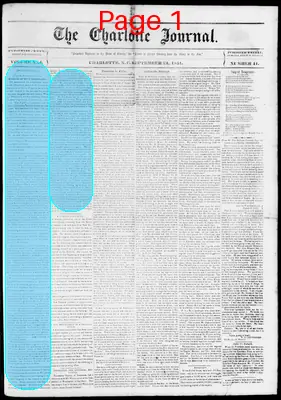
Editorial
September 24, 1851
The Charlotte Journal
Charlotte, Mecklenburg County, North Carolina
What is this article about?
Editorial from Baltimore American celebrates Whig and Democratic parties adopting the Compromise of 1850 as their platform, praises Fillmore Administration's firm commitment to it as final slavery settlement, and calls for unity against abolitionists and secessionists to preserve the Union.
Clipping
OCR Quality
95%
Excellent
Full Text
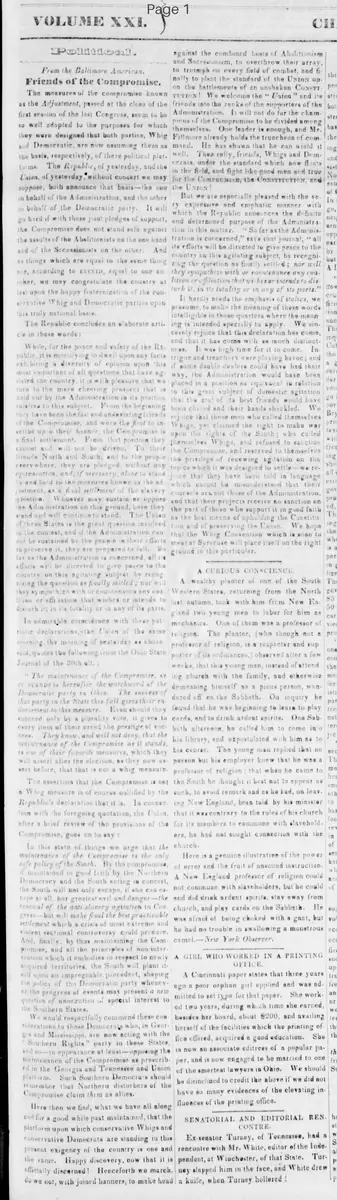
VOLUME XXI.
From the Baltimore American.
Friends of the Compromise.
The measures of the compromise known as the Adjustment, passed at the close of the first session of the last Congress, seem to be so well adapted to the purposes for which they were designed that both parties, Whig and Democratic, are now assuming them as the basis, respectively, of their political platforms. The Republic, of yesterday, and the Union, of yesterday, without concert we may suppose, both announce that basis—the one in behalf of the Administration, and the other in behalf of the Democratic party. It will go hard if with these tripled pledges of support, the Compromise does not stand safe against the assaults of the Abolitionists on the one hand and of the Secessionists on the other. And as things which are equal to the same thing are, according to Euclid, equal to one another, we may congratulate the country at last upon the happy fraternization of the conservative Whig and Democratic parties upon this truly national base.
The Republic concludes an elaborate article in these words:
While, for the peace and safety of the Republic, it is mortifying to dwell upon any facts exhibiting a diversity of opinion upon this the most important of all questions that have agitated the country, it is with pleasure that we turn to the more cheering prospect that is held out by the Administration in its position in relation to this subject. From the beginning they have been the fast and undeviating friends of the Compromise, and were the first to inscribe upon their banner the Compromise as a final settlement. From that position they cannot and will not be driven. To their friends North and South, and to the people everywhere, they are pledged without any equivocation, and, if necessary, alone to stand and hold to the measures known as the Adjustment, as a final settlement of the slavery question. Never may I sustain or oppose the Administration on this ground, here they stand and will continue to stand. The Union of these States is the great question involved in the contest, and if the Administration can but be sustained by the people in their efforts to preserve it, they are prepared to fall. So far as the Administration is concerned, all its efforts will be directed to give peace to the country on this agitating subject by recognizing the question as finally settled, nor will they sympathize with or countenance any course of action or agitation that wishes or intends to disturb it, in its totality or in any of its parts.
In admirable coincidence with these patriotic declarations the Union of the same morning (the morning of yesterday as above said) quotes the following from the Ohio State Journal of the 30th ult.
"The maintenance of the Compromise. As it is, is hereafter the watchword of the Democratic party in Ohio. The success of that party in the State this fall gives their endorsement to this measure. Even should they succeed only by a plurality vote, it gives to every atom of their creed the prestige of success. They know, and will not deny, that the maintenance of the Compromise as it stands, is one of their favorite measures, which they will assert after the election, as they now assert before, that that is not a Whig measure."
The assertion that the Compromise is not a Whig measure is of course nullified by the Republic's declaration that it is. In consequence with the foregoing quotation, the Union, after a brief review of the provisions of the Compromise, goes on to say:
In this state of things we urge that the maintenance of the Compromise is the only safe policy of the South. By the Compromise, if maintained in good faith by the Northern Democracy and the South acting in concert, the South will not only escape, if she chooses, her greatest evil and danger—the renewal of the anti-slavery agitation in Congress—but will make final the best practicable settlement which a crisis of most extreme and violent sectional controversy could produce. And, finally, by thus maintaining the Compromise, and all the principles of non-intervention which it embodies in respect to newly acquired territories, the South will plant it well upon an impregnable precedent, shaping the policy of the Democratic party whenever the progress of events may present a new question of annexation special interest to the Southern States.
We would respectfully commend these considerations to those Democrats who, in Georgia and Mississippi, are now acting with the Southern Rights party in those States, and so—in appearance at least—opposing the maintenance of the Compromise as prescribed in the Georgia and Tennessee and Union platforms. Such Southern Democrats should remember that Northern disturbers of the Compromise claim them as allies.
Here then we find, what we have all along and for a good while past maintained, that the platform upon which conservative Whigs and conservative Democrats are standing in this present exigency of the country is one and the same. Happy discovery, now that it is officially discerned! Henceforth we march, do we not, with joined banners, to make head against the combined hosts of Abolitionism and Secessionism, to overthrow their array, to triumph on every field of combat, and finally to plant the standard of the Union upon the battlements of an unshaken Constitution! We welcome the "Union" and its friends into the ranks of the supporters of the Administration. It will not do for the champions of the Compromise to be divided among themselves. One leader is enough, and Mr. Fillmore already holds the truncheon of command. He has shown that he can wield it well. Then rally, friends, Whigs and Democrats, under the standard which now floats in the field, and fight like good men and true for the Compromise, the Constitution, and the Union!
But we are especially pleased with the very expressive and emphatic manner with which the Republic announces the definite and determined purpose of the Administration in this matter. "So far as the Administration is concerned," says that journal, "all its efforts will be directed to give peace to the country on this agitating subject, by recognizing the question as finally settled; nor will they sympathize with or countenance any coalition or agitation that wishes or intends to disturb it, in its totality or in any of its parts." It hardly needs the emphasis of italics, we presume, to make the meaning of these words intelligible in those quarters where the meaning is intended specially to apply. We sincerely rejoice that this declaration has come, and that it has come with so much distinctness. It was high time for it to come. Intrigue and treachery were playing havoc; and if some double dealers could have had their way, the Administration would have been placed in a position so equivocal in relation to this great subject of domestic agitation that the zeal of its best friends would have been chilled and their hands shackled. We rejoice that those men who called themselves Whigs, yet claimed the right to make war upon the rights of the South; who called themselves Whigs, and refused to sanction the Compromise, and reserved to themselves the privilege of renewing agitation on the top of which it was designed to settle—we rejoice that they have been told in language which cannot be misunderstood that their counsels are not those of the Administration, and that their projects receive no sanction on the part of those who support it in good faith as the best means of upholding the Constitution and of preserving the Union. We hope that the Whig Convention which is soon to meet at Syracuse will place itself on the right ground in this particular.
From the Baltimore American.
Friends of the Compromise.
The measures of the compromise known as the Adjustment, passed at the close of the first session of the last Congress, seem to be so well adapted to the purposes for which they were designed that both parties, Whig and Democratic, are now assuming them as the basis, respectively, of their political platforms. The Republic, of yesterday, and the Union, of yesterday, without concert we may suppose, both announce that basis—the one in behalf of the Administration, and the other in behalf of the Democratic party. It will go hard if with these tripled pledges of support, the Compromise does not stand safe against the assaults of the Abolitionists on the one hand and of the Secessionists on the other. And as things which are equal to the same thing are, according to Euclid, equal to one another, we may congratulate the country at last upon the happy fraternization of the conservative Whig and Democratic parties upon this truly national base.
The Republic concludes an elaborate article in these words:
While, for the peace and safety of the Republic, it is mortifying to dwell upon any facts exhibiting a diversity of opinion upon this the most important of all questions that have agitated the country, it is with pleasure that we turn to the more cheering prospect that is held out by the Administration in its position in relation to this subject. From the beginning they have been the fast and undeviating friends of the Compromise, and were the first to inscribe upon their banner the Compromise as a final settlement. From that position they cannot and will not be driven. To their friends North and South, and to the people everywhere, they are pledged without any equivocation, and, if necessary, alone to stand and hold to the measures known as the Adjustment, as a final settlement of the slavery question. Never may I sustain or oppose the Administration on this ground, here they stand and will continue to stand. The Union of these States is the great question involved in the contest, and if the Administration can but be sustained by the people in their efforts to preserve it, they are prepared to fall. So far as the Administration is concerned, all its efforts will be directed to give peace to the country on this agitating subject by recognizing the question as finally settled, nor will they sympathize with or countenance any course of action or agitation that wishes or intends to disturb it, in its totality or in any of its parts.
In admirable coincidence with these patriotic declarations the Union of the same morning (the morning of yesterday as above said) quotes the following from the Ohio State Journal of the 30th ult.
"The maintenance of the Compromise. As it is, is hereafter the watchword of the Democratic party in Ohio. The success of that party in the State this fall gives their endorsement to this measure. Even should they succeed only by a plurality vote, it gives to every atom of their creed the prestige of success. They know, and will not deny, that the maintenance of the Compromise as it stands, is one of their favorite measures, which they will assert after the election, as they now assert before, that that is not a Whig measure."
The assertion that the Compromise is not a Whig measure is of course nullified by the Republic's declaration that it is. In consequence with the foregoing quotation, the Union, after a brief review of the provisions of the Compromise, goes on to say:
In this state of things we urge that the maintenance of the Compromise is the only safe policy of the South. By the Compromise, if maintained in good faith by the Northern Democracy and the South acting in concert, the South will not only escape, if she chooses, her greatest evil and danger—the renewal of the anti-slavery agitation in Congress—but will make final the best practicable settlement which a crisis of most extreme and violent sectional controversy could produce. And, finally, by thus maintaining the Compromise, and all the principles of non-intervention which it embodies in respect to newly acquired territories, the South will plant it well upon an impregnable precedent, shaping the policy of the Democratic party whenever the progress of events may present a new question of annexation special interest to the Southern States.
We would respectfully commend these considerations to those Democrats who, in Georgia and Mississippi, are now acting with the Southern Rights party in those States, and so—in appearance at least—opposing the maintenance of the Compromise as prescribed in the Georgia and Tennessee and Union platforms. Such Southern Democrats should remember that Northern disturbers of the Compromise claim them as allies.
Here then we find, what we have all along and for a good while past maintained, that the platform upon which conservative Whigs and conservative Democrats are standing in this present exigency of the country is one and the same. Happy discovery, now that it is officially discerned! Henceforth we march, do we not, with joined banners, to make head against the combined hosts of Abolitionism and Secessionism, to overthrow their array, to triumph on every field of combat, and finally to plant the standard of the Union upon the battlements of an unshaken Constitution! We welcome the "Union" and its friends into the ranks of the supporters of the Administration. It will not do for the champions of the Compromise to be divided among themselves. One leader is enough, and Mr. Fillmore already holds the truncheon of command. He has shown that he can wield it well. Then rally, friends, Whigs and Democrats, under the standard which now floats in the field, and fight like good men and true for the Compromise, the Constitution, and the Union!
But we are especially pleased with the very expressive and emphatic manner with which the Republic announces the definite and determined purpose of the Administration in this matter. "So far as the Administration is concerned," says that journal, "all its efforts will be directed to give peace to the country on this agitating subject, by recognizing the question as finally settled; nor will they sympathize with or countenance any coalition or agitation that wishes or intends to disturb it, in its totality or in any of its parts." It hardly needs the emphasis of italics, we presume, to make the meaning of these words intelligible in those quarters where the meaning is intended specially to apply. We sincerely rejoice that this declaration has come, and that it has come with so much distinctness. It was high time for it to come. Intrigue and treachery were playing havoc; and if some double dealers could have had their way, the Administration would have been placed in a position so equivocal in relation to this great subject of domestic agitation that the zeal of its best friends would have been chilled and their hands shackled. We rejoice that those men who called themselves Whigs, yet claimed the right to make war upon the rights of the South; who called themselves Whigs, and refused to sanction the Compromise, and reserved to themselves the privilege of renewing agitation on the top of which it was designed to settle—we rejoice that they have been told in language which cannot be misunderstood that their counsels are not those of the Administration, and that their projects receive no sanction on the part of those who support it in good faith as the best means of upholding the Constitution and of preserving the Union. We hope that the Whig Convention which is soon to meet at Syracuse will place itself on the right ground in this particular.
What sub-type of article is it?
Partisan Politics
Slavery Abolition
Constitutional
What keywords are associated?
Compromise Support
Party Unity
Slavery Settlement
Administration Pledge
Anti Abolition
Preserving Union
Fillmore Administration
What entities or persons were involved?
Administration
Fillmore
Whig Party
Democratic Party
Abolitionists
Secessionists
Republic
Union
Ohio State Journal
Editorial Details
Primary Topic
Unity Of Whig And Democratic Parties In Support Of The Compromise As Final Settlement Of Slavery Question
Stance / Tone
Strongly Supportive Of Compromise And Administration Against Abolitionists And Secessionists
Key Figures
Administration
Fillmore
Whig Party
Democratic Party
Abolitionists
Secessionists
Republic
Union
Ohio State Journal
Key Arguments
Compromise Measures Adopted By Both Whig And Democratic Parties As Political Platforms
Administration Pledged Without Equivocation To Defend Compromise As Final Settlement
Maintenance Of Compromise Prevents Anti Slavery Agitation And Secures Southern Interests
Conservative Whigs And Democrats United On Compromise Platform
Opposition To Southern Democrats Aligning With Secessionists
Whig Convention Urged To Support Compromise