Thank you for visiting SNEWPapers!
Sign up free
Story
November 3, 1847
The Sumter Banner
Sumter, Sumter County, South Carolina
What is this article about?
Article emphasizes the critical importance of thorough soil cultivation after transplanting fruit trees, especially peaches, to ensure survival and growth. Illustrates with examples of trees thriving under hoed crops like potatoes versus failing in grass, wheat, or meadows, and provides practical cultivation tips.
Clipping
OCR Quality
95%
Excellent
Full Text
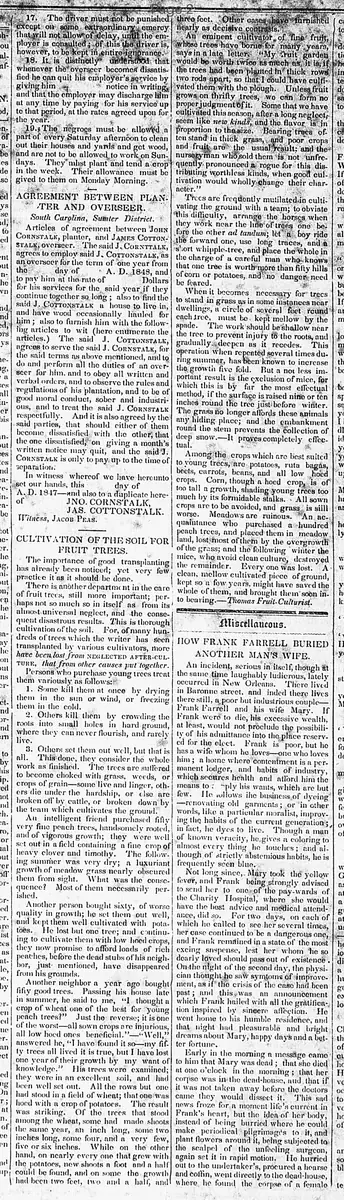
CULTIVATION OF THE SOIL FOR FRUIT TREES.
The importance of good transplanting has already been noticed; yet very few practice it as it should be done. There is another department in the care of fruit trees, still more important; perhaps not so much so in itself as from its almost universal neglect, and the consequent disastrous results. This is thorough cultivation of the soil. For, of many hundreds of trees which the writer has seen transplanted by various cultivators, more have been lost from neglected after-culture, than from other causes put together.
Persons who purchase young trees treat them variously as follows:
1. Some kill them at once by drying them in the sun or wind, or freezing them in the cold.
2. Others kill them by crowding the roots into small holes in hard ground, where they can never flourish, and rarely live.
3. Others set them out well, but that is all. This done, they consider the whole work as finished. The trees are suffered to become choked with grass, weeds, or crops of grain—some live and linger, others die under the hardship, or else are broken off by cattle, or broken down by the team which cultivates the ground.
An intelligent friend purchased fifty very fine peach trees, handsomely rooted, and of vigorous growth; they were well set out in a field containing a fine crop of heavy clover and timothy. The following summer was very dry; a luxuriant growth of meadow grass nearly obscured them from sight. What was the consequence? Most of them necessarily perished.
Another person bought sixty, of worse quality in growth; he set them out well, and kept them well cultivated with potatoes. He lost but one tree; and continuing to cultivate them with low hoed crops, they now promise to afford loads of rich peaches, before the dead stubs of his neighbor, just mentioned, have disappeared from his grounds.
Another neighbor a year ago bought fifty good trees. Passing his house late in summer, he said to me, "I thought a crop of wheat one of the best for young peach trees?" Just the reverse; it is one of the worst—all sown crops are injurious all low hoed ones beneficial. "Well," answered he, "I have found it so—my fifty trees all lived it is true, but I have lost one year of their growth by my want of knowledge." His trees were examined; they were in an excellent soil, and had been well set out. All the rows but one had stood in a field of wheat; that one was hoed with a crop of potatoes. The result was striking. Of the trees that stood among the wheat, some had made shoots the same year, an inch long, some two inches long, some four, and a very few, five or six inches. While on the other hand, on nearly every one that grew with the potatoes, new shoots a foot and a half could be found, and on some the growth had been two feet, two and a half, and three feet. Other cases have furnished nearly as decisive contrasts.
An eminent cultivator of fine fruit whose trees have borne for many years, says in a late letter "My fruit garden would be worth twice as much as it is, if the trees had been planted in thick rows two rods apart, so that I could have cultivated them with the plough." Unless fruit grows on thrifty trees, we can form no proper judgment of it. Some that we have cultivated this season, after a long neglect; seem like new kinds, and the flavor is in proportion to the size. Bearing trees of ten stand in thick grass, and poor crops and fruit are the usual result: and the nurseryman who sold them is not unfrequently pronounced a rogue for this distributing worthless kinds, when good cultivation would wholly change their character.
Trees are frequently mutilated in cultivating the ground with a team; to obviate this difficulty, arrange the horses when they work near the line of trees one before the other tandem; let a boy ride the forward one, use long traces, and a short whipple-tree, and place the whole in the charge of a careful man who knows that one tree is worth more than fifty hills of corn or potatoes, and no danger need be feared.
When it becomes necessary for trees to stand in grass as in some instances near dwellings, a circle of several feet round each tree, must be kept mellow by the spade. The work should be shallow near the tree to prevent injury to the roots, and gradually deepen as it recedes. This operation when repeated several times during summer, has been known to increase the growth five fold. But a not less important result is the exclusion of mice, for which this is by far the most effectual method, if the surface is raised nine or ten inches round the tree just before winter. The grass no longer affords these animals any hiding place; and the embankment round the stem prevents the collection of deep snow.—It proves completely effectual.
Among the crops which are best suited to young trees, are potatoes, ruta bagas, beets, carrots, beans, and all low hoed crops. Corn, though a hoed crop, is of too tall a growth, shading young trees too much by its formidable stalks. All sown crops are to be avoided, and grass is still worse. Meadows are ruinous. An acquaintance who purchased a hundred peach trees, and placed them in meadow land, lost most of them by the overgrowth of the grass; and the following winter the mice, who avoid clean culture, destroyed the remainder. Every one was lost. A clean, mellow cultivated piece of ground, kept so a few years, might have saved the whole of them, and brought them soon into bearing.
Thomas Fruit-Culturist
The importance of good transplanting has already been noticed; yet very few practice it as it should be done. There is another department in the care of fruit trees, still more important; perhaps not so much so in itself as from its almost universal neglect, and the consequent disastrous results. This is thorough cultivation of the soil. For, of many hundreds of trees which the writer has seen transplanted by various cultivators, more have been lost from neglected after-culture, than from other causes put together.
Persons who purchase young trees treat them variously as follows:
1. Some kill them at once by drying them in the sun or wind, or freezing them in the cold.
2. Others kill them by crowding the roots into small holes in hard ground, where they can never flourish, and rarely live.
3. Others set them out well, but that is all. This done, they consider the whole work as finished. The trees are suffered to become choked with grass, weeds, or crops of grain—some live and linger, others die under the hardship, or else are broken off by cattle, or broken down by the team which cultivates the ground.
An intelligent friend purchased fifty very fine peach trees, handsomely rooted, and of vigorous growth; they were well set out in a field containing a fine crop of heavy clover and timothy. The following summer was very dry; a luxuriant growth of meadow grass nearly obscured them from sight. What was the consequence? Most of them necessarily perished.
Another person bought sixty, of worse quality in growth; he set them out well, and kept them well cultivated with potatoes. He lost but one tree; and continuing to cultivate them with low hoed crops, they now promise to afford loads of rich peaches, before the dead stubs of his neighbor, just mentioned, have disappeared from his grounds.
Another neighbor a year ago bought fifty good trees. Passing his house late in summer, he said to me, "I thought a crop of wheat one of the best for young peach trees?" Just the reverse; it is one of the worst—all sown crops are injurious all low hoed ones beneficial. "Well," answered he, "I have found it so—my fifty trees all lived it is true, but I have lost one year of their growth by my want of knowledge." His trees were examined; they were in an excellent soil, and had been well set out. All the rows but one had stood in a field of wheat; that one was hoed with a crop of potatoes. The result was striking. Of the trees that stood among the wheat, some had made shoots the same year, an inch long, some two inches long, some four, and a very few, five or six inches. While on the other hand, on nearly every one that grew with the potatoes, new shoots a foot and a half could be found, and on some the growth had been two feet, two and a half, and three feet. Other cases have furnished nearly as decisive contrasts.
An eminent cultivator of fine fruit whose trees have borne for many years, says in a late letter "My fruit garden would be worth twice as much as it is, if the trees had been planted in thick rows two rods apart, so that I could have cultivated them with the plough." Unless fruit grows on thrifty trees, we can form no proper judgment of it. Some that we have cultivated this season, after a long neglect; seem like new kinds, and the flavor is in proportion to the size. Bearing trees of ten stand in thick grass, and poor crops and fruit are the usual result: and the nurseryman who sold them is not unfrequently pronounced a rogue for this distributing worthless kinds, when good cultivation would wholly change their character.
Trees are frequently mutilated in cultivating the ground with a team; to obviate this difficulty, arrange the horses when they work near the line of trees one before the other tandem; let a boy ride the forward one, use long traces, and a short whipple-tree, and place the whole in the charge of a careful man who knows that one tree is worth more than fifty hills of corn or potatoes, and no danger need be feared.
When it becomes necessary for trees to stand in grass as in some instances near dwellings, a circle of several feet round each tree, must be kept mellow by the spade. The work should be shallow near the tree to prevent injury to the roots, and gradually deepen as it recedes. This operation when repeated several times during summer, has been known to increase the growth five fold. But a not less important result is the exclusion of mice, for which this is by far the most effectual method, if the surface is raised nine or ten inches round the tree just before winter. The grass no longer affords these animals any hiding place; and the embankment round the stem prevents the collection of deep snow.—It proves completely effectual.
Among the crops which are best suited to young trees, are potatoes, ruta bagas, beets, carrots, beans, and all low hoed crops. Corn, though a hoed crop, is of too tall a growth, shading young trees too much by its formidable stalks. All sown crops are to be avoided, and grass is still worse. Meadows are ruinous. An acquaintance who purchased a hundred peach trees, and placed them in meadow land, lost most of them by the overgrowth of the grass; and the following winter the mice, who avoid clean culture, destroyed the remainder. Every one was lost. A clean, mellow cultivated piece of ground, kept so a few years, might have saved the whole of them, and brought them soon into bearing.
Thomas Fruit-Culturist
What sub-type of article is it?
Agricultural Advice
Horticultural Guide
What keywords are associated?
Fruit Trees
Soil Cultivation
Peach Trees
Hoed Crops
Tree Transplanting
Agricultural Neglect
Mouse Protection
What entities or persons were involved?
Thomas Fruit Culturist
Intelligent Friend
Another Person
Another Neighbor
Eminent Cultivator
Acquaintance
Story Details
Key Persons
Thomas Fruit Culturist
Intelligent Friend
Another Person
Another Neighbor
Eminent Cultivator
Acquaintance
Story Details
The article stresses the necessity of thorough soil cultivation after transplanting fruit trees to prevent loss and promote vigorous growth, contrasting successful cultivation with hoed crops like potatoes against failures in grass, wheat, or meadows, and offers methods to protect trees from damage and pests.