Thank you for visiting SNEWPapers!
Sign up free
Story
August 4, 1893
The Globe Republican
Dodge City, Ford County, Kansas
What is this article about?
An experienced dairy woman advises letting milking cows eat freely if feed is not too rich, except before calving to prevent milk fever, trusting the cow's judgment over strict measurements.
Clipping
OCR Quality
98%
Excellent
Full Text
What Feed and How Much.
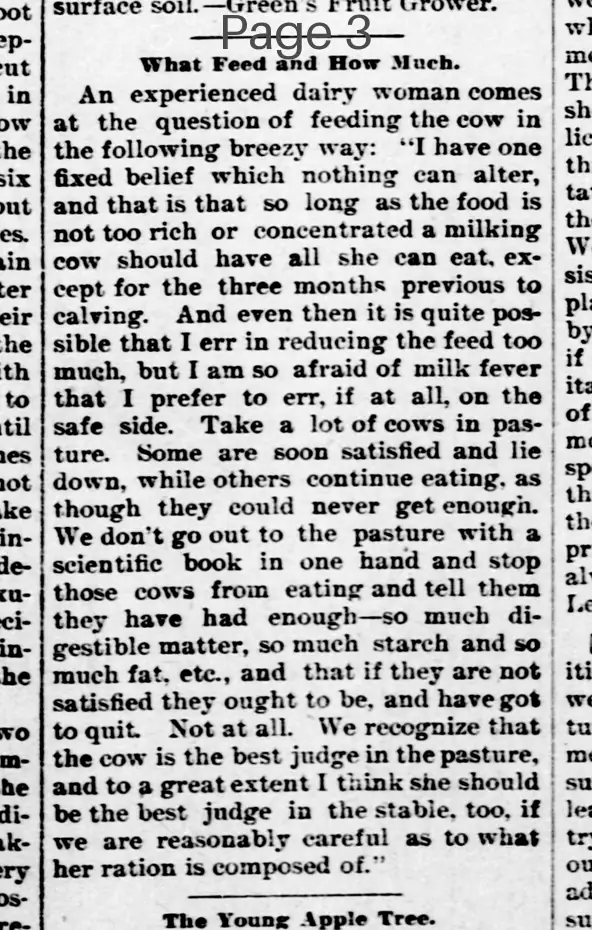
An experienced dairy woman comes at the question of feeding the cow in the following breezy way: "I have one fixed belief which nothing can alter, and that is that so long as the food is not too rich or concentrated a milking cow should have all she can eat, except for the three months previous to calving. And even then it is quite possible that I err in reducing the feed too much, but I am so afraid of milk fever that I prefer to err, if at all, on the safe side. Take a lot of cows in pasture. Some are soon satisfied and lie down, while others continue eating, as though they could never get enough. We don't go out to the pasture with a scientific book in one hand and stop those cows from eating and tell them they have had enough--so much digestible matter, so much starch and so much fat, etc., and that if they are not satisfied they ought to be, and have got to quit. Not at all. We recognize that the cow is the best judge in the pasture, and to a great extent I think she should be the best judge in the stable, too, if we are reasonably careful as to what her ration is composed of."
An experienced dairy woman comes at the question of feeding the cow in the following breezy way: "I have one fixed belief which nothing can alter, and that is that so long as the food is not too rich or concentrated a milking cow should have all she can eat, except for the three months previous to calving. And even then it is quite possible that I err in reducing the feed too much, but I am so afraid of milk fever that I prefer to err, if at all, on the safe side. Take a lot of cows in pasture. Some are soon satisfied and lie down, while others continue eating, as though they could never get enough. We don't go out to the pasture with a scientific book in one hand and stop those cows from eating and tell them they have had enough--so much digestible matter, so much starch and so much fat, etc., and that if they are not satisfied they ought to be, and have got to quit. Not at all. We recognize that the cow is the best judge in the pasture, and to a great extent I think she should be the best judge in the stable, too, if we are reasonably careful as to what her ration is composed of."
What sub-type of article is it?
Biography
What themes does it cover?
Moral Virtue
What keywords are associated?
Cow Feeding
Dairy Farming
Milk Fever
Pasture Grazing
Stable Ration
What entities or persons were involved?
Experienced Dairy Woman
Story Details
Key Persons
Experienced Dairy Woman
Story Details
An experienced dairy woman shares her belief that milking cows should eat all they can handle if the food isn't too rich, except before calving to avoid milk fever, emphasizing that cows know their own needs best.