Thank you for visiting SNEWPapers!
Sign up free
Letter to Editor
June 19, 1829
Phenix Gazette
Alexandria, Virginia
What is this article about?
This letter advocates for a systematic, natural, and progressive approach to education that maintains pupil interest and promotes intellectual growth, using analogies from nature and divine providence. It critiques obstacles like unskilled teachers, inadequate facilities, and frivolous pursuits that hinder learning.
Clipping
OCR Quality
98%
Excellent
Full Text
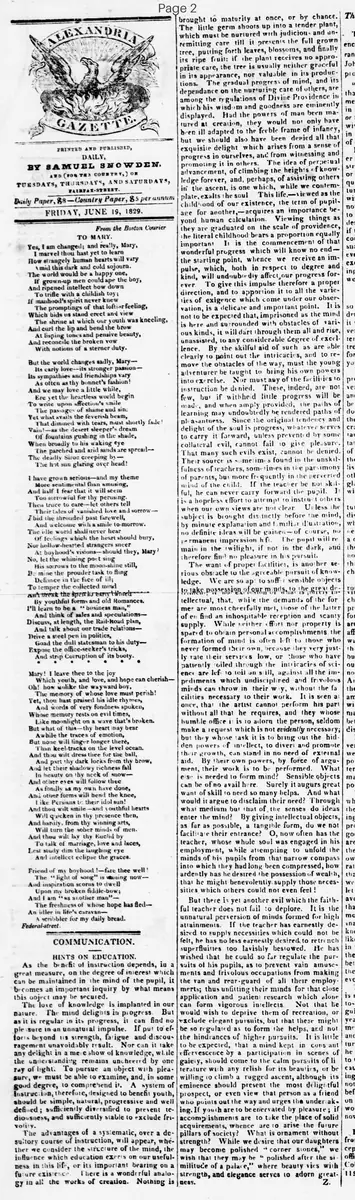
COMMUNICATION.
HINTS ON EDUCATION.
As the benefit of instruction depends, in a great measure, on the degree of interest which can be maintained in the mind of the pupil, it becomes an important inquiry by what means this object may be secured.
The love of knowledge is implanted in our nature. The mind delights in progress. But as it is regular in its progress, it can find no pleasure in an unnatural impulse. If put to efforts beyond its strength, fatigue and discouragement unavoidably result. Nor can it take any delight in a mere show of knowledge, while the understanding remains uncheered by one ray of light. To pursue an object with pleasure, we must be able to examine, and, in some good degree, to comprehend it. A system of instruction, therefore, designed to benefit youth, should be simple, natural, progressive and well defined; sufficiently diversified to prevent tediousness, and sufficiently stable to exclude frivolity.
The advantages of a systematic, over a desultory course of instruction, will appear, whether we consider the structure of the mind, the influence which education exerts on our usefulness in this life, or its important bearing on a future existence. There is a wonderful analogy in all the works of creation. Nothing is brought to maturity at once, or by chance.
The little germ shoots up into a tender plant, which must be nurtured with judicious and unremitting care till it presents the full grown tree, putting forth leaves, blossoms, and finally its ripe fruit: if the plant receives no appropriate care, the tree is usually neither graceful in its appearance, nor valuable in its productions. The gradual progress of mind, and its dependance on the nurturing care of others, are among the regulations of Divine Providence in which his wisdom and goodness are eminently displayed. Had the powers of man been matured at creation, they would not only have been ill adapted to the feeble frame of infancy, but we should also have been denied all that exquisite delight which arises from a sense of progress in ourselves, and from witnessing and promoting it in others. The idea of perpetual advancement, of climbing the heights of knowledge forever, and, perhaps, of assisting others in the ascent, is one which, while we contemplate, exalts the soul. This life—viewed as the childhood of our existence, the term of pupilage for another—acquires an importance beyond human calculation. Viewing things as they are graduated on the scale of providence, the literal childhood bears a proportion equally important. It is the commencement of that wonderful progress which will know no end—the starting point, whence we receive an impulse, which, both in respect to degree and kind, will undoubtedly affect our progress forever. To give this impulse therefore a proper direction, and to apportion it to all the varieties of exigence which come under our observation, is a delicate and important point. It is not to be expected that, imprisoned as the mind is here and surrounded with obstacles of various kinds, it will dart through them all and rise, unassisted, to any considerable degree of excellence. By the skilful aid of such as are able clearly to point out the intricacies, and to remove the obstacles of the way, must the young adventurer be taught to bring his own powers into exercise. Nor must any of the facilities to instruction be denied. These, indeed, are not few, but if withheld little progress will be made, and when amply provided, the paths of learning may undoubtedly be rendered paths of pleasantness. Since the original tendency and delight of the soul is progress, whatever serves to carry it forward, unless prevented by some collateral evil, cannot fail to give pleasure.
That many such evils exist, cannot be denied. Their source is sometimes found in the unskilfulness of teachers, sometimes in the parsimony of parents, but more frequently in the perverted mind of the child. If the teacher be not skilful, he can never carry forward the pupil. It is a hopeless effort to attempt to instruct others when our own views are not clear. Unless the subject is brought distinctly before the mind, by minute explanation and familiar illustration, no definite ideas will be gained—of course, no permanent impression left. The pupil will remain in the twilight, if not in the dark, and therefore find no pleasure in his pursuit.
The want of proper facilities, is another serious obstacle to the agreeable pursuit of knowledge. We are so apt to suffer sensible objects to take possession of our minds. To the great detriment, that, while the demands of the former are most cheerfully met, those of the latter often find an inhospitable reception and scanty supply. While neither effort nor property is spared to obtain personal accomplishments the formation of mind is often left to those who never formed their own, because they very justly rate their services low, or those who have patiently toiled through the intricacies of science are left to toil on still, against all the impediments which undisciplined and frivolous minds can throw in their way, without the facilities necessary to their work. It is seen at once, that the artist cannot perform his part without all that he requires, and they whose humble office it is to adorn the person, seldom make a request which is not evidently necessary; but they whose task it is to bring out the hidden powers of intellect, to divert and promote their growth, can stand in no need of external aid. By their own powers, by force of argument, their work is to be performed. What else is needed to form mind? Sensible objects can be of no avail here. Surely it augurs great want of skill to need so many helps. And what would it argue to disclaim their need? Through what medium but that of the senses do ideas enter the mind? By giving intellectual objects, as far as possible, a tangible form, do we not facilitate their entrance? O, how often has the teacher, whose whole soul was engaged in his employment, while attempting to unfold the minds of his pupils from that narrow compass into which they had long been compressed, how ardently has he desired the possession of wealth, that he might benevolently supply those necessities which others could not even feel!
But there is yet another evil which the faithful teacher does not fail to deplore. It is the unnatural perversion of minds formed for high attainments. If the teacher has earnestly desired to supply necessities which could not be felt, he has no less earnestly desired to retrench superfluities too lavishly bestowed. He has wished that he could so far regulate the pursuits of his pupils, as to prevent vain amusements and frivolous occupations from making the van and rear-guard of all their employments; thus unfitting their minds for that close application and patient research which alone can form vigorous intellects. Not that he would wish to deprive them of recreation, or exclude elegant pursuits, but that these might be so regulated as to form the helps, and not the hindrances of higher pursuits. It is little to be expected, that a mind kept in constant effervescence by a participation in scenes of gaiety, should come to the calm pursuits of literature with any relish for its beauties, or be willing to climb a rugged ascent, although its eminence should present the most delightful prospect, or even view that person as a friend who points out the way and urges the undertaking. If youth are to be enervated by pleasure; if accomplishments are to take the place of solid acquirements, whence are to arise the future pillars of society? What is ornament without strength? While we desire that our daughters may become polished "corner stones,"
we wish that they may be "polished after the similitude of a palace," where beauty vies with strength, and elegance serves to adorn greatness.
Z.
HINTS ON EDUCATION.
As the benefit of instruction depends, in a great measure, on the degree of interest which can be maintained in the mind of the pupil, it becomes an important inquiry by what means this object may be secured.
The love of knowledge is implanted in our nature. The mind delights in progress. But as it is regular in its progress, it can find no pleasure in an unnatural impulse. If put to efforts beyond its strength, fatigue and discouragement unavoidably result. Nor can it take any delight in a mere show of knowledge, while the understanding remains uncheered by one ray of light. To pursue an object with pleasure, we must be able to examine, and, in some good degree, to comprehend it. A system of instruction, therefore, designed to benefit youth, should be simple, natural, progressive and well defined; sufficiently diversified to prevent tediousness, and sufficiently stable to exclude frivolity.
The advantages of a systematic, over a desultory course of instruction, will appear, whether we consider the structure of the mind, the influence which education exerts on our usefulness in this life, or its important bearing on a future existence. There is a wonderful analogy in all the works of creation. Nothing is brought to maturity at once, or by chance.
The little germ shoots up into a tender plant, which must be nurtured with judicious and unremitting care till it presents the full grown tree, putting forth leaves, blossoms, and finally its ripe fruit: if the plant receives no appropriate care, the tree is usually neither graceful in its appearance, nor valuable in its productions. The gradual progress of mind, and its dependance on the nurturing care of others, are among the regulations of Divine Providence in which his wisdom and goodness are eminently displayed. Had the powers of man been matured at creation, they would not only have been ill adapted to the feeble frame of infancy, but we should also have been denied all that exquisite delight which arises from a sense of progress in ourselves, and from witnessing and promoting it in others. The idea of perpetual advancement, of climbing the heights of knowledge forever, and, perhaps, of assisting others in the ascent, is one which, while we contemplate, exalts the soul. This life—viewed as the childhood of our existence, the term of pupilage for another—acquires an importance beyond human calculation. Viewing things as they are graduated on the scale of providence, the literal childhood bears a proportion equally important. It is the commencement of that wonderful progress which will know no end—the starting point, whence we receive an impulse, which, both in respect to degree and kind, will undoubtedly affect our progress forever. To give this impulse therefore a proper direction, and to apportion it to all the varieties of exigence which come under our observation, is a delicate and important point. It is not to be expected that, imprisoned as the mind is here and surrounded with obstacles of various kinds, it will dart through them all and rise, unassisted, to any considerable degree of excellence. By the skilful aid of such as are able clearly to point out the intricacies, and to remove the obstacles of the way, must the young adventurer be taught to bring his own powers into exercise. Nor must any of the facilities to instruction be denied. These, indeed, are not few, but if withheld little progress will be made, and when amply provided, the paths of learning may undoubtedly be rendered paths of pleasantness. Since the original tendency and delight of the soul is progress, whatever serves to carry it forward, unless prevented by some collateral evil, cannot fail to give pleasure.
That many such evils exist, cannot be denied. Their source is sometimes found in the unskilfulness of teachers, sometimes in the parsimony of parents, but more frequently in the perverted mind of the child. If the teacher be not skilful, he can never carry forward the pupil. It is a hopeless effort to attempt to instruct others when our own views are not clear. Unless the subject is brought distinctly before the mind, by minute explanation and familiar illustration, no definite ideas will be gained—of course, no permanent impression left. The pupil will remain in the twilight, if not in the dark, and therefore find no pleasure in his pursuit.
The want of proper facilities, is another serious obstacle to the agreeable pursuit of knowledge. We are so apt to suffer sensible objects to take possession of our minds. To the great detriment, that, while the demands of the former are most cheerfully met, those of the latter often find an inhospitable reception and scanty supply. While neither effort nor property is spared to obtain personal accomplishments the formation of mind is often left to those who never formed their own, because they very justly rate their services low, or those who have patiently toiled through the intricacies of science are left to toil on still, against all the impediments which undisciplined and frivolous minds can throw in their way, without the facilities necessary to their work. It is seen at once, that the artist cannot perform his part without all that he requires, and they whose humble office it is to adorn the person, seldom make a request which is not evidently necessary; but they whose task it is to bring out the hidden powers of intellect, to divert and promote their growth, can stand in no need of external aid. By their own powers, by force of argument, their work is to be performed. What else is needed to form mind? Sensible objects can be of no avail here. Surely it augurs great want of skill to need so many helps. And what would it argue to disclaim their need? Through what medium but that of the senses do ideas enter the mind? By giving intellectual objects, as far as possible, a tangible form, do we not facilitate their entrance? O, how often has the teacher, whose whole soul was engaged in his employment, while attempting to unfold the minds of his pupils from that narrow compass into which they had long been compressed, how ardently has he desired the possession of wealth, that he might benevolently supply those necessities which others could not even feel!
But there is yet another evil which the faithful teacher does not fail to deplore. It is the unnatural perversion of minds formed for high attainments. If the teacher has earnestly desired to supply necessities which could not be felt, he has no less earnestly desired to retrench superfluities too lavishly bestowed. He has wished that he could so far regulate the pursuits of his pupils, as to prevent vain amusements and frivolous occupations from making the van and rear-guard of all their employments; thus unfitting their minds for that close application and patient research which alone can form vigorous intellects. Not that he would wish to deprive them of recreation, or exclude elegant pursuits, but that these might be so regulated as to form the helps, and not the hindrances of higher pursuits. It is little to be expected, that a mind kept in constant effervescence by a participation in scenes of gaiety, should come to the calm pursuits of literature with any relish for its beauties, or be willing to climb a rugged ascent, although its eminence should present the most delightful prospect, or even view that person as a friend who points out the way and urges the undertaking. If youth are to be enervated by pleasure; if accomplishments are to take the place of solid acquirements, whence are to arise the future pillars of society? What is ornament without strength? While we desire that our daughters may become polished "corner stones,"
we wish that they may be "polished after the similitude of a palace," where beauty vies with strength, and elegance serves to adorn greatness.
Z.
What sub-type of article is it?
Informative
Philosophical
Reflective
What themes does it cover?
Education
Morality
What keywords are associated?
Education System
Youth Instruction
Teacher Skill
Intellectual Growth
Moral Development
Frivolous Pursuits
Divine Providence
What entities or persons were involved?
Z.
Letter to Editor Details
Author
Z.
Main Argument
education should be simple, natural, progressive, and well-supported to foster genuine interest and intellectual growth in youth, overcoming obstacles like unskilled teaching, inadequate resources, and frivolous distractions to prepare individuals for useful lives and eternal progress.
Notable Details
Analogy Of Plant Growth To Mental Development
Reference To Divine Providence And Gradual Maturation
Critique Of Prioritizing Personal Accomplishments Over Intellectual Formation
Biblical Allusion To 'Polished Corner Stones' From Psalms