Thank you for visiting SNEWPapers!
Sign up free
Daily National Intelligencer
Washington, District Of Columbia
What is this article about?
In a congressional debate, Mr. Montgomery proposes amendments to the direct tax assessment and collection bills, advocating for taxation based on actual specie value of property to ensure equitable apportionment among counties and states, criticizing the current system's reliance on outdated state revenue laws and population data as unjust and inconsistent.
Merged-components note: Full transcript of Mr. Montgomery's speeches on the tax bills in Congress, spanning pages 2 and 3; merged split components and relabeled from story to domestic_news as it reports national legislative proceedings.
Clippings
1 of 2
OCR Quality
Full Text
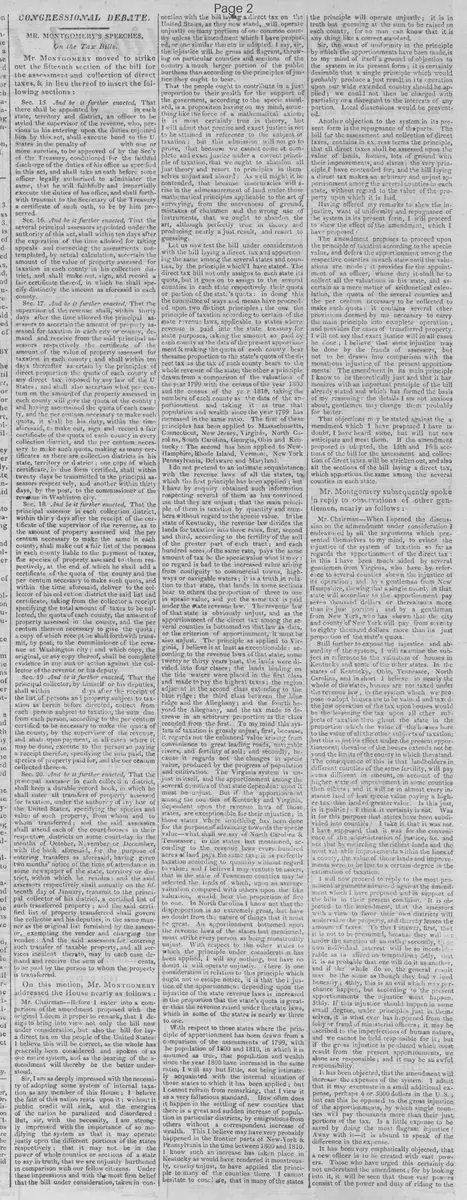
MR. MONTGOMERY'S SPEECHES,
On the Tax Bills.
Mr. Montgomery moved to strike out the fifteenth section of the bill for the assessment and collection of direct taxes, & in lieu thereof to insert the following sections:
Sec. 15. And be it further enacted. That there shall be appointed by in each state, territory and district, an officer to be styled the supervisor of the revenue, who, previous to his entering upon the duties enjoined him by this act, shall execute bond to the U. States in the penalty of with one or more sureties, to be approved of by the Sec'y of the Treasury, conditioned for the faithful discharge of the duties of his office as specified in this act, and shall take an oath before some officer legally authorised to administer the same, that he will faithfully and impartially execute the duties of his office, and shall forthwith transmit to the Secretary of the Treasury a certificate of such oath, to be by him preserved.
Sec. 16. And be it further enacted. That the several principal assessors appointed under the authority of this act, shall within ten days after the expiration of the time allowed for taking appeals and correcting the assessments contemplated, by actual calculation, ascertain the amount of the value of property assessed for taxation in each county in his collection district, and shall make out, sign, and record a fair certificate thereof, in which he shall specify distinctly the amount as aforesaid in each county.
Sec. 17. And be it further enacted, That the supervisor of the revenue shall, within thirty days after the time allowed the principal assessors to ascertain the amount of property assessed for taxation in each city or county, demand and receive from the said principal assessors respectively the certificate of the amount of the value of property assessed for taxation in each county; and shall within ten days thereafter ascertain by the principles of direct proportion the quota of each county of any direct tax imposed by any law of the U States, and shall also ascertain what per centum on the amount of the property assessed in each county will give the quota of the county; and having ascertained the quota of each county, and the per centum necessary to make such quota, it shall be his duty, within the time aforesaid, to make out, sign and record a fair certificate of the quota of each county in every collection district, and the per centum necessary to make such quota, making as many certificates as there are collection districts in his state, territory or district; one copy of which certificate, in due form certified, shall within twenty days be transmitted to the principal assessors respectively, and another within thirty days, by the post, to the commissioner of the revenue in Washington city.
Sec. 18. And be it further enacted. That the principal assessor in each collection district, within thirty days after the receipt of the certificate of the supervisor of the revenue, as to the amount of property assessed and the per centum necessary to make the same in each county, shall make out a fair list of the persons in each county liable to the payment of taxes, the species of property assessed to them respectively, at the end of which he shall add a certificate of the quota of the county and the per centum necessary to make such quota, and within the time aforesaid, deliver to the collector of his collection district the said list and certificate, taking from the collector a receipt specifying the total amount of taxes to be collected, the quota of each county, the amount of property assessed in the county, and the per centum thereon necessary to give the quota; a copy of which receipt he shall forthwith transmit, by post, to the commissioner of the revenue at Washington city; and which copy, the original, or any copy thereof, shall be complete evidence in any suit or action against the collector of the revenue or his deputy.
Sec. 19. And be it further enacted, That the principal collector, by himself or his deputies, shall within 30 days after the receipt of the list of persons and property subject to taxation as herein before directed, collect from each person subject to taxation, the sum due from each person, according to the per centum certified to be necessary to make the quota of the county, by the supervisor of the revenue, and shall upon payment, in all cases where it may be done, execute to the person so paying a receipt therefor, specifying the sum paid, the species of property paid for, and the per centum collected thereon.
Sec. 20. And be it further enacted, That the principal assessor in each collection district, shall keep a durable record book, in which he shall enter all transfers of property assessed for taxation, under the authority of any law of the United States, specifying the species and value of such property, from whom and to whom transferred; and the said assessors shall attend each of the court-houses in their respective districts on some court-day in the months of October, November or December, with the book aforesaid, for the purpose of entering transfers as aforesaid, having given two months' notice of the time of attendance in some newspaper of the state, territory or district, within which he resides; and the said assessors respectively shall annually on the fifteenth day of January, transmit to the principal collector of his district, a certified list of such transferred property; and the said certified list of property transferred shall govern the collector and his deputies, in the same manner as the original list furnished by the assessor, exempting the vender and charging the vendee: And the said assessors for entering such transfer of taxable property, and all services incident thereto, may in each case demand and receive the sum of 25 cents, to be paid by the person to whom the property is transferred.
On this motion, Mr. MONTGOMERY addressed the House nearly as follows:
Mr. Chairman--Before I enter into a comparison of the amendment proposed with the original I deem it proper to remark, that I design to bring into view not only the bill now under consideration, but also the bill for laying a direct tax on the people of the United States: I believe this will be correct, as the whole has generally been considered and spoken of as one entire system, and as the bearing of the amendment will thereby be the better understood.
Sir, I am as deeply impressed with the necessity of adopting some system of internal taxation as any member of this House; I believe the fate of this nation rests upon it; without it public credit will sink, and the energies of the nation be paralyzed and disordered: But, sir, with the necessity, I am strongly impressed with the importance of so modifying the system as that it may operate justly upon the different portions of the states respectively; that it may not be in the power of whole counties or sections of a state to say in truth, that we are unjustly burdened in comparison with our fellow citizens. Under these impressions and with the most firm belief that the bill under consideration, taken in connection with the bill laying a direct tax on the United States, as they now stand, will operate unjustly on many portions of our common country unless the amendment which I have proposed, or one similar thereto is adopted. I say, sir the injustice will be gross and flagrant, throwing on particular counties and sections of the country a much larger portion of the public burdens than according to the principles of justice they ought to bear.
That the people ought to contribute in a just proportion to their wealth for the support of the government, according to the specie standard, is a proposition having on my mind, something like the force of a mathematical axiom; it is most certainly true in theory, but I will admit that precise and exact justice is not to be attained in reference to the subject of taxation: but this admission will not go to prove, that because we cannot come at complete and exact justice under a correct principle of taxation, that we ought to abandon all just theory and resort to principles in themselves unjust and absurd: As well might it be contended that because inaccuracies will arise in the admeasurement of land under those mathematical principles applicable to the art of surveying, from the unevenness of ground, mistakes of chainmen and the wrong use of instruments, that we ought to abandon the art, although perfectly true in theory and producing nearly a just result, and resort to guessing.
Let us now test the bill under consideration with the bill laying a direct tax and apportioning the same among the several states and counties, by the principle which I have stated. The direct tax bill not only assigns to each state its quota, but it goes on to assign to the several counties in each state respectively their quota or portion of the state's quota: in doing this the committee of ways and means have proceeded upon two distinct principles; the one the principle of taxation according to certain of the state revenue laws, applicable to states where revenue is paid into the state treasury for state purposes, taking the amount so paid by each county as the data of the present apportionment & making the quota of each county bear the same proportion to the state's quota of the direct tax as the tax of such county bears to the whole revenue of the state; the other a principle drawn from a comparison of the valuations of the year 1799 with the census of the year 1800 and the census of the year 1810, taking the numbers of each county as the data of the apportionment and taking it as true that population and wealth since the year 1799 has increased in the same ratio. The first of these principles has been applied to Massachusetts, Connecticut, New Jersey, Virginia, North Carolina, South Carolina, Georgia, Ohio and Kentucky: The second has been applied to New Hampshire, Rhode Island, Vermont, New York, Pennsylvania, Delaware and Maryland.
I do not pretend to an intimate acquaintance with the revenue laws of all the states, to which the first principle has been applied; but I have by enquiry obtained such information respecting several of them as has convinced me that they are unjust; that the main principle of them is taxation by quantity and numbers without regard to the specie value. In the state of Kentucky the revenue law divides the lands for taxation into three rates, first, second and third, according to the fertility of the soil of the greater part of each tract; and each hundred acres of the same rate, pays the same amount of tax be the specie value what it may: no regard is had to the increased value arising from contiguity to commercial towns, highways or navigable waters; it is a truth in relation to that state, that lands in some sections bear to others the proportion of three to one in specie value, and yet the same tax is paid under the state revenue law. The revenue law of that state is obviously unjust, and as the apportionment of the direct tax among the several counties is bottomed on that law as data, or the criterion of apportionment, it must be also unjust. The principle as applied to Virginia, I believe is at least as exceptionable: according to the revenue laws of that state, some twenty or thirty years past, the lands were divided into four classes; the lands binding on the tide waters were placed in the first class and made to pay the highest taxes; the region adjacent in the second class extending to the blue ridge; the third class between the blue ridge and the Alleghany; and the fourth beyond the Alleghany, and the tax made to decrease in an arbitrary proportion as the class receded from the first. To my mind this system of taxation is grossly unjust, first, because, it regards not the enhanced value arising from convenience to great leading roads, navigable rivers, and fertility of soil; and secondly, because it regards not the changes in specie value, produced by the progress of population and cultivation. The Virginia system is unjust in itself, and the apportionment among the several counties of that state dependent upon it must be unjust. But if the apportionment among the counties of Kentucky and Virginia, dependent upon the revenue laws of those states, are exceptionable for their injustice; in those states where something has been done for the purpose of advancing towards the specie value--what shall we say of North Carolina & Tennessee; in the states last mentioned, according to the revenue laws every hundred acres of land pays the same tax; it is perfectly taxation according to quantity without regard to value; and I believe I may venture to assert, that in the state of Tennessee counties may be selected the lands of which, upon an average valuation compared with others upon the like valuation, would bear the proportion of five to one. In North Carolina I know not that the disproportion is so extremely great, but have no doubt from the nature of things that it must be great. An apportionment bottomed upon the revenue laws of the states last mentioned, must strike every person as being monstrously unjust. With respect to the other states to which the principle under consideration has been applied, I will say nothing, but have no doubt it will operate unjustly. There is one consideration in relation to this principle which ought not to escape notice, it is that the injustice of the apportionment depending upon the injustice of the state revenue laws is increased in the proportion that the state's quota is greater than the revenue raised under the state laws, which in some of the states is nearly as three to one.
With respect to those states where the principle of apportionment has been drawn from a comparison of the assessments of 1799, with the population of 1800 and 1810, in which it is assumed as true, that population and wealth since the year 1800 have increased in the same ratio, I will say but little, not being intimately acquainted with the internal situation of those states to which it has been applied; but I cannot refrain from remarking, that I view it as a very fallacious standard, How often does it happen in the settling of new counties that there is a great and sudden increase of population in particular districts, by emigrations from others without a correspondent increase of wealth. This I believe may have very probably happened in the frontier parts of New-York & Pennsylvania in the time between 1800 and 1810. I know such an increase has taken place in Kentucky as would have rendered it monstrously, cruelly unjust, to have applied the principle to many of the counties there. I cannot hesitate to conclude, that in many of the states the principle will operate unjustly; it is in truth but guessing at the sum to be raised on each county, for no man can know that it is any thing like a correct standard.
Sir, the want of uniformity in the principle by which the apportionments have been made, is to my mind of itself a ground of objection to the system in its present form; it is certainly desirable that a single principle which would probably produce a just result in its operation upon our wide extended country should be applied; we could not then be charged with partiality or a disregard to the interests of any portion. Local dissensions would be prevented.
Another objection to the system in its present form is the repugnance of the parts. The bill for the assessment and collection of direct taxes, contains in express terms the principle, that all direct taxes shall be assessed upon the value of lands, houses, lots of ground with their improvements, and slaves; the very principle I have contended for; and the bill laying a direct tax makes an arbitrary and unjust apportionment among the several counties in each state, without regard to the value of the property upon which it is laid
Having offered my remarks to shew the injustice, want of uniformity and repugnance of the system in its present form, I will proceed to shew the effect of the amendment, which I have proposed:
The amendment proposes to proceed upon the principle of taxation according to the specie value, and defers the apportionment among the respective counties in each state until the valuations are made; it provides for the appointment of an officer, whose duty it shall be to collect all the valuations in his state, and ascertain as a mere matter of arithmetical calculation, the quota of the several counties and the per centum necessary to be collected to make such quota: it contains several other provisions deemed by me necessary to carry the main principle into complete operation; and provides for cases of transferred property.
I will not say that exact justice will in all cases be done: I believe that some injustice may be done by the frauds of assessors, but not to be drawn into comparison with the monstrous injustice of the present apportionments. The amendment in its main principle I know to be theoretically just and that it harmonizes with an important principle of the bill already stated and which has formed the basis of my reasoning: the details I am not anxious about, gentlemen may change them probably for better.
That objections may be stated against the amendment which I have proposed I have no doubt, I have heard some, but will not now anticipate and meet them. If the amendment proposed is adopted, the 15th and 16th sections of the bill for the assessment and collection of direct taxes will be stricken out, and also all the sections of the bill laying a direct tax, which apportions the same among the several counties in each state.
Mr. Montgomery subsequently spoke in reply to observations of other gentlemen, nearly as follows:
Mr. Chairman--When I opened the discussion on the amendment under consideration I endeavored by all the arguments which presented themselves to my mind, to evince the injustice of the system of taxation so far as regards the apportionment of the direct tax: in this I have been much aided by several gentlemen from Virginia, who have by reference to several counties shewn the injustice of its operation; and by a gentleman from New Hampshire, shewing that a single county in that state will according to the apportionment pay seven thousand dollars or thereabouts more than its just portion; and by a gentleman from New York, who has shewn that the city and county of New York will pay from seventy to eighty thousand dollars more than its just proportion of the state's quota.
Still further to expose the injustice and absurdity of the system, I will examine the subject in reference to the valuation of houses in Kentucky and some of the other states. In the states of Kentucky, Ohio, Tennessee, North Carolina, and in short I believe in nearly the whole of the states, houses are not taxed under the revenue law; in the system which we propose to adopt houses are to be valued and taxed: the just operation of the tax upon houses would be the lessening the tax upon all other subjects of taxation throughout the state in the proportion which the value of the houses bore to the value of all the other subjects of taxation: but this is not its effect under the present apportionment; the value of the houses extends not beyond the limits of the county in which they stand The consequence of this is that landholders in different counties of the same fertility, will pay sums different in amount, on account of the higher state of improvement in some counties than others: and it will be in almost every instance land of less specie value paying a higher tax than land of greater value. Is this just, is it politic? I think it certainly is not. Was it for this purpose that states have been subdivided into counties? I take it that it was not. I have supposed that it was for the convenience of the administration of justice, &c. and not that by encircling the richest lands and the most valuable improvements within the lines of a county, the value of those lands and improvements were to be lost to a certain degree in the estimation of taxation.
I will now proceed to reply to the most prominent arguments advanced against the amendment which I have proposed and in support of the bills in their present condition. It is objected to the amendment, that the assessors with a view to favor their own districts will undervalue the property, and thereby lessen the amount of taxes. To this I answer, first, that it is not to be presumed, because they will act under the sanction of an oath; secondly, their own individual interest will be so inconsiderable as to afford no temptation; 3dly, that it is as probable that one will do it as another, and if the whole do so, the general result may be the same as though they had valued honestly; 4thly, this is an evil which may perchance happen, but according to the present apportionments the injustice must happen. 5thly. If this injustice should happen in some small degree, under principles just in themselves, it is what ever has happened from the folly or fraud of ministerial officers; it may be ascribed to the imperfections of human nature, and we cannot be held responsible for it; but if the gross injustice is produced which must result from the present apportionments, we alone are responsible; and it may be an awful responsibility.
It has been objected, that the amendment will increase the expenses of the system. I admit that it may eventuate in a small additional expense, perhaps 4 or 5000 dollars in the U.S.; but can this be opposed to the gross injustice of the apportionments, by which single counties will pay thousands more than their just portions of the tax. Is a little expense to be saved by doing the most flagrant injustice? Away with it--it is absurd to speak of the difference in the expense.
It has been very emphatically objected, that a new officer is to be created with vast powers. Those who have urged this certainly do not understand the amendment; for by looking into it, it will be seen that those vast powers consist of the power and duty of riding to the different assessors' offices and then making a mere arithmetical calculation of the quotas of the counties and the per centums necessary to raise them.
It has been objected to the amendment, that it would procrastinate the collection of the revenue. It is true that if the bill contained no section for postponement, that the plan of the amendment would require about 20 days longer to carry it into operation; but certainly this delay ought not to urge us into an unjust apportionment. But if my amendment is adopted, and a majority of the committee take the same view of the subject which I consider as politic, the part containing the principle of postponement will be stricken out. Gentlemen talk strangely indeed, when they speak of the importance of expedition, and are at the same time in favor of postponing the operation of the revenue laws for five or six months without any reason.
But there is a cure for all the injustice of the apportionments, say gentlemen, in the power vested in the state legislatures to alter the same. To this I answer, first, that I cannot see the correctness of doing injustice and trusting to others to correct it; it is very uncertain whether the state legislatures will interfere—it is in a word leaving the matter to chance. In the second place, I doubt the constitutionality of transferring this subject to the state legislatures, and will find considerable difficulty in voting for the bill until it is stripped of this provision. It is a matter of importance with me to get clear of it.
It has been said that we ought to adopt the present plan as a temporary one, that the valuations under it will be just and that upon them we can build a most perfect system, upon them we can make a just apportionment. How strangely, how inconsistently gentlemen argue! when speaking of the valuations as they relate to the amendment, they are to be unjust and made so with a view to lessen the quota of particular counties; but when it is necessary to find an apology for present injustice, the valuations are to be just. In the same breath it blows hot and cold.
I have now examined all the objections urged against the amendment, and can find nothing in them to change my opinion; they are such as are always at hand, and will lie to any system however perfect; and indeed the main principle of the amendment is exactly correct in theory, but subject like all other principles correct in themselves to be in some measure perverted by the imperfections of human nature; the bills under consideration are imperfect in themselves and liable in some degree to be rendered still more so by the imperfections of human nature. I have proposed to substitute a just plan for one which will produce gross injustice. I have proposed to substitute a plan operating uniformly and consistently for one which is directly the reverse. I have proposed it under the most thorough sense of duty, and not from a disposition to be captious; if it succeeds it will give me pleasure, because I can then vote for the bills with pleasure, and can with ease justify my votes: if it does not I assure gentlemen I will vote for the bills reluctantly and will find it difficult to justify my votes. I will, however, as I now expect, vote for them, believing as I do that partial injustice will not be so great an evil as the loss of public credit at this eventful crisis of our national affairs.
What sub-type of article is it?
What keywords are associated?
What entities or persons were involved?
Domestic News Details
Key Persons
Event Details
Mr. Montgomery proposes amendments to strike section 15 of the direct tax assessment bill and insert new sections 15-20 establishing a supervisor of revenue, procedures for assessing property values, apportioning quotas by county based on specie value, handling collections, and recording property transfers. In his speeches, he argues the current bills are unjust due to reliance on flawed state revenue laws and population data, leading to unequal burdens; advocates for uniform taxation by actual property value; addresses objections on assessor fraud, costs, new offices, delays, and state legislature fixes; and expresses intent to vote for bills if amendment fails to preserve public credit.