Thank you for visiting SNEWPapers!
Sign up free
The New Hampshire Gazette
Portsmouth, Rockingham County, New Hampshire
What is this article about?
Historical account of British conquest of Cape Breton from the French, asserting English rights since 1621, detailing the island's strategic value, fortifications, resources, and vast fishery trade that will benefit Britain economically and militarily.
Merged-components note: These two components form a continuous narrative article on the history and importance of Cape Breton, flowing directly from one to the other across columns on page 1.
Clipping
OCR Quality
Full Text
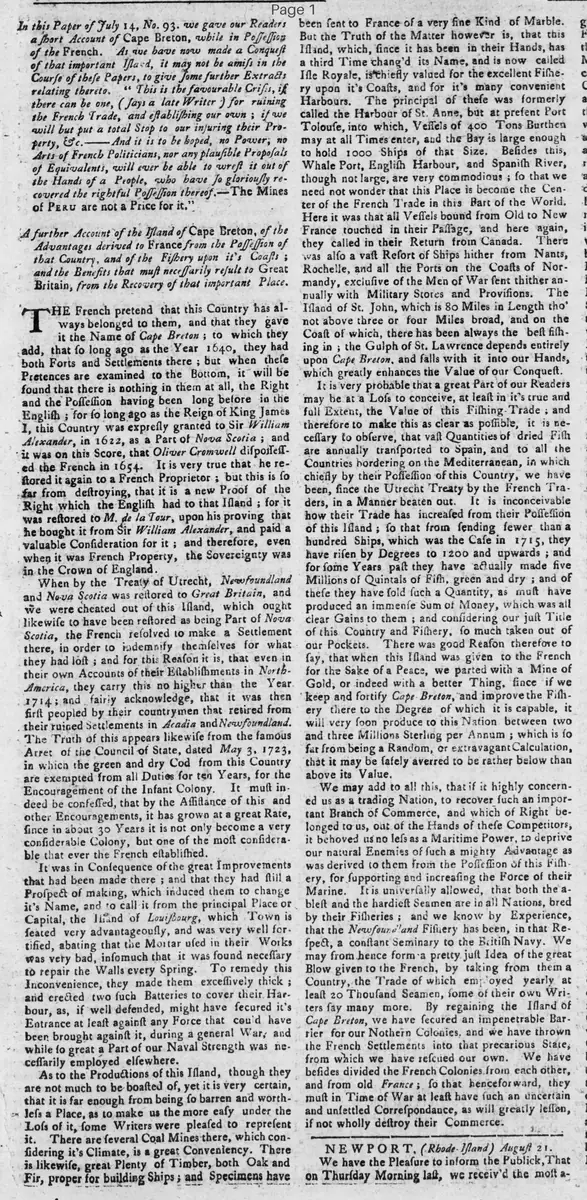
"This is the favourable Crisis, if there can be one, (Says a late Writer) for ruining the French Trade, and establishing our own; if we will but put a total Stop to our injuring their Property, &c.--And it is to be hoped, no Power; no Arts of French Politicians, nor any plausible Proposals of Equivalents, will ever be able to wrest it out of the Hands of a People, who have so gloriously recovered the rightful Possession thereof:= The Mines of Peru are not a Price for it."
A further Account of the Island of Cape Breton. of the Advantages derived to France from the Possession of that Country. and of the Fishery upon it's Coasts; and the Benefits that must necessarily result to Great Britain, from the Recovery of that important Place.
The French pretend that this Country has always belonged to them, and that they gave it the Name of Cape Breton; to which they add, that so long ago as the Year 1640. they had both Forts and Settlements there; but when these Pretences are examined to the Bottom. it will be found that there is nothing in them at all, the Right and the Possession having been long before in the English; for so long ago as the Reign of King James I, this Country was expressly granted to Sir William Alexander, in 1621, as a Part of Nova Scotia; and it was on this Score, that Oliver Cromwell disposed. ed the French in 1654. It is very true that - he restored it again to a French Proprietor; but this is so far from destroying, that it is a new Proof of the Right which the English had to that Island; for it was restored to M. de La Tour, upon his proving that he bought it from Sir William Alexander, and paid a valuable Consideration for it; and therefore, even when it was French Property, the Sovereignty was in the Crown of England.
When by the Treaty of Utrecht. Newfoundland and Nova Scotia was restored to Great Britain, and we were cheated out of this Island, which ought likewise to have been restored as being Part of Nova Scotia, the French resolved to make a Settlement there, in order to indemnify themselves for what they had lost; and for this Reason it is, that even in their own Accounts of their Establishments in North- America, they carry this no higher than the Year 1714; and fairly acknowledge, that it was then first peopled by their Countrymen that retired from their ruined Settlements in Acadia and Newfoundland.
The Truth of this appears likewise from the famous Arret of the Council of State, dated May 3, 1723, in which the green and dry Cod from this Country are exempted from all Duties for ten Years, for the Encouragement of the Infant Colony. It must in- deed be confessed, that by the Assistance of this and other Encouragements, it has grown at a great Rate, since in about 30 Years it is not only become a very considerable Colony, but one of the most considerable that ever the French established.
It was in Consequence of the great Improvements that had been made there; and that they had still a Prospect of making, which induced them to change it's Name, and to call it from the principal Place or Capital, the Island of Louisbourg, which Town is seated very advantageously, and was very well for- tified, abating that the Mortar used in their Works was very bad, insomuch that it was found necessary to repair the Walls every Spring. To remedy this Inconvenience, they made them excessively thick; and erected two such Batteries to cover their. Har- bour. as, if well defended, might have secured it's Entrance at least against any Force that could have been brought against it, during a general War; and while so great a Part of our Naval Strength was ne- cessarily employed elsewhere.
As to the Productions of this Island, though they are not much to be boasted of, yet it is very certain, that it is far enough from being so barren and worth- less a Place. as to make us the more easy under the Loss of it. Some Writers were pleased to represent it. There are several Coal Mines there, which con- sidering it's Climate, is a great Conveniency. There is likewise, great Plenty of Timber, both Oak and Fir, proper for building Ships; and Specimens have
been sent to France of a very fine Kind of Marble. But the Truth of the Matter however is. that this Island, which, since it has been in their Hands, has a third Time chang'd its Name. and is now called Isle Royale, is chiefly valued for the excellent Fish- ery upon it's Coasts, and for it's many convenient Harbours. The principal of these was formerly called the Harbour of St. Anne, but at present Port Toulouse, into which, Vessels of 400 Tons Burthen may at all Times enter, and the Bay is large enough to hold 1000 Ships of that Size, Besides this, Whale Port, English Harbour, and Spanish River, though not large, are very commodious; so that we need not wonder that this Place is become the Cen- ter of the French Trade in this Part of the World. Here it was that all Vessels bound from Old to New France touched in their Passage, and here again, they called in their Return from Canada. There was also a vast Resort of Ships hither from Nantes, Rochelle, and all the Ports on the Coasts of Nor- mandy, exclusive of the Men of War sent thither an- nually with Military Stores and Provisions. The Island of St. John, which is 80 Miles in Length tho' not above three or four Miles broad, and on the Coast of which, there has been always the best fish- ing in ; the Gulph of St. Lawrence depends entirely upon Cape Breton. and falls with it into our Hands, which greatly enhances the Value of our Conquest.
It is very probable that a great Part of our Readers may be at a Loss to conceive, at least in it's true and full Extent, the Value of this Fishing-Trade : and therefore to make this as clear as possible. it is ne- cessary to observe, that vast Quantities of dried Fish are annually transported to Spain, and to all the Countries bordering on the Mediterranean, in which chiefly by their Possession of this Country, we have been, since the Utrecht Treaty by the French Tra- ders. in a Manner beaten out. It is inconceivable how their Trade has increased from their Possession of this Island; so that from sending fewer than a hundred Ships, which was the Case in 1715, they have risen by Degrees to 1200 and upwards ; and for some Years past they have actually made five Millions of Quintals of Fish, green and dry ; and of these they have sold such a Quantity, as must have produced an immense Sum of Money, which was all clear Gains to them ; and considering our just Title of this Country and Fishery. so much taken out of our Pockets. There was good Reason therefore to say, that when this Island was given to the French for the Sake of a Peace. we parted with a Mine of Gold, or indeed with a better Thing. since if we keep and fortify Cape- Breton, and improve the Fish- ery there to the Degree of which it is capable, it will very soon produce to this Nation between two and three Millions Sterling per Annum ; which is so far from being a Random, or extravagant Calculation, that it may be safely averred to be rather below than above its Value.
We may add to all this. that if it highly concern- ed us as a trading Nation, to recover such an impor- tant Branch of Commerce, and which of Right be- longed to us, out of the Hands of these Competitors, it behoved us no less as a Maritime Power, ta deprive our natural Enemies of such a mighty Advantage as was derived to them from the Possession Of this Fish- ery, for supporting and increasing the Force of their Marine. It is universally allowed. that both the ablest and the hardiest Seamen are in all Nations, bred by their Fisheries ; and we know by Experience, that the Newfound- land Fishery has been. in that Re- Spect, a constant Seminary to the British Navy. We may from hence form a pretty. just Idea of the great Blow given to the French, by taking from them a Country, the Trade of which em- ployed yearly at least 20 Thousand Seamen, Some of their own Wri- ters say many more. By regaining the Island of Cape Breton, we have secured an impenetrable Bar- rier for our Northern Colonies. and we have thrown the French Settlements into that precarious State, from which we have rescued our own. We have besides divided the French Colonies from each other, and from old France; so that henceforward. they must in Time of War at least have such an uncertain and unsettled Correspondence, as will greatly lessen, if not wholly destroy their Commerce.
What sub-type of article is it?
What themes does it cover?
What keywords are associated?
What entities or persons were involved?
Where did it happen?
Story Details
Key Persons
Location
Cape Breton Island
Event Date
1745
Story Details
British conquest of Cape Breton from French, asserting historical English rights from 1621 grant, detailing French settlements post-1713 Utrecht Treaty, island's fortifications at Louisbourg, resources including coal, timber, marble, and vital cod fishery supporting French trade and navy, projecting immense economic benefits to Britain upon recovery.