Thank you for visiting SNEWPapers!
Sign up free
Editorial
October 19, 1864
The Daily Confederate
Raleigh, Wake County, North Carolina
What is this article about?
Editorial defends Confederate cotton manufacturers against greed accusations by North Carolina's Commissioners of Appraisement, highlighting their low-price supplies to government and poor despite high costs from farmers; critiques farmers and railroads for profiteering amid war-paralyzed economy.
Clipping
OCR Quality
78%
Good
Full Text
For the Confederate.
Manufactures.
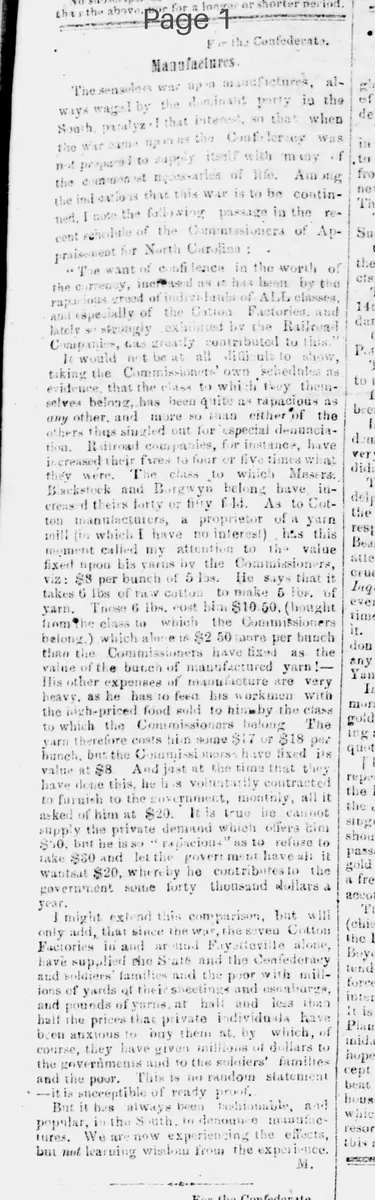
So paralyzed are the times that we are not prepared to supply ourselves with any of the every wants the Confederacy was most necessitous of—the necessaries of life. Among the most obvious that this war is to be continued, I note the following passage in the recent schedule of the Commissioners of Appraisement for North Carolina:
"The want of confidence in the worth of the currency, more as it has been by the rapacious greed of individuals of ALL classes, especially of the Cotton Factories, and lately so strongly exhibited by the Railroad Companies, has greatly contributed to this."
It would not be at all difficult to show, taking the Commissioners' own schedules as evidence, that the class to which they themselves belong, has been quite as rapacious as any other, and more so than either of the others thus singled out for especial denunciation. Railroad companies, for instance, have increased their fares to four or five times what they were. The class to which Messrs. Blackstock and Burgwyn belong have increased theirs forty or fifty fold. As to Cotton manufacturers, a proprietor of a yarn mill (to which I have no interest!) has this moment called my attention to the value fixed upon his yarns by the Commissioners, viz: $8 per bunch of 5 lbs. He says that it takes 6 lbs of raw cotton to make 5 lbs. of yarn. Those 6 lbs. cost him $10 50, (bought from the class to which the Commissioners belong.) which are $2 50 more per bunch than the Commissioners have fixed as the value of the bunch of manufactured yarn!—His other expenses of manufacture are very heavy, as he has to feed his workmen with the high-priced food sold to him by the class to which the Commissioners belong. The yarn therefore costs him some $17 or $18 per bunch, but the Commissioners have fixed its value at $8. And just at the time that they have done this, he has voluntarily contracted to furnish to the government, monthly, all it asked of him at $20. "It is true he cannot supply the private demand which offers him so, but he is as "rapacious" as to refuse to take $50 and let the government have it at $20, whereby he contributes to the government some forty thousand dollars a year.
I might extend this comparison, but will only add, that since the war, these few Cotton Factories in and around Fayetteville alone, have supplied the State and the Confederacy and soldiers' families and the poor with millions of yards of their sheetings and osnaburgs, and pounds of yarns, at half and less than half the prices that private individuals have been anxious to buy them at, by which, of course, they have given millions of dollars to the governments and to the soldiers' families and the poor. This is no random statement—it is susceptible of ready proof.
But it has always been fashionable, and popular, in the South, to denounce manufactures. We are now experiencing the effects, but not learning wisdom from the experience.
M.
Manufactures.
So paralyzed are the times that we are not prepared to supply ourselves with any of the every wants the Confederacy was most necessitous of—the necessaries of life. Among the most obvious that this war is to be continued, I note the following passage in the recent schedule of the Commissioners of Appraisement for North Carolina:
"The want of confidence in the worth of the currency, more as it has been by the rapacious greed of individuals of ALL classes, especially of the Cotton Factories, and lately so strongly exhibited by the Railroad Companies, has greatly contributed to this."
It would not be at all difficult to show, taking the Commissioners' own schedules as evidence, that the class to which they themselves belong, has been quite as rapacious as any other, and more so than either of the others thus singled out for especial denunciation. Railroad companies, for instance, have increased their fares to four or five times what they were. The class to which Messrs. Blackstock and Burgwyn belong have increased theirs forty or fifty fold. As to Cotton manufacturers, a proprietor of a yarn mill (to which I have no interest!) has this moment called my attention to the value fixed upon his yarns by the Commissioners, viz: $8 per bunch of 5 lbs. He says that it takes 6 lbs of raw cotton to make 5 lbs. of yarn. Those 6 lbs. cost him $10 50, (bought from the class to which the Commissioners belong.) which are $2 50 more per bunch than the Commissioners have fixed as the value of the bunch of manufactured yarn!—His other expenses of manufacture are very heavy, as he has to feed his workmen with the high-priced food sold to him by the class to which the Commissioners belong. The yarn therefore costs him some $17 or $18 per bunch, but the Commissioners have fixed its value at $8. And just at the time that they have done this, he has voluntarily contracted to furnish to the government, monthly, all it asked of him at $20. "It is true he cannot supply the private demand which offers him so, but he is as "rapacious" as to refuse to take $50 and let the government have it at $20, whereby he contributes to the government some forty thousand dollars a year.
I might extend this comparison, but will only add, that since the war, these few Cotton Factories in and around Fayetteville alone, have supplied the State and the Confederacy and soldiers' families and the poor with millions of yards of their sheetings and osnaburgs, and pounds of yarns, at half and less than half the prices that private individuals have been anxious to buy them at, by which, of course, they have given millions of dollars to the governments and to the soldiers' families and the poor. This is no random statement—it is susceptible of ready proof.
But it has always been fashionable, and popular, in the South, to denounce manufactures. We are now experiencing the effects, but not learning wisdom from the experience.
M.
What sub-type of article is it?
Economic Policy
Trade Or Commerce
What keywords are associated?
Confederate Manufactures
Cotton Factories
Appraisement Commissioners
Currency Confidence
War Economy
North Carolina
Fayetteville
Price Controls
What entities or persons were involved?
Commissioners Of Appraisement
Messrs. Blackstock And Burgwyn
Railroad Companies
Cotton Factories
Yarn Mill Proprietor
Fayetteville Factories
Editorial Details
Primary Topic
Defense Of Confederate Manufactures Against Greed Accusations
Stance / Tone
Supportive Of Manufacturers, Critical Of Appraisers And Farmers
Key Figures
Commissioners Of Appraisement
Messrs. Blackstock And Burgwyn
Railroad Companies
Cotton Factories
Yarn Mill Proprietor
Fayetteville Factories
Key Arguments
Commissioners' Class (Farmers) More Rapacious Than Accused Groups
Railroads Increased Fares 4 5 Times
Farmers Increased Prices 40 50 Times
Yarn Production Costs $17 18 Per Bunch But Appraised At $8
Manufacturer Sells To Government At $20 Vs Private $50, Saving Government $40,000 Yearly
Fayetteville Factories Supplied Goods At Half Price, Benefiting Confederacy And Poor
Southern Tradition Denounces Manufactures, Causing Current War Shortages