Thank you for visiting SNEWPapers!
Sign up free
Story
March 5, 1903
Valentine Democrat
Valentine, Cherry County, Nebraska
What is this article about?
Detailed explanation of thermometer manufacturing process, from glass tube preparation and filling with colored alcohol to marking freezing (32°F) and body temperature (96°F) points using snow or ice and heated water, for common use instruments.
Clipping
OCR Quality
98%
Excellent
Full Text
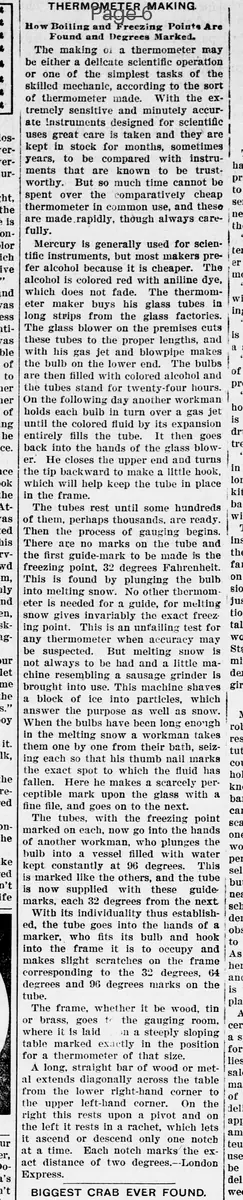
How Boiling and Freezing Points Are Found and Degrees Marked.
The making of a thermometer may be either a delicate scientific operation or one of the simplest tasks of the skilled mechanic, according to the sort of thermometer made. With the extremely sensitive and minutely accurate instruments designed for scientific uses great care is taken and they are kept in stock for months, sometimes years, to be compared with instruments that are known to be trustworthy. But so much time cannot be spent over the comparatively cheap thermometer in common use, and these are made rapidly, though always carefully.
Mercury is generally used for scientific instruments, but most makers prefer alcohol because it is cheaper. The alcohol is colored red with aniline dye, which does not fade. The thermometer maker buys his glass tubes in long strips from the glass factories. The glass blower on the premises cuts these tubes to the proper lengths, and with his gas jet and blowpipe makes the bulb on the lower end. The bulbs are then filled with colored alcohol and the tubes stand for twenty-four hours.
On the following day another workman holds each bulb in turn over a gas jet until the colored fluid by its expansion entirely fills the tube. It then goes back into the hands of the glass blower. He closes the upper end and turns the tip backward to make a little hook, which will help keep the tube in place in the frame.
The tubes rest until some hundreds of them, perhaps thousands, are ready. Then the process of gauging begins. There are no marks on the tube and the first guide-mark to be made is the freezing point, 32 degrees Fahrenheit. This is found by plunging the bulb into melting snow. No other thermometer is needed for a guide, for melting snow gives invariably the exact freezing point. This is an unfailing test for any thermometer when accuracy may be suspected. But melting snow is not always to be had and a little machine resembling a sausage grinder is brought into use. This machine shaves a block of ice into particles, which answer the purpose as well as snow.
When the bulbs have been long enough in the melting snow a workman takes them one by one from their bath, seizing each so that his thumb nail marks the exact spot to which the fluid has fallen. Here he makes a scarcely perceptible mark upon the glass with a fine file, and goes on to the next.
The tubes, with the freezing point marked on each, now go into the hands of another workman, who plunges the bulb into a vessel filled with water kept constantly at 96 degrees. This is marked like the others, and the tube is now supplied with these guide marks, each 32 degrees from the next.
With its individuality thus established, the tube goes into the hands of a marker, who fits its bulb and hook into the frame it is to occupy and makes slight scratches on the frame corresponding to the 32 degrees, 64 degrees and 96 degrees marks on the tube.
The frame, whether it be wood, tin or brass, goes to the gauging room, where it is laid on a steeply sloping table marked exactly in the position for a thermometer of that size. A long, straight bar of wood or metal extends diagonally across the table from the lower right-hand corner to the upper left-hand corner. On the right this rests upon a pivot and on the left it rests in a ratchet, which lets it ascend or descend only one notch at a time. Each notch marks the exact distance of two degrees.—London Express.
The making of a thermometer may be either a delicate scientific operation or one of the simplest tasks of the skilled mechanic, according to the sort of thermometer made. With the extremely sensitive and minutely accurate instruments designed for scientific uses great care is taken and they are kept in stock for months, sometimes years, to be compared with instruments that are known to be trustworthy. But so much time cannot be spent over the comparatively cheap thermometer in common use, and these are made rapidly, though always carefully.
Mercury is generally used for scientific instruments, but most makers prefer alcohol because it is cheaper. The alcohol is colored red with aniline dye, which does not fade. The thermometer maker buys his glass tubes in long strips from the glass factories. The glass blower on the premises cuts these tubes to the proper lengths, and with his gas jet and blowpipe makes the bulb on the lower end. The bulbs are then filled with colored alcohol and the tubes stand for twenty-four hours.
On the following day another workman holds each bulb in turn over a gas jet until the colored fluid by its expansion entirely fills the tube. It then goes back into the hands of the glass blower. He closes the upper end and turns the tip backward to make a little hook, which will help keep the tube in place in the frame.
The tubes rest until some hundreds of them, perhaps thousands, are ready. Then the process of gauging begins. There are no marks on the tube and the first guide-mark to be made is the freezing point, 32 degrees Fahrenheit. This is found by plunging the bulb into melting snow. No other thermometer is needed for a guide, for melting snow gives invariably the exact freezing point. This is an unfailing test for any thermometer when accuracy may be suspected. But melting snow is not always to be had and a little machine resembling a sausage grinder is brought into use. This machine shaves a block of ice into particles, which answer the purpose as well as snow.
When the bulbs have been long enough in the melting snow a workman takes them one by one from their bath, seizing each so that his thumb nail marks the exact spot to which the fluid has fallen. Here he makes a scarcely perceptible mark upon the glass with a fine file, and goes on to the next.
The tubes, with the freezing point marked on each, now go into the hands of another workman, who plunges the bulb into a vessel filled with water kept constantly at 96 degrees. This is marked like the others, and the tube is now supplied with these guide marks, each 32 degrees from the next.
With its individuality thus established, the tube goes into the hands of a marker, who fits its bulb and hook into the frame it is to occupy and makes slight scratches on the frame corresponding to the 32 degrees, 64 degrees and 96 degrees marks on the tube.
The frame, whether it be wood, tin or brass, goes to the gauging room, where it is laid on a steeply sloping table marked exactly in the position for a thermometer of that size. A long, straight bar of wood or metal extends diagonally across the table from the lower right-hand corner to the upper left-hand corner. On the right this rests upon a pivot and on the left it rests in a ratchet, which lets it ascend or descend only one notch at a time. Each notch marks the exact distance of two degrees.—London Express.
What sub-type of article is it?
Curiosity
What keywords are associated?
Thermometer Manufacturing
Freezing Point
Alcohol Thermometer
Glass Blowing
Gauging Process
Scientific Instruments
Story Details
Story Details
Process of making common thermometers: glass tubes cut and bulb formed, filled with colored alcohol, sealed, marked at freezing point using melting snow or ice shavings, then at 96 degrees in heated water, framed and gauged with degree notches.