Thank you for visiting SNEWPapers!
Sign up free
Alexandria Daily Gazette, Commercial & Political
Alexandria, Virginia
What is this article about?
The first essay in a series argues against capital punishment for civil crimes, claiming life is an unalienable right that individuals cannot delegate to governments or magistrates. It invokes reason, scripture, and humanity, suggesting substitutes for punishment and criticizing the practice's origins and effects, including on dueling.
Merged-components note: Continuation of the essays on capital punishments across two components on the same page.
Clipping
OCR Quality
Full Text
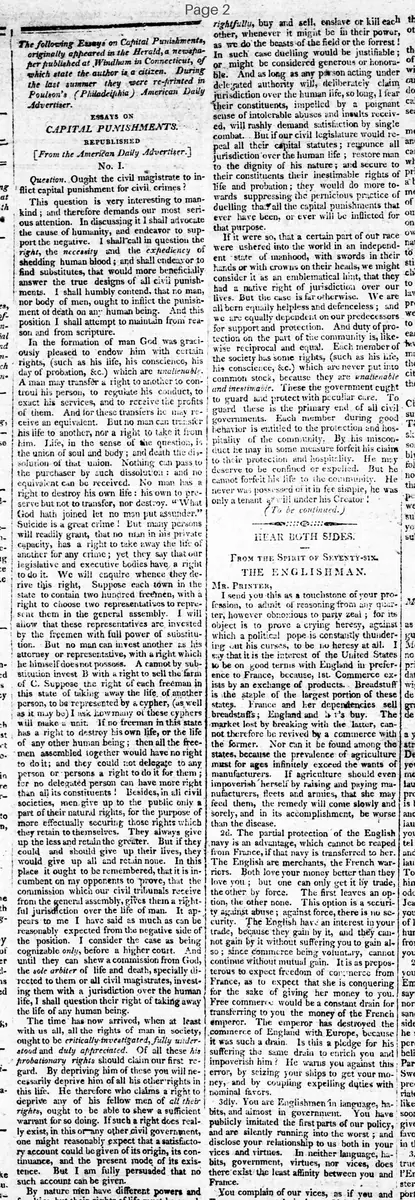
originally appeared in the Herald, a newspaper
published at Windham in Connecticut, of
which state the author is a citizen. During
the last summer they were re-printed in
Poulson's (Philadelphia) American Daily
Advertiser.
ESSAYS ON
CAPITAL PUNISHMENTS.
REPUBLISHED
[From the American Daily Advertiser.]
No. I.
Question. Ought the civil magistrate to inflict
capital punishment for civil crimes?
This question is very interesting to mankind;
and therefore demands our most serious
attention. In discussing it I shall advocate
the cause of humanity, and endeavor to support
the negative. I shall call in question the
right, the necessity and the expediency of
shedding human blood: and shall endeavor to
find substitutes, that would more beneficially
answer the true designs of all civil punishments.
I shall humbly contend, that no man,
nor body of men, ought to inflict the punishment
of death on any human being. And this
position I shall attempt to maintain from reason
and from scripture.
In the formation of man God was graciously
pleased to endow him with certain
rights, (such as his life, his conscience, his
day of probation, &c.) which are unalienable.
A man may transfer a right to another to control
his person, to regulate his conduct, to
exact his services, and to receive the profits
of them. And for these transfers he may receive
an equivalent. But no man can transfer
his life to another, nor a right to take it from
him. Life, in the sense of the question, is
the union of soul and body: and death the dissolution
of that union. Nothing can pass to
the purchaser by such dissolution: and no
equivalent can be received. No man has a
right to destroy his own life: his own to preserve
but not to transfer, nor destroy. "What
God hath joined let no man put asunder."
Suicide is a great crime! But many persons
will readily grant, that no man in his private
capacity, has a right to take away the life of
another for any crime; yet they say that our
legislative and executive bodies have a right
to do it. We will enquire whence they derive
this right. Suppose each town in the
state to contain two hundred freemen, with a
right to choose two representatives to represent
them in the general assembly. I will
allow that these representatives are invested
by the freemen with full power of substitution.
But no man can invest another as his
attorney or representative, with a right which
he himself does not possess. A cannot by substitution
invest B with a right to sell the farm
of C. Suppose the right of each freeman in
this state of taking away the life of another
person, to be represented by a cypher, (as well
as it may be) I ask how many of these cyphers
will make a unit. If no freeman in this state
has a right to destroy his own life, or the life
of any other human being; then all the freemen
assembled together would have no right
to do it; and they could not delegate to any
person or persons a right to do it for them;
for no delegated person can have more right
than all his constituents! Besides, in all civil
societies, men give up to the public only a
part of their natural rights, for the purpose of
more effectually securing those rights which
they retain to themselves. They always give
up the less and retain the greater. But if they
could and should give up their lives, they
would give up all and retain none. In this
place it ought to be remembered, that it is incumbent
on my opponents to prove, that the
commission which our civil tribunals receive
from the general assembly, gives them a rightful
jurisdiction over the life of man. It appears
to me I have said as much as can be
reasonably expected from the negative side of
the position. I consider the case as being
cognizable only, before a higher court. And
until they can shew a commission from God,
the sole arbiter of life and death, specially directed
to them or all civil magistrates, investing
them with a jurisdiction over the human
life, I shall question their right of taking away
the life of any human being.
The time has now arrived, when at least
with us all, all the rights of man in society,
ought to be critically investigated, fully understood
and duly appreciated. Of all these his
probationary rights should claim our first regard.
By depriving him of these you will necessarily
deprive him of all his other rights in
this life. He therefore who claims a right to
deprive any of his fellow men of all their
rights, ought to be able to shew a sufficient
warrant for so doing. If such a right does really
exist, in this or any other civil government,
one might reasonably expect that a satisfactory
account could be given of its origin, its continuance,
and the present mode of its existence.
But I am fully persuaded that no
such account can be given.
By nature men have different powers and
faculties, but their rights of life must be equal.
If one man have, or could have the right to
take away the life another then each man
would have a reciprocal right. And if each
man had a right to inflict the punishment of
death, he would have a right to inflict any less
punishment, and there would be no necessity
of resorting to civil tribunals in any case
whatever. Each man might then administer
justice in a summary way, and men might
rightfully, buy and sell, enslave or kill each
other, whenever it might be in their power.
as we do the beasts of the field or the forrest!
In such case duelling would be justifiable;
or might be considered generous or honorable.
And as long as any person acting under
delegated authority will deliberately claim
jurisdiction over the human life, so long, I fear
their constituents, impelled by a poignant
sense of intolerable abuses and insults received,
will rashly demand satisfaction by single
combat. But if our civil legislature would repeal
all their capital statutes; renounce all
jurisdiction over the human life; restore man
to the dignity of his nature; and secure to
their constituents their inestimable rights of
life and probation; they would do more towards
suppressing the pernicious practice of
duelling than all the capital punishments that
ever have been, or ever will be inflicted for
that purpose.
If it were so, that a certain part of our race
were ushered into the world in an independent
state of manhood, with swords in their
hands or with crowns on their heads, we might
consider it as an emblematical hint, that they
had a native right of jurisdiction over our
lives. But the case is far otherwise. We are
all born equally helpless and defenceless; and
we are equally dependent on our predecessors
for support and protection. And duty of protection
on the part of the community is, likewise
reciprocal and equal. Each member of
the society has some rights, (such as his life,
his conscience, &c.) which are never put into
common stock, because they are unalienable
and inestimable. These the government ought
to guard and protect with peculiar Care. To
guard these is the primary end of all civil
governments. Each member during good
behavior is entitled to the protection and hospitality
of the community. By his misconduct
he may in some measure forfeit his claim
to their protection and hospitality. He may
deserve to be confined or expelled. But he
Cannot forfeit his life to the community. He
never was possessed of it in fee simple, he was
only a tenant at will under his Creator!
(To be continued.)
What sub-type of article is it?
What themes does it cover?
What keywords are associated?
Literary Details
Title
Essays On Capital Punishments. No. I.
Subject
Ought The Civil Magistrate To Inflict Capital Punishment For Civil Crimes?
Form / Style
Argumentative Prose Essay Advocating Against Capital Punishment
Key Lines