Thank you for visiting SNEWPapers!
Sign up free
Norfolk Gazette And Publick Ledger
Norfolk, Virginia
What is this article about?
This editorial from the Virginia Patriot critiques Thomas Jefferson's rejection of the Monroe-Pinkney treaty with Britain, arguing it was motivated by anti-British policy rather than national interest. It contrasts potential benefits of ratification, like secured trade and amity, with current tensions possibly leading to war. It defends Federalist criticism of the administration while pledging support if war occurs, and recalls past Democratic-Republican opposition to Federalist policies during French crises.
Clipping
OCR Quality
Full Text
Reflections upon the State of our Country
No. IV.
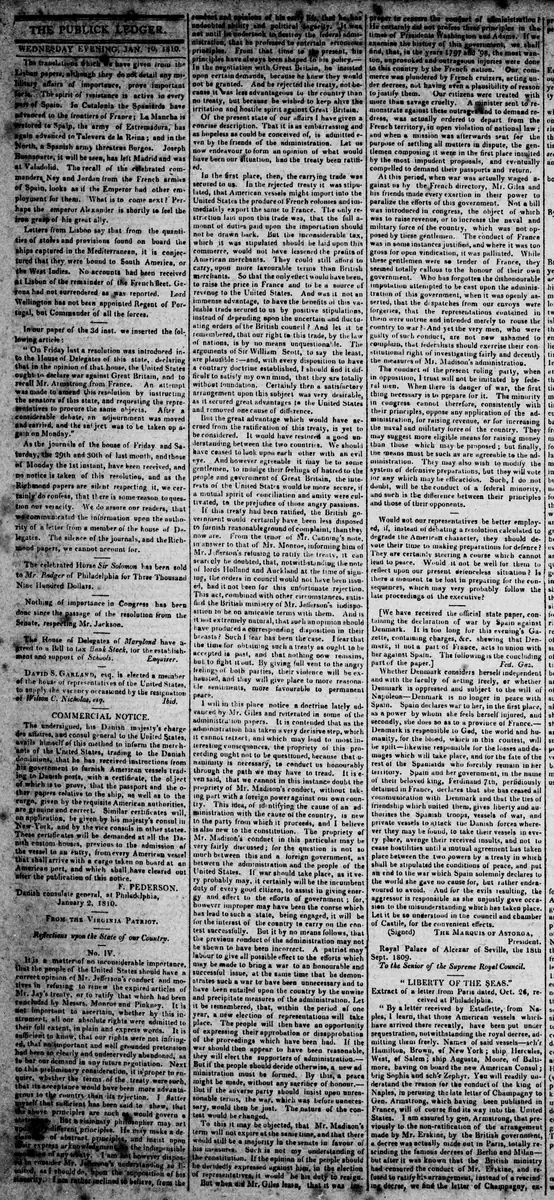
It is a matter of no inconsiderable importance that the people of the United States should have a correct opinion of Mr. Jefferson's conduct and motives in refusing to renew the expired articles of Mr. Jay's treaty, or to ratify that which had been concluded by Messrs. Monroe and Pinkney. It is not important to ascertain, whether by this instrument, all our absolute rights were admitted to their full extent, in plain and express words. It is sufficient to know, that our rights were not infringed, that no important and well grounded pretension had been so clearly and undeservedly abandoned, as to bar our demand in any future negotiation. Next to this preliminary consideration, it is proper to enquire, whether the terms of the treaty were such, that its acceptance would have been more advantageous to the country than its rejection. I flatter myself that sufficient has been said to shew, that by principles are such as would govern a sound and honest statesman. He may act upon different principles. He may make a display of abstract principles, and insist upon express acknowledgment. the indispensable condition of any treaty, I am not however disposed to consider Mr. Jefferson's understanding to limited, as I should do upon the supposition of his being an utter stranger to the acknowledged rules of national law. I am rather inclined to believe, from the preceding and opinions of his early life that he has undoubted ability and political sagacity. It was not until he undertook to destroy the federal administration that he professed to entertain erroneous principles. From that time to present, his principles have always been shaped to his policy. In the negotiation with Great Britain, he insisted upon certain demands, because he knew they would not be granted. And he rejected the treaty, not because it was less advantageous to the country than no treaty, but because he wished to keep alive the irritation and hostile spirit against Great Britain. Of the present state of our affairs I have given a concise description. That it is as embarrassing and as hopeless as could be conceived of, is admitted even by the friends of the administration. Let us now endeavour to form an opinion of what would have been our situation, had the treaty been ratified.
In the first place, then, the carrying trade was secured to us. In the rejected treaty it was stipulated, that American vessels might import into the United States the produce of French colonies and immediately export the same to France. The only restriction laid upon this trade was, that the full amount of duties paid upon the importation should not be drawn back. But the inconsiderable tax, which it was stipulated should be laid upon this commerce, would not have lessened the profits of American merchants. They could still afford to carry, upon more favourable terms than British merchants. So that the only effect would have been, to raise the price in France and to be a source of revenue to the United States. And was it not an immense advantage, to have the benefits of this valuable trade secured to us by positive stipulations, instead of depending upon the uncertain and fluctuating orders of the British council? And let it be remembered, that our right to this trade, by the law of nations, is by no means unquestionable. The arguments of Sir William Scott, to say the least, are plausible:--and, with every disposition to have a contrary doctrine established, I should find it difficult to satisfy my own mind, that they are totally without foundation. Certainly then a satisfactory arrangement upon this subject was very desirable, as it secured great advantages to the United States and removed one cause of difference. But the great advantage which would have accrued from the ratification of this treaty, is yet to be considered. It would have restored a good understanding between the two countries. We should have ceased to look upon each other with an evil eye. And however agreeable it may be to some gentlemen, to indulge their feelings of hatred to the people and government of Great Britain, the interests of the United States would be more secure, if a mutual spirit of conciliation and amity were cultivated, to the prejudice of those angry passions. If this treaty had been ratified, the British government would certainly have been less disposed to furnish reasonable ground of complaint, than they now are. From the tenor of Mr. Canning's note, in answer to that of Mr. Monroe, informing him of Mr. Jefferson's refusing to ratify the treaty, It can scarcely be doubted, that, notwithstanding the note of lords Holland and Auckland at the time of signing, the orders in council would not have been issued, had it not been of this unfortunate rejection. This act, combined with other circumstances, satisfied the British ministry of Mr. Jefferson's indisposition to be on amicable terms with them. And is it not extremely natural, that such an opinion should have produced a corresponding disposition in their breasts? Such I fear has been the case. I fear that the time for obtaining such a treaty as ought to be accepted is past, and that nothing now remains, but to fight it out. By giving full vent to the angry feelings of both parties, their violence will be exhausted, and they will give place to more reasonable sentiments, more favourable to permanent peace.
I will in this place notice a doctrine lately advanced by Mr. Giles and reiterated in some of the administration papers. It is contended that as the administration has taken a very decisive step, which it cannot retract, and which may lead to most interesting consequences, the propriety of this proceeding ought not to be questioned, because that unanimity is necessary, to conduct us honourably through the path we may have to tread. It is even said, that we cannot in this instance doubt the propriety of Mr. Madison's conduct, without taking part with a foreign power against our own country. This idea, of identifying the cause of an administration with the cause of the country, is new to the party from which it proceeds, and I believe is also new to the constitution. The propriety of Mr. Madison's conduct in this particular may be very fairly discussed; or the question is not so much between this and a foreign government, as between the administration and the people of the United States. If war should take place, as it very probably may, it certainly will be the incumbent duty of every good citizen, to assist in giving energy and effect to the efforts of government; or, however improper may have been the course which has lead to such a state, being engaged, it will be for the interest of the country to carry on the contest successfully. But it by no means follows, that the previous conduct of the administration may not be shewn to have been incorrect. A patriot may labour to give all possible effect to the efforts which may be made to bring a war to an honourable and successful issue, at the same time that he demonstrates such a war to have been unnecessary and to have been entailed upon the country by the unwise and precipitate measures of the administration. Let it be remembered, that, within the period of one year, a new election of representatives will take place. The people will then have an opportunity of expressing their approbation or disapprobation of the proceedings which have been had. If the war should then appear to have been reasonable, they will elect the supporters of administration.-- But if the people should decide otherwise, a new administration must be formed. By this, a peace might be made, without any sacrifice of honour.- But if the adverse party should insist upon unreasonable terms, the war, which was before unnecessary, would then be just. The nature of the contest would be changed.
To this it may be objected, that Mr. Madison's term will not expire at the same time, and that there would still be a majority in the senate in favour of his measures. Such is not my understanding of the constitution. If the opinion of the people should be decidedly expressed against him in the election of representatives, it would be his duty to resign. But when did Mr. Giles learn that it was proper to censure the conduct of administration? He certainly did not profess these principles in the times of Presidents Washington and Adams. If we examine the history of this government, we shall find, that, in the years 1797 and 98, the most wanton, unprovoked and outrageous injuries were done to this country by the French nation. Our commerce was plundered by French cruizers, acting under decrees, not having even a plausibility of reason to justify them. Our citizens were treated with more than savage cruelty. A minister sent to remonstrate against these outrages and to demand redress, was actually ordered to depart from the French territory, in open violation of national law; and when a mission was afterwards sent for the purpose of settling all matters in dispute, the gentlemen composing it were in the first place insulted by the most impudent proposals, and eventually compelled to demand their passports and return. At this period, when war was actually waged against us by the French directory, Mr. Giles and his friends made every exertion in their power to paralyze the efforts of this government. Not a bill was introduced in congress, the object of which was to raise revenue, or to increase the naval and military force of the country, which was not opposed by these gentlemen. The conduct of France was in some instances justified, and where it was too gross for open vindication, it was palliated. While these gentlemen were so tender of France, they seemed totally callous to the honour of their own government. Who has forgotten the dishonourable imputation attempted to be cast upon the administration of this government, when it was openly asserted, that the despatches from our envoys were forgeries, that the representations contained in them were untrue and intended merely to rouse the country to war?--And yet the very men, who were guilty of such conduct, are now ashamed to complain, that federalists should exercise their constitutional right of investigating fairly and decently the measures of Mr. Madison's administration. The conduct of the present ruling party, when in opposition, I trust will not be imitated by federal men. When there is danger of war, the first thing necessary is to prepare for it. The minority in congress cannot therefore, consistently with their principles, oppose any application of the administration, for raising revenue, or for increasing the naval and military force of the country. They may suggest more eligible means for raising money than those which may be proposed; but finally, the means must be such as are agreeable to the administration. They may also wish to modify the system of defensive preparations, but they will vote for any which may be efficacious. Such, I do not doubt, will be the conduct of a federal minority, and such is the difference between their principles and those of their opponents.
Would not our representatives be better employed, if, instead of debating a resolution calculated to degrade the American character, they should devote their time to making preparations for defence? They are certainly steering a course which cannot lead to peace. Would it not be well for them to reflect upon our present defenceless situation? Is there a moment to be lost in preparing for the consequences, which may very probably follow the late proceedings of the executive?
What sub-type of article is it?
What keywords are associated?
What entities or persons were involved?
Editorial Details
Primary Topic
Critique Of Jefferson's Rejection Of The Monroe Pinkney Treaty
Stance / Tone
Critical Of Jefferson And Madison's Foreign Policy Towards Britain
Key Figures
Key Arguments