Thank you for visiting SNEWPapers!
Sign up free
Editorial
June 28, 1942
Imperial Valley Press
El Centro, Imperial County, California
What is this article about?
Editorial criticizes Col. Donald Leehey's call for suppressing unfavorable news and criticism, contrasting it with Gen. Douglas MacArthur's policy of openness and earned trust from soldiers during WWII.
Clipping
OCR Quality
98%
Excellent
Full Text
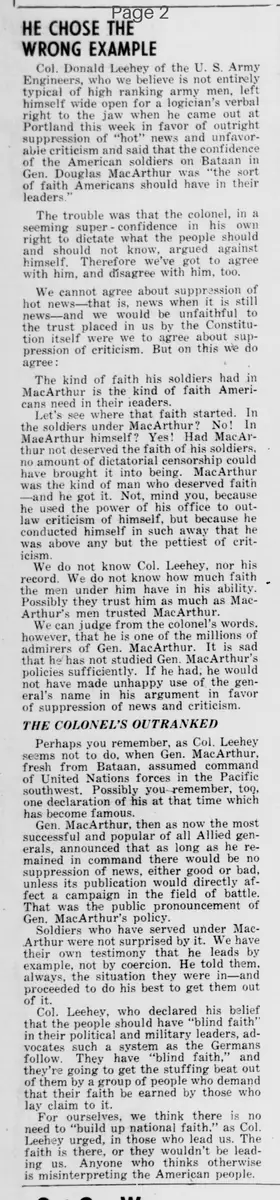
HE CHOSE THE WRONG EXAMPLE
Col. Donald Leehey of the U. S. Army Engineers, who we believe is not entirely typical of high ranking army men, left himself wide open for a logician's verbal right to the jaw when he came out at Portland this week in favor of outright suppression of "hot" news and unfavorable criticism and said that the confidence of the American soldiers on Bataan in Gen. Douglas MacArthur was "the sort of faith Americans should have in their leaders."
The trouble was that the colonel, in a seeming super-confidence in his own right to dictate what the people should and should not know, argued against himself. Therefore we've got to agree with him, and disagree with him, too.
We cannot agree about suppression of hot news—that is, news when it is still news—and we would be unfaithful to the trust placed in us by the Constitution itself were we to agree about suppression of criticism. But on this we do agree:
The kind of faith his soldiers had in MacArthur is the kind of faith Americans need in their leaders.
Let's see where that faith started. In the soldiers under MacArthur? No! In MacArthur himself? Yes! Had MacArthur not deserved the faith of his soldiers, no amount of dictatorial censorship could have brought it into being. MacArthur was the kind of man who deserved faith—and he got it. Not, mind you, because he used the power of his office to outlaw criticism of himself, but because he conducted himself in such a way that he was above any but the pettiest of criticism.
We do not know Col. Leehey, nor his record. We do not know how much faith the men under him have in his ability. Possibly they trust him as much as MacArthur's men trusted MacArthur.
We can judge from the colonel's words, however, that he is one of the millions of admirers of Gen. MacArthur. It is sad that he has not studied Gen. MacArthur's policies sufficiently. If he had, he would not have made unhappy use of the general's name in his argument in favor of suppression of news and criticism.
THE COLONEL'S OUTRANKED
Perhaps you remember, as Col. Leehey seems not to do, when Gen. MacArthur, fresh from Bataan, assumed command of United Nations forces in the Pacific southwest. Possibly you remember, too, one declaration of his at that time which has become famous.
Gen. MacArthur, then as now the most successful and popular of all Allied generals, announced that as long as he remained in command there would be no suppression of news, either good or bad, unless its publication would directly affect a campaign in the field of battle.
That was the public pronouncement of Gen. MacArthur's policy.
Soldiers who have served under MacArthur were not surprised by it. We have their own testimony that he leads by example, not by coercion. He told them, always, the situation they were in—and proceeded to do his best to get them out of it.
Col. Leehey, who declared his belief that the people should have "blind faith" in their political and military leaders, advocates such a system as the Germans follow. They have "blind faith," and they're going to get the stuffing beat out of them by a group of people who demand that their faith be earned by those who lay claim to it.
For ourselves, we think there is no need to "build up national faith," as Col. Leehey urged, in those who lead us. The faith is there, or they wouldn't be leading us. Anyone who thinks otherwise is misinterpreting the American people.
Col. Donald Leehey of the U. S. Army Engineers, who we believe is not entirely typical of high ranking army men, left himself wide open for a logician's verbal right to the jaw when he came out at Portland this week in favor of outright suppression of "hot" news and unfavorable criticism and said that the confidence of the American soldiers on Bataan in Gen. Douglas MacArthur was "the sort of faith Americans should have in their leaders."
The trouble was that the colonel, in a seeming super-confidence in his own right to dictate what the people should and should not know, argued against himself. Therefore we've got to agree with him, and disagree with him, too.
We cannot agree about suppression of hot news—that is, news when it is still news—and we would be unfaithful to the trust placed in us by the Constitution itself were we to agree about suppression of criticism. But on this we do agree:
The kind of faith his soldiers had in MacArthur is the kind of faith Americans need in their leaders.
Let's see where that faith started. In the soldiers under MacArthur? No! In MacArthur himself? Yes! Had MacArthur not deserved the faith of his soldiers, no amount of dictatorial censorship could have brought it into being. MacArthur was the kind of man who deserved faith—and he got it. Not, mind you, because he used the power of his office to outlaw criticism of himself, but because he conducted himself in such a way that he was above any but the pettiest of criticism.
We do not know Col. Leehey, nor his record. We do not know how much faith the men under him have in his ability. Possibly they trust him as much as MacArthur's men trusted MacArthur.
We can judge from the colonel's words, however, that he is one of the millions of admirers of Gen. MacArthur. It is sad that he has not studied Gen. MacArthur's policies sufficiently. If he had, he would not have made unhappy use of the general's name in his argument in favor of suppression of news and criticism.
THE COLONEL'S OUTRANKED
Perhaps you remember, as Col. Leehey seems not to do, when Gen. MacArthur, fresh from Bataan, assumed command of United Nations forces in the Pacific southwest. Possibly you remember, too, one declaration of his at that time which has become famous.
Gen. MacArthur, then as now the most successful and popular of all Allied generals, announced that as long as he remained in command there would be no suppression of news, either good or bad, unless its publication would directly affect a campaign in the field of battle.
That was the public pronouncement of Gen. MacArthur's policy.
Soldiers who have served under MacArthur were not surprised by it. We have their own testimony that he leads by example, not by coercion. He told them, always, the situation they were in—and proceeded to do his best to get them out of it.
Col. Leehey, who declared his belief that the people should have "blind faith" in their political and military leaders, advocates such a system as the Germans follow. They have "blind faith," and they're going to get the stuffing beat out of them by a group of people who demand that their faith be earned by those who lay claim to it.
For ourselves, we think there is no need to "build up national faith," as Col. Leehey urged, in those who lead us. The faith is there, or they wouldn't be leading us. Anyone who thinks otherwise is misinterpreting the American people.
What sub-type of article is it?
Press Freedom
Military Affairs
What keywords are associated?
Censorship
Press Freedom
Military Leadership
Macarthur
Faith In Leaders
News Suppression
What entities or persons were involved?
Col. Donald Leehey
Gen. Douglas Macarthur
American Soldiers
Editorial Details
Primary Topic
Opposition To Suppression Of News And Criticism By Military Officer
Stance / Tone
Strongly Against Censorship And For Earned Faith In Leaders
Key Figures
Col. Donald Leehey
Gen. Douglas Macarthur
American Soldiers
Key Arguments
Suppression Of Hot News And Criticism Violates Constitutional Trust
Faith In Leaders Like Macarthur Is Earned Through Deserving Actions, Not Coercion
Macarthur's Policy Allowed No Suppression Of News Unless It Affected Campaigns
Blind Faith As Advocated By Leehey Resembles German System And Is Misguided
American Faith In Leaders Is Already Present If They Are Truly Leading