Thank you for visiting SNEWPapers!
Sign up free
The Daily Morning Astorian
Astoria, Clatsop County, Oregon
What is this article about?
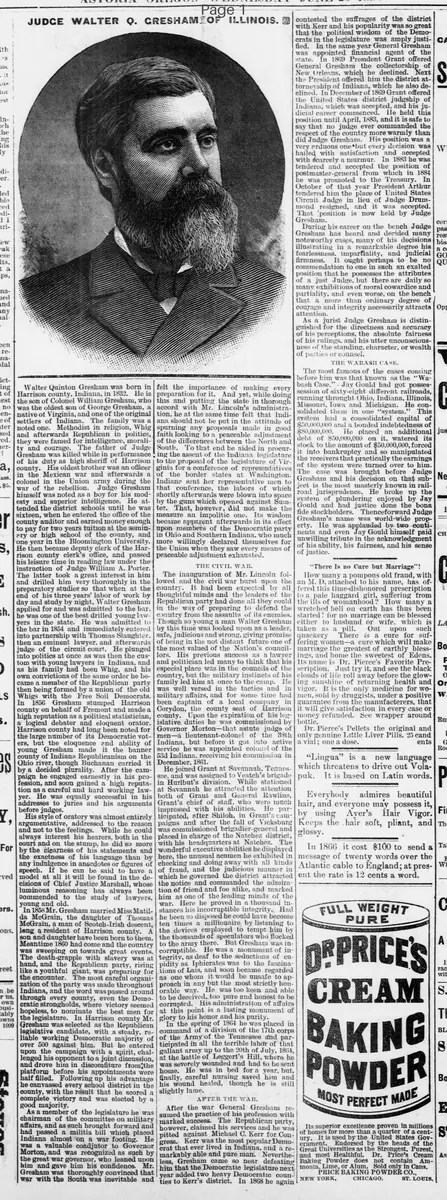
Biographical sketch of Walter Quinton Gresham, born 1832 in Indiana, detailing his family background, education, legal career, Republican politics, Civil War service as colonel and general, post-war judicial roles, and notable decisions like the Wabash Case.
Merged-components note: Merged sequential components with adjacent bboxes and continuous biographical text on Walter Quinton Gresham.
Clipping
OCR Quality
Full Text
In 1856 Gresham stumped Harrison county on behalf of Fremont and made a high reputation as a political statistician, a logical debater and eloquent orator. Harrison county had long been noted for the large number of its Democratic voters, but the eloquence and ability of young Gresham made it the banner county of Indiana Republicanism on the Ohio river, though Buchanan carried it by a decided plurality. After the campaign he engaged earnestly in his profession, and soon gained a high reputation as a careful and hard working lawyer. He was equally successful in his addresses to juries and his arguments before judges.
His style of oratory was almost entirely argumentative, addressed to the reason and not to the feelings. While he could always interest his hearers, both in the court and on the stump, he did so more by the clearness of his statements and the exactness of his language than by any indulgence in anecdotes or figures of speech. If he can be said to have a model at all it will be found in the decisions of Chief Justice Marshall, whose luminous reasoning has always been commended to the study of lawyers, young and old.
In 1858 Mr. Gresham married Miss Matilda McGrain, the daughter of Thomas McGrain, a man of Scotch-Irish descent, long a resident of Harrison county. A son and daughter have been born to them. Meantime 1860 had come and the country was sweeping on towards great events. The death-grapple with slavery was at hand, and the Republican party, rising like a youthful giant, was preparing for the encounter. The most careful organization of the party was made throughout Indiana, and the word was passed around through every county, even the Democratic strongholds, where victory seemed hopeless, to nominate the best men for the legislature. In Harrison county Mr. Gresham was selected as the Republican legislative candidate, with a steady, reliable working Democratic majority of over 500 against him. But he entered upon the campaign with a spirit, challenged his opponent to a joint discussion, and drove him in discomfiture from the platform before his appointments were half filled. Following up his advantage he canvassed every school district in the county, with the result that he scored a complete victory and was elected by a good majority
As a member of the legislature he was chairman of the committee on military affairs, and as such brought forward and had passed a militia bill which placed Indiana almost on a war footing. He was a valuable coadjutor to Governor Morton, and was recognized as such by the great war governor, who leaned upon him and gave him his confidence. Mr. Gresham was thoroughly convinced that war with the South was inevitable and felt the importance of making every preparation for it. And yet, while doing this and putting the state in thorough accord with Mr. Lincoln's administration, he at the same time felt that Indiana should not be put in the attitude of spurning any proposals made in good faith looking to a peaceable adjustment of the differences between the North and South. To that end he aided in procuring the assent of the Indiana legislature to the proposal of the legislature of Virginia for a conference of representatives of the border States at Washington. Indiana sent her representative men to that conference, the labors of which shortly afterwards were blown into space by the guns which opened against Sumter. That, however, did not make the measure an impolitic one. Its wisdom became apparent afterwards in its effect upon members of the Democratic party in Ohio and Southern Indiana, who much more willingly declared themselves for the Union when they saw every means of peaceable adjustment exhausted.
THE CIVIL WAR.
The inauguration of Mr. Lincoln followed and the civil war burst upon the country. It had been expected by all thoughtful minds and the leaders of the Republican party had done all they could in the way of preparing to defend the country from the assaults of its enemies. Though so young a man Walter Gresham by this time was looked upon as a leader, safe, judicious and strong, giving promise of being in the not distant future one of the most valued of the Nation's counsellors. His previous success as a lawyer and politician led many to think that his especial place was in the councils of the country, but the military instincts of his family led him at once to the camp. He was well versed in the tactics and in military affairs, and for some time had been captain of a local company in Corydon, the county seat of Harrison county. Upon the expiration of his legislative duties he was commissioned by Governor Morton-that astute judge of men-a lieutenant-colonel of the 38th Indiana, but before it got into active service he was appointed colonel of the 53d Indiana, receiving his commission in December, 1861.
He joined Grant at Savannah, Tennessee, and was assigned to Veatch's brigade in Hurlbut's division. While stationed at Savannah he attracted the attention both of Grant and General Rawlins, Grant's chief of staff, who were much impressed with his abilities. He participated, after Shiloh, in Grant's campaigns and after the fall of Vicksburg was commissioned brigadier-general and placed in charge of the Natchez district, with his headquarters at Natchez. The wonderful executive abilities he displayed here, the unusual acumen he exhibited in checking and doing away with all kinds of fraud, and the judicious manner in which he governed the district attracted the notice and commanded the admiration of friend and foe alike, and marked him as one of the leading minds of the war. Here he proved in a thousand instances his incorruptible integrity. Had he been so disposed he could have become ten times a millionaire by listening to the devices employed to tempt him by the thousands of speculators who flocked to the army there. But Gresham was incorruptible. He was a monument of integrity, as deaf to the seductions of cupidity as Iphicrates was to the fascinations of Lais, and soon became regarded as one whom it would be unsafe to approach in any but the most strictly honorable way. He was too keen and able to be deceived, too pure and honest to be corrupted. His administration of affairs at this point is a lasting monument of glory to his honor and his purity.
In the spring of 1864 he was placed in command of a division of the 17th corps of the Army of the Tennessee and participated in all the terrible labor of that gallant army up to the 20th of July, 1864, at the battle of Leggert's Hill, where he was severely wounded and had to be sent home. He was in bed for a year, but, finally, careful nursing saved him and his wound healed, though he is still slightly lame.
AFTER THE WAR.
After the war General Gresham resumed the practice of his profession with marked success. The Republican party, however, claimed his services and he was pitted against Michael C. Kerr for Congress. Kerr was the most popular Democrat that ever lived in Indiana, and a remarkably able and pure man. Nevertheless, Gresham came so near defeating him that the Democratic legislature next year added two heavy Democratic counties to Kerr's district. In 1868 he again contested the suffrages of the district with Kerr and his popularity was so great that the political wisdom of the Democrats in the legislature was amply justified. In the same year General Gresham was appointed financial agent of the state. In 1869 President Grant offered General Gresham the collectorship of New Orleans, which he declined. Next the President offered him the district attorneyship of Indiana, which he also declined. In December of 1869 Grant offered the United States district judgeship of Indiana, which was accepted, and his judicial career commenced. He held this position until April, 1883, and it is safe to say that no judge ever commanded the respect of the country more warmly than did Judge Gresham. His position was a very arduous one but every decision was hailed with satisfaction and accepted with scarcely a murmur. In 1883 he was tendered and accepted the position of postmaster-general from which in 1884 he was promoted to the Treasury. In October of that year President Arthur tendered him the place of United States Circuit Judge in lieu of Judge Drummond resigned, and it was accepted. That position is now held by Judge Gresham.
During his career on the bench Judge Gresham has heard and decided many noteworthy cases, many of his decisions illustrating in a remarkable degree his fearlessness, impartiality, and judicial firmness. It ought perhaps to be no commendation to one in such an exalted position that he possesses the attributes of a just Judge, but there are daily so many exhibitions of moral cowardice and partiality, and even worse, on the bench that a more than ordinary degree of courage and integrity necessarily attracts attention.
As a jurist Judge Gresham is distinguished for the directness and accuracy of his perceptions, the absolute fairness of his rulings, and his utter unconsciousness of the standing, character, or wealth of parties or counsel.
THE WABASH CASE.
The most famous of the cases coming before him was that known as the "Wabash Case." Jay Gould had got possession of sixty-eight different railroads, running through Ohio, Indiana, Illinois, Missouri, Iowa and Michigan. He consolidated them in one "system." This system had a consolidated capital of $50,000,000 and a bonded indebtedness of $80,000,000. He placed an additional debt of $50,000,000 on it, watered its stock to the amount of $50,000,000, forced it into bankruptcy and so manipulated the receivers that practically the earnings of the system were turned over to him. The case was brought before Judge Gresham and his decision on that subject is the most masterly known in railroad jurisprudence. He broke up the system of plundering enjoyed by Jay Gould and had justice done the bona fide stockholders. Thenceforward Judge Gresham's name was world-wide property. He was applauded by two continents and even Jay Gould himself paid unwilling tribute in the acknowledgment of his ability, his fairness, and his sense of justice.
What sub-type of article is it?
What themes does it cover?
What keywords are associated?
What entities or persons were involved?
Where did it happen?
Story Details
Key Persons
Location
Harrison County, Indiana
Event Date
1832 1884
Story Details
Walter Gresham rises from modest beginnings in Indiana to become a prominent lawyer, politician, Civil War general, and federal judge, noted for integrity, military service, and landmark decisions like the Wabash Case against railroad fraud.