Thank you for visiting SNEWPapers!
Sign up free
The Daily Phoenix
Columbia, Richland County, South Carolina
What is this article about?
In Columbia, S.C., on Dec. 19, 1874, the House passed a Senate bill on legislative appropriations with reduced expenses and qualified funding. A contentious debate between Rep. Bampfield and Speaker Elliott highlighted concerns over public spending safeguards amid Republican corruption accusations.
Clipping
OCR Quality
Full Text
Sunday Morning, December 20, 1874.
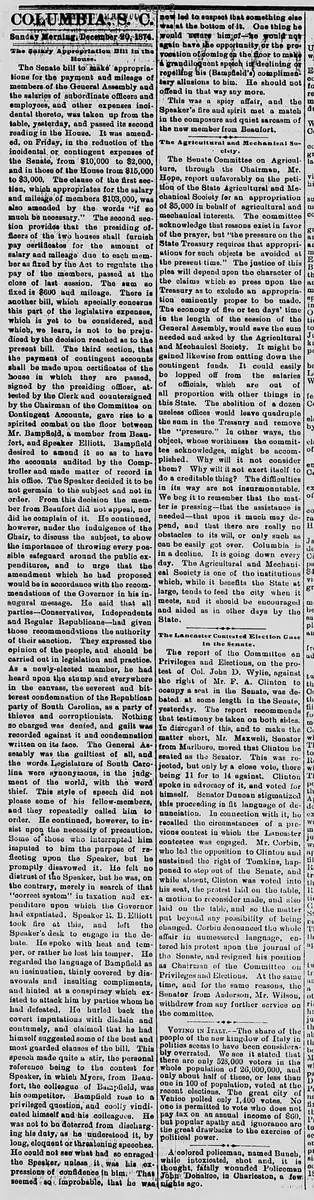
The Senate bill to make appropriations for the payment and mileage of members of the General Assembly and the salaries of subordinate officers and employees, and other expenses incidental thereto, was taken up from the table yesterday, and passed its second reading in the House. It was amended on Friday, in the reduction of the incidental, or contingent expenses of the Senate, from $10,000 to $2,000, and in those of the House from $15,000 to $3,000. The clause of the first section, which appropriates for the salary and mileage of members $103,000, was also amended by the words "if so much be necessary." The second section provides that the presiding officers of the two houses shall furnish pay certificates for the amount of salary and mileage due to each member as fixed by the Act to regulate the pay of the members, passed at the close of last session. The sum so fixed is $600 and mileage. There is another bill, which specially concerns this part of the legislative expenses, which is yet to be considered, and which, we learn, is not to be prejudiced by the decision reached as to the present bill. The third section, that the payment of contingent accounts shall be made upon certificates of the house in which they are passed, signed by the presiding officer, attested by the Clerk and countersigned by the Chairman of the Committee on Contingent Accounts, gave rise to a spirited combat on the floor between Mr. Bampfield, a member from Beaufort, and Speaker Elliott. Bampfield desired to amend it so as to have the accounts audited by the Comptroller and made matter of record in his office. The Speaker decided it to be not germane to the subject and not in order. From this decision the member from Beaufort did not appeal, nor did he complain of it. He continued, however, under the indulgence of the Chair, to discuss the subject, to show the importance of throwing every possible safeguard around the public expenditures, and to urge that the amendment which he had proposed would be in accordance with the recommendations of the Governor in his inaugural message. He said that all parties—Conservatives, Independents and Regular Republicans—had given those recommendations the authority of their sanction. They expressed the opinion of the people, and should be carried out in legislation and practice. As a newly-elected member, he had heard upon the stump and everywhere in the canvass, the severest and bitterest condemnation of the Republican party of South Carolina, as a party of thieves and corruptionists. Nothing so charged was denied, and guilt was recorded against it and condemnation written on its face. The General Assembly was the guiltiest of all, and the words "Legislature of South Carolina" were synonymous, in the judgment of the world, with the word thief. This style of speech did not please some of his fellow-members, and they repeatedly called him to order. He continued, however, to insist upon the necessity of precaution. Some of those who interrupted him imputed to him the purpose of reflecting upon the Speaker, but he promptly disavowed it. He felt no distrust of the Speaker, but he was, on the contrary, merely in search of that "correct system" in taxation and expenditure upon which the Governor had expatiated. Speaker R. B. Elliott took fire at this, and left the Speaker's desk to engage in the debate. He spoke with heat and temper, or rather he lost his temper. He regarded the language of Bampfield as an insinuation, thinly covered by disavowals and insulting compliments, and hinted at a conspiracy which existed to attack him by parties whom he had defeated. He hurled back the covert imputations with disdain and contumely, and claimed that he had himself suggested some of the best and most guarded clauses of the bill. This speech made quite a stir, the personal reference being to the contest for Speaker, in which Myers, from Beaufort, the colleague of Bampfield, was his competitor. Bampfield rose to a privileged question, and coolly vindicated himself and his colleagues. He was not to be deterred from discharging his duty, as he understood it, by long, eloquent or threatening speeches. He could not see what had so enraged the Speaker; unless it was his expressions of confidence in him: "That seemed quite improbable, that he was"
no more led to suspect that something else was at the bottom of it. One thing he would assure him of—he would not again have the opportunity or the provocation of coming on the floor to make a grandiloquent speech in declining a (Bampfield's) complimentary allusions to him. He should not offend in that way any more.
This was a spicy affair, and the Speaker's fire and spirit met a match in the composure and quiet sarcasm of the new member from Beaufort.
What sub-type of article is it?
What keywords are associated?
What entities or persons were involved?
Where did it happen?
Domestic News Details
Primary Location
Columbia, S.C.
Event Date
December 19, 1874
Key Persons
Outcome
the senate bill passed its second reading in the house with amendments reducing contingent expenses and adding 'if so much be necessary' to the appropriation clause. a heated debate occurred between mr. bampfield and speaker elliott over an amendment proposal, but the bill proceeded.
Event Details
The House took up and passed the second reading of a Senate bill for appropriations to pay members of the General Assembly, their mileage, salaries of officers and employees, and incidental expenses. Amendments reduced Senate contingent expenses from $10,000 to $2,000 and House from $15,000 to $3,000. The salary and mileage appropriation of $103,000 was qualified with 'if so much be necessary.' Provisions included pay certificates by presiding officers based on prior act ($600 and mileage). A debate arose over the third section on contingent accounts, where Mr. Bampfield proposed auditing by the Comptroller, ruled out of order by Speaker Elliott. Bampfield discussed safeguards for expenditures, referencing Governor's recommendations and criticisms of the Republican party. Speaker Elliott responded heatedly, perceiving insinuations, leading to personal exchanges involving the prior Speaker contest with Myers.