Thank you for visiting SNEWPapers!
Sign up free
Editorial
July 8, 1857
New York Daily Tribune
New York, New York County, New York
What is this article about?
Editorial defends President Buchanan's expected support for Gov. Walker's Kansas policies, emphasizing popular sovereignty on slavery and need for direct vote on constitution amid disputes. Criticizes Southern Democratic opposition as hasty, arguing Walker's views align with natural laws and party principles.
Clipping
OCR Quality
92%
Excellent
Full Text
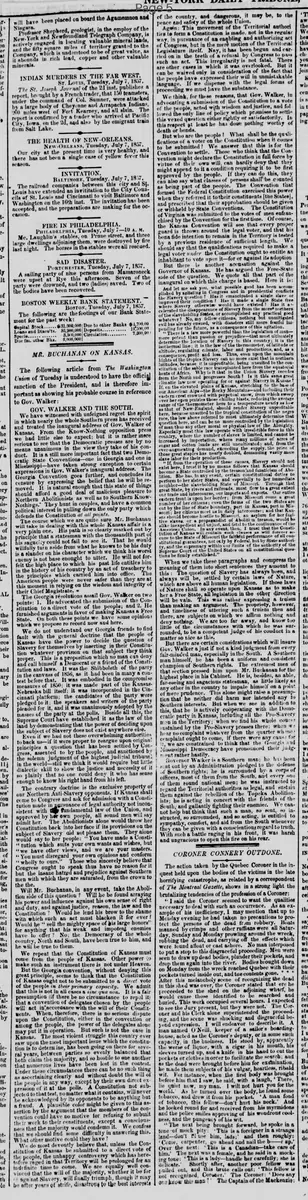
MR. BUCHANAN ON KANSAS.
GOV. WALKER AND THE SOUTH.
The following article from The Washington Union of Tuesday is understood to have the official sanction of the President, and is therefore important as showing his probable course in reference to Gov. Walker:
We have witnessed with unfeigned regret the spirit in which nearly the whole Southern press has received and treated the inaugural address of Gov. Walker of Kansas. From the Know-Nothing opposition press we had little else to expect; but it is rather serious to see that the Democratic presses are by no means unanimous in the view they take of his conduct. It is a still more important fact that two Democratic State Conventions-one in Georgia and one in Mississippi-have taken strong exception to certain expressions in Gov. Walker's inaugural address. The Georgia Convention goes further, and concludes its censure by expressing the belief that he will be removed. It is natural enough that this state of things should afford a good deal of malicious pleasure to Northern Abolitionists as well as to Southern Know-Nothings. They hunt in couples, and have a common political interest in pulling down the only party which defends the Constitution at all points.
The course which we are quite sure Mr. Buchanan will take in dealing with this whole Kansas affair is a very plain one. His path is so clearly marked out by principle that a statesman with the thousandth part of his sagacity could not fail to see it. That he would willfully turn aside from what he knows to be his duty is a slander on his character which we think his worst enemy is not base enough to utter. He will not forfeit the high place to which his past life entitles him in the history of his country by an act of treachery to the principles which carried him into office. The American people were never safer than they are at this moment in relying on the wisdom and integrity of their Chief Magistrate.
The Georgia resolutions assail Gov. Walker on two points: 1. He advocated the submission of the Constitution to a direct vote of the people; and 2. He furnished arguments in favor of making Kansas a Free State. On both these points we have some opinions which we propose to record now and here.
We do not understand our Georgia friends to find fault with the general doctrine that the people of Kansas have the power to decide the question of Slavery for themselves by inserting in their Constitution whatever provision on that subject they think proper. This is a proposition which no man can deny and call himself a Democrat or a friend of the Constitution and laws. It was the Shibboleth of the party in the canvass of 1856, as it had been in many a contest before that. It was embodied in the compromise measures of 1850; it was made part of the Kansas-Nebraska bill itself; it was incorporated in the Cincinnati platform; the candidates of the party were pledged to it; the speakers and writers of the party pleaded for it, and it was unanimously adopted by the masses of the party at the polls. Beside all this, the Supreme Court have established it as the law of the land by demonstrating that the power of deciding upon the subject of Slavery does not exist anywhere else.
Even if we had not these overwhelming authorities to back us-if it were proper to reargue upon original principles a question that has been settled by Congress, assented to by the people, and sanctioned by the solemn judgment of the highest judicial tribunal in the world-still we think it would require but little dialectic skill to show the justice and necessity of it so plainly that no one could deny it who has sense enough to know his right hand from his left.
The contrary doctrine is the exclusive property of our Northern Anti-Slavery opponents. If Kansas shall come to Congress and ask for admission with a Constitution made in pursuance of legal authority not inconsistent with the fundamental law of the Union, and approved by her own people, all sound men will say admit her. The Abolitionists alone would throw her Constitution back into her face if its provisions on the subject of Slavery did not please them. They alone would say to her people: "You have made a Constitution which suits your own wants and wishes, but we have other views, and we are your masters. You must disregard your own opinions and conform wholly to ours."
Those who sincerely believe that Congress ought to speak thus have no reason for it but the insane hatred and prejudice against Southern men with which they are saturated, from the crown to the sole.
Will Mr. Buchanan, in any event, take the Abolition side of this question? Will he be found arraying his power and influence against his own sense of right and duty, and against justice, reason, the law and the Constitution? Would he lend his brow to the shame with which such an act must blacken it for ever? Would he "sell the mighty space of his large honors for anything that his weak and impotent enemies have to offer?" No; the Democracy of the whole country, North and South, have been true to him, and he will be true to them.
We repeat that the Constitution of Kansas must come from the people of Kansas. Other power to make such an instrument there is not under Heaven.
But the Georgia convention, without denying this great principle, seems to think that the Constitution of Kansas ought not to be submitted to a direct vote of the people in their primary capacity. We admit that this is not in all cases a sine qua non. It is a fair presumption (if there be no circumstance to repel it) that a convention of delegates chosen by the people will act in accordance with the will of their Constituents. When, therefore, there is no serious dispute upon the Constitution either in the convention or among the people, the power of the delegates alone may put it in operation. But such is not the case in Kansas.
For several years, between parties so evenly balanced that both claim the majority, and so hostile to one another that numerous lives have been lost in the contest, the most important issue which the constitution has to determine has been going on there. Under these circumstances there can be no such thing as ascertaining clearly and without doubt the will of the people in any way, except by their own direct expression of it at the polls. A Constitution not subjected to that test, no matter what it contains, will never be acknowledged by its opponents to be anything but a fraud. A plausible color might be given to this assertion by the argument that the members of the convention could have no motive for refusing to submit their work to their constituents, except a consciousness that the majority would condemn it. We confess that we should find some difficulty in answering this. What other motive could they have?
We do most devoutly believe that, unless the Constitution of Kansas be submitted to a direct vote of the people, the unhappy controversy which has heretofore raged in that Territory will be prolonged for an indefinite time to come. We are equally well convinced that the will of the majority, whether it be for or against Slavery, will finally triumph, though it may be after years of strife, disastrous to the best interests of the country, and dangerous, it may be, to the peace and safety of the whole Union.
Again: This movement of the Territorial authorities to form a Constitution is made, not in the regular way, in pursuance of an enabling and authorizing act of Congress, but in the mere motion of the Territorial Legislature itself. Nay, it has been begun and carried on in the teeth of a refusal by Congress to pass such an act. This irregularity is not fatal. There are other cases in which it was overlooked. But it can be waived only in consideration of the fact that the people have expressed their will in unmistakable language. If we dispense with the legal forms of proceeding we must have the substance.
We think, for these reasons, that Gov. Walker, in advocating a submission of the Constitution to a vote of the people, acted with wisdom and justice, and followed the only line of policy which promises to settle this vexed question either rightly or satisfactorily. In this respect at least he has done nothing worthy of death or bonds.
But who are the people? What shall be the qualifications of a voter on the Constitution when it comes to be submitted? We answer that this is for the Convention to settle. Those who think that the Convention might declare the Constitution in full force by virtue of their own will, can hardly deny that they might append to it a condition requiring it to be first approved by the people. If they can do this, they can also say what classes of persons shall be counted as being part of the people. The Convention that formed the Federal Constitution exercised this power and prescribed that their approbation should be given or withheld by State Conventions. The Constitution of Virginia was submitted to the votes of men enfranchised by the Convention for the first time. Of course, the Kansas Convention will see that every proper guard is thrown around the legal voter, and that his bona fide intention to remain in the Territory is tested by a previous residence of sufficient length. We should say that the qualifications required to make a legal voter under the Constitution ought to entitle an inhabitant to vote upon it-for or against its adoption on either side of the question. We quote all that part of the inaugural on which this charge is based. Here it is:
But there is another accusation against the Governor of Kansas. He has argued the Free-State side of the Slavery question in his inaugural. Here it is:
"And let me ask you, what possible good has been accomplished by agitating in Congress and in presidential conflicts the Slavery question? Has it improved their condition? Has it made a single State free where Slavery otherwise would have existed! Has it accelerated the disappearance of Slavery from the more northern of the slaveholding States, or accomplished any practical good whatever? No, my fellow-citizens, nothing but unmitigated evil has already ensued, with disasters still more pending for the future, as a consequence of this agitation.
"There is a law more powerful than the legislation of man-more potent than passion or prejudice-that must ultimately determine the location of Slavery in this country; it is the isothermal line; it is the law of the thermometer, of latitude or altitude, regulating climate, labor and productions, and, as a consequence, profit and loss. Thus, even upon the mountain heights of the tropics Slavery can no more exist than in northern latitudes, because it is unprofitable, being unsuited to the constitution of the sable race transplanted here from the equatorial heats of Africa. Why is it that in the Union Slavery recedes from the North and progresses South? Is it this same great climatic law now operating for or against Slavery in Kansas?
If, on the elevated plains of Kansas, stretching to the base of our American Alps-the Rocky Mountains-and including their eastern crest crowned with perpetual snow, from which sweep over her open prairies those chilling blasts reducing the average range of the thermometer here to a temperature nearly as low as that of New-England, should render Slavery unprofitable here, because unsuited to the tropical constitution of the negro race, the law above referred to must ultimately determine that question here, and can be no more controlled by the legislation of man than any other moral or physical law of the Almighty.
Especially must this law operate with irresistible force in this country, where the number of slaves is limited, and cannot be increased by importation, where many millions of acres of sugar and cotton lands are still uncultivated: and, from the ever-augmenting demand, exceeding the supply, the price of those great staples has nearly doubled, demanding vastly more slave labor for their production.
"If, from the operation of these causes, Slavery should not exist here, I trust it by no means follows that Kansas should become a State controlled by the treason and fanaticism of Abolition. She has, in any event, certain constitutional duties to perform to her sister States, and especially to her immediate neighbor-the slaveholding State of Missouri. Through that State flow our great rivers, railroads, must flow our trade and intercourse, our imports and exports. Our entire eastern front is upon her border; from Missouri come a great number of her citizens; even the farms of the two States are cut by the line of State boundary, part in Kansas, part in Missouri; her citizens meet us in daily intercourse; and that Kansas should become hostile to Missouri, an asylum for her fugitive slaves, or a propagandist of Abolition treason, would be alike inexpedient and unjust, and fatal to the continuance of the American Union. In any event, then, I trust that the Constitution of Kansas will contain such clauses as will secure to the State of Missouri the faithful performance of all constitutional guarantees, not only by Federal, but by State authority. Let the Supreme Court of the United States on all constitutional questions be firmly established."
When we take these paragraphs and compress the meaning of them into short sentences they amount to this: The question of Slavery has always been, and always will be, settled by certain laws of Nature, which are above all human legislation. If those laws of Nature shall so operate upon Kansas as to make her a Free State, all legislation in the other direction will be vain. This was rather expressing a truism than making an argument. The propriety, however, and timeliness of uttering such a truism then and there, are subjects on which we affirm nothing and deny nothing. We are too far away, and know too little of the circumstances with which he was surrounded, to be a competent judge of his conduct in a matter so nice as this.
But there are certain considerations which will insure Gov. Walker a just if not a kind judgment from every fair-minded man, especially in the South. A Southern man himself, he has been a uniform and consistent champion of Southern rights. The extremest men of that section pressed him upon Mr. Buchanan for the highest place in his Cabinet. He is, besides, an able, far-seeing and sagacious statesman, as little likely as any other in the country to impale himself on a point of mere prudence. This alone might raise a presumption that he neither did harm nor intended any to Southern interests. But when we see in addition to this, that he is actively co-operating with the Democratic party in Kansas, including all the Pro-Slavery men in the Territory; when we find his whole course sustained by the Pro-Slavery presses there: when we hear no complaint whatever from the quarter where complaint ought to come, if there were any cause for it, we are constrained to think that the Georgia and Mississippi Democracy have pronounced their judgment rather hastily.
Governor Walker is a Southern man: he has been sent out by an Administration pledged to the defense of Southern rights; he is surrounded by a corps of officers, most of them from the South, and every one of them sound national men; he was instructed to regard the Territorial authorities as legal, and sustain them against the rebellion of the Topeka Abolitionists; he is acting in concert with the friends of the South; and gallantly fighting their enemies. We cannot help but think that such a man, so sent, so instructed, so surrounded, and so acting, is entitled to sympathy, comfort, and aid from the South whenever they can be given with a conscientious regard to truth.
With such a battle raging in his front, it was harsh and ungracious to open this fire on his rear.
GOV. WALKER AND THE SOUTH.
The following article from The Washington Union of Tuesday is understood to have the official sanction of the President, and is therefore important as showing his probable course in reference to Gov. Walker:
We have witnessed with unfeigned regret the spirit in which nearly the whole Southern press has received and treated the inaugural address of Gov. Walker of Kansas. From the Know-Nothing opposition press we had little else to expect; but it is rather serious to see that the Democratic presses are by no means unanimous in the view they take of his conduct. It is a still more important fact that two Democratic State Conventions-one in Georgia and one in Mississippi-have taken strong exception to certain expressions in Gov. Walker's inaugural address. The Georgia Convention goes further, and concludes its censure by expressing the belief that he will be removed. It is natural enough that this state of things should afford a good deal of malicious pleasure to Northern Abolitionists as well as to Southern Know-Nothings. They hunt in couples, and have a common political interest in pulling down the only party which defends the Constitution at all points.
The course which we are quite sure Mr. Buchanan will take in dealing with this whole Kansas affair is a very plain one. His path is so clearly marked out by principle that a statesman with the thousandth part of his sagacity could not fail to see it. That he would willfully turn aside from what he knows to be his duty is a slander on his character which we think his worst enemy is not base enough to utter. He will not forfeit the high place to which his past life entitles him in the history of his country by an act of treachery to the principles which carried him into office. The American people were never safer than they are at this moment in relying on the wisdom and integrity of their Chief Magistrate.
The Georgia resolutions assail Gov. Walker on two points: 1. He advocated the submission of the Constitution to a direct vote of the people; and 2. He furnished arguments in favor of making Kansas a Free State. On both these points we have some opinions which we propose to record now and here.
We do not understand our Georgia friends to find fault with the general doctrine that the people of Kansas have the power to decide the question of Slavery for themselves by inserting in their Constitution whatever provision on that subject they think proper. This is a proposition which no man can deny and call himself a Democrat or a friend of the Constitution and laws. It was the Shibboleth of the party in the canvass of 1856, as it had been in many a contest before that. It was embodied in the compromise measures of 1850; it was made part of the Kansas-Nebraska bill itself; it was incorporated in the Cincinnati platform; the candidates of the party were pledged to it; the speakers and writers of the party pleaded for it, and it was unanimously adopted by the masses of the party at the polls. Beside all this, the Supreme Court have established it as the law of the land by demonstrating that the power of deciding upon the subject of Slavery does not exist anywhere else.
Even if we had not these overwhelming authorities to back us-if it were proper to reargue upon original principles a question that has been settled by Congress, assented to by the people, and sanctioned by the solemn judgment of the highest judicial tribunal in the world-still we think it would require but little dialectic skill to show the justice and necessity of it so plainly that no one could deny it who has sense enough to know his right hand from his left.
The contrary doctrine is the exclusive property of our Northern Anti-Slavery opponents. If Kansas shall come to Congress and ask for admission with a Constitution made in pursuance of legal authority not inconsistent with the fundamental law of the Union, and approved by her own people, all sound men will say admit her. The Abolitionists alone would throw her Constitution back into her face if its provisions on the subject of Slavery did not please them. They alone would say to her people: "You have made a Constitution which suits your own wants and wishes, but we have other views, and we are your masters. You must disregard your own opinions and conform wholly to ours."
Those who sincerely believe that Congress ought to speak thus have no reason for it but the insane hatred and prejudice against Southern men with which they are saturated, from the crown to the sole.
Will Mr. Buchanan, in any event, take the Abolition side of this question? Will he be found arraying his power and influence against his own sense of right and duty, and against justice, reason, the law and the Constitution? Would he lend his brow to the shame with which such an act must blacken it for ever? Would he "sell the mighty space of his large honors for anything that his weak and impotent enemies have to offer?" No; the Democracy of the whole country, North and South, have been true to him, and he will be true to them.
We repeat that the Constitution of Kansas must come from the people of Kansas. Other power to make such an instrument there is not under Heaven.
But the Georgia convention, without denying this great principle, seems to think that the Constitution of Kansas ought not to be submitted to a direct vote of the people in their primary capacity. We admit that this is not in all cases a sine qua non. It is a fair presumption (if there be no circumstance to repel it) that a convention of delegates chosen by the people will act in accordance with the will of their Constituents. When, therefore, there is no serious dispute upon the Constitution either in the convention or among the people, the power of the delegates alone may put it in operation. But such is not the case in Kansas.
For several years, between parties so evenly balanced that both claim the majority, and so hostile to one another that numerous lives have been lost in the contest, the most important issue which the constitution has to determine has been going on there. Under these circumstances there can be no such thing as ascertaining clearly and without doubt the will of the people in any way, except by their own direct expression of it at the polls. A Constitution not subjected to that test, no matter what it contains, will never be acknowledged by its opponents to be anything but a fraud. A plausible color might be given to this assertion by the argument that the members of the convention could have no motive for refusing to submit their work to their constituents, except a consciousness that the majority would condemn it. We confess that we should find some difficulty in answering this. What other motive could they have?
We do most devoutly believe that, unless the Constitution of Kansas be submitted to a direct vote of the people, the unhappy controversy which has heretofore raged in that Territory will be prolonged for an indefinite time to come. We are equally well convinced that the will of the majority, whether it be for or against Slavery, will finally triumph, though it may be after years of strife, disastrous to the best interests of the country, and dangerous, it may be, to the peace and safety of the whole Union.
Again: This movement of the Territorial authorities to form a Constitution is made, not in the regular way, in pursuance of an enabling and authorizing act of Congress, but in the mere motion of the Territorial Legislature itself. Nay, it has been begun and carried on in the teeth of a refusal by Congress to pass such an act. This irregularity is not fatal. There are other cases in which it was overlooked. But it can be waived only in consideration of the fact that the people have expressed their will in unmistakable language. If we dispense with the legal forms of proceeding we must have the substance.
We think, for these reasons, that Gov. Walker, in advocating a submission of the Constitution to a vote of the people, acted with wisdom and justice, and followed the only line of policy which promises to settle this vexed question either rightly or satisfactorily. In this respect at least he has done nothing worthy of death or bonds.
But who are the people? What shall be the qualifications of a voter on the Constitution when it comes to be submitted? We answer that this is for the Convention to settle. Those who think that the Convention might declare the Constitution in full force by virtue of their own will, can hardly deny that they might append to it a condition requiring it to be first approved by the people. If they can do this, they can also say what classes of persons shall be counted as being part of the people. The Convention that formed the Federal Constitution exercised this power and prescribed that their approbation should be given or withheld by State Conventions. The Constitution of Virginia was submitted to the votes of men enfranchised by the Convention for the first time. Of course, the Kansas Convention will see that every proper guard is thrown around the legal voter, and that his bona fide intention to remain in the Territory is tested by a previous residence of sufficient length. We should say that the qualifications required to make a legal voter under the Constitution ought to entitle an inhabitant to vote upon it-for or against its adoption on either side of the question. We quote all that part of the inaugural on which this charge is based. Here it is:
But there is another accusation against the Governor of Kansas. He has argued the Free-State side of the Slavery question in his inaugural. Here it is:
"And let me ask you, what possible good has been accomplished by agitating in Congress and in presidential conflicts the Slavery question? Has it improved their condition? Has it made a single State free where Slavery otherwise would have existed! Has it accelerated the disappearance of Slavery from the more northern of the slaveholding States, or accomplished any practical good whatever? No, my fellow-citizens, nothing but unmitigated evil has already ensued, with disasters still more pending for the future, as a consequence of this agitation.
"There is a law more powerful than the legislation of man-more potent than passion or prejudice-that must ultimately determine the location of Slavery in this country; it is the isothermal line; it is the law of the thermometer, of latitude or altitude, regulating climate, labor and productions, and, as a consequence, profit and loss. Thus, even upon the mountain heights of the tropics Slavery can no more exist than in northern latitudes, because it is unprofitable, being unsuited to the constitution of the sable race transplanted here from the equatorial heats of Africa. Why is it that in the Union Slavery recedes from the North and progresses South? Is it this same great climatic law now operating for or against Slavery in Kansas?
If, on the elevated plains of Kansas, stretching to the base of our American Alps-the Rocky Mountains-and including their eastern crest crowned with perpetual snow, from which sweep over her open prairies those chilling blasts reducing the average range of the thermometer here to a temperature nearly as low as that of New-England, should render Slavery unprofitable here, because unsuited to the tropical constitution of the negro race, the law above referred to must ultimately determine that question here, and can be no more controlled by the legislation of man than any other moral or physical law of the Almighty.
Especially must this law operate with irresistible force in this country, where the number of slaves is limited, and cannot be increased by importation, where many millions of acres of sugar and cotton lands are still uncultivated: and, from the ever-augmenting demand, exceeding the supply, the price of those great staples has nearly doubled, demanding vastly more slave labor for their production.
"If, from the operation of these causes, Slavery should not exist here, I trust it by no means follows that Kansas should become a State controlled by the treason and fanaticism of Abolition. She has, in any event, certain constitutional duties to perform to her sister States, and especially to her immediate neighbor-the slaveholding State of Missouri. Through that State flow our great rivers, railroads, must flow our trade and intercourse, our imports and exports. Our entire eastern front is upon her border; from Missouri come a great number of her citizens; even the farms of the two States are cut by the line of State boundary, part in Kansas, part in Missouri; her citizens meet us in daily intercourse; and that Kansas should become hostile to Missouri, an asylum for her fugitive slaves, or a propagandist of Abolition treason, would be alike inexpedient and unjust, and fatal to the continuance of the American Union. In any event, then, I trust that the Constitution of Kansas will contain such clauses as will secure to the State of Missouri the faithful performance of all constitutional guarantees, not only by Federal, but by State authority. Let the Supreme Court of the United States on all constitutional questions be firmly established."
When we take these paragraphs and compress the meaning of them into short sentences they amount to this: The question of Slavery has always been, and always will be, settled by certain laws of Nature, which are above all human legislation. If those laws of Nature shall so operate upon Kansas as to make her a Free State, all legislation in the other direction will be vain. This was rather expressing a truism than making an argument. The propriety, however, and timeliness of uttering such a truism then and there, are subjects on which we affirm nothing and deny nothing. We are too far away, and know too little of the circumstances with which he was surrounded, to be a competent judge of his conduct in a matter so nice as this.
But there are certain considerations which will insure Gov. Walker a just if not a kind judgment from every fair-minded man, especially in the South. A Southern man himself, he has been a uniform and consistent champion of Southern rights. The extremest men of that section pressed him upon Mr. Buchanan for the highest place in his Cabinet. He is, besides, an able, far-seeing and sagacious statesman, as little likely as any other in the country to impale himself on a point of mere prudence. This alone might raise a presumption that he neither did harm nor intended any to Southern interests. But when we see in addition to this, that he is actively co-operating with the Democratic party in Kansas, including all the Pro-Slavery men in the Territory; when we find his whole course sustained by the Pro-Slavery presses there: when we hear no complaint whatever from the quarter where complaint ought to come, if there were any cause for it, we are constrained to think that the Georgia and Mississippi Democracy have pronounced their judgment rather hastily.
Governor Walker is a Southern man: he has been sent out by an Administration pledged to the defense of Southern rights; he is surrounded by a corps of officers, most of them from the South, and every one of them sound national men; he was instructed to regard the Territorial authorities as legal, and sustain them against the rebellion of the Topeka Abolitionists; he is acting in concert with the friends of the South; and gallantly fighting their enemies. We cannot help but think that such a man, so sent, so instructed, so surrounded, and so acting, is entitled to sympathy, comfort, and aid from the South whenever they can be given with a conscientious regard to truth.
With such a battle raging in his front, it was harsh and ungracious to open this fire on his rear.
What sub-type of article is it?
Slavery Abolition
Partisan Politics
Constitutional
What keywords are associated?
Kansas Constitution
Popular Sovereignty
Slavery Question
Buchanan Policy
Gov Walker
Democratic Party
Southern Rights
Territorial Legislature
What entities or persons were involved?
Mr. Buchanan
Gov. Walker
Georgia Convention
Mississippi Convention
Democratic Party
Abolitionists
Know Nothings
Supreme Court
Editorial Details
Primary Topic
Defense Of Gov. Walker And Popular Sovereignty In Kansas
Stance / Tone
Supportive Of Buchanan And Walker Against Southern Democratic Criticisms
Key Figures
Mr. Buchanan
Gov. Walker
Georgia Convention
Mississippi Convention
Democratic Party
Abolitionists
Know Nothings
Supreme Court
Key Arguments
The People Of Kansas Have The Power To Decide Slavery In Their Constitution, As Established By Party Platforms, Compromises, And Supreme Court.
Submission Of Kansas Constitution To Direct Popular Vote Is Necessary Due To Balanced Parties And Violent Disputes.
Gov. Walker's Advocacy For Popular Vote Is Wise And Just To Settle The Controversy.
Walker's Arguments On Slavery Are Truisms Based On Natural Climatic Laws, Not Pro Free State Advocacy.
Buchanan Will Uphold Democratic Principles And Support Walker, Avoiding Abolitionist Positions.
Southern Democrats' Hasty Judgments Overlook Walker's Pro Southern Credentials And Actions.