Thank you for visiting SNEWPapers!
Sign up free
Daily National Intelligencer
Washington, District Of Columbia
What is this article about?
An 1820s article analyzes competing infrastructure projects like Virginia's James River-Kanawha Canal, Potomac Canal, and turnpikes in Philadelphia and Baltimore, calculating transport costs and times to the Ohio River. It critiques New York's Erie Canal ambitions for western trade monopoly and proposes cooperative investments for efficient commerce.
Merged-components note: The table at reading_order 46 is embedded within the bounding box of the main story at 45 and provides cost estimates referenced in the text, indicating it is part of the same logical article on canals and transportation.
Clipping
OCR Quality
Full Text
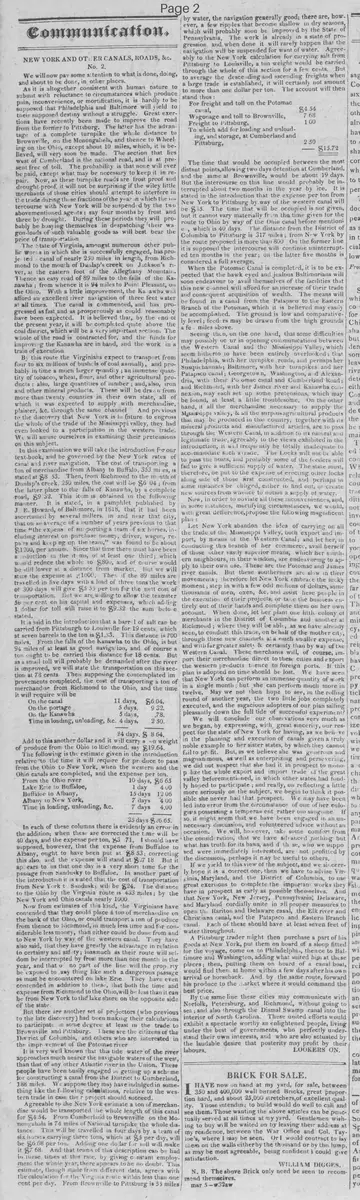
NEW YORK AND OTHER CANALS, ROADS, &C.
No. 2.
We will now pay some attention to what is done, doing, and about to be done, in other places. As it is altogether consistent with human nature to pain, inconvenience, or mortification, it is hardly to be supposed that Philadelphia and Baltimore will yield to their supposed destiny without a struggle. Great exertions have recently been made to improve the road from the former to Pittsburg. The latter has the advantage of a complete turnpike the whole distance to Brownsville, on the Monongahela, and thence to Wheeling on the Ohio, except about 10 miles, which, it is believed, will very soon be made. The section that lies west of Cumberland is the national road, and is at present free of toll. The probability is that none will ever be paid, except what may be necessary to keep it in repair. Now, as these turnpike roads are frost proof and drought-proof, it will not be surprising if the wily little merchants of those cities should attempt to interfere in the trade during those fractions of the year in which the intercourse with New York will be suspended by the two abovementioned agents; say four months by frost and three by drought. During these periods they will probably be busying themselves in despatching their wagon-loads of such valuable goods as will best bear the price of transportation.
The State of Virginia, amongst numerous other public works in which she is successfully engaged, has projected a canal of nearly 250 miles in length, from Richmond to the mouth of Dunlap's creek on Jackson's river, at the eastern foot of the Alleghany Mountain. Thence an easy road of 89 miles to the falls of the Kanawha; from whence it is 94 miles to Point Pleasant, on the Ohio. With a little improvement, the Kanawha will afford an excellent river navigation of three feet water at all times. The canal is commenced, and has progressed as fast and as prosperously as could reasonably have been expected. It is believed that, by the end of the present year, it will be completed quite above the coal district, which will be a very important section. The whole of the road is contracted for, and the funds for improving the Kanawha are in hand, and the work in a train of execution.
By this route the Virginians expect to transport from four to six millions of bushels of coal annually, and probably in time a much larger quantity; an immense quantity of tobacco, wheat, flour, and other agricultural products: also, large quantities of lumber; and, also, iron and other mineral products. These will be drawn from more than twenty counties in their own state, all of which it was expected to supply with merchandise, plaster, &c. through the same channel. And previous to the discovery that New York is in future to engross the whole of the trade of the Mississippi valley, they had even looked to a participation in the western trade.
We will amuse ourselves in examining their pretensions on this subject.
In this examination we will take the introduction for our text-book, and be governed by the New York rates of canal and river navigation. The cost of transporting a ton of merchandise from Albany to Buffalo, 353 miles, is stated at $8.53. Then, from Richmond to the mouth of Dunlap's creek, 250 miles, the cost will be $6.04; from the latter place to the falls of Kanawha, by a complete road, $8.32. This item is obtained in the following manner. It is stated, in a pamphlet published by J. E. Howard, of Baltimore, in 1818, that it had been ascertained by several millers in and near that city, that on an average of a number of years previous to that time "the expense of supporting a team of six horses, including interest on purchase money, driver, wagon, repairs and keeping up the team," was found to be about $1200, per annum. Since that time there must have been reduction in the items, of at least one third; which would reduce the whole to $800, and of course would be still lower at a distance from market. But we will state the expense at $1000. Then if the 89 miles are travelled in five days with a load of three tons the work of 300 days will give $5.55 per ton for the nett cost of transportation. But we are willing to allow the teamster 50 per cent on his capital and expenses, which adding 1 dollar for toll will raise it to $9.32 the sum before stated.
It is said in the introduction that a barrel of salt can be carried from Pittsburgh to Louisville for 19 cents, which at seven barrels to the ton is $1.33. This distance is 700 miles. From the falls of the Kanawha to the Ohio, is but 94 miles of at least as good navigation, and of course a ton ought to be carried this distance for 18 cents. But as a small toll will probably be demanded after the river is improved, we will state the transportation on this section at 78 cents. Then supposing the contemplated improvements completed, the cost of transporting a ton of merchandise from Richmond to the Ohio, and the time it will require will be 24 days. $8.64.
Add to this another dollar and it will carry a ton weight of produce from the Ohio to Richmond, say $9.64.
The following is the estimate given in the introduction relative to the time it will require for produce to pass from the Ohio to New York, when the western and the Ohio canals are completed, and the expense per ton.
From the Ohio river 10 days, $6.65
Lake Erie to Buffalo. 1 day 4.00
Buffalo to Albany, 15 days 12.06
Albany to New York, 7 days 4.00
Time in loading, unloading, &c. 7 days 4.00
35 days $26.65.
In each of these columns there is evidently an error in the addition; when these are corrected the time will be 40 days, and the expense per ton, $26.71. I should have supposed, however, that the expense from Buffalo to Albany, ought to have been put at $8.53; correcting this also, and the expense will stand at $23.18. But it appears to us that one day is a very short time for the passage from Sandusky to Buffalo. In another part of the introduction it is stated that the cost of transportation from New York to Sandusky will be $24. The distance to the Ohio by the Virginia route is 433 miles; by the New York and Ohio canals nearly 1000.
Now from estimates of this kind, the Virginians have contended that they could place a ton of merchandise on the bank of the Ohio, or could transport a ton of produce from thence to Richmond, in much less time and for considerably less money, than either could be done from and to New York by way of the western canal. They have also said, that they have greatly the advantage in relation to certainty and safety; inasmuch as their route will seldom be interrupted by frost more than one month in the year, and that on no part of the line will the property be exposed to any thing like such a dangerous passage as must be encountered on lake Erie. They have even contended in addition to these, that both the time and expense from Richmond to the Ohio, will be less than it can be from New York to the lake shore on the opposite side of the state.
But there are another set of projectors (who previous to the late discovery) had been making their calculations to participate in some degree at least in the trade to Brownsville and Pittsburg. These are the citizens of the District of Columbia, and others who are interested in the improvement of the Potomac river.
It is very well known that this tide water of the river approaches much nearer the navigable waters of the west, than that of any other Atlantic river in the Union. These people have been busily engaged in getting up a scheme for constructing a canal from the District to Cumberland, 188 miles. We suppose they may have indulged in something like the following calculations, relative to the western trade in case their project should succeed.
Agreeable to the New York estimate a ton of merchandise would be transported the whole length of this canal for $4.54. From Cumberland to Brownsville on the Monongahela is 74 miles of National turnpike the whole distance. This will be travelled in four days by a team of six horses carrying three tons, which at $5 per day, will be $6.68 per ton. Adding one dollar for toll will make it $7.68. And that teams of this description can be had in these times at this rate, by giving constant employment the whole year, there appears to be no doubt. This estimate, though made from different data, agrees with the calculation for the Virginia route within less than one cent per day. From Brownsville to Pittsburg is 55 miles by water, the navigation generally good; there are, however, a few ripples that become shallow in dry seasons, which will probably soon be improved by the State of Pennsylvania. The work is already in a state of progression, and when done it will rarely happen that the navigation will be suspended for want of water. Agreeably to the New York calculation for carrying salt from Pittsburgh to Louisville, a ton weight would be carried through the whole of this section for a few cents. But to average the descending and ascending freights when a large trade is established, it will certainly not amount to more than one dollar per ton. The account will then stand thus:
For freight and toll on the Potomac canal, $4.54
Wagonage and toll to Brownsville, 7.68
Freight to Pittsburg, 1.00
To which add for loading and unloading, and storage, at Cumberland and Pittsburg 2.50
$15.72
The time that would be occupied between the most distant points, allowing two days detention at Cumberland, and the same at Brownsville, would be about 19 days.
But the intercourse on this line would probably be interrupted about two months in the year by ice. It is stated in the introduction that the expense per ton from New York to Pittsburg by way of the western canal will be $35. The time that will be occupied is not given, but it cannot vary materially from the time given for the route to Ohio by way of the Ohio canal before mentioned, which is 40 days. The distance from the District of Columbia to Pittsburgh is 317 miles: from New York by the route proposed is more than 800. On the former line it is supposed the intercourse will continue uninterrupted ten months in the year; on the latter five months is considered a full average.
When the Potomac Canal is completed, it is to be expected that the hawk-eyed and jealous Baltimoreans will soon endeavour to avail themselves of the facilities that this new channel will afford for an increase of their trade and consequent acquisition of wealth. The means will be found in a canal from the Patapsco to the Eastern Branch of the Potomac, which it is believed may easily be accomplished. The ground is low and comparatively level; feeders may be drawn from the high grounds a few miles above.
Seeing then, on the one hand, that some difficulties may possibly occur in opening communications between the Western Canal and the Mississippi Valley, which seem hitherto to have been entirely overlooked; that Philadelphia, with her turnpike roads, and perhaps her Susquehanna; Baltimore, with her turnpikes and her Patapsco canal; Georgetown, Washington, and Alexandria, with their Potomac canal and Cumberland Road; and Richmond, with her James river and Kanawha connexion, may each set up some pretensions, which may be found, at least a little troublesome. On the other hand, if all the merchandise necessary to supply the Mississippi valley, & all the surplus agricultural products that may be produced in that country, together with its mineral products and manufactured articles, are to pass through the Western Canal, in addition to its natural and legitimate trade, agreeably to the views exhibited in the introduction, it will frequently be totally inadequate to accommodate such a trade. The Locks will not be able to pass the boats, and probably some of the feeders will fail to give a sufficient supply of water. The state must, therefore, be put to the expense of erecting other locks along side of those first constructed, and perhaps in some instances be obliged, either to find out, or create new sources from whence to obtain a supply of water.
Now, in order to obviate all these inconveniences, and, in some instances, mortifying circumstances, we would, with great deference, propose the following magnificent plan:
Let New York abandon the idea of carrying on all the trade of the Mississippi Valley, both export and import, by means of the Western Canal; and let her, in conducting this branch of her commerce, avail herself of those other vastly superior means, which her southern neighbours, in their wisdom, are endeavoring to apply to their own use. These are the Potomac and James river canals. But these southerners are slow in their movements; therefore let New York embrace the lucky moment; step in with a few odd millions of dollars, some thousands of men, oxen, &c. and assist these people in the execution of their projects; or take the business entirely out of their hands and complete them on her own account. When done, let her plant one little colony of merchants in the District of Columbia and another at Richmond; where they will be able, as we have already seen, to conduct this trade, on behalf of the mother city, through these new channels at a much smaller expense, and with far greater safety & certainty than by way of the Western Canal. These merchants will, of course, import their merchandise direct to these cities and export the western products thence to foreign ports. If this plan is adopted no time should be lost. We have seen that New York can perform an immense quantity of work in a single month; but she can perform much more in twelve. May we not then hope to see, in the rolling round of another year, the two little jobs completely executed, and the sagacious adopters of our plan sailing pleasantly down the full tide of successful experiment?
We will conclude our observations very much as we began, by expressing, with great sincerity, our respect for the state of New York for having, as we believe, in the planning and execution of canals given a truly noble example to her sister states, by which they cannot fail to profit. But, as we believe she was generous and magnanimous, as well as enterprising and persevering, we did not suspect that she had it in prospect to monopolize the whole export and import trade of the great valley beforementioned, in which other states had fondly hoped to participate; and really, on reflecting a little more seriously on the subject, we begin to think it possible she never had that prospect. We may have been led into error from the circumstance of one of her eulogists possessing a temperament rather too sanguine. If so, it might seem that we have been engaged in an unnecessary discussion, and volunteered advice without an occasion. We will, however, take some comfort from the consideration, that we have advanced nothing but what has truth for its basis, and if those, who we supposed were immediately interested, are not profitted by the discussion, perhaps it may be useful to others.
If we yield to this view of the subject, and we sincerely hope it is a correct one, then we have to advise Virginia, Maryland, and the District of Columbia, to use great exertions to complete the important works they have in prospect as early as possible themselves. And that New York, New Jersey, Pennsylvania, Delaware, and Maryland cordially unite in all proper measures to open the Raritan and Delaware canal, the Elk river and Christiana canal, and the Patapsco and Eastern Branch canal. Each of these should have at least seven feet of water throughout.
A Pittsburgh trader might then purchase a part of his goods at New York, put them on board of a sloop fitted for the voyage, come on to Philadelphia, thence to Baltimore and Washington, adding what suited him at these places; then, putting them on board of a canal boat, would find them at home within a few days after his own arrival on horseback. And by the same route, forward his produce to the market where it would command the best price.
By the same line these cities may communicate with Norfolk, Petersburg, and Richmond, without going to sea; and also through the Dismal Swamp canal into the interior of North Carolina. These united efforts would exhibit a spectacle worthy an enlightened people, living under the best of governments, who perfectly understand their own interests, and who are also actuated by the laudable desire that posterity may profit by their labours.
LOOKERS ON.
| On the canal | 11 days, | $604. |
| On the portage | 5 days, | 932. |
| On the Kanawha | 5 days, | .78. |
| Time in loading, unloading, &c. 4 days, | 250. |
What sub-type of article is it?
What themes does it cover?
What keywords are associated?
Where did it happen?
Story Details
Location
Eastern United States (New York, Virginia, Maryland, Pennsylvania, Ohio River Valley)
Event Date
Circa 1820 (References 1818 Pamphlet, Ongoing Projects)
Story Details
The article examines ongoing and proposed canal and road projects in Virginia, Maryland, and Pennsylvania aimed at accessing western trade via the Ohio River, comparing costs and times to New York's Erie Canal route, and suggests cooperative development to avoid monopolies and ensure efficient commerce.