Thank you for visiting SNEWPapers!
Sign up free
Story
March 15, 1834
The Liberator
Boston, Suffolk County, Massachusetts
What is this article about?
Critique of a poorly attended meeting of the Massachusetts Colonization Society at Park-Street Church in Boston, clashing with an Anti-Slavery Society event; highlights low turnout, failed invitations, and denunciations of abolitionists by clergymen like Malcom, Blagden, and Green.
Clipping
OCR Quality
95%
Excellent
Full Text
MEETING AT PARK-STREET CHURCH.
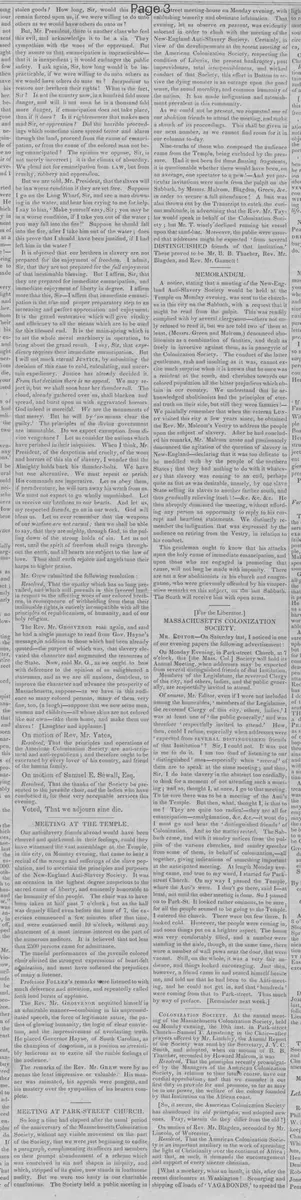
So long a time had elapsed after the usual period of the anniversary of the Massachusetts Colonization Society, without any visible movement on the part of the Society, that we were just beginning to endite a paragraph, complimenting its officers and members on their prompt abandonment of a scheme which was conceived in sin and shapen in iniquity, and which, stripped of its guise, now stands in loathsome nudity. But we were too hasty in our charitable conclusions. The Society held a public meeting in unblushing temerity and obstinate infatuation. That evening, let us observe en passant, was evidently selected in order to clash with the meeting of the New-England Anti-Slavery Society. Certainly, in view of the developments at the recent meeting of the American Colonization Society, respecting the condition of Liberia, the present bankruptcy, past improvidence, total irresponsibility, and wicked conduct of that Society, this effort in Boston to revive the dying monster is an outrage upon the good sense, the sound morality and common humanity of the nation. It has made indignation and astonishment prevalent in this community.
As we could not be present, we requested one of our abolition friends to attend the meeting, and make a sketch of its proceedings. This shall be given in our next number, as we cannot find room for it in our columns to-day. Nine-tenths of those who composed the audience came from the Temple, being excluded by the pressure. Had it not been for these floating fragments, it is questionable whether there would have been, on an average, one spectator to a pew!—And yet particular invitations were made from the pulpit on the Sabbath, by Messrs. Malcom, Blagden, Green, &c. in order to secure a full attendance! A bait was also thrown out by the Transcript to catch the curious multitude, in advertising that the Rev. Mr. Taylor would speak in behalf of the Colonization Society; but Mr. T. wisely declined running his vessel upon that sand-bar. Moreover, the public were assured that addresses might be expected 'from several DISTINGUISHED friends of that institution.' These proved to be Mr. B. B. Thacher, Rev. Mr. Blagden, and Rev. Mr. Gannett!
MEMORANDUM. A notice, stating that a meeting of the New-England Anti-Slavery Society would be held at the Temple on Monday evening, was sent to the churches in this city on the Sabbath, with a request that it might be read from the pulpit. This was readily complied with by several clergymen—others not only refused to read it, but we are told two of them at least, (Messrs. Green and Malcom,) denounced abolitionists as a combination of fanatics, and dealt as freely in invective against them, as in panegyric of the Colonization Society. The conduct of the latter gentleman, rash and insulting as it was, cannot excite much surprise when it is known that he once was a resident at the south, and cherishes towards our colored population all the bitter prejudices which obtain in our country. We understand that he acknowledged abolitionists had the principles of eternal truth on their side, but still they were fanatics!— We painfully remember that when the veteran Lundy visited this city a few years since, he obtained the Rev. Mr. Malcom's Vestry to address the people upon the subject of slavery. After he had concluded his remarks, Mr. Malcom arose and passionately denounced the agitation of the question of slavery in New-England—declaring that it was too delicate to be meddled with by the people of the northern States; that they had nothing to do with it whatever; that slavery was coming to an end, perhaps quite as fast as was desirable, namely, by one slave State selling its slaves to another farther south, and thus gradually relieving itself!—&c. &c. &c. He then abruptly dismissed the meeting, without affording any person an opportunity to reply to his corrupt and heartless statements. We distinctly remember the indignation that was expressed by the audience on retiring from the Vestry, in relation to his conduct. This gentleman ought to know that his attacks upon the holy cause of immediate emancipation, and upon those who are engaged in promoting that cause, will not long be made with impunity. There are not a few abolitionists in his church and congregation, who were grievously offended by his vituperative remarks on this subject, on the last Sabbath. The South will receive him with open arms.
So long a time had elapsed after the usual period of the anniversary of the Massachusetts Colonization Society, without any visible movement on the part of the Society, that we were just beginning to endite a paragraph, complimenting its officers and members on their prompt abandonment of a scheme which was conceived in sin and shapen in iniquity, and which, stripped of its guise, now stands in loathsome nudity. But we were too hasty in our charitable conclusions. The Society held a public meeting in unblushing temerity and obstinate infatuation. That evening, let us observe en passant, was evidently selected in order to clash with the meeting of the New-England Anti-Slavery Society. Certainly, in view of the developments at the recent meeting of the American Colonization Society, respecting the condition of Liberia, the present bankruptcy, past improvidence, total irresponsibility, and wicked conduct of that Society, this effort in Boston to revive the dying monster is an outrage upon the good sense, the sound morality and common humanity of the nation. It has made indignation and astonishment prevalent in this community.
As we could not be present, we requested one of our abolition friends to attend the meeting, and make a sketch of its proceedings. This shall be given in our next number, as we cannot find room for it in our columns to-day. Nine-tenths of those who composed the audience came from the Temple, being excluded by the pressure. Had it not been for these floating fragments, it is questionable whether there would have been, on an average, one spectator to a pew!—And yet particular invitations were made from the pulpit on the Sabbath, by Messrs. Malcom, Blagden, Green, &c. in order to secure a full attendance! A bait was also thrown out by the Transcript to catch the curious multitude, in advertising that the Rev. Mr. Taylor would speak in behalf of the Colonization Society; but Mr. T. wisely declined running his vessel upon that sand-bar. Moreover, the public were assured that addresses might be expected 'from several DISTINGUISHED friends of that institution.' These proved to be Mr. B. B. Thacher, Rev. Mr. Blagden, and Rev. Mr. Gannett!
MEMORANDUM. A notice, stating that a meeting of the New-England Anti-Slavery Society would be held at the Temple on Monday evening, was sent to the churches in this city on the Sabbath, with a request that it might be read from the pulpit. This was readily complied with by several clergymen—others not only refused to read it, but we are told two of them at least, (Messrs. Green and Malcom,) denounced abolitionists as a combination of fanatics, and dealt as freely in invective against them, as in panegyric of the Colonization Society. The conduct of the latter gentleman, rash and insulting as it was, cannot excite much surprise when it is known that he once was a resident at the south, and cherishes towards our colored population all the bitter prejudices which obtain in our country. We understand that he acknowledged abolitionists had the principles of eternal truth on their side, but still they were fanatics!— We painfully remember that when the veteran Lundy visited this city a few years since, he obtained the Rev. Mr. Malcom's Vestry to address the people upon the subject of slavery. After he had concluded his remarks, Mr. Malcom arose and passionately denounced the agitation of the question of slavery in New-England—declaring that it was too delicate to be meddled with by the people of the northern States; that they had nothing to do with it whatever; that slavery was coming to an end, perhaps quite as fast as was desirable, namely, by one slave State selling its slaves to another farther south, and thus gradually relieving itself!—&c. &c. &c. He then abruptly dismissed the meeting, without affording any person an opportunity to reply to his corrupt and heartless statements. We distinctly remember the indignation that was expressed by the audience on retiring from the Vestry, in relation to his conduct. This gentleman ought to know that his attacks upon the holy cause of immediate emancipation, and upon those who are engaged in promoting that cause, will not long be made with impunity. There are not a few abolitionists in his church and congregation, who were grievously offended by his vituperative remarks on this subject, on the last Sabbath. The South will receive him with open arms.
What sub-type of article is it?
Historical Event
What themes does it cover?
Moral Virtue
Justice
Social Manners
What keywords are associated?
Colonization Society
Anti Slavery
Public Meeting
Clergymen Denunciation
Liberia Criticism
Abolitionists
Boston Churches
What entities or persons were involved?
Malcom
Blagden
Green
B. B. Thacher
Gannett
Taylor
Lundy
Where did it happen?
Park Street Church, Boston
Story Details
Key Persons
Malcom
Blagden
Green
B. B. Thacher
Gannett
Taylor
Lundy
Location
Park Street Church, Boston
Story Details
The Massachusetts Colonization Society held a meeting at Park-Street Church despite criticisms of its failures; low attendance mostly from Anti-Slavery overflow; clergymen promoted it but denounced abolitionists; Rev. Malcom's past hostility to anti-slavery agitation recalled.