Thank you for visiting SNEWPapers!
Sign up free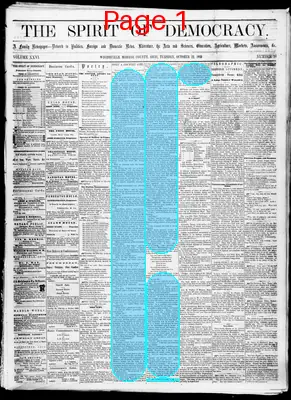
Literary
October 12, 1869
The Spirit Of Democracy
Woodsfield, Monroe County, Ohio
What is this article about?
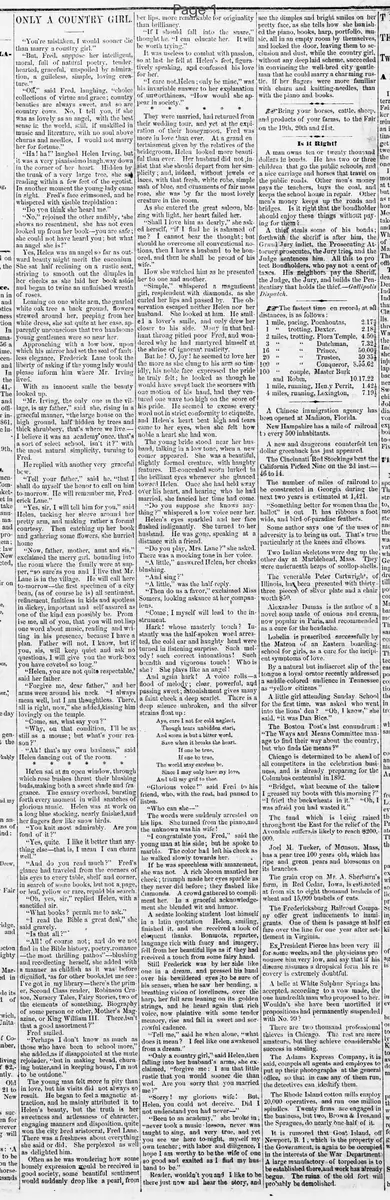
A city gentleman, Frederick Lane, initially dismisses marrying uneducated country girls but falls in love with Helen Irving, who pretends ignorance of music and literature to test his sincerity. After marriage, she reveals her self-taught talents, winning his admiration.
Clipping
OCR Quality
95%
Excellent
Full Text
"You're mistaken, I would sooner die than marry a country girl."
"But, Fred, suppose her intelligent, moral, full of natural poetry, tender hearted, graceful, unspoiled by admiration, a guileless, simple, loving creature."
"Oh," said Fred, laughing, "choice collections of virtue and grace; country beauties are always sweet, and so are country cows. No, I tell you, if she was as lovely as an angel, with the best sense in the world, still, if unskilled in music and literature, with no soul above churns and needles, I would not marry her for fortune."
"Ha! ha!" laughed Helen Irving, but it was a very pianissimo laugh, way down in the corner of her heart. Hidden by the trunk of a very large tree, she sat reading within a few feet of the egotist. In another moment the young lady came in sight. Fred's face crimsoned, and he whispered with visible trepidation:
"Do you think she heard me."
"No," rejoined the other audibly, "she shows no resentment. she has not even looked up from her book-you are safe: she could not have heard you; but what an angel she is!"
Yes, Helen was an angel so far as outward beauty might merit the enconium She sat half reclining on a rustic seat, striving to smooth out the dimples in her cheeks as she laid her book aside and began to twine an unfinished wreath of roses.
Leaning on one white arm, the gnarled white oak tree a background, flowers strewed around her, peeping from her white dress, she sat quite at her ease, apparently unconscious that two handsome young gentlemen were so near her.
Approaching with a low bow, upon which his mirror had set the seal of faultless elegance, Frederick Lane took the liberty of asking if the young lady would please inform him where Mr. Irving lived.
With an innocent smile the beauty looked up.
"Mr. Irving, the only one in the village, is my father," said she, rising in a graceful manner, "the large house on the high ground, half hidden by trees and thick shrubbery, that's where we live. I believe it was an academy once, that's a sort of select school, isn't it?" with the most natural simplicity, turning to Fred.
He replied with another very graceful bow.
"Tell your father," said he, "that I shall do myself the honor to call on him to-morrow. He will remember me, Frederick Lane."
"Yes, sir, I will tell him for you," said Helen, tucking her sleeve around her pretty arm, and making rather a formal courtesy. Then catching up her book and gathering some flowers, she hurried home
"Now, father, mother, aunt and sis," exclaimed the merry girl, bounding into the room where the family were at supper, "so sure as you and I live that Mr. Lane is in the village. He will call here to-morrow-the first specimen of a city beau, (as of course he is) all sentiment refinement, faultless in kids and spotless in dickey, important and self-assured as one of the kind can possibly be. Promise me, all of you, that you will not lisp one word about music, reading and writing in his presence, because I have a plan. Father will not, I know, but if you, sis, will keep quiet and ask no questions, I will give you the work-box you have coveted so long"
"Helen, you are not quite respectable," said her father.
"Forgive me, dear father," and her arms were around his neck. "I always mean well, but I am thoughtless. There all is right, now," she added, kissing him lovingly on the temple.
"Come, sis, what say you?"
"Why, on that condition, I'll be as still as a mouse; but what's your reason?"
"Ah! that's my own business," said Helen dancing out of the room.
Helen sat at an open window, through which rose bushes thrust their blushing buds, making both a sweet shade and fragrance. The canary overhead, bursting forth every moment in wild snatches of glorious music. Helen was at work on a long blue stocking, nearly finished, and her fingers flew like snow birds.
"You knit most admirably. Are you fond of it?"
"Yes, quite. I like it better than anything else-that is, I mean I can churn well."
"And do you read much?" Fred's glance had traveled from the corners of his eyes to every table, shelf and corner in search of some books, but not a page, or leaf, yellow or rare, repaid his search.
"Oh, yes, sir," replied Helen, with a sanctified air.
"What books? permit me to ask."
"I read the Bible a great deal," she said gravely.
"Is that all?"
"All! of course not; and do we not find in the Bible history, poetry, romance -the most thrilling pathos"--blushing and recollecting herself, she added with a manner as childish as it was before dignified. as for other books, let me see: I've got in my library-there's the primer, Second Class reader, Robinson Crusoe, Nursery Tales, Fairy Stories, two of the elements of something, Biography of some person or other, Mother's Magazine, or King William III. There, isn't that a good assortment?"
Fred smiled.
"Perhaps I don't know as much as those who have been to school more," she added, as if disappointed at the mute rejoinder, "but in making bread, churning butter, and in keeping house, I'm not to be outdone."
The young man felt more in pity than in love, but his visits did not always so result. He began to feel a magnetic attraction, and he mainly attributed it to Helen's beauty, but the truth is her sweetness and artlessness of character, engaging manners and disposition, quite won the city bred aristocrat, Fred Lane.
There was a freshness about everything she said or did. She perplexed as well as delighted him.
Often as he was wondering how some homely expression would be received in good society, some beautiful sentiment would suddenly drop like a pearl, from her lips, more remarkable for originality than brilliancy.
"If I should fall into the snare," thought he. "I can educate her. It will be worth trying."
It was useless to combat with passion, so at last he fell at Helen's feet, figuratively speaking, and confessed his love for her.
"I care not, Helen; only be mine," was his invariable answer to her explanation of unworthiness, "How would she appear in society."
They were married, had returned from their wedding tour, and yet at the expiration of their honeymoon, Fred was more in love than ever. At a grand entertainment given by the relatives of the bridegroom, Helen looked more beautiful than ever. Her husband did not insist that she should depart from her simplicity; and, indeed, without jewels or laces, with that fresh, white robe, simple sash of blue, and ornaments of fair moss rose, she was by far the most lovely creature in the room.
As she entered the great salon, blazing with light, her heart failed her.
"Shall I love him as dearly," she asked herself, "if I find he is ashamed of me? I cannot bear the thought; but should he overcome all conventional notions, then I have a husband to be honored, and then he shall be proud of his wife."
How she watched him as he presented her to one and another.
"Simple," whispered a magnificent girl, resplendent with diamonds, as she curled her lips and passed by. The observation escaped neither Helen nor her husband. She looked at him. He smiled a lover's smile, and only drew her closer to his side. Many in that brilliant throng pitied poor Fred, and wondered why he had martyred himself at the shrine of ignorant rusticity.
But he! O, joy! he seemed to love her the more as she clung to his arm so timidly, his noble face expressed the pride he truly felt; he looked as though he would have swept back the scorners with one motion of his hand, had they ventured one word too high on the score of his pride. He seemed to excuse every word not in strict conformity to etiquette, and Helen's heart beat high and tears came to her eyes, when she felt how noble a heart she had won.
The young bride stood near her husband, talking in a low tone, when a new comer appeared. She was a beautiful, slightly formed creature, with haughty features. Ill-concealed scorn lurked in the brilliant eyes whenever she glanced toward Helen. Once she had held sway over his heart, and hearing who he had married, she fancied her time had come.
"Do you suppose she knows anything?" whispered a low voice near her.
Helen's eyes sparkled and her face flushed indignantly. She turned to her husband. He was gone, speaking at a distance with a friend
"Do you play, Mrs. Lane?" she asked
There was a mocking tone in her voice.
"A little," answered Helen, her cheeks blushing.
"And sing"
"A little," was the half-reply
"Then do us a favor," exclaimed Miss Somers, looking askance at her companions.
"Come; I myself will lead to the instrument."
Hark! whose masterly touch? Instantly was the half-spoken word arrested, the cold ear and haughty head were turned in listening surprise. Such melody! such correct intonations! Such breadth and vigorous touch! Who is she? She plays like an angel!
And again hark! A voice rolls-a flood of melody; clear, powerful, and passing sweet; astonishment gives many a faint cheek a deep scarlet. There is a deep silence unbroken, and the silver strains float up:
"Glorious voice!" said Fred to his friend, who, with the rest, had paused to listen.
"Who can she--"
The words were suddenly arrested on his lips. She turned from the piano, and the unknown was his wife!
"I congratulate you, Fred," said the young man at his side; but he spoke to marble. The color had left his cheek as he walked slowly towards her.
If he was speechless with amazement, she was not. A rich bloom mantled her cheek; triumph made her eyes sparkle as they never did before; they flashed like diamonds. A crowd gathered to compliment her. In a graceful acknowledgement she blended wit and humor.
A sedate looking student lost himself in a latin quotation Helen, smiling, finished it, and she received a look of eloquent thanks. Bonmots, repartee, language rich with fancy and imagery, fell from her beautiful lips as if they had received a touch from some fairy hand.
Still Frederick was by her side like one in a dream, and pressed his hand over his bewildered eyes to be sure of his senses, when he saw her bending, a breathing vision of loveliness, over the harp, her full arm leaning on its golden strings, and he heard again that rich voice, now plaintive with some tender memory, rise and fall in sweet and sorrowful cadence.
"Tell me," said he when alone, "what does it mean? I feel like one awakened from a dream."
"Only a country girl," said Helen, then falling into her husband's arms, she exclaimed, "forgive me; I am that little rustic that you would sooner die than wed. Are you sorry that you married me?"
"Sorry! my glorious wife!
But, Helen, you could not deceive. Did I not understand you had never-"
"Been to an academy," she broke in; never took a music lesson, never was taught to sing, and very true, and yet you see me here to-night, myself my own teacher; with labor and diligence, I hope I am worthy to be the wife of one so good and exalted as I find my husband to be."
Reader, wouldn't you and I like to be there just now and hear the story, and see the dimples and bright smiles on her pretty face, as she tells how she banished the piano, books, harp, portfolio, music, all in an empty room by themselves, and locked the door, leaving them to seclusion and dust, while the country girl, without any deep laid scheme, succeeded in convincing the well-bred city gentleman that he could marry a charming rustic, if her fingers were more familiar with churn and knitting-needles, than with the piano and books.
"But, Fred, suppose her intelligent, moral, full of natural poetry, tender hearted, graceful, unspoiled by admiration, a guileless, simple, loving creature."
"Oh," said Fred, laughing, "choice collections of virtue and grace; country beauties are always sweet, and so are country cows. No, I tell you, if she was as lovely as an angel, with the best sense in the world, still, if unskilled in music and literature, with no soul above churns and needles, I would not marry her for fortune."
"Ha! ha!" laughed Helen Irving, but it was a very pianissimo laugh, way down in the corner of her heart. Hidden by the trunk of a very large tree, she sat reading within a few feet of the egotist. In another moment the young lady came in sight. Fred's face crimsoned, and he whispered with visible trepidation:
"Do you think she heard me."
"No," rejoined the other audibly, "she shows no resentment. she has not even looked up from her book-you are safe: she could not have heard you; but what an angel she is!"
Yes, Helen was an angel so far as outward beauty might merit the enconium She sat half reclining on a rustic seat, striving to smooth out the dimples in her cheeks as she laid her book aside and began to twine an unfinished wreath of roses.
Leaning on one white arm, the gnarled white oak tree a background, flowers strewed around her, peeping from her white dress, she sat quite at her ease, apparently unconscious that two handsome young gentlemen were so near her.
Approaching with a low bow, upon which his mirror had set the seal of faultless elegance, Frederick Lane took the liberty of asking if the young lady would please inform him where Mr. Irving lived.
With an innocent smile the beauty looked up.
"Mr. Irving, the only one in the village, is my father," said she, rising in a graceful manner, "the large house on the high ground, half hidden by trees and thick shrubbery, that's where we live. I believe it was an academy once, that's a sort of select school, isn't it?" with the most natural simplicity, turning to Fred.
He replied with another very graceful bow.
"Tell your father," said he, "that I shall do myself the honor to call on him to-morrow. He will remember me, Frederick Lane."
"Yes, sir, I will tell him for you," said Helen, tucking her sleeve around her pretty arm, and making rather a formal courtesy. Then catching up her book and gathering some flowers, she hurried home
"Now, father, mother, aunt and sis," exclaimed the merry girl, bounding into the room where the family were at supper, "so sure as you and I live that Mr. Lane is in the village. He will call here to-morrow-the first specimen of a city beau, (as of course he is) all sentiment refinement, faultless in kids and spotless in dickey, important and self-assured as one of the kind can possibly be. Promise me, all of you, that you will not lisp one word about music, reading and writing in his presence, because I have a plan. Father will not, I know, but if you, sis, will keep quiet and ask no questions, I will give you the work-box you have coveted so long"
"Helen, you are not quite respectable," said her father.
"Forgive me, dear father," and her arms were around his neck. "I always mean well, but I am thoughtless. There all is right, now," she added, kissing him lovingly on the temple.
"Come, sis, what say you?"
"Why, on that condition, I'll be as still as a mouse; but what's your reason?"
"Ah! that's my own business," said Helen dancing out of the room.
Helen sat at an open window, through which rose bushes thrust their blushing buds, making both a sweet shade and fragrance. The canary overhead, bursting forth every moment in wild snatches of glorious music. Helen was at work on a long blue stocking, nearly finished, and her fingers flew like snow birds.
"You knit most admirably. Are you fond of it?"
"Yes, quite. I like it better than anything else-that is, I mean I can churn well."
"And do you read much?" Fred's glance had traveled from the corners of his eyes to every table, shelf and corner in search of some books, but not a page, or leaf, yellow or rare, repaid his search.
"Oh, yes, sir," replied Helen, with a sanctified air.
"What books? permit me to ask."
"I read the Bible a great deal," she said gravely.
"Is that all?"
"All! of course not; and do we not find in the Bible history, poetry, romance -the most thrilling pathos"--blushing and recollecting herself, she added with a manner as childish as it was before dignified. as for other books, let me see: I've got in my library-there's the primer, Second Class reader, Robinson Crusoe, Nursery Tales, Fairy Stories, two of the elements of something, Biography of some person or other, Mother's Magazine, or King William III. There, isn't that a good assortment?"
Fred smiled.
"Perhaps I don't know as much as those who have been to school more," she added, as if disappointed at the mute rejoinder, "but in making bread, churning butter, and in keeping house, I'm not to be outdone."
The young man felt more in pity than in love, but his visits did not always so result. He began to feel a magnetic attraction, and he mainly attributed it to Helen's beauty, but the truth is her sweetness and artlessness of character, engaging manners and disposition, quite won the city bred aristocrat, Fred Lane.
There was a freshness about everything she said or did. She perplexed as well as delighted him.
Often as he was wondering how some homely expression would be received in good society, some beautiful sentiment would suddenly drop like a pearl, from her lips, more remarkable for originality than brilliancy.
"If I should fall into the snare," thought he. "I can educate her. It will be worth trying."
It was useless to combat with passion, so at last he fell at Helen's feet, figuratively speaking, and confessed his love for her.
"I care not, Helen; only be mine," was his invariable answer to her explanation of unworthiness, "How would she appear in society."
They were married, had returned from their wedding tour, and yet at the expiration of their honeymoon, Fred was more in love than ever. At a grand entertainment given by the relatives of the bridegroom, Helen looked more beautiful than ever. Her husband did not insist that she should depart from her simplicity; and, indeed, without jewels or laces, with that fresh, white robe, simple sash of blue, and ornaments of fair moss rose, she was by far the most lovely creature in the room.
As she entered the great salon, blazing with light, her heart failed her.
"Shall I love him as dearly," she asked herself, "if I find he is ashamed of me? I cannot bear the thought; but should he overcome all conventional notions, then I have a husband to be honored, and then he shall be proud of his wife."
How she watched him as he presented her to one and another.
"Simple," whispered a magnificent girl, resplendent with diamonds, as she curled her lips and passed by. The observation escaped neither Helen nor her husband. She looked at him. He smiled a lover's smile, and only drew her closer to his side. Many in that brilliant throng pitied poor Fred, and wondered why he had martyred himself at the shrine of ignorant rusticity.
But he! O, joy! he seemed to love her the more as she clung to his arm so timidly, his noble face expressed the pride he truly felt; he looked as though he would have swept back the scorners with one motion of his hand, had they ventured one word too high on the score of his pride. He seemed to excuse every word not in strict conformity to etiquette, and Helen's heart beat high and tears came to her eyes, when she felt how noble a heart she had won.
The young bride stood near her husband, talking in a low tone, when a new comer appeared. She was a beautiful, slightly formed creature, with haughty features. Ill-concealed scorn lurked in the brilliant eyes whenever she glanced toward Helen. Once she had held sway over his heart, and hearing who he had married, she fancied her time had come.
"Do you suppose she knows anything?" whispered a low voice near her.
Helen's eyes sparkled and her face flushed indignantly. She turned to her husband. He was gone, speaking at a distance with a friend
"Do you play, Mrs. Lane?" she asked
There was a mocking tone in her voice.
"A little," answered Helen, her cheeks blushing.
"And sing"
"A little," was the half-reply
"Then do us a favor," exclaimed Miss Somers, looking askance at her companions.
"Come; I myself will lead to the instrument."
Hark! whose masterly touch? Instantly was the half-spoken word arrested, the cold ear and haughty head were turned in listening surprise. Such melody! such correct intonations! Such breadth and vigorous touch! Who is she? She plays like an angel!
And again hark! A voice rolls-a flood of melody; clear, powerful, and passing sweet; astonishment gives many a faint cheek a deep scarlet. There is a deep silence unbroken, and the silver strains float up:
"Glorious voice!" said Fred to his friend, who, with the rest, had paused to listen.
"Who can she--"
The words were suddenly arrested on his lips. She turned from the piano, and the unknown was his wife!
"I congratulate you, Fred," said the young man at his side; but he spoke to marble. The color had left his cheek as he walked slowly towards her.
If he was speechless with amazement, she was not. A rich bloom mantled her cheek; triumph made her eyes sparkle as they never did before; they flashed like diamonds. A crowd gathered to compliment her. In a graceful acknowledgement she blended wit and humor.
A sedate looking student lost himself in a latin quotation Helen, smiling, finished it, and she received a look of eloquent thanks. Bonmots, repartee, language rich with fancy and imagery, fell from her beautiful lips as if they had received a touch from some fairy hand.
Still Frederick was by her side like one in a dream, and pressed his hand over his bewildered eyes to be sure of his senses, when he saw her bending, a breathing vision of loveliness, over the harp, her full arm leaning on its golden strings, and he heard again that rich voice, now plaintive with some tender memory, rise and fall in sweet and sorrowful cadence.
"Tell me," said he when alone, "what does it mean? I feel like one awakened from a dream."
"Only a country girl," said Helen, then falling into her husband's arms, she exclaimed, "forgive me; I am that little rustic that you would sooner die than wed. Are you sorry that you married me?"
"Sorry! my glorious wife!
But, Helen, you could not deceive. Did I not understand you had never-"
"Been to an academy," she broke in; never took a music lesson, never was taught to sing, and very true, and yet you see me here to-night, myself my own teacher; with labor and diligence, I hope I am worthy to be the wife of one so good and exalted as I find my husband to be."
Reader, wouldn't you and I like to be there just now and hear the story, and see the dimples and bright smiles on her pretty face, as she tells how she banished the piano, books, harp, portfolio, music, all in an empty room by themselves, and locked the door, leaving them to seclusion and dust, while the country girl, without any deep laid scheme, succeeded in convincing the well-bred city gentleman that he could marry a charming rustic, if her fingers were more familiar with churn and knitting-needles, than with the piano and books.
What sub-type of article is it?
Prose Fiction
What themes does it cover?
Love Romance
Social Manners
Moral Virtue
What keywords are associated?
Country Girl
City Beau
Deception
Marriage
Hidden Talents
Romance
Social Prejudice
Literary Details
Key Lines
"You're Mistaken, I Would Sooner Die Than Marry A Country Girl."
"Only A Country Girl," Said Helen, Then Falling Into Her Husband's Arms, She Exclaimed, "Forgive Me; I Am That Little Rustic That You Would Sooner Die Than Wed. Are You Sorry That You Married Me?"
Reader, Wouldn't You And I Like To Be There Just Now And Hear The Story, And See The Dimples And Bright Smiles On Her Pretty Face, As She Tells How She Banished The Piano, Books, Harp, Portfolio, Music, All In An Empty Room By Themselves, And Locked The Door...