Thank you for visiting SNEWPapers!
Sign up free
Editorial
April 4, 1788
The New York Journal, And Daily Patriotic Register
New York, New York County, New York
What is this article about?
The 'Columbian Patriot' continues a series of observations criticizing the proposed US Constitution, highlighting dangers to conscience, press liberty, judiciary overreach, power blending, abolition of civil jury trials, standing armies, revenue monopolies, perpetual offices, inadequate representation, and lack of a bill of rights, warning of despotism and subversion of state sovereignty.
Clipping
OCR Quality
98%
Excellent
Full Text
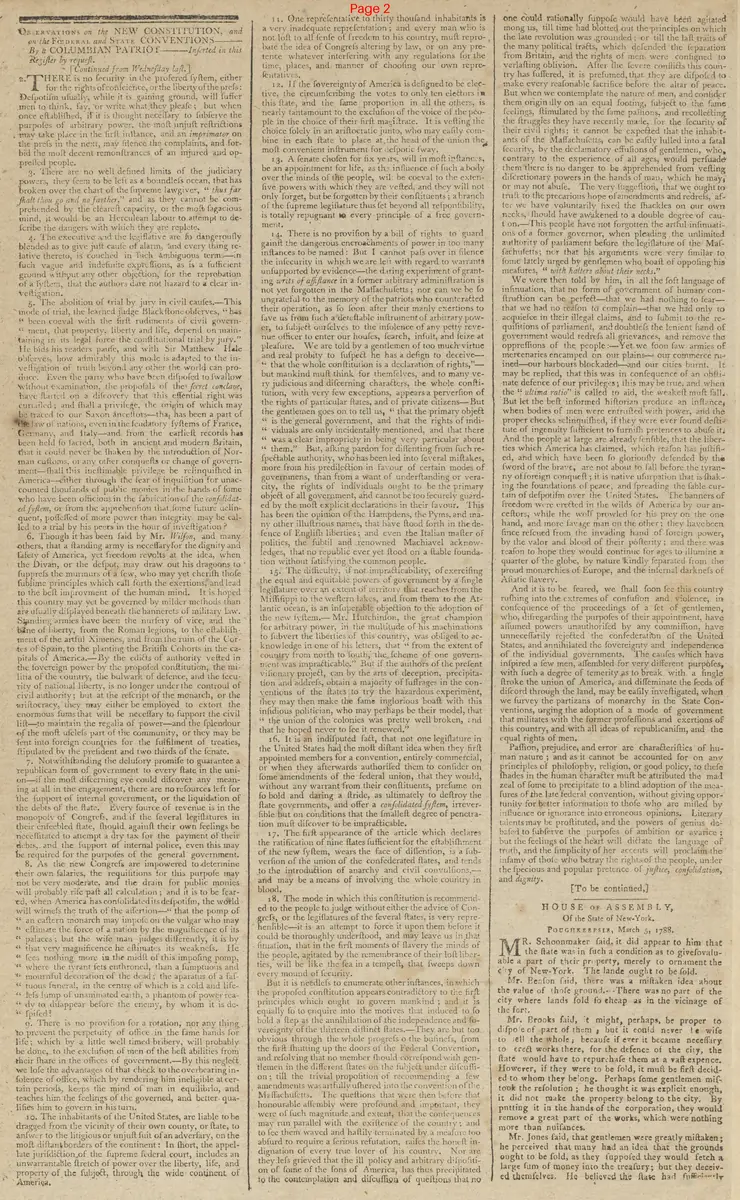
OBSERVATIONS on the NEW CONSTITUTION, and on the FEDERAL and STATE CONVENTIONS
By a COLUMBIAN PATRIOT—Inserted in this Register by request.
Continued from Wednesday last.
2. There is no security in the proposed system, either for the rights of conscience, or the liberty of the press: Despotism usually, while it is gaining ground, will suffer men to think, say, or write what they please; but when once established, if it is thought necessary to subserve the purposes of arbitrary power, the most unjust restrictions may take place in the first instance, and an imprimatur on the press in the next, may silence the complaints, and forbid the most decent remonstrances of an injured and oppressed people.
3. There are no well defined limits of the judiciary powers, they seem to be left as a boundless ocean, that has broken over the chart of the supreme lawgiver, "thus far shalt thou go and no farther," and as they cannot be comprehended by the clearest capacity, or the most sagacious mind, it would be an Herculean labour to attempt to describe the dangers with which they are replete.
4. The executive and the legislative are so dangerously blended as to give just cause of alarm, and every thing relative thereto, is couched in such ambiguous terms—in such vague and indefinite expressions, as is a sufficient ground without any other objection, for the reprobation of a system, that the authors dare not hazard to a clear investigation.
5. The abolition of trial by jury in civil causes.—This mode of trial, the learned judge Blackstone observes, "has been coeval with the first rudiments of civil government, that property, liberty and life, depend on maintaining in its legal force the constitutional trial by jury." He bids his readers pause, and with Sir Matthew Hale observes, how admirably this mode is adapted to the investigation of truth beyond any other the world can produce. Even the party who have been disposed to swallow without examination, the proposals of the secret conclave, have started on a discovery that this essential right was curtailed; and shall a privilege, the origin of which may be traced to our Saxon ancestors—that, has been a part of the law of nations, even in the feudatory systems of France, Germany, and Italy—and from the earliest records has been held so sacred, both in ancient and modern Britain, that it could never be shaken by the introduction of Norman customs, or any other conquests or change of government—shall this inestimable privilege be relinquished in America—either through the fear of inquisition for unaccounted thousands of public monies in the hands of some who have been officious in the fabrication of the consolidated system, or from the apprehension that some future delinquent, possessed of more power than integrity, may be called to a trial by his peers in the hour of investigation?
6. Though it has been said by Mr. Wilson, and many others, that a standing army is necessary for the dignity and safety of America, yet freedom revolts at the idea, when the Divan, or the despot, may draw out his dragoons to suppress the murmurs of a few, who may yet cherish those sublime principles which call forth the exertions, and lead to the best improvement of the human mind. It is hoped this country may yet be governed by milder methods than are usually displayed beneath the bannerets of military law. Standing armies have been the nursery of vice, and the bane of liberty, from the Roman legions, to the establishment of the artful Ximenes, and from the ruin of the Cortes of Spain, to the planting the British Cohorts in the capitals of America.—By the edicts of authority vested in the sovereign power by the proposed constitution, the militia of the country, the bulwark of defence, and the security of national liberty, is no longer under the controul of civil authority; but at the receipt of the monarch, or the aristocracy, "they may either be employed to extort the enormous sums that will be necessary to support the civil list—to maintain the regalia of power—and the splendour of the most useless part of the community, or they may be sent into foreign countries for the fulfilment of treaties, stipulated by the president and two thirds of the senate."
7. Notwithstanding the delusive promise to guarantee a republican form of government to every state in the union—if the most discerning eye could discover any meaning at all in the engagement, there are no resources left for the support of internal government, or the liquidation of the debts of the state. Every source of revenue is in the monopoly of Congress, and if the several legislatures in their enfeebled state, should against their own feelings be necessitated to attempt a direct tax for the payment of their debts, and the support of internal police, even this may be required for the purposes of the general government.
8. As the new Congress are empowered to determine their own salaries, the requisitions for this purpose may not be very moderate, and the drain for public monies will probably rise past all calculation: and it is to be feared, when America has consolidated its despotism, the world will witness the truth of the assertion—that the pomp of an eastern monarch may impose on the vulgar who may estimate the force of a nation by the magnificence of its palaces; but the wise man judges differently, it is by that very magnificence he estimates its weakness. He sees nothing more in the midst of this imposing pomp, where the tyrant sits enthroned, than a sumptuous and mournful decoration of the dead: the apparatus of a fastuous funeral, in the centre of which is a cold and lifeless lump of unanimated earth, a phantom of power ready to disappear before the enemy, by whom it is despised!
9. There is no provision for a rotation, nor any thing to prevent the perpetuity of office in the same hands for life; which by a little well timed bribery, will probably be done, to the exclusion of men of the best abilities from their share in the offices of government.—By this neglect we lose the advantages of that check to the overbearing insolence of office, which by rendering him ineligible at certain periods, keeps the mind of man in equilibrio, and teaches him the feelings of the governed, and better qualifies him to govern in his turn.
10. The inhabitants of the United States, are liable to be dragged from the vicinity of their own county, or state, to answer to the litigious or unjust suit of an adversary, on the most distant borders of the continent: In short, the appellate jurisdiction of the supreme federal court, includes an unwarrantable stretch of power over the liberty, life, and property of the subject, through the wide continent of America.
11. One representative to thirty thousand inhabitants is a very inadequate representation; and every man who is not lost to all sense of freedom to his country, must reprobate the idea of Congress altering by law, or on any pretence whatever interfering, with any regulations for the time, places, and manner of choosing our own representatives.
12. If the sovereignty of America is designed to be elective, the circumscribing the votes to only ten electors in this state, and the same proportion in all the others, is nearly tantamount to the exclusion of the voice of the people in the choice of their first magistrate. It is vesting the choice solely in an aristocratic junto, who may easily combine in each state to place at the head of the union the most convenient instrument for despotic sway.
13. A senate chosen for six years, will in most instances, be an appointment for life, as the influence of such a body over the minds of the people, will be coeval to the extensive powers with which they are vested, and they will not only forget, but be forgotten by their constituents; a branch of the supreme legislature thus set beyond all responsibility, is totally repugnant to every principle of a free government.
14. There is no provision by a bill of rights to guard against the dangerous encroachments of power in too many instances to be named: But I cannot pass over in silence the insecurity in which we are left with regard to warrants unsupported by evidence—the daring experiment of granting writs of assistance in a former arbitrary administration is not yet forgotten in the Massachusetts; nor can we be so ungrateful to the memory of the patriots who counteracted their operation, as so soon after their manly exertions to save us from such a detestable instrument of arbitrary power, to subject ourselves to the insolence of any petty revenue officer to enter our houses, search, insult, and seize at pleasure. We are told by a gentleman of too much virtue and real probity to suspect he has a design to deceive "that the whole constitution is a declaration of rights,"—but mankind must think for themselves, and to many very judicious and discerning characters, the whole constitution, with very few exceptions, appears a perversion of the rights of particular states, and of private citizens—But the gentleman goes on to tell us, "that the primary object is the general government, and that the rights of individuals are only incidentally mentioned, and that there was a clear impropriety in being very particular about them." But, asking pardon for dissenting from such respectable authority, who has been led into several mistakes, more from his predilection in favour of certain modes of governments, than from a want of understanding or veracity, the rights of individuals ought to be the primary object of all government, and cannot be too securely guarded by the most explicit declarations in their favour. This has been the opinion of the Hampdens, the Pyms, and many other illustrious names, that have stood forth in the defence of English liberties; and even the Italian master of politics, the subtle and renowned Machiavel acknowledges, that no republic ever yet stood on a stable foundation without satisfying the common people.
15. The difficulty, if not impracticability, of exercising the equal and equitable powers of government by a single legislature over an extent of territory that reaches from the Mississippi to the western lakes, and from them to the Atlantic ocean, is an insuperable objection to the adoption of the new system.— Mr. Hutchinson, the great champion for arbitrary power, in the multitude of his machinations to subvert the liberties of this country, was obliged to acknowledge in one of his letters, that "from the extent of country from north to south, the scheme of one government was impracticable." But if the authors of the present visionary project, can by the arts of deception, precipitation and address, obtain a majority of suffrages in the conventions of the states to try the hazardous experiment, they may then make the same inglorious boast with this insidious politician, who may perhaps be their model, that "the union of the colonies was pretty well broken, and that he hoped never to see it renewed."
16. It is an undisputed fact, that not one legislature in the United States had the most distant idea when they first appointed members for a convention, entirely commercial, or when they afterwards authorised them to consider on some amendments of the federal union, that they would, without any warrant from their constituents, presume on so bold and daring a stride, as ultimately to destroy the state governments, and offer a consolidated system, irreversible but on conditions that the smallest degree of penetration must discover to be impracticable.
17. The first appearance of the article which declares the ratification of nine states sufficient for the establishment of the new system, wears the face of dissension, is a subversion of the union of the confederated states, and tends to the introduction of anarchy and civil convulsions.— and may be a means of involving the whole country in blood.
18. The mode in which this constitution is recommended to the people to judge without either the advice of Congress, or the legislatures of the several states, is very reprehensible—it is an attempt to force it upon them before it could be thoroughly understood, and may leave us in that situation, that in the first moments of slavery the minds of the people, agitated by the remembrance of their lost liberties, will be like the sea in a tempest, that sweeps down every mound of security.
But it is needless to enumerate other instances, in which the proposed constitution appears contradictory to the first principles which ought to govern mankind; and it is equally so to enquire into the motives that induced to so bold a step as the annihilation of the independence and sovereignty of the thirteen distinct states.—They are but too obvious through the whole progress of the business, from the first shutting up the doors of the Federal Convention, and resolving that no member should correspond with gentlemen in the different states on the subject under discussion; till the trivial proposition of recommending a few amendments was artfully ushered into the convention of the Massachusetts. The questions that were then before that honourable assembly were profound and important, they were of such magnitude and extent, that the consequences may run parallel with the existence of the country; and to see them waved and hastily terminated by a measure too absurd to require a serious refutation, raises the honest indignation of every true lover of his country. Nor are they less grieved that the ill policy and arbitrary disposition of some of the sons of America, has thus precipitated to the contemplation and discussion of questions that no one could rationally suppose would have been agitated among us, till time had blotted out the principles on which the late revolution was grounded; or till the last traits of the many political tracts, which defended the separation from Britain, and the rights of men were consigned to vertating oblivion. After the severe conflicts this country has suffered, it is presumed, that they are disposed to make every reasonable sacrifice before the altar of peace. But when we contemplate the nature of men, and consider them originally on an equal footing, subject to the same feelings, stimulated by the same passions, and recollecting the struggles they have recently made, for the security of their civil rights; it cannot be expected that the inhabitants of the Massachusetts, can be easily lulled into a fatal security, by the declamatory effusions of gentlemen, who, contrary to the experience of all ages, would persuade them there is no danger to be apprehended from vesting discretionary powers in the hands of man, which he may, or may not abuse. The very suggestion, that we ought to trust to the precarious hope of amendments and redress, after we have voluntarily fixed the shackles on our own necks, should have awakened to a double degree of caution.—This people have not forgotten the artful insinuations of a former governor, when pleading the unlimited authority of parliament before the legislature of the Massachusetts; nor that his arguments were very similar to some lately urged by gentlemen who boast of opposing his measures. "with halters about their necks." We were then told by him; in all the soft language of insinuation, that no form of government of human construction can be perfect—that we had nothing to fear—that we had no reason to complain—that we had only to acquiesce in their illegal claims, and to submit to the requisitions of parliament, and doubtless the lenient hand of government would redress all grievances, and remove the oppressions of the people:—Yet, we soon saw, armies of mercenaries encamped on our plains: our commerce ruined—our harbours blockaded—and our cities burnt. It may be replied, that this was in consequence of an obstinate defence of our privileges; this may be true, and when the "ultima ratio" is called to aid, the weakest must fall. But let the best informed historian produce an instance, when bodies of men were entrusted with power, and the proper checks relinquished, if they were ever found destitute of ingenuity sufficient to furnish pretences to abuse it. And the people at large are already sensible, that the liberties which America has claimed, which reason has justified, and which have been so gloriously defended by the sword of the brave, are not about to fall before the tyranny of foreign conquest; it is native usurpation that is shaking the foundations of peace, and spreading the sable curtain of despotism over the United States. The banners of freedom were erected in the wilds of America by our ancestors, while the wolf prowled for his prey on the one hand, and more savage man on the other; they have since rescued from the invading hand of foreign power, by the valor and blood of their posterity; and there was reason to hope they would continue for ages to illumine a quarter of the globe, by nature kindly separated from the proud monarchies of Europe, and the infernal darkness of Asiatic slavery. And it is to be feared, we shall soon see this country rushing into the extremes of confusion and violence, in consequence of the proceedings of a set of gentlemen, who, disregarding the purposes of their appointment, have assumed powers unauthorised by any commission, have unnecessarily rejected the confederation of the United States, and annihilated the sovereignty and independence of the individual governments. The causes which have inspired a few men, assembled for very different purposes, with such a degree of temerity as to break with a single stroke the union of America, and disseminate the seeds of discord through the land, may be easily investigated; when we survey the partizans of monarchy in the State Conventions, urging the adoption of a mode of government that militates with the former professions and exertions of this country, and with all ideas of republicanism, and the equal rights of men. Passion, prejudice, and error are characteristics of human nature; and as it cannot be accounted for on any principles of philosophy, religion, or good policy, to these shades in the human character must be attributed the mad zeal of some to precipitate to a blind adoption of the measures of the late federal convention, without giving opportunity for better information to those who are misled by influence or ignorance into erroneous opinions. Literary talents may be prostituted, and the powers of genius debased to subserve the purposes of ambition or avarice; but the feelings of the heart will dictate the language of truth, and the simplicity of her accents will proclaim the infamy of those who betray the rights of the people, under the specious and popular pretence of justice, consolidation, and dignity.
[To be continued,]
By a COLUMBIAN PATRIOT—Inserted in this Register by request.
Continued from Wednesday last.
2. There is no security in the proposed system, either for the rights of conscience, or the liberty of the press: Despotism usually, while it is gaining ground, will suffer men to think, say, or write what they please; but when once established, if it is thought necessary to subserve the purposes of arbitrary power, the most unjust restrictions may take place in the first instance, and an imprimatur on the press in the next, may silence the complaints, and forbid the most decent remonstrances of an injured and oppressed people.
3. There are no well defined limits of the judiciary powers, they seem to be left as a boundless ocean, that has broken over the chart of the supreme lawgiver, "thus far shalt thou go and no farther," and as they cannot be comprehended by the clearest capacity, or the most sagacious mind, it would be an Herculean labour to attempt to describe the dangers with which they are replete.
4. The executive and the legislative are so dangerously blended as to give just cause of alarm, and every thing relative thereto, is couched in such ambiguous terms—in such vague and indefinite expressions, as is a sufficient ground without any other objection, for the reprobation of a system, that the authors dare not hazard to a clear investigation.
5. The abolition of trial by jury in civil causes.—This mode of trial, the learned judge Blackstone observes, "has been coeval with the first rudiments of civil government, that property, liberty and life, depend on maintaining in its legal force the constitutional trial by jury." He bids his readers pause, and with Sir Matthew Hale observes, how admirably this mode is adapted to the investigation of truth beyond any other the world can produce. Even the party who have been disposed to swallow without examination, the proposals of the secret conclave, have started on a discovery that this essential right was curtailed; and shall a privilege, the origin of which may be traced to our Saxon ancestors—that, has been a part of the law of nations, even in the feudatory systems of France, Germany, and Italy—and from the earliest records has been held so sacred, both in ancient and modern Britain, that it could never be shaken by the introduction of Norman customs, or any other conquests or change of government—shall this inestimable privilege be relinquished in America—either through the fear of inquisition for unaccounted thousands of public monies in the hands of some who have been officious in the fabrication of the consolidated system, or from the apprehension that some future delinquent, possessed of more power than integrity, may be called to a trial by his peers in the hour of investigation?
6. Though it has been said by Mr. Wilson, and many others, that a standing army is necessary for the dignity and safety of America, yet freedom revolts at the idea, when the Divan, or the despot, may draw out his dragoons to suppress the murmurs of a few, who may yet cherish those sublime principles which call forth the exertions, and lead to the best improvement of the human mind. It is hoped this country may yet be governed by milder methods than are usually displayed beneath the bannerets of military law. Standing armies have been the nursery of vice, and the bane of liberty, from the Roman legions, to the establishment of the artful Ximenes, and from the ruin of the Cortes of Spain, to the planting the British Cohorts in the capitals of America.—By the edicts of authority vested in the sovereign power by the proposed constitution, the militia of the country, the bulwark of defence, and the security of national liberty, is no longer under the controul of civil authority; but at the receipt of the monarch, or the aristocracy, "they may either be employed to extort the enormous sums that will be necessary to support the civil list—to maintain the regalia of power—and the splendour of the most useless part of the community, or they may be sent into foreign countries for the fulfilment of treaties, stipulated by the president and two thirds of the senate."
7. Notwithstanding the delusive promise to guarantee a republican form of government to every state in the union—if the most discerning eye could discover any meaning at all in the engagement, there are no resources left for the support of internal government, or the liquidation of the debts of the state. Every source of revenue is in the monopoly of Congress, and if the several legislatures in their enfeebled state, should against their own feelings be necessitated to attempt a direct tax for the payment of their debts, and the support of internal police, even this may be required for the purposes of the general government.
8. As the new Congress are empowered to determine their own salaries, the requisitions for this purpose may not be very moderate, and the drain for public monies will probably rise past all calculation: and it is to be feared, when America has consolidated its despotism, the world will witness the truth of the assertion—that the pomp of an eastern monarch may impose on the vulgar who may estimate the force of a nation by the magnificence of its palaces; but the wise man judges differently, it is by that very magnificence he estimates its weakness. He sees nothing more in the midst of this imposing pomp, where the tyrant sits enthroned, than a sumptuous and mournful decoration of the dead: the apparatus of a fastuous funeral, in the centre of which is a cold and lifeless lump of unanimated earth, a phantom of power ready to disappear before the enemy, by whom it is despised!
9. There is no provision for a rotation, nor any thing to prevent the perpetuity of office in the same hands for life; which by a little well timed bribery, will probably be done, to the exclusion of men of the best abilities from their share in the offices of government.—By this neglect we lose the advantages of that check to the overbearing insolence of office, which by rendering him ineligible at certain periods, keeps the mind of man in equilibrio, and teaches him the feelings of the governed, and better qualifies him to govern in his turn.
10. The inhabitants of the United States, are liable to be dragged from the vicinity of their own county, or state, to answer to the litigious or unjust suit of an adversary, on the most distant borders of the continent: In short, the appellate jurisdiction of the supreme federal court, includes an unwarrantable stretch of power over the liberty, life, and property of the subject, through the wide continent of America.
11. One representative to thirty thousand inhabitants is a very inadequate representation; and every man who is not lost to all sense of freedom to his country, must reprobate the idea of Congress altering by law, or on any pretence whatever interfering, with any regulations for the time, places, and manner of choosing our own representatives.
12. If the sovereignty of America is designed to be elective, the circumscribing the votes to only ten electors in this state, and the same proportion in all the others, is nearly tantamount to the exclusion of the voice of the people in the choice of their first magistrate. It is vesting the choice solely in an aristocratic junto, who may easily combine in each state to place at the head of the union the most convenient instrument for despotic sway.
13. A senate chosen for six years, will in most instances, be an appointment for life, as the influence of such a body over the minds of the people, will be coeval to the extensive powers with which they are vested, and they will not only forget, but be forgotten by their constituents; a branch of the supreme legislature thus set beyond all responsibility, is totally repugnant to every principle of a free government.
14. There is no provision by a bill of rights to guard against the dangerous encroachments of power in too many instances to be named: But I cannot pass over in silence the insecurity in which we are left with regard to warrants unsupported by evidence—the daring experiment of granting writs of assistance in a former arbitrary administration is not yet forgotten in the Massachusetts; nor can we be so ungrateful to the memory of the patriots who counteracted their operation, as so soon after their manly exertions to save us from such a detestable instrument of arbitrary power, to subject ourselves to the insolence of any petty revenue officer to enter our houses, search, insult, and seize at pleasure. We are told by a gentleman of too much virtue and real probity to suspect he has a design to deceive "that the whole constitution is a declaration of rights,"—but mankind must think for themselves, and to many very judicious and discerning characters, the whole constitution, with very few exceptions, appears a perversion of the rights of particular states, and of private citizens—But the gentleman goes on to tell us, "that the primary object is the general government, and that the rights of individuals are only incidentally mentioned, and that there was a clear impropriety in being very particular about them." But, asking pardon for dissenting from such respectable authority, who has been led into several mistakes, more from his predilection in favour of certain modes of governments, than from a want of understanding or veracity, the rights of individuals ought to be the primary object of all government, and cannot be too securely guarded by the most explicit declarations in their favour. This has been the opinion of the Hampdens, the Pyms, and many other illustrious names, that have stood forth in the defence of English liberties; and even the Italian master of politics, the subtle and renowned Machiavel acknowledges, that no republic ever yet stood on a stable foundation without satisfying the common people.
15. The difficulty, if not impracticability, of exercising the equal and equitable powers of government by a single legislature over an extent of territory that reaches from the Mississippi to the western lakes, and from them to the Atlantic ocean, is an insuperable objection to the adoption of the new system.— Mr. Hutchinson, the great champion for arbitrary power, in the multitude of his machinations to subvert the liberties of this country, was obliged to acknowledge in one of his letters, that "from the extent of country from north to south, the scheme of one government was impracticable." But if the authors of the present visionary project, can by the arts of deception, precipitation and address, obtain a majority of suffrages in the conventions of the states to try the hazardous experiment, they may then make the same inglorious boast with this insidious politician, who may perhaps be their model, that "the union of the colonies was pretty well broken, and that he hoped never to see it renewed."
16. It is an undisputed fact, that not one legislature in the United States had the most distant idea when they first appointed members for a convention, entirely commercial, or when they afterwards authorised them to consider on some amendments of the federal union, that they would, without any warrant from their constituents, presume on so bold and daring a stride, as ultimately to destroy the state governments, and offer a consolidated system, irreversible but on conditions that the smallest degree of penetration must discover to be impracticable.
17. The first appearance of the article which declares the ratification of nine states sufficient for the establishment of the new system, wears the face of dissension, is a subversion of the union of the confederated states, and tends to the introduction of anarchy and civil convulsions.— and may be a means of involving the whole country in blood.
18. The mode in which this constitution is recommended to the people to judge without either the advice of Congress, or the legislatures of the several states, is very reprehensible—it is an attempt to force it upon them before it could be thoroughly understood, and may leave us in that situation, that in the first moments of slavery the minds of the people, agitated by the remembrance of their lost liberties, will be like the sea in a tempest, that sweeps down every mound of security.
But it is needless to enumerate other instances, in which the proposed constitution appears contradictory to the first principles which ought to govern mankind; and it is equally so to enquire into the motives that induced to so bold a step as the annihilation of the independence and sovereignty of the thirteen distinct states.—They are but too obvious through the whole progress of the business, from the first shutting up the doors of the Federal Convention, and resolving that no member should correspond with gentlemen in the different states on the subject under discussion; till the trivial proposition of recommending a few amendments was artfully ushered into the convention of the Massachusetts. The questions that were then before that honourable assembly were profound and important, they were of such magnitude and extent, that the consequences may run parallel with the existence of the country; and to see them waved and hastily terminated by a measure too absurd to require a serious refutation, raises the honest indignation of every true lover of his country. Nor are they less grieved that the ill policy and arbitrary disposition of some of the sons of America, has thus precipitated to the contemplation and discussion of questions that no one could rationally suppose would have been agitated among us, till time had blotted out the principles on which the late revolution was grounded; or till the last traits of the many political tracts, which defended the separation from Britain, and the rights of men were consigned to vertating oblivion. After the severe conflicts this country has suffered, it is presumed, that they are disposed to make every reasonable sacrifice before the altar of peace. But when we contemplate the nature of men, and consider them originally on an equal footing, subject to the same feelings, stimulated by the same passions, and recollecting the struggles they have recently made, for the security of their civil rights; it cannot be expected that the inhabitants of the Massachusetts, can be easily lulled into a fatal security, by the declamatory effusions of gentlemen, who, contrary to the experience of all ages, would persuade them there is no danger to be apprehended from vesting discretionary powers in the hands of man, which he may, or may not abuse. The very suggestion, that we ought to trust to the precarious hope of amendments and redress, after we have voluntarily fixed the shackles on our own necks, should have awakened to a double degree of caution.—This people have not forgotten the artful insinuations of a former governor, when pleading the unlimited authority of parliament before the legislature of the Massachusetts; nor that his arguments were very similar to some lately urged by gentlemen who boast of opposing his measures. "with halters about their necks." We were then told by him; in all the soft language of insinuation, that no form of government of human construction can be perfect—that we had nothing to fear—that we had no reason to complain—that we had only to acquiesce in their illegal claims, and to submit to the requisitions of parliament, and doubtless the lenient hand of government would redress all grievances, and remove the oppressions of the people:—Yet, we soon saw, armies of mercenaries encamped on our plains: our commerce ruined—our harbours blockaded—and our cities burnt. It may be replied, that this was in consequence of an obstinate defence of our privileges; this may be true, and when the "ultima ratio" is called to aid, the weakest must fall. But let the best informed historian produce an instance, when bodies of men were entrusted with power, and the proper checks relinquished, if they were ever found destitute of ingenuity sufficient to furnish pretences to abuse it. And the people at large are already sensible, that the liberties which America has claimed, which reason has justified, and which have been so gloriously defended by the sword of the brave, are not about to fall before the tyranny of foreign conquest; it is native usurpation that is shaking the foundations of peace, and spreading the sable curtain of despotism over the United States. The banners of freedom were erected in the wilds of America by our ancestors, while the wolf prowled for his prey on the one hand, and more savage man on the other; they have since rescued from the invading hand of foreign power, by the valor and blood of their posterity; and there was reason to hope they would continue for ages to illumine a quarter of the globe, by nature kindly separated from the proud monarchies of Europe, and the infernal darkness of Asiatic slavery. And it is to be feared, we shall soon see this country rushing into the extremes of confusion and violence, in consequence of the proceedings of a set of gentlemen, who, disregarding the purposes of their appointment, have assumed powers unauthorised by any commission, have unnecessarily rejected the confederation of the United States, and annihilated the sovereignty and independence of the individual governments. The causes which have inspired a few men, assembled for very different purposes, with such a degree of temerity as to break with a single stroke the union of America, and disseminate the seeds of discord through the land, may be easily investigated; when we survey the partizans of monarchy in the State Conventions, urging the adoption of a mode of government that militates with the former professions and exertions of this country, and with all ideas of republicanism, and the equal rights of men. Passion, prejudice, and error are characteristics of human nature; and as it cannot be accounted for on any principles of philosophy, religion, or good policy, to these shades in the human character must be attributed the mad zeal of some to precipitate to a blind adoption of the measures of the late federal convention, without giving opportunity for better information to those who are misled by influence or ignorance into erroneous opinions. Literary talents may be prostituted, and the powers of genius debased to subserve the purposes of ambition or avarice; but the feelings of the heart will dictate the language of truth, and the simplicity of her accents will proclaim the infamy of those who betray the rights of the people, under the specious and popular pretence of justice, consolidation, and dignity.
[To be continued,]
What sub-type of article is it?
Constitutional
Partisan Politics
Legal Reform
What keywords are associated?
New Constitution
Federal Convention
Trial By Jury
Standing Army
Bill Of Rights
Despotism
State Sovereignty
Ratification
Press Liberty
Judiciary Powers
What entities or persons were involved?
Columbian Patriot
Federal Convention
Congress
Mr. Wilson
Blackstone
Sir Matthew Hale
Mr. Hutchinson
Hampdens
Pyms
Machiavel
Editorial Details
Primary Topic
Objections To The Proposed Federal Constitution
Stance / Tone
Strongly Anti Constitution, Warning Of Despotism
Key Figures
Columbian Patriot
Federal Convention
Congress
Mr. Wilson
Blackstone
Sir Matthew Hale
Mr. Hutchinson
Hampdens
Pyms
Machiavel
Key Arguments
No Security For Rights Of Conscience Or Press Liberty
Undefined Judiciary Powers Pose Dangers
Dangerous Blending Of Executive And Legislative Branches
Abolition Of Trial By Jury In Civil Causes
Standing Army Threatens Freedom
Congress Monopolizes Revenue, Weakening States
Congress Sets Own Salaries, Leading To Excess
No Rotation In Office Allows Perpetuity And Bribery
Inadequate Representation And Jurisdiction Stretches
Lack Of Bill Of Rights Exposes To Encroachments