Thank you for visiting SNEWPapers!
Sign up free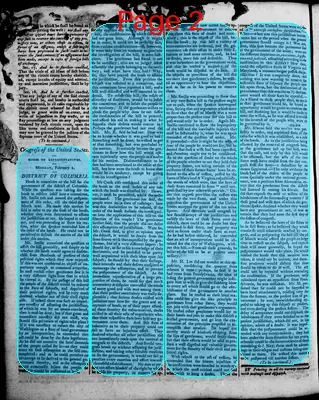
Alexandria Advertiser And Commercial Intelligencer
Alexandria, Virginia
What is this article about?
On February 2, in the U.S. House of Representatives, debate on a bill for governing the District of Columbia. Mr. Smilie moves to postpone until March 3, citing concerns over disfranchising residents and unnecessary jurisdiction assumption. Opponents like Messrs. [R.], Craik, H. Lee, and Macon argue for proceeding to resolve property uncertainties and fulfill constitutional duties.
Clipping
OCR Quality
Full Text
HOUSE OF REPRESENTATIVES.
Monday, February 2.
DISTRICT OF COLUMBIA.
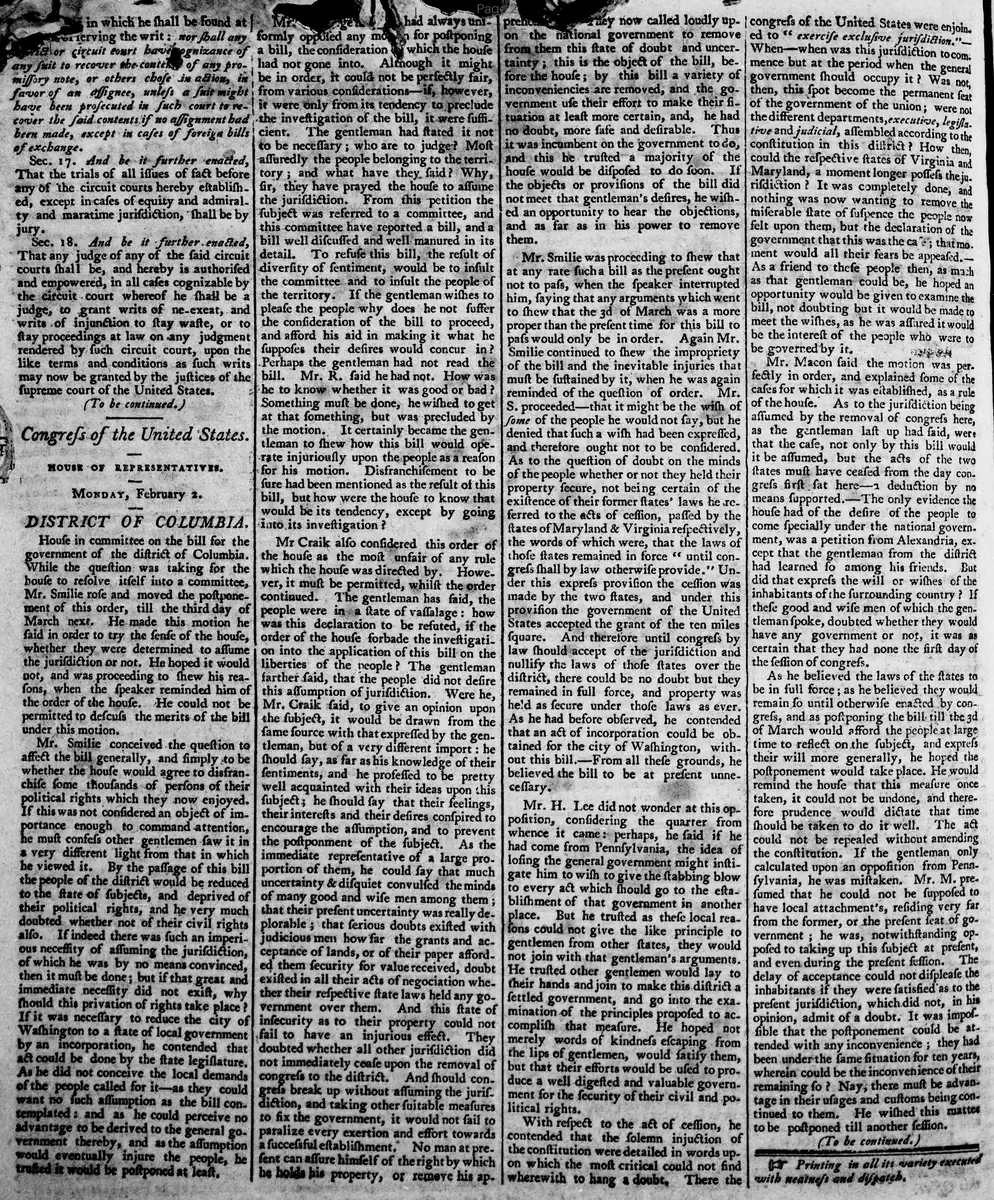
House in committee on the bill for the government of the district of Columbia. While the question was taking for the house to resolve itself into a committee, Mr. Smilie rose and moved the postponement of this order, till the third day of March next. He made this motion he said in order to try the sense of the house, whether they were determined to assume the jurisdiction or not. He hoped it would not, and was proceeding to show his reasons, when the speaker reminded him of the order of the house. He could not be permitted to discuss the merits of the bill under this motion. Mr. Smilie conceived the question to affect the bill generally, and simply to be whether the house would agree to disfranchise some thousands of persons of their political rights which they now enjoyed. If this was not considered an object of importance enough, to command attention, he must confess other gentlemen saw it in a very different light from that in which he viewed it. By the passage of this bill the people of the district would be reduced to the state of subjects, and deprived of their political rights, and he very much doubted whether not of their civil rights also. If indeed there was such an imperious necessity of assuming the jurisdiction, of which he was by no means convinced, then it must be done; but if that great and immediate necessity did not exist, why should this privation of rights take place ? If it was necessary to reduce the city of Washington to a state of local government by an incorporation, he contended that act could be done by the state legislature. As he did not conceive the local demands of the people called for it--as they could want no such assumption as the bill contemplated: and as he could perceive no advantage to be derived to the general government thereby, and as the assumption would eventually injure the people, he trusted it would be postponed at least.
Mr. [R.] had always uniformly opposed any motion for postponing a bill, the consideration which the house had not gone into. Although it might be in order, it could not be perfectly fair, from various considerations- if, however, it were only from its tendency to preclude the investigation of the bill, it were sufficient. The gentleman had stated it not to be necessary ; who are to judge? Most assuredly the people belonging to the territory; and what have they said? Why, sir, they have prayed the house to assume the jurisdiction. From this petition the subject was referred to a committee, and this committee have reported a bill, and a bill well discussed and well matured in its detail. To refuse this bill, the result of diversity of sentiment, would be to insult the committee and to insult the people of the territory. If the gentleman wishes to please the people why does he not suffer the consideration of the bill to proceed, and afford his aid in making it what he supposes their desires would concur in? Perhaps the gentleman had not read the bill. Mr. R. said he had not. How was he to know whether it was good or bad ? Something must be done, he wished to get at that something, but was precluded by the motion. It certainly became the gentleman to show how this bill would operate injuriously upon the people as a reason for his motion. Disfranchisement to be sure had been mentioned as the result of this bill, but how were the house to know that would be its tendency, except by going into its investigation ?
Mr. Craik also considered this order of the house as the most unfair of any rule which the house was directed by. However, it must be permitted, whilst the order continued. The gentleman has said, the people were in a state of vassalage : how was this declaration to be refuted, if the order of the house forbade the investigation into the application of this bill on the liberties of the people? The gentleman farther said, that the people did not desire this assumption of jurisdiction. Were he, Mr. Craik said, to give an opinion upon the subject, it would be drawn from the same source with that expressed by the gentleman, but of a very different import : he should say, as far as his knowledge of their sentiments, and he professed to be pretty well acquainted with their ideas upon this subject; he should say that their feelings, their interests and their desires conspired to encourage the assumption, and to prevent the postponement of the subject. As the immediate representative of a large proportion of them, he could say that much uncertainty & disquiet convulsed the minds of many good and wise men among them ; that their present uncertainty was really deplorable ; that serious doubts existed with judicious men how far the grants and acceptance of lands, or of their paper afforded them security for value received, doubt existed in all their acts of negotiation whether their respective state laws held any government over them. And this state of insecurity as to their property could not fail to have an injurious effect. They doubted whether all other jurisdiction did not immediately cease upon the removal of congress to the district. And should congress break up without assuming the jurisdiction, and taking other suitable measures to fix the government, it would not fail to paralyze every exertion and effort towards a successful establishment. No man at present can assure himself of the right by which he holds his property, or remove his apprehensions.
Necessity now called loudly upon the national government to remove from them this state of doubt and uncertainty : this is the object of the bill, before the house; by this bill a variety of inconveniencies are removed, and the government use their effort to make their situation at least more certain, and, he had no doubt, more safe and desirable. Thus it was incumbent on the government to do, and this he trusted a majority of the house would be disposed to do soon. If the objects or provisions of the bill did not meet that gentleman's desires, he wished an opportunity to hear the objections, and as far as in his power to remove them.
Mr. Smilie was proceeding to show that at any rate such a bill as the present ought not to pass, when the speaker interrupted him, saying that any arguments which went to show that the 3d of March was a more proper than the present time for this bill to pass would only be in order. Again Mr. Smilie continued to show the impropriety of the bill and the inevitable injuries that must be sustained by it, when he was again reminded of the question of order. Mr. S. proceeded--that it might be the wish of some of the people he would not say, but he denied that such a wish had been expressed, and therefore ought not to be considered. As to the question of doubt on the minds of the people whether or not they held their property secure, not being certain of the existence of their former states' laws he referred to the acts of cession, passed by the States of Maryland & Virginia respectively, the words of which were, that the laws of those states remained in force "until congress shall by law otherwise provide." Under this express provision the cession was made by the two states, and under this provision the government of the United States accepted the grant of the ten miles square. And therefore until congress by law should accept of the jurisdiction and nullify the laws of those states over the district, there could be no doubt but they remained in full force, and property was held as secure under those laws as ever. As he had before observed, he contended that an act of incorporation could be obtained for the city of Washington, without this bill. From all these grounds, he believed the bill to be at present unnecessary.
Mr. H. Lee did not wonder at this opposition, considering the quarter from whence it came: perhaps, he said if he had come from Pennsylvania, the idea of losing the general government might instigate him to wish to give the stabbing blow to every act which should go to the establishment of that government in another place. But he trusted as these local reasons could not give the like principle to gentlemen from other states, they would not join with that gentleman's arguments. He trusted other gentlemen would lay to their hands and join to make this district a settled government, and go into the examination of the principles proposed to accomplish that measure. He hoped not merely words of kindness escaping from the lips of gentlemen, would satisfy them, but that their efforts would be used to produce a well digested and valuable government for the security of their civil and political rights.
With respect to the act of cession, he contended that the solemn injunction of the constitution were detailed in words upon which the most critical could not find wherewith to hang a doubt. There the congress of the United States were enjoined to "exercise exclusive jurisdiction." When then was this jurisdiction to commence but at the period when the general government should occupy it ? Was not, then, this spot become the permanent seat of the government of the union; were not the different departments, executive, legislative and judicial, assembled according to the constitution in this district ? How then could the respective states of Virginia and Maryland, a moment longer possess the jurisdiction ? It was completely done, and nothing was now wanting to remove the miserable state of suspense the people now felt upon them, but the declaration of the government that this was the case; that moment would all their fears be appeased. As a friend to these people then, as much as that gentleman could be, he hoped an opportunity would be given to examine the bill, not doubting but it would be made to meet the wishes, as he was assured it would be the interest of the people who were to be governed by it.
Mr. Macon said the motion was perfectly in order, and explained some of the cases for which it was established, as a rule of the house. As to the jurisdiction being assumed by the removal of congress here, as the gentleman last up had said, were that the case, not only by this bill would it be assumed, but the acts of the two states must have ceased from the day congress first sat here--a deduction by no means supported. The only evidence the house had of the desire of the people to come especially under the national government, was a petition from Alexandria, except that the gentleman from the district had learned so among his friends. But did that express the will or wishes of the inhabitants of the surrounding country ? If these good and wise men of which the gentleman spoke, doubted whether they would have any government or not, it was as certain that they had none the first day of the session of congress.
As he believed the laws of the states to be in full force : as he believed they would remain so until otherwise enacted by congress, and as postponing the bill till the 3d of March would afford the people at large time to reflect on the subject, and express their will more generally, he hoped the postponement would take place. He would remind the house that this measure once taken, it could not be undone, and therefore prudence would dictate that time should be taken to do it well. The act could not be repealed without amending the constitution. If the gentleman only calculated upon an opposition from Pennsylvania, he was mistaken. Mr. M. presumed that he could not be supposed to have local attachments, residing very far from the former, or the present seat of government : he was, notwithstanding opposed to taking up this subject at present, and even during the present session. The delay of acceptance could not displease the inhabitants if they were satisfied as to the present jurisdiction, which did not, in his opinion, admit of a doubt: It was impossible that the postponement could be attended with any inconvenience ; they had been under the same situation for ten years, wherein could be the inconvenience of their remaining so ? Nay there must be advantage in their usages and customs being continued to them, He wished this matter to be postponed till another session.
(To be continued.)
What sub-type of article is it?
What themes does it cover?
What keywords are associated?
What entities or persons were involved?
Where did it happen?
Story Details
Key Persons
Location
House Of Representatives, District Of Columbia
Event Date
Monday, February 2
Story Details
Debate in the House on a bill to assume jurisdiction over the District of Columbia. Mr. Smilie moves to postpone, arguing it would disfranchise residents and is unnecessary given state laws. Opponents counter that petitions support it, it resolves property uncertainties, and fulfills constitutional mandates.