Thank you for visiting SNEWPapers!
Sign up free
Editorial
May 28, 1830
Rhode Island American, Statesman And Providence Gazette
Providence, Providence County, Rhode Island
What is this article about?
The editorial praises the U.S. favorable balance of trade, attributing it to protective tariffs that enable domestic production and prevent foreign debt, contrasting with past excessive imports. It argues nations should prioritize their own industry over foreign labor.
Clipping
OCR Quality
98%
Excellent
Full Text
All the World in debt to the United States.
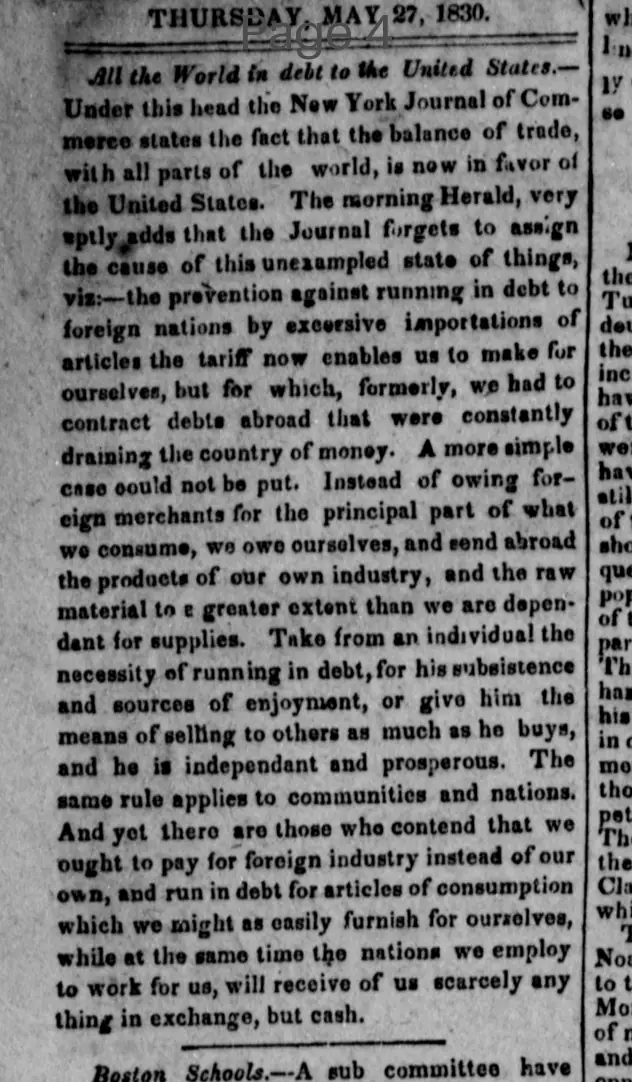
Under this head the New York Journal of Commerce states the fact that the balance of trade, with all parts of the world, is now in favor of the United States. The morning Herald, very aptly adds that the Journal forgets to assign the cause of this unprecedented state of things, viz: the protection against running in debt to foreign nations by excessive importations of articles the tariff now enables us to make for ourselves, but for which, formerly, we had to contract debts abroad that were constantly draining the country of money. A more simple case could not be put. Instead of owing foreign merchants for the principal part of what we consume, we owe ourselves, and send abroad the products of our own industry, and the raw material to a greater extent than we are dependent for supplies. Take from an individual the necessity of running in debt, for his subsistence and sources of enjoyment, or give him the means of selling to others as much as he buys, and he is independent and prosperous. The same rule applies to communities and nations. And yet there are those who contend that we ought to pay for foreign industry instead of our own, and run in debt for articles of consumption which we might as easily furnish ourselves, while at the same time the nations we employ to work for us, will receive of us scarcely anything in exchange, but cash.
Under this head the New York Journal of Commerce states the fact that the balance of trade, with all parts of the world, is now in favor of the United States. The morning Herald, very aptly adds that the Journal forgets to assign the cause of this unprecedented state of things, viz: the protection against running in debt to foreign nations by excessive importations of articles the tariff now enables us to make for ourselves, but for which, formerly, we had to contract debts abroad that were constantly draining the country of money. A more simple case could not be put. Instead of owing foreign merchants for the principal part of what we consume, we owe ourselves, and send abroad the products of our own industry, and the raw material to a greater extent than we are dependent for supplies. Take from an individual the necessity of running in debt, for his subsistence and sources of enjoyment, or give him the means of selling to others as much as he buys, and he is independent and prosperous. The same rule applies to communities and nations. And yet there are those who contend that we ought to pay for foreign industry instead of our own, and run in debt for articles of consumption which we might as easily furnish ourselves, while at the same time the nations we employ to work for us, will receive of us scarcely anything in exchange, but cash.
What sub-type of article is it?
Economic Policy
Trade Or Commerce
What keywords are associated?
Balance Of Trade
Protective Tariffs
Domestic Industry
Foreign Debt
Importation
National Prosperity
What entities or persons were involved?
New York Journal Of Commerce
Morning Herald
United States
Foreign Nations
Editorial Details
Primary Topic
Favorable Balance Of Trade Due To Protective Tariffs
Stance / Tone
Supportive Of Protective Tariffs And Domestic Industry
Key Figures
New York Journal Of Commerce
Morning Herald
United States
Foreign Nations
Key Arguments
Balance Of Trade In Favor Of The United States With All Parts Of The World
Protection Against Debt To Foreign Nations Via Tariffs Enabling Domestic Production
Formerly Debts Abroad Drained The Country Of Money
Nations Should Support Own Industry Instead Of Paying For Foreign Industry
Independence And Prosperity From Not Running In Debt For Subsistence