Thank you for visiting SNEWPapers!
Sign up free
Virginia Argus
Richmond, Virginia
What is this article about?
Henry Banks critiques past mismanagement and deceptions in the Virginia Armory's operations, including faulty musket inspections and poor iron quality. He praises recent reforms under new officers using superior iron from Beverley, reports improved production, and proposes relocating the facility and adding a forge for better efficiency and cost savings.
Merged-components note: These components form a single continuous letter to the editor by Henry Banks discussing the management and issues at the Virginia armory, including an embedded table of musket statistics. The final component was originally labeled 'editorial' but is part of this letter.
Clippings
1 of 2
OCR Quality
Full Text
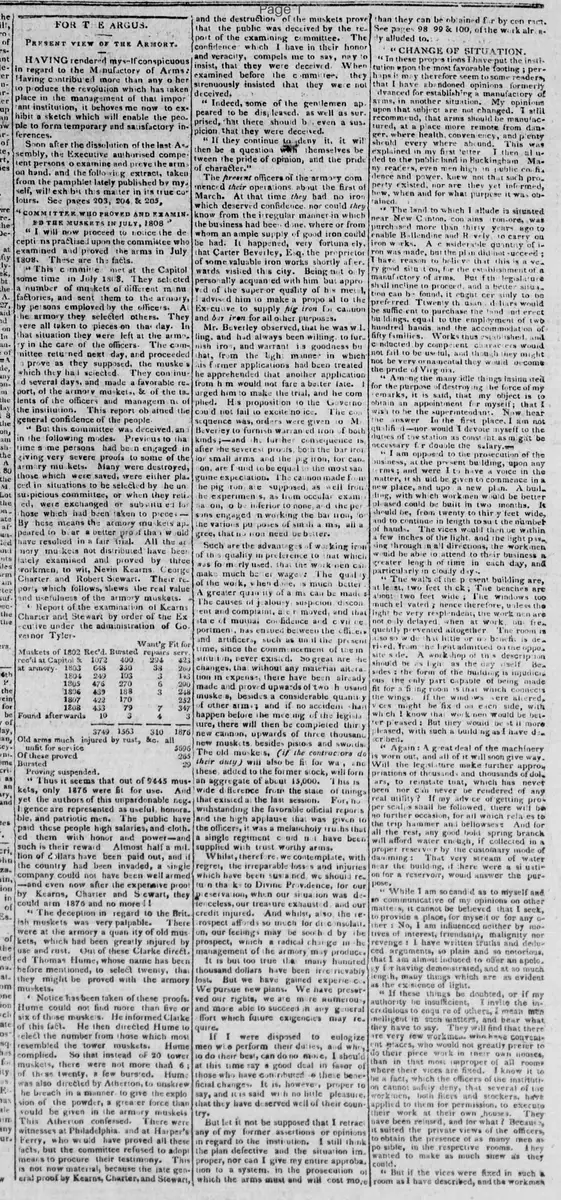
Present view of the Armory.
HAVING rendered myself conspicuous in regard to the Manufactory of Arms:
Having contributed more than any other to produce the revolution which has taken place in the management of that important institution, it behoves me now to exhibit a sketch which will enable the people to form temporary and satisfactory inferences.
Soon after the dissolution of the last Assembly, the Executive authorised competent persons to examine and prove the arms on hand, and the following extract, taken from the pamphlet lately published by myself, will exhibit this matter in its true colours. See pages 203, 204, & 205,
"COMMITTEE WHO PROVED AND EXAMINED THE MUSKETS IN JULY, 1808"
"I will now proceed to notice the deceptions practised upon the committee who examined and proved the arms in July 1808. These are the facts."
"This committee met at the Capitol some time in July 1808. They selected a number of muskets of different manufactories, and sent them to the armory, by persons employed by the officers. At the armory they selected others. They were all taken to pieces—on that day. In that situation they were left at the armory in the care of the officers. The committee returned next day, and proceeded to prove as they supposed, the muskets which they had selected. They continued several days, and made a favorable report, of the armory muskets, & of the talents of the officers and management of the institution. This report obtained the general confidence of the people."
"But this Committee was deceived, and in the following modes. Previous to that time some persons had been engaged in giving very severe proofs to some of the armory muskets. Many were destroyed, those which were saved, were either placed in situations to be selected by the unsuspecting committee, or when they retired, were exchanged or substituted for those which had been taken to pieces—By these means the armory muskets appeared to bear a better proof than would have resulted in a fair Trial. All the armory muskets not distributed have been lately examined and proved by three workmen, to wit, Nevin Kearns, George Charter, and Robert Stewart. Their report, which follows, shews the real value and usefulness of the armory muskets.
Report of the examination of Kearns Charter and Stewart by order of the Executive under the administration of Governor Tyler—
3749 1563
310
1876
Old arms much injured by rust, &c, all unfit for service
5696
Of these proved
265
Bursted
29
Proving suspended.
"Thus it seems that out of 9445 muskets, only 1876 were fit for use. And yet the authors of this unpardonable negligence are represented as useful, honorable, and patriotic men. The public have paid these people high salaries, and clothed them with honor and power—and such is their reward. Almost half a million of dollars have been paid out, and if the country had been invaded, a single company could not have been well armed—and even now after the expensive proof by Kearns, Charter and Stewart, they could arm 1876 and no more!!"
"The deception in regard to the British muskets was very palpable. There were at the armory a quantity of old muskets, which had been greatly injured by use and rust. Out of these Clarke directed Thomas Hume, whose name has been before mentioned, to select twenty, that they might be proved with the armory muskets."
Notice has been taken of these proofs. Hume could not find more than five or six of those muskets. He informed Clarke of this fact. He then directed Hume to elect the number from those which most resembled the tower muskets, Hume complied. So that instead of 20 tower muskets, there were not more than 6; of these twenty, a few bursted. Hume was also directed by Atherton, to unscrew the breach in a manner to give the explosion of the powder, a greater force than would be given in the armory muskets This Atherton confessed. There were witnesses at Philadelphia. and at Harper's Ferry, who would have proved all these facts, but the committee refused to adopt means to procure their testimony. This is not now material, because the late general proof by Kearns, Charter, and Stewart,
| Muskets of 1802 Rec'd. Burned | repairs | serv. |
| rec'd at Capitol & | 1072 | 400 |
| at armory. | 1803 | 648 |
| 1804 | 249 | 103 |
| 1805 | 476 | 270 |
| 1806 | 439 | 188 |
| 1807 | 422 | 170 |
| 1808 | 433 | 79 |
| Found afterwards | 10 | 3 |
and the destruction of the muskets prove that the public was deceived by the report of the examining committee. The confidence which I have in their honor and veracity, compels me to say, nay to insist, that they were deceived. When examined before the committee; they strenuously insisted that they were not deceived.
"Indeed, some of the gentlemen appeared to be displeased, as well as surprised, that there should be, even a suspicion, that they were deceived."
"If they continue to deny it, it will then be a question between the pride of opinion, and the pride of character."
The present officers of the armory commenced their operations. about the first of March. At that time they had no iron which deserved confidence, nor could they know from the irregular manner in which the business had been done. where or from whom an ample supply of good iron could be had. It happened, very fortunately, that Carter Beverley, Esq. the proprietor of some valuable iron works shortly after. wards visited this city. Being not only personally acquainted with him but approved of the superior quality of his metal, I advised him to make a proposal to the Executive to supply his iron for cannon and bar iron for all other purposes.
Mr. Beverley observed, that he was willing. and had always been willing. to furnish iron, and warrant its goodness but that. from the light manner in which his former applications had been treated he apprehended that another application from him would not fare a better fate. I urged him to make the trial, and he complied. His proposition to the Governor could not fail to excite notice. The consequence was, orders were given to Mr. Beverley to furnish warranted iron both kinds and the further consequence is after the severest proofs. both the bar iron for small arms and the pig iron, for cannon, are found to be equal to the most sanguine expectation. The cannon made from the pig iron, are supposed, as well from. the experiments, as from ocular examination, to be inferior to none, and the persons engaged in working the bar iron, for the various purposes of small arms, all agree, that no iron need be better.
s, 7
Such are the advantages of working iron of this quality in preference to that which was formerly used, that the work men can make much better wages: The quality of the work, when done, much better. A greater quantity of arms can be made :
The causes of jealousy, suspicion discontent and complaint, are removed, and that state of mutual confidence and civil deportment, has ensued between the officers and artificers, such as until the present time, since the commencement of the institution, never existed. so great are the changes, that without any material alteration in expense, there have been already made and proved upwards of two thousand muskets, besides a considerable quantity of other arms: and if no accident happens before the meeting of the legislature, there will then be completed thirty new cannon, upwards of three thousand new muskets, besides pistols and swords. The old muskets, if the contractors do their duty) will also be fit for war, and these, added to the former stock, will form an aggregate of about 15,000, This is wide difference from the state of things that existed at the last session. For, notwithstanding the favorable official reports and the high applause that was given to the officers, it was a melancholy truth that a single regiment could not have been supplied with trustworthy arms.
Whilst, therefore, we contemplate, with regret, the irreparable losses and injuries which have been sustained, we should return thanks to Divine Providence, for our preservation, when our situation was defenseless, our treasure exhausted, and our credit injured. And whilst, also, the prospect affords so much for consolation, our feelings may be soothed by the prospect, which a radical change in the management of the armory may produce
It is but too true the many hundred thousand dollars have been irrevocably lost. But we have gained experience. We pursue new plans. We have preserved our rights, we are more numerous, and more able to succeed in any general effort which future exigencies may require.
If I were disposed to eulogize men who perform their duties, and who, to do their best, can do no more, I should at this time say a good deal in favor of those who have contributed these beneficial changes. It is, however, proper to say, and it is said with no little pleasure, that they have deserved well of their country.
But let it not be supposed that I retract any of my former assertions or opinions in regard to the institution. I still think the plan defective and the situation improper, nor can I give my entire approbation to a system. in the prosecution of which the arms must and will cost more
than they can be obtained for by contract.
See pages 98 99 & 100, of the work already alluded to.: —
" CHANGE OF SITUATION."
"In these propositions I have put the institution upon the most favorable footing ; perhaps it may therefore seem to some readers, that I have abandoned opinions formerly advanced for establishing a manufactory of arms, in another situation. My opinions upon that subject are not changed. I still recommend, that arms should be manufactured, at a place more remote from danger, where health, convenience, and plenty should every where abound. This was explained in my first letter I then alluded to the public land in Buckingham Many readers, even men high in public confidence and power. knew not that such property existed, nor are they yet informed, how, when and for what purpose it was obtained. :"
" The land to which I allude is situated near New Canton. contains iron-ore, was purchased more than thirty years ago to enable Ballendine and Revely, to carry on iron works. A considerable quantity of iron was made, but the plan did not succeed; I have reason to believe that this is a very good situation, for the establishment of a manufactory of arms. But if the legislature shall incline to proceed, and a better situation can be found, it ought certainly to be preferred. Twenty thousand dollars would be sufficient to purchase the land and erect buildings. equal to the employment of two hundred hands, and the accommodation of fifty families. Works thus established, and conducted by competent characters would not fail to be useful, and though they might not be very ornamental they would become the pride of Virginia."
"Among the many idle things insinuated for the purpose of destroying the force of my remarks, it is said, that my object is to obtain an appointment for myself; that I wish to be the superintendant. Now hear the answer In the first place, I am not qualified—nor would I devote myself to the duties of the station as constantly as might be necessary for double the salary.—"
"I am opposed to the prosecution of the business, at the present building, upon any terms; and were I to have a voice in the matter, it should be given to commence in a new place, and upon a new plan. a building, with which workmen would be better pleased could be built in two months. It should be, from twenty to thirty feet wide, and to continue in length to suit the number of hands. The vices would then be within a few inches of the light, and the light passing through in all directions, the workmen would be able to attend to their business a greater length of time in each day, and particularly in cloudy days."
" The walls of the present building are, at least, two feet thick; The benches are about two feet wide ; The windows too much elevated ; hence therefore, unless the light be very resplendent, the Workmen are not only delayed, when at work. frequently prevented altogether The room is also so wide that little or no benefit. is derived from the light admitted on the opposite side. A work shop of this description should be as light as the day itself Besides : the form of the building is injudicious the only part capable of being made fit for a firing room is that which Connects the wings. If the windows were altered, vices might be fixed on each side, with which I know that workmen would be better pleased: But they would be still more pleased, with such a building as I have described."
" Again : A great deal of the machinery is worn out, and all of it will soon give way. Will the legislature make further appropriations of thousand and thousands of dollars, to reinstate that, which has never been nor can never be rendered of any real utility? If my advice of getting proper scales shall be followed. there will be no further occasion, for all which relates to the trip hammer and bellowses: And for all the rest, any good bold spring branch will afford water enough, if collected in a proper reservoir by the customary mode of damming: That very stream of water near the building, if there were a situation for a reservoir, would answer the purpose,"
"While I am so candid as to myself and so communicative of my opinions on other matters, it cannot be believed that I seek. to provide a place, for myself or for any O- ther : No, I am influenced neither by motives of interest, friendship, malignity nor revenge : I have written truths and deduced arguments, so plain and so notorious, that I am almost induced to offer an apology for having demonstrated, and at so much length, many things which are as evident as the existence of light."
" If these things be doubted, or if my authority be insufficient, I invite the incredulous to enquire of others, I mean men intelligent in such matters, and hear what they have to say. They will find that there are very few workmen who have convenient spaces, who would not greatly prefer to do their piece work in their own houses, than in that most improper of all rooms where their vices are fixed. I know it to be a fact, which the officers of the institution cannot safely deny, that several of the workmen, both filers and stockers. have applied to them for permission, to execute their work at their own houses. They have been refused, and for what ? Because it suited the private views of the officers, to obtain the presence of as many men as possible, in the respective rooms. They wanted to make as much shew as they could."
" But if the vices were fixed in such room as I have described, and the workmen were at liberty to carry on their business at home, the institution would soon present a very different appearance from what it has hitherto done; and the people of Virginia would have reason to believe, that their money had not been altogether thrown away.
see had families were provided with convenient houses and gardens, no such application would be made; no such desire would exist.
"Thus have I submitted to public consideration, some propositions for future pursuit, not indeed brilliant, nor calculated to make amends for the scenes through which we have passed, nor for the losses sustained by the public. They are propositions which promise utility: In them I have no personal interest, and may therefore, without seeming to obtrude, request every friend to the public welfare to read and reflect with patience and impartiality, and to decide with candor and patriotism.
I ask thus, not for myself, but for our common country, whose interests have been deserted, neglected, and irreparably injured."
Altho' the changes since the expulsion of the former officers have been beneficial, yet others may be made which will add much to future benefits. For good as Mr. Beverly's iron may be, yet it is impossible for the most skilful workmen to refine the whole mass from which the bar is drawn, in such a manner as to render all of it fit for scalp. Some particles of unrefined iron will remain, and wherever they exist the barrel will in spite of the greatest care be defective. The further change now recommended is to erect a forge (upon a small scale where the iron may be refined, and the scraps may be drawn, so as to afford them much cheaper, than they can be obtained by purchasing bar iron, and forming scraps under the trip hammer.
Such a forge would moreover be extremely useful for other purposes.
Evident and great as these benefits would be, I shall not now recommend them, if the execution was likely to involve the public in any important expense or delay. Such a forge could be built in a few months. It need not cost more than $2000, and may be erected between the present Boring Mill and the river upon the public ground, and may be operated by the water which passes from the Armory and is now wasted.
I have ever thought and still assert, that the trip hammer is a bad and expensive contrivance, and therefore until the forge can be completed, I would recommend the purchase of warranted scraps from those works where the quality of the iron is known to be malleable.
It is needless here to illustrate these matters. My remarks are supported by observation as well as experience, and my purposes will be answered if they are duly noticed by those who may be in authority.
HENRY BANKS.
What sub-type of article is it?
What themes does it cover?
What keywords are associated?
What entities or persons were involved?
Letter to Editor Details
Author
Henry Banks
Recipient
For The Argus
Main Argument
the virginia armory suffered from past deceptions and mismanagement leading to unusable arms despite high costs; recent changes with better iron and officers have improved production, but relocation to a better site and additional forge are needed for optimal efficiency and lower costs.
Notable Details