Thank you for visiting SNEWPapers!
Sign up free
Domestic News
May 30, 1911
The Cairo Bulletin
Cairo, Alexander County County, Illinois
What is this article about?
Census Bureau reports New Jersey's 1910 population at 2,537,167, up 34.7% from 1900, with urban areas growing faster (39.9%) than rural (21.1%). Urban pop 75.2% of total; Newark largest city at 347,469.
Clipping
OCR Quality
95%
Excellent
Full Text
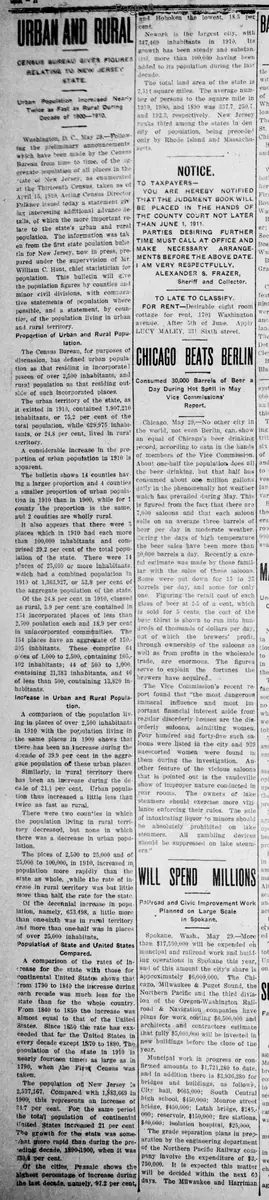
URBAN AND RURAL
CENSUS BUREAU GIVES FIGURES
RELATING TO NEW JERSEY STATE
Urban Population Increased Nearly
Twice as Fast as Rural During
Decade of 1910
Washington, D. C., May 29.—Following the preliminary announcements
which have been made by the Census
Bureau from time to time, of the aggregate population of all places in the
state of New Jersey, as enumerated
April 15, 1910, Acting Census Director
Falkner issued today a statement giving
interesting additional advance details,
of which the more important relate to the state's urban and rural
population. The information was taken
from the first state population bulletin for New Jersey, now in press, prepared under the supervision of Mr.
William C. Hunt, chief statistician for
population. This bulletin will give
the population figures by counties and
minor civil divisions, with comparative statements of population where
possible, and a statement, by counties, of the population living in urban
and rural territory.
Proportion of Urban and Rural Population.
The Census Bureau, for purposes of
discussion, has defined urban population as that residing in incorporated
places of over 2,500 inhabitants, and
rural population as that residing outside of such incorporated places.
The urban territory of the state, as
it existed in 1910, contained 1,907,210
inhabitants, or 75.2 per cent of the
total population, while 629,975 inhabitants, or 24.8 per cent, lived in rural
territory.
A considerable increase in the proportion of urban population in 1910 is
apparent.
The bulletin shows 14 counties having a larger proportion and 4 counties
a smaller proportion of urban population in 1910 than in 1900, while for 1
county the proportion is the same, and 2 counties are wholly rural.
It also appears that there were 3
places which in 1910 had each more
than 100,000 inhabitants and comprised 29.2 per cent of the total population of the state. There were 14
places of 25,000 or more inhabitants,
which had a combined population in
1910 of 1,363,927, or 53.8 per cent of
the aggregate population of the state.
Of the 24.8 per cent in 1910, classed
as rural, 5.9 per cent are contained in
154 incorporated places of less than
2,500 population each and 18.9 per cent
in unincorporated communities. The
154 places have an aggregate of 150,
305 inhabitants. These comprise 64
places of 1,000 to 2,500, containing 105,
102 inhabitants; 44 of 500 to 1,000,
containing 31,383 inhabitants, and 46
of less than 500, containing 13,820 inhabitants.
Increase in Urban and Rural Population.
A comparison of the population living in places of over 2,500 inhabitants
in 1910 with the population living in
the same places in 1900 shows that
there has been an increase during the
decade of 39.9 per cent in the aggregate population of these urban places.
Similarly, in rural territory there
has been an increase during the decade of 21.1 per cent. Urban population thus increased a little less than
twice as fast as rural.
There were two counties in which
the population living in rural territory decreased, but none in which
there was a decrease in urban population.
The places of 2,500 to 25,000 and of
25,000 to 100,000, in 1910, increased in
population more rapidly than the
state as a whole, while the rate of increase in rural territory was but little
more than half the rate for the state.
Of the decennial increase in population, namely, 653,498, a little more
than one-sixth was in rural territory
and more than one-half was in places
of over 25,000 inhabitants.
Population of State and United States
Compared.
A comparison of the rates of increase for the state with those for
continental United States shows that
from 1790 to 1840 the increase during
each decade was much less for the
state than for the whole country.
From 1840 to 1850 the increase was
almost equal to that of the United
States. Since 1850 the rate has exceeded that for the United States in
every decade except 1870 to 1880. The
population of the state in 1910 is
nearly fourteen times as large as in
1790, when the First Census was
taken.
The population of New Jersey is
2,537,167. Compared with 1,883,669 in
1900, this represents an increase of
34.7 per cent. For the same period
the total population of continental
United States increased 21 per cent.
The growth for the state was somewhat more rapid than during the preceding decade, 1890-1900, when it was
13.4 per cent.
Of the cities, Passaic shows the
highest percentage of increase during
the last decade, namely, 97.2 per cent,
and Hoboken the lowest, 18.5 per
cent.
Newark is the largest city, with
347,469 inhabitants in 1910. Its
growth has been steady and substantial, more than 100,000 having been
added to its population during the last
decade.
The total land area of the state is
7,815 square miles. The average number of persons to the square mile in
1910, 1900, and 1890 was 337.7, 250.7
and 192.3, respectively. New Jersey
ranks third among the states in density of population, being preceded
only by Rhode Island and Massachusetts.
CENSUS BUREAU GIVES FIGURES
RELATING TO NEW JERSEY STATE
Urban Population Increased Nearly
Twice as Fast as Rural During
Decade of 1910
Washington, D. C., May 29.—Following the preliminary announcements
which have been made by the Census
Bureau from time to time, of the aggregate population of all places in the
state of New Jersey, as enumerated
April 15, 1910, Acting Census Director
Falkner issued today a statement giving
interesting additional advance details,
of which the more important relate to the state's urban and rural
population. The information was taken
from the first state population bulletin for New Jersey, now in press, prepared under the supervision of Mr.
William C. Hunt, chief statistician for
population. This bulletin will give
the population figures by counties and
minor civil divisions, with comparative statements of population where
possible, and a statement, by counties, of the population living in urban
and rural territory.
Proportion of Urban and Rural Population.
The Census Bureau, for purposes of
discussion, has defined urban population as that residing in incorporated
places of over 2,500 inhabitants, and
rural population as that residing outside of such incorporated places.
The urban territory of the state, as
it existed in 1910, contained 1,907,210
inhabitants, or 75.2 per cent of the
total population, while 629,975 inhabitants, or 24.8 per cent, lived in rural
territory.
A considerable increase in the proportion of urban population in 1910 is
apparent.
The bulletin shows 14 counties having a larger proportion and 4 counties
a smaller proportion of urban population in 1910 than in 1900, while for 1
county the proportion is the same, and 2 counties are wholly rural.
It also appears that there were 3
places which in 1910 had each more
than 100,000 inhabitants and comprised 29.2 per cent of the total population of the state. There were 14
places of 25,000 or more inhabitants,
which had a combined population in
1910 of 1,363,927, or 53.8 per cent of
the aggregate population of the state.
Of the 24.8 per cent in 1910, classed
as rural, 5.9 per cent are contained in
154 incorporated places of less than
2,500 population each and 18.9 per cent
in unincorporated communities. The
154 places have an aggregate of 150,
305 inhabitants. These comprise 64
places of 1,000 to 2,500, containing 105,
102 inhabitants; 44 of 500 to 1,000,
containing 31,383 inhabitants, and 46
of less than 500, containing 13,820 inhabitants.
Increase in Urban and Rural Population.
A comparison of the population living in places of over 2,500 inhabitants
in 1910 with the population living in
the same places in 1900 shows that
there has been an increase during the
decade of 39.9 per cent in the aggregate population of these urban places.
Similarly, in rural territory there
has been an increase during the decade of 21.1 per cent. Urban population thus increased a little less than
twice as fast as rural.
There were two counties in which
the population living in rural territory decreased, but none in which
there was a decrease in urban population.
The places of 2,500 to 25,000 and of
25,000 to 100,000, in 1910, increased in
population more rapidly than the
state as a whole, while the rate of increase in rural territory was but little
more than half the rate for the state.
Of the decennial increase in population, namely, 653,498, a little more
than one-sixth was in rural territory
and more than one-half was in places
of over 25,000 inhabitants.
Population of State and United States
Compared.
A comparison of the rates of increase for the state with those for
continental United States shows that
from 1790 to 1840 the increase during
each decade was much less for the
state than for the whole country.
From 1840 to 1850 the increase was
almost equal to that of the United
States. Since 1850 the rate has exceeded that for the United States in
every decade except 1870 to 1880. The
population of the state in 1910 is
nearly fourteen times as large as in
1790, when the First Census was
taken.
The population of New Jersey is
2,537,167. Compared with 1,883,669 in
1900, this represents an increase of
34.7 per cent. For the same period
the total population of continental
United States increased 21 per cent.
The growth for the state was somewhat more rapid than during the preceding decade, 1890-1900, when it was
13.4 per cent.
Of the cities, Passaic shows the
highest percentage of increase during
the last decade, namely, 97.2 per cent,
and Hoboken the lowest, 18.5 per
cent.
Newark is the largest city, with
347,469 inhabitants in 1910. Its
growth has been steady and substantial, more than 100,000 having been
added to its population during the last
decade.
The total land area of the state is
7,815 square miles. The average number of persons to the square mile in
1910, 1900, and 1890 was 337.7, 250.7
and 192.3, respectively. New Jersey
ranks third among the states in density of population, being preceded
only by Rhode Island and Massachusetts.
What sub-type of article is it?
Economic
What keywords are associated?
New Jersey Census
Urban Population
Rural Population
1910 Population
What entities or persons were involved?
Falkner
William C. Hunt
Where did it happen?
New Jersey
Domestic News Details
Primary Location
New Jersey
Event Date
May 29, 1910
Key Persons
Falkner
William C. Hunt
Event Details
The Census Bureau released preliminary figures showing New Jersey's 1910 population at 2,537,167, a 34.7% increase from 1900. Urban population (incorporated places over 2,500) was 1,907,210 (75.2%), up 39.9%; rural was 629,975 (24.8%), up 21.1%. Newark largest city at 347,469. State density 337.7 per sq mi, third highest.