Thank you for visiting SNEWPapers!
Sign up free
The Virginia Gazette
Richmond, Williamsburg, Richmond County, Virginia
What is this article about?
Extract from Copenhagen, March 26, details the Danish commission's proceedings after the January 27 revolution. Attorney General Uldahl defends Queen Charlotte, arguing her royal status exempts her from trial as a subject and calls for her liberty based on equity and matrimonial rights.
Clipping
OCR Quality
Full Text
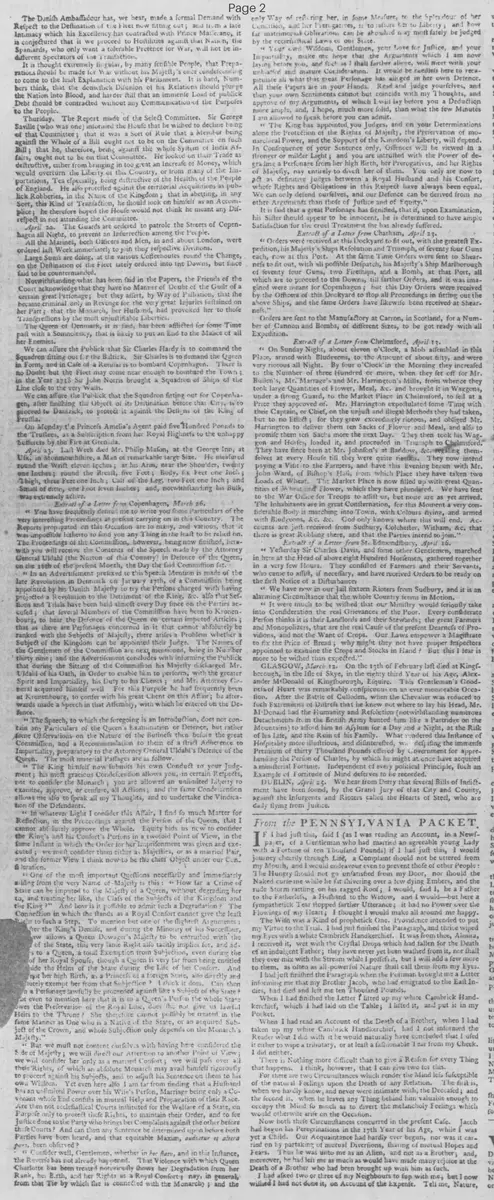
"You have frequently desired me to write you some Particulars of the very interesting Proceedings at present carrying on in this Country. The Reports propagated on this Occasion are so many, and various, that it was impossible hitherto to send you any Thing in the least to be relied on. The Proceedings of the Commission, however, being now finished, herewith you will receive the Contents of the Speech made by the Attorney General Uldahl (the Norton of this Country) in Defence of the Queen, on the 26th of the present Month, the Day the said Commission sat.
In an Advertisement prefixed to this Speech Mention is made of the late Revolution in Denmark on January 27th, of a Commission being appointed by his Danish Majesty to try the Persons charged with having projected a Revolution to the Detriment of the King, &c. also that Sessions and Trials have been held almost every Day since on the Parties accused; that several Members of the Commission have been to Kronenbourg, to hear the Defence of the Queen on certain imputed Articles; that as there are Personages concerned in it that cannot absolutely be ranked with the Subjects of Majesty, there arises a Problem whether a Subject of the Kingdom can be appointed their Judge. The Names of the Gentlemen of the Commission are next mentioned, being in Number thirty nine; and the Advertisement concludes with informing the Publick that during the Sitting of the Commission his Majesty discharged Mr. Uldall of his Oath, in Order to enable him to perform, with the greater Spirit and Impartiality, his Duty to his Clients; and Mr. Attorney General acquitted himself well. For this Purpose he had frequently been at Kronenbourg, to confer with his great Client on this Affair; he afterwards made a Speech in that Assembly, with which he entered on the Defence.
The Speech, to which the foregoing is an Introduction, does not contain any Particulars of the Queen's Examination or Defence, but rather some Observations on the Nature of the Business then before the great Commission, and a Recommendation to them of a strict Adherence to Impartiality, preparatory to the Attorney General Uldahl's Defence of the Queen. The most material Passages are as follow.
The King himself now submits his own Conduct to your Judgment; his most gracious Condescension allows you, in certain Respects, not to consider the Monarch; you are allowed an unlimited Liberty to examine, approve, or censure, all Actions; and the same Condescension allows me also to speak all my Thoughts, and to undertake the Vindication of the Defendants.
In whatever Light I consider this Affair, I find so much Matter for Reflection, in the Proceedings against the Person of the Queen, that I cannot absolutely approve the Whole. Equity bids us now to consider the King's and his Consort's Persons in a twofold Point of View, in the same Instant in which the Order for her Imprisonment was given and executed; we must consider them either as Majesties, or as a married Pair; and the former View I think now to be the chief Object under our Consideration.
One of the most important Questions necessarily and immediately arising from the very Name of Majesty is this: "How far a Crime of State can be imputed to the Majesty of a Queen, without degrading her to, and treating her like, the Class of the Subjects of the Kingdom and the King?" And how is it possible to admit such a Degradation? The Connection in which she stands as a Royal Consort cannot give the least Right to such a Step. To mention but one of the slightest Arguments: After the King's Demise, and during the Minority of his Successor, Law allows a Queen Dowager's Majesty to be entrusted with the Helm of the State, this very same Right also tacitly implies for, and adds to a Queen, a total Exemption from Subjection, even during the Life of her Royal Spouse, though a Queen is very far from being entitled to hold the Helm of the State during the Life of her Consort. And does not her high Birth, as a Princess of a foreign State, also directly and absolutely exempt her from that Subjection? I think it does. Can then a Personage lawfully be proceeded against like a Subject of the State? Or even to mention here that it is to a Queen's Person the whole State owes the Preservation of the Royal Line, does this not give us lawful Heirs to the Throne? She therefore cannot possibly be treated in the same Manner as One who is a Native of the State, or an acquired Subject of the Crown, and whose Subjection only depends on the Monarch's Majesty.
But we must not content ourselves with having here considered the Side of Majesty; we will direct our Attention to another Point of View; we will consider her only as a married Consort; we will pass over all these Rights, of which an absolute Monarch may avail himself rigorously to proceed against his Subjects, and to adjust his Sentence on them to his own Wisdom. Yet even here also I am far from finding that a Husband has an unlimited Power over his Wife's Person, Marriage being only a Covenant whose End consists in mutual Help and Propagation of their Race. Are then not ecclesiastical Courts instituted for the Welfare of a State, on Purpose only to protect these Rights, to maintain their Order, and to see Justice done to the Party who brings her Complaints against the other before those Courts? And can then any Sentence be determined upon before both Parties have been heard, and that equitable Maxim, audiatur et altera pars, been observed?
Consider well, Gentlemen, whether in both Cases, and in this Instance, the Reverse has not already happened. That Violence with which Queen Charlotte has been treated notoriously shows her Degradation from her Rank, her Birth, and her Rights as a Royal Consort; nay, in general, from that Tie by which she is connected with the Monarchy; and the only Way of restoring her, in some Measure, to the Splendour of her Condition, and her Privileges, is to restore her to Liberty; and how far matrimonial Obligations can be abolished may most safely be judged by the ecclesiastical Laws of our State.
Your own Wisdom, Gentlemen, your Love for Justice, and your Impartiality, make me hope that the Arguments which I am now laying before you, and such as I shall further allege, will meet with your unbiassed and mature Consideration. It would be needless here to recapitulate all what that great Personage has alleged in her own Defence. All these Papers are in your Hands. Read and judge yourselves, and then your own Sentiments cannot but coincide with my Thoughts, and approve of my Arguments, of which I will lay before you a Deduction more ample, and, I hope, much more solid, than what the few Minutes I am allowed to speak before you can admit.
The King has appointed you Judges, and on your Determinations alone the Protection of the Rights of Majesty, the Preservation of monarchical Power, and the Support of the Kingdom's Liberty, will depend. In Consequence of your Sentence only, Offences will be viewed in a stronger or milder Light; and you are intrusted with the Power of degrading a Personage from her high Birth, her Prerogatives, and her Rights of Majesty, nay entirely to divest her of them. You only are now to act as definitive Judges between a Royal Husband and his Consort, whose Rights and Obligations in this Respect have always been equal. We can only defend ourselves, and our Defence can be derived from no other Arguments than those of Justice and of Equity."
What sub-type of article is it?
What keywords are associated?
What entities or persons were involved?
Where did it happen?
Foreign News Details
Primary Location
Copenhagen, Denmark
Event Date
March 26, Present Month; Revolution On January 27th
Key Persons
Outcome
advocacy for queen's liberty and exemption from trial; no final outcome reported
Event Details
Following the January 27 revolution in Denmark, a commission of 39 members was appointed by the King to try accused persons, including the Queen. Attorney General Uldahl delivered a speech on March 26 defending the Queen, arguing her royal status and foreign birth exempt her from subjection and trial like a subject, and that as a consort, matrimonial issues should go to ecclesiastical courts. He urged impartiality and restoration of her liberty.