Thank you for visiting SNEWPapers!
Sign up free
Daily National Intelligencer
Washington, District Of Columbia
What is this article about?
Editorial from Washington on December 21 discusses the end of piracy trials in Baltimore without convictions, despite evident depredations by privateers on friendly nations' commerce. Criticizes privateering as immoral and criminal, harming U.S. reputation and commerce. Notes clearance of J.S. Skinner, who lent money to a privateer officer.
Clipping
OCR Quality
Full Text
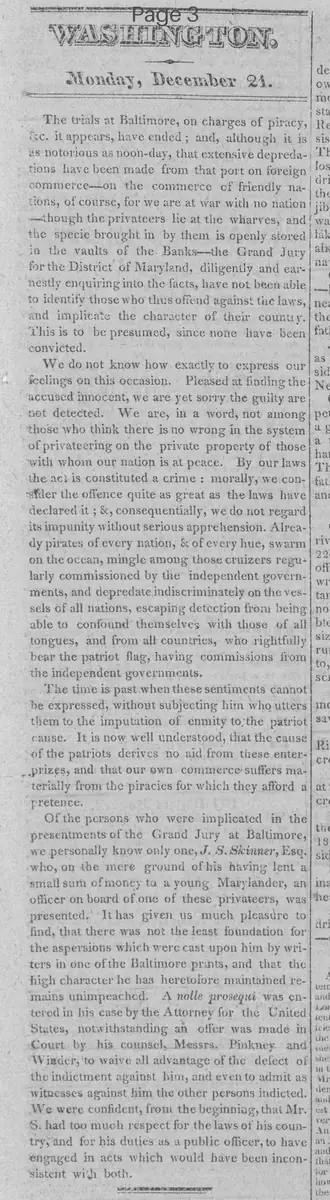
Monday, December 21.
The trials at Baltimore, on charges of piracy, etc. it appears, have ended; and, although it is as notorious as noon-day, that extensive depredations have been made from that port on foreign commerce--on the commerce of friendly nations, of course, for we are at war with no nation --though the privateers lie at the wharves, and the specie brought in by them is openly stored in the vaults of the Banks--the Grand Jury for the District of Maryland, diligently and earnestly enquiring into the facts, have not been able to identify those who thus offend against the laws, and implicate the character of their country.
This is to be presumed, since none have been convicted.
We do not know how exactly to express our feelings on this occasion. Pleased at finding the accused innocent, we are yet sorry the guilty are not detected. We are, in a word, not among those who think there is no wrong in the system of privateering on the private property of those with whom our nation is at peace. By our laws the act is constituted a crime : morally, we consider the offence quite as great as the laws have declared it ; &, consequentially, we do not regard its impunity without serious apprehension. Already pirates of every nation, & of every hue, swarm on the ocean, mingle among those cruizers regularly commissioned by the independent governments, and depredate indiscriminately on the vessels of all nations, escaping detection from being able to confound themselves with those of all tongues, and from all countries, who rightfully bear the patriot flag, having commissions from the independent governments.
The time is past when these sentiments cannot be expressed, without subjecting him who utters them to the imputation of enmity to the patriot cause. It is now well understood, that the cause of the patriots derives no aid from these enterprizes, and that our own commerce suffers materially from the piracies for which they afford a pretence.
Of the persons who were implicated in the presentments of the Grand Jury at Baltimore. we personally know only one, J. S. Skinner, Esq. who, on the mere ground of his having lent a small sum of money to a young Marylander, an officer on board of one of these privateers, was presented. It has given us much pleasure to find, that there was not the least foundation for the aspersions which were cast upon him by writers in one of the Baltimore prints, and that the high character he has heretofore maintained remains unimpeached. A nolle prosequi was entered in his case by the Attorney for the United States, notwithstanding an offer was made in Court by his counsel, Messrs. Pinkney and Winder, to waive all advantage of the defect of the indictment against him, and even to admit as witnesses against him the other persons indicted.
We were confident, from the beginning, that Mr. S. had too much respect for the laws of his country, and for his duties as a public officer, to have engaged in acts which would have been inconsistent with both.
What sub-type of article is it?
What themes does it cover?
What keywords are associated?
What entities or persons were involved?
Where did it happen?
Story Details
Key Persons
Location
Baltimore, District Of Maryland
Event Date
Monday, December 21
Story Details
Piracy trials in Baltimore end without convictions despite evident privateer depredations on friendly nations' commerce; editorial criticizes privateering as piracy harming U.S. interests; J.S. Skinner cleared of charges for lending money to a privateer officer.