Thank you for visiting SNEWPapers!
Sign up free
Editorial
February 28, 1815
Alexandria Gazette, Commercial And Political
Alexandria, Virginia
What is this article about?
An oration honoring George Washington's birthday, praising his virtues and leadership in American independence, contrasting him with Napoleon and the excesses of the French Revolution, and reflecting on the spread of liberty principles in Europe and the need for moral governance.
Clipping
OCR Quality
75%
Good
Full Text
AN ORATION
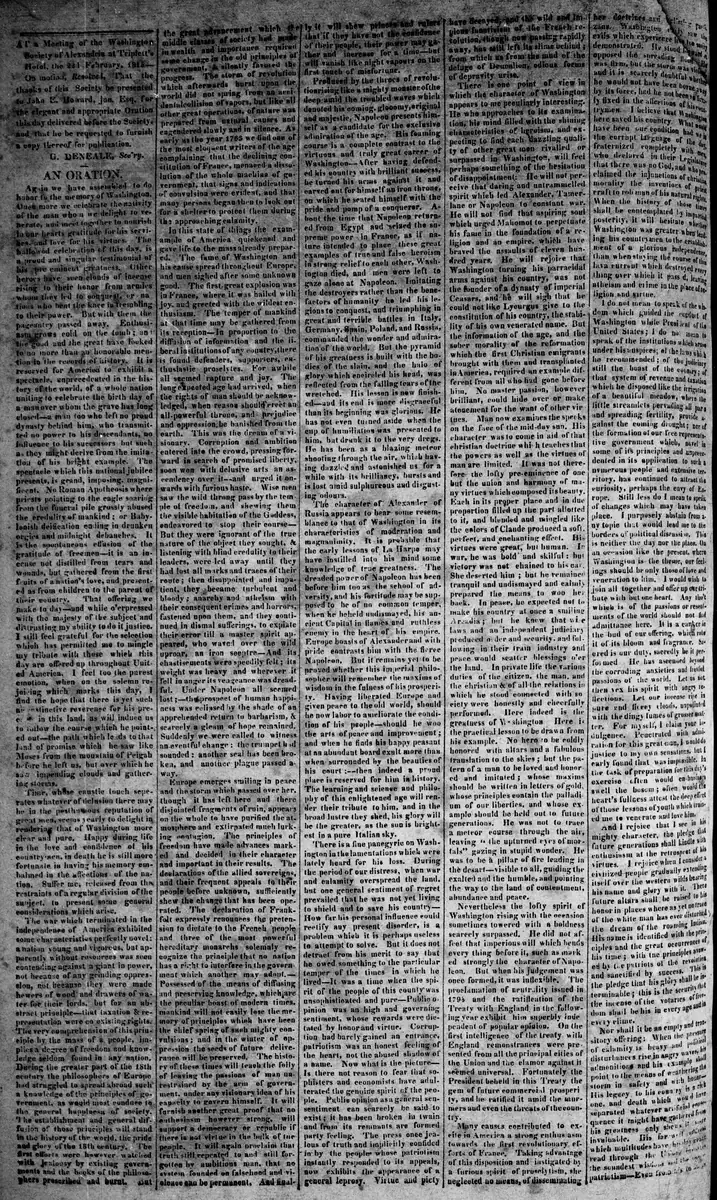
Again we have assembled to do honor to the memory of Washington. Once more we celebrate the nativity of the man whom we delight to venerate, and meet together to nourish in our hearts gratitude for his services, and love for his virtues. The hallowed celebration of this day, is a proud and singular testimonial of his pre-eminent greatness. Other heroes have seen clouds of incense rise to their honor from armies whom they led to conquest or nations who bent the knee in trembling to their power. But with them the pageantry passed away. Enthusiasm grows cold on the tomb; and the crowd and the great have looked to no more than an honorable mention in the records of history. It is reserved for America to exhibit a spectacle, unprecedented in the history of the world, of a whole nation uniting to celebrate the birth day of a man over whom the grave has long closed its marble, a man too who left no proud dynasty behind him, who transmitted no power to his descendants, no influence to his successors but such as they might derive from the imitation of his bright example. The spectacle which this national jubilee presents, is grand, imposing, magnificent. No Roman Apotheosis where priests pointing to the eagle soaring from the funeral pile grossly abused the credulity of mankind; or Babylonian deification ending in drunken orgies and midnight debauches. It is the spontaneous effusion of the gratitude of freemen--it is an incense not distilled from tears and wounds, but gathered from the first fruits of a nation's love, and presented as from children to the parent of their country. That offering we make to day--and while oppressed with the majesty of the subject and distrusting my ability to do it justice, I still feel grateful for the selection which has permitted me to mingle my tribute with those which this day are offered up throughout United America. I feel too the purest emotion, when on the solemn rejoicing which marks this day, I find the hope that there is yet such an instinctive reverence for his precepts in this land, as will induce us to follow the course which he pointed out--the path which leads to that land of promise which he saw like Moses from the mountain of Nebo before he left us, but over which he saw impending clouds and gathering storm.
Time, whose caustic touch separates whatever of delusion there may be in the posthumous reputation of great men, seems yearly to delight in rendering that of Washington more clear and pure. Happy during life in the love and confidence of his countrymen, in death he is still more fortunate in having his memory embalmed in the affections of the nation. Suffer me, released from the restraints of a regular division of the subject, to present some general considerations which arise.
The war which terminated in the independence of America exhibited some characteristics perfectly novel. A nation young and vigorous, but apparently without resources was seen contending against a giant in power, not because of any grinding oppression, not because they were made hewers of wood and drawers of water for their lords, but for an abstract principle--that taxation & representation were co-existing rights. The very comprehension of this principle by the mass of a people, implies a degree of freedom and knowledge seldom found in any nation. During the greater part of the 18th century the philosophers of Europe had struggled to spread abroad such a knowledge of the principles of government, as would most conduce to the proper happiness of society. The establishment and general diffusion of those principles will stand in the history of the world, the pride and glory of the 18th century. The first efforts were however, watched with jealousy by existing governments and the books of the philosophers proscribed and burnt. But the middle class of society had made the great advancement which is ever the silent forerunner of revolution; some change in the old principles of government, as their wealth and importance required progress. The storm of revolution which afterwards burst upon the world did not spring from an accidental collision of vapors, but like all other great operations, of nature was prepared from natural causes and engendered slowly and in silence. As early as the year 1765 we find one of the most eloquent writers of the age complaining that the declining constitution of France, menaced a dissolution of the whole machine of government, that signs and indications of convulsion were evident, and that many persons began then to look out for a shelter to protect them during the approaching calamity.
In this state of things the example of America quickened and gave life to the mass already prepared. The fame of Washington and his cause spread throughout Europe and men sighed after some unknown good. The first great explosion was in France where it was hailed with joy, and greeted with the wildest enthusiasm. The temper of mankind at that time may be gathered from its reception. In proportion to the diffusion of information and the liberal institutions of any country there is found defenders, supporters, enthusiastic proselytes. For awhile all seemed rapture and joy. The long expected age had arrived, when the rights of man should be acknowledged, when reason should erect an all-powerful throne, and prejudice and oppression be banished from the earth. This was the dream of a visionary. Corruption and ambition entered into the crowd, pressing forward in search of promised liberty, soon won with delusive arts an ascendency over it--and urged it onwards with furious haste. Wise men saw the wild throng pass by the temple of freedom, and shewing them the visible habitation of the Goddess, endeavored to stop their course. But they were ignorant of the true nature of the object they sought, & listening with blind credulity to their leaders, were led away until they had lost all marks and traces of their route; then disappointed and impatient, they became turbulent and bloody; anarchy and atheism with their consequent crimes and horrors, fastened upon them, and they continued in dismal sufferings, to expiate their error till a master spirit appeared, who waved over the wild uproar, an iron sceptre--And its chastisements were speedily felt; its weight was heavy and wherever it fell in anger its vengeance was dreadful. Under Napoleon all seemed lost ;--the prospect of human happiness was eclipsed by the shade of an apprehended return to barbarism, & scarcely a gleam of hope remained. Suddenly we were called to witness an eventful change : the trumpet had sounded : another seal has been broken, and another plague passed away. Europe emerges smiling in peace and the storm which passed over her, though it has left here and there disjointed fragments of ruin, appears on the whole to have purified the atmosphere and extirpated much lurking contagion. The principles of freedom have made advances marked and decided in their character and important in their results. The declarations of the allied sovereigns, and their frequent appeals to their people before unknown, sufficiently shew the change that has been operated. The declaration of Frankfort expressly renounces the pretension to dictate to the French people and three of the most powerful hereditary monarchs solemnly recognize the principle that no nation has a right to interfere in the government which another may adopt. Possessed of the means of diffusing and preserving knowledge, which are the peculiar boast of modern times, mankind will not easily lose the memory of principles which have been the chief spring of such mighty convulsions: and in the winter of oppression the seeds of future deliverance will be preserved. The history of these times will teach the folly of leaving the passions of man unrestrained by the arm of government, under any visionary idea of his capacity to govern himself. It will furnish another great proof that no enthusiasm however strong will support a democracy or republic if there is not virtue in the bulk of the people. It will again proclaim that truth still repeated to and still forgotten by ambitious man, that no system founded on falsehood and violence can be permanent. And finally it will teach monarchs and princes that if they take not the commons of their kingdoms into their confidence their power may rather and increase for a time--but will vanish like night vapors on the first touch of misfortune.
Produced by the throes of revolution rising like a mighty monster of the deep amid the troubled waves which denoted his coming, gloomy, original and majestic, Napoleon presents himself as a candidate for the exclusive admiration of the age. His foaming course is a complete contrast to the virtuous and truly great career of Washington--After having defended his country with brilliant success, he turned his arms against it and carved out for himself an iron throne, on which he seated himself with the pride and pomp of a conqueror. About the time that Napoleon returned from Egypt and seized the supreme power in France, as if nature intended to place these great examples of true and false heroism in strong relief to each other, Washington died, and men were left to gaze alone at Napoleon. Imitating the destroyers rather than the benefactors of humanity he led his legions to conquest, and triumphing in great and terrible battles, in Italy, Germany, Spain, Poland, and Russia, commanded the wonder and admiration of the world. But the pyramid of his greatness is built with the bones of the slain, and the halo of glory which encircled his head, was reflected from the falling tears of the wretched. His lesson is now finished and its end is more disgraceful than its beginning was glorious. He has not even turned aside when the cup of humiliation was presented to him, but drunk it to the very dregs. He has been as a blazing meteor shooting through the air, which having dazzled and astonished us for a while with its brilliancy, bursts and is lost amid sulphureous and disgusting odours.
The character of Alexander of Russia appears to bear some resemblance to that of Washington in its characteristics of moderation and magnanimity. It is probable that the early lessons of La Harpe may have instilled into his mind some knowledge of true greatness. The dreaded power of Napoleon has been before him too as the school of adversity, and his fortitude may be supposed to be of no common temper, when he beheld undismayed, his ancient Capital in flames and ruthless enemy in the heart of his empire. Europe boasts of Alexander and with pride contrasts him with the fierce Napoleon, But it remains yet to be proved whether this imperial philosopher will remember the maxims of wisdom in the fulness of his prosperity. Having liberated Europe and given peace to the old world, should he now labor to ameliorate the condition of his people--should he woo the arts of peace and improvement ; and when he finds his happy peasant at an abundant board exalt more than when surrounded by the beauties of his court :--then indeed a proud place is reserved for him in history. The learning and science and philosophy of this enlightened age will render their tribute to him, and in the broad lustre they shed, his glory will be the greater, as the sun is brightest in a pure Italian sky.
There is a fine panegyric on Washington in the lamentations which were lately heard for his loss. During the period of our distress, when war and calamity overspread the land, but one general sentiment of regret prevailed that he was not yet living to shield and to save his country-- How far his personal influence could rectify any present disorder, is a problem which it is perhaps useless to attempt to solve. But it does not detract from his merit to say that he owed something to the particular temper of the times in which he lived. It was a time when the spirit of the people of this country was unsophisticated and pure--Public opinion was an high and governing sentiment, whose rewards were dictated by honor and virtue. Corruption had barely gained an entrance, patriotism was an honest feeling of the heart, not the abused shadow of a name. Now what is the picture? Is there not reason to fear that sophisters and economists have adulterated the genuine spirit of the people. Public opinion as general sentiment can scarcely be said to exist; it has been broken in twain and from its remnants are formed party feeling. The press once jealous of truth and implicitly confided in by the people whose patriotism instantly responded to its appeals now exhibits the appearance of a general leprosy. Virtue and piety pious factions of the French revolution have decayed and the wild one has left its slime behind corruption, though now passing rapidly from which as from the mud of the deluge of Deucalion odious forms of depravity arise.
There is one point of view in which the character of Washington appears to me peculiarly interesting. He who approaches to its examination his mind filled with the shining characteristics of heroism, and expecting to find each dazzling quality of other great men rivalled or surpassed in Washington, will feel perhaps something of the hesitation of disappointment. He will not perceive that daring and untrammelled spirit which led Alexander, Tamerlane or Napoleon to constant war. He will not find that aspiring soul which urged Mahomet to perpetuate his fame in the foundation of a religion and an empire, which have braved the assaults of eleven hundred years. He will rejoice that Washington turning his parricidal arms against his country, was not the founder of a dynasty of imperial Caesars, and he will sigh that he could not like Lycurgus give to the constitution of his country the stability of his own venerated name. But the information of the age, and the sober morality of the reformation which the first Christian emigrants brought with them and transplanted in America, required an example different from all who had gone before him. No master passion, however brilliant, could hide over or make atonement for the want of other virtues, Man now examines the specks on the face of the mid-day sun. His character was to come in aid of that christian doctrine which teaches that the powers as well as the virtues of man are limited. It was not therefore the lofty pre-eminence of one but the union and harmony of many virtues which composed its beauty. Each in its proper place and in due proportion filled up the part allotted to it, and blended and mingled like the colors of Claude produced a soft, perfect, and enchanting effect. His virtues were great, but human. In war, he was bold and skilful : but victory was not chained to his car. She deserted him ; but he remained tranquil and undismayed and calmly prepared the means to woo her back. In peace, he expected not to make his country at once a smiling Arcadia; but he knew that wise laws and an independent judiciary produced order and security. and following in their train industry and peace would scatter blessings o'er the land. In private life the various duties of the citizen, the man, and the christian & of all the relations in which he stood connected with society were honestly and cheerfully performed. Here indeed is the greatness of Washington. Here is the practical lesson to be drawn from his example. No hero to be coldly honored with altars and a fabulous translation to the skies ; but the pattern of a man to be loved and honored and imitated; whose maxims should be written in letters of gold, whose principles contain the palladium of our liberties. and whose example should be held out to future generations. He was not to trace a meteor course through the air, leaving " the upturned eyes of mortals" gazing in stupid wonder. He was to be a pillar of fire leading in the desart--visible to all, guiding the exalted and the humble, and pointing the way to the land of contentment, abundance and peace.
Nevertheless the lofty spirit of Washington rising with the occasion sometimes towered with a boldness scarcely surpassed. He did not affect that imperious will which bends every thing before it, such as marked strongly the character of Napoleon. But when his judgement was once formed, it was inflexible. The proclamation of neutrality issued in 1793 and the ratification of the Treaty with England in the following year exhibit him superbly independent of popular opinion. On the first intelligence of the treaty with England remonstrances were presented from all the principal cities of the Union and the clamor against it seemed universal. Fortunately the President beheld in this Treaty the germ of future commercial prosperity, and he ratified it amid the murmurs and even the threats of the country.
Many causes contributed to excite in America a strong enthusiasm towards the first revolutionary efforts of France. Taking advantage of this disposition--and instigated by a furious spirit of proselytism, she neglected no means, of disseminating her errors and the evils which experience had demonstrated. It stood opposed the spreading. Who was dim but the storm was violent and it is scarcely doubtful when he would not have been borne away by its force, had he not been so firmly fixed in the affections of his countrymen. I believe that Washington here saved his country. What would have been. our condition had we the corrupt language of the day. fraternized completely with men who declared in their Legislature that there was no God, and who proclaimed the injunctions of christian morality the inventions of priest craft to rob man of his natural rights. When the history of those times shall be contemplated by impartial posterity, it will hesitate whether Washington was greater when leading his countrymen to the establishment of a glorious independence than. when staying the course of this lava current which destroyed every thing over which it passed, leaving atheism and crime in the place of religion and virtue.
I do not mean to speak of the wisdom which guided the conduct of Washington while President of the United States; I do not mean to speak of the institutions which arose under his auspices; of the laws which he recommended ; of the judiciary still the boast of the country; of that system of revenue and taxation which he disposed like the irrigation of a beautiful meadow, where the little streamlets pervading all parts and spreading fertility, provide against the coming drought; nor of the formation of our free representative government which, novel in some of its principles and unprecedented in its application to such a numerous people and extensive territory, has continued to attract the curiosity, perhaps the envy of Europe. Still less do I mean to speak of changes which may have taken place. I purposely abstain from any topic that would lead me to the borders of political discussion. This is neither the day nor the place. On an occasion like the present. where Washington is the theme, our feelings should be only those of love and veneration to him. I would wish to join all together and offer up our tribute with but one heart. Any thought which is of the passions or resentments of the world should not find admittance here. It is a canker in the bud of our offering, which robs it of its bloom and fragrance. Sacred is our duty, sacredly be it performed He has ascended beyond the corroding anxieties and fretful passions of the world. Let us not then vex his spirit with angry reflections. Let our incense rise in pure and fleecy clouds, unpolluted with the dingy fumes of grosser indulgence. Penetrated with admiration for this great man, I would do justice to my own sensations, but the task of preparation for this day's early found that was impossible. In swell the bosom; oien would the exercise cten would en husiast heart's fullness attest the deep effect of those lessons of youth which trained mne to venerate and love him. future generations shall kindle with mighty character, the pledge that And I rejoice that I see in his enthusiasm at the retrospect of his eivijized people gradually extending virtues. I rejoice when I consider a itself over the western wilds bearing his name and glory with it. There honor in places where as yet no trace future altars shall be raised to his of the white man has ever disturbed the dream of the roaming Indian. ciples and the great occurrences of His name is identified with the principles avowed and sanctified by success. This is the pledge that his glory shall be interminable; this is the security that dom shall be his in every age and in the incense of the votaries of free- evry clime. Nor shall it be an empty and transient offering: When the pressure of calamity is heavy and political sitory offering: His legacy. to his country is a rich admenitions and his example shall dist urbanees rise in angry waves, high poiot to the means of weathering the storm in saety and with honor- one. and death which nou d hare separated wbatever artificial conse- quenee it might have gathered from his greatness only sheus i: modt invaluable. Bis far welf gecros read through the Uroae brske w hich multitudes have his shay read the soundest wiasond mgd the " patriotism Even frodtis to n
Again we have assembled to do honor to the memory of Washington. Once more we celebrate the nativity of the man whom we delight to venerate, and meet together to nourish in our hearts gratitude for his services, and love for his virtues. The hallowed celebration of this day, is a proud and singular testimonial of his pre-eminent greatness. Other heroes have seen clouds of incense rise to their honor from armies whom they led to conquest or nations who bent the knee in trembling to their power. But with them the pageantry passed away. Enthusiasm grows cold on the tomb; and the crowd and the great have looked to no more than an honorable mention in the records of history. It is reserved for America to exhibit a spectacle, unprecedented in the history of the world, of a whole nation uniting to celebrate the birth day of a man over whom the grave has long closed its marble, a man too who left no proud dynasty behind him, who transmitted no power to his descendants, no influence to his successors but such as they might derive from the imitation of his bright example. The spectacle which this national jubilee presents, is grand, imposing, magnificent. No Roman Apotheosis where priests pointing to the eagle soaring from the funeral pile grossly abused the credulity of mankind; or Babylonian deification ending in drunken orgies and midnight debauches. It is the spontaneous effusion of the gratitude of freemen--it is an incense not distilled from tears and wounds, but gathered from the first fruits of a nation's love, and presented as from children to the parent of their country. That offering we make to day--and while oppressed with the majesty of the subject and distrusting my ability to do it justice, I still feel grateful for the selection which has permitted me to mingle my tribute with those which this day are offered up throughout United America. I feel too the purest emotion, when on the solemn rejoicing which marks this day, I find the hope that there is yet such an instinctive reverence for his precepts in this land, as will induce us to follow the course which he pointed out--the path which leads to that land of promise which he saw like Moses from the mountain of Nebo before he left us, but over which he saw impending clouds and gathering storm.
Time, whose caustic touch separates whatever of delusion there may be in the posthumous reputation of great men, seems yearly to delight in rendering that of Washington more clear and pure. Happy during life in the love and confidence of his countrymen, in death he is still more fortunate in having his memory embalmed in the affections of the nation. Suffer me, released from the restraints of a regular division of the subject, to present some general considerations which arise.
The war which terminated in the independence of America exhibited some characteristics perfectly novel. A nation young and vigorous, but apparently without resources was seen contending against a giant in power, not because of any grinding oppression, not because they were made hewers of wood and drawers of water for their lords, but for an abstract principle--that taxation & representation were co-existing rights. The very comprehension of this principle by the mass of a people, implies a degree of freedom and knowledge seldom found in any nation. During the greater part of the 18th century the philosophers of Europe had struggled to spread abroad such a knowledge of the principles of government, as would most conduce to the proper happiness of society. The establishment and general diffusion of those principles will stand in the history of the world, the pride and glory of the 18th century. The first efforts were however, watched with jealousy by existing governments and the books of the philosophers proscribed and burnt. But the middle class of society had made the great advancement which is ever the silent forerunner of revolution; some change in the old principles of government, as their wealth and importance required progress. The storm of revolution which afterwards burst upon the world did not spring from an accidental collision of vapors, but like all other great operations, of nature was prepared from natural causes and engendered slowly and in silence. As early as the year 1765 we find one of the most eloquent writers of the age complaining that the declining constitution of France, menaced a dissolution of the whole machine of government, that signs and indications of convulsion were evident, and that many persons began then to look out for a shelter to protect them during the approaching calamity.
In this state of things the example of America quickened and gave life to the mass already prepared. The fame of Washington and his cause spread throughout Europe and men sighed after some unknown good. The first great explosion was in France where it was hailed with joy, and greeted with the wildest enthusiasm. The temper of mankind at that time may be gathered from its reception. In proportion to the diffusion of information and the liberal institutions of any country there is found defenders, supporters, enthusiastic proselytes. For awhile all seemed rapture and joy. The long expected age had arrived, when the rights of man should be acknowledged, when reason should erect an all-powerful throne, and prejudice and oppression be banished from the earth. This was the dream of a visionary. Corruption and ambition entered into the crowd, pressing forward in search of promised liberty, soon won with delusive arts an ascendency over it--and urged it onwards with furious haste. Wise men saw the wild throng pass by the temple of freedom, and shewing them the visible habitation of the Goddess, endeavored to stop their course. But they were ignorant of the true nature of the object they sought, & listening with blind credulity to their leaders, were led away until they had lost all marks and traces of their route; then disappointed and impatient, they became turbulent and bloody; anarchy and atheism with their consequent crimes and horrors, fastened upon them, and they continued in dismal sufferings, to expiate their error till a master spirit appeared, who waved over the wild uproar, an iron sceptre--And its chastisements were speedily felt; its weight was heavy and wherever it fell in anger its vengeance was dreadful. Under Napoleon all seemed lost ;--the prospect of human happiness was eclipsed by the shade of an apprehended return to barbarism, & scarcely a gleam of hope remained. Suddenly we were called to witness an eventful change : the trumpet had sounded : another seal has been broken, and another plague passed away. Europe emerges smiling in peace and the storm which passed over her, though it has left here and there disjointed fragments of ruin, appears on the whole to have purified the atmosphere and extirpated much lurking contagion. The principles of freedom have made advances marked and decided in their character and important in their results. The declarations of the allied sovereigns, and their frequent appeals to their people before unknown, sufficiently shew the change that has been operated. The declaration of Frankfort expressly renounces the pretension to dictate to the French people and three of the most powerful hereditary monarchs solemnly recognize the principle that no nation has a right to interfere in the government which another may adopt. Possessed of the means of diffusing and preserving knowledge, which are the peculiar boast of modern times, mankind will not easily lose the memory of principles which have been the chief spring of such mighty convulsions: and in the winter of oppression the seeds of future deliverance will be preserved. The history of these times will teach the folly of leaving the passions of man unrestrained by the arm of government, under any visionary idea of his capacity to govern himself. It will furnish another great proof that no enthusiasm however strong will support a democracy or republic if there is not virtue in the bulk of the people. It will again proclaim that truth still repeated to and still forgotten by ambitious man, that no system founded on falsehood and violence can be permanent. And finally it will teach monarchs and princes that if they take not the commons of their kingdoms into their confidence their power may rather and increase for a time--but will vanish like night vapors on the first touch of misfortune.
Produced by the throes of revolution rising like a mighty monster of the deep amid the troubled waves which denoted his coming, gloomy, original and majestic, Napoleon presents himself as a candidate for the exclusive admiration of the age. His foaming course is a complete contrast to the virtuous and truly great career of Washington--After having defended his country with brilliant success, he turned his arms against it and carved out for himself an iron throne, on which he seated himself with the pride and pomp of a conqueror. About the time that Napoleon returned from Egypt and seized the supreme power in France, as if nature intended to place these great examples of true and false heroism in strong relief to each other, Washington died, and men were left to gaze alone at Napoleon. Imitating the destroyers rather than the benefactors of humanity he led his legions to conquest, and triumphing in great and terrible battles, in Italy, Germany, Spain, Poland, and Russia, commanded the wonder and admiration of the world. But the pyramid of his greatness is built with the bones of the slain, and the halo of glory which encircled his head, was reflected from the falling tears of the wretched. His lesson is now finished and its end is more disgraceful than its beginning was glorious. He has not even turned aside when the cup of humiliation was presented to him, but drunk it to the very dregs. He has been as a blazing meteor shooting through the air, which having dazzled and astonished us for a while with its brilliancy, bursts and is lost amid sulphureous and disgusting odours.
The character of Alexander of Russia appears to bear some resemblance to that of Washington in its characteristics of moderation and magnanimity. It is probable that the early lessons of La Harpe may have instilled into his mind some knowledge of true greatness. The dreaded power of Napoleon has been before him too as the school of adversity, and his fortitude may be supposed to be of no common temper, when he beheld undismayed, his ancient Capital in flames and ruthless enemy in the heart of his empire. Europe boasts of Alexander and with pride contrasts him with the fierce Napoleon, But it remains yet to be proved whether this imperial philosopher will remember the maxims of wisdom in the fulness of his prosperity. Having liberated Europe and given peace to the old world, should he now labor to ameliorate the condition of his people--should he woo the arts of peace and improvement ; and when he finds his happy peasant at an abundant board exalt more than when surrounded by the beauties of his court :--then indeed a proud place is reserved for him in history. The learning and science and philosophy of this enlightened age will render their tribute to him, and in the broad lustre they shed, his glory will be the greater, as the sun is brightest in a pure Italian sky.
There is a fine panegyric on Washington in the lamentations which were lately heard for his loss. During the period of our distress, when war and calamity overspread the land, but one general sentiment of regret prevailed that he was not yet living to shield and to save his country-- How far his personal influence could rectify any present disorder, is a problem which it is perhaps useless to attempt to solve. But it does not detract from his merit to say that he owed something to the particular temper of the times in which he lived. It was a time when the spirit of the people of this country was unsophisticated and pure--Public opinion was an high and governing sentiment, whose rewards were dictated by honor and virtue. Corruption had barely gained an entrance, patriotism was an honest feeling of the heart, not the abused shadow of a name. Now what is the picture? Is there not reason to fear that sophisters and economists have adulterated the genuine spirit of the people. Public opinion as general sentiment can scarcely be said to exist; it has been broken in twain and from its remnants are formed party feeling. The press once jealous of truth and implicitly confided in by the people whose patriotism instantly responded to its appeals now exhibits the appearance of a general leprosy. Virtue and piety pious factions of the French revolution have decayed and the wild one has left its slime behind corruption, though now passing rapidly from which as from the mud of the deluge of Deucalion odious forms of depravity arise.
There is one point of view in which the character of Washington appears to me peculiarly interesting. He who approaches to its examination his mind filled with the shining characteristics of heroism, and expecting to find each dazzling quality of other great men rivalled or surpassed in Washington, will feel perhaps something of the hesitation of disappointment. He will not perceive that daring and untrammelled spirit which led Alexander, Tamerlane or Napoleon to constant war. He will not find that aspiring soul which urged Mahomet to perpetuate his fame in the foundation of a religion and an empire, which have braved the assaults of eleven hundred years. He will rejoice that Washington turning his parricidal arms against his country, was not the founder of a dynasty of imperial Caesars, and he will sigh that he could not like Lycurgus give to the constitution of his country the stability of his own venerated name. But the information of the age, and the sober morality of the reformation which the first Christian emigrants brought with them and transplanted in America, required an example different from all who had gone before him. No master passion, however brilliant, could hide over or make atonement for the want of other virtues, Man now examines the specks on the face of the mid-day sun. His character was to come in aid of that christian doctrine which teaches that the powers as well as the virtues of man are limited. It was not therefore the lofty pre-eminence of one but the union and harmony of many virtues which composed its beauty. Each in its proper place and in due proportion filled up the part allotted to it, and blended and mingled like the colors of Claude produced a soft, perfect, and enchanting effect. His virtues were great, but human. In war, he was bold and skilful : but victory was not chained to his car. She deserted him ; but he remained tranquil and undismayed and calmly prepared the means to woo her back. In peace, he expected not to make his country at once a smiling Arcadia; but he knew that wise laws and an independent judiciary produced order and security. and following in their train industry and peace would scatter blessings o'er the land. In private life the various duties of the citizen, the man, and the christian & of all the relations in which he stood connected with society were honestly and cheerfully performed. Here indeed is the greatness of Washington. Here is the practical lesson to be drawn from his example. No hero to be coldly honored with altars and a fabulous translation to the skies ; but the pattern of a man to be loved and honored and imitated; whose maxims should be written in letters of gold, whose principles contain the palladium of our liberties. and whose example should be held out to future generations. He was not to trace a meteor course through the air, leaving " the upturned eyes of mortals" gazing in stupid wonder. He was to be a pillar of fire leading in the desart--visible to all, guiding the exalted and the humble, and pointing the way to the land of contentment, abundance and peace.
Nevertheless the lofty spirit of Washington rising with the occasion sometimes towered with a boldness scarcely surpassed. He did not affect that imperious will which bends every thing before it, such as marked strongly the character of Napoleon. But when his judgement was once formed, it was inflexible. The proclamation of neutrality issued in 1793 and the ratification of the Treaty with England in the following year exhibit him superbly independent of popular opinion. On the first intelligence of the treaty with England remonstrances were presented from all the principal cities of the Union and the clamor against it seemed universal. Fortunately the President beheld in this Treaty the germ of future commercial prosperity, and he ratified it amid the murmurs and even the threats of the country.
Many causes contributed to excite in America a strong enthusiasm towards the first revolutionary efforts of France. Taking advantage of this disposition--and instigated by a furious spirit of proselytism, she neglected no means, of disseminating her errors and the evils which experience had demonstrated. It stood opposed the spreading. Who was dim but the storm was violent and it is scarcely doubtful when he would not have been borne away by its force, had he not been so firmly fixed in the affections of his countrymen. I believe that Washington here saved his country. What would have been. our condition had we the corrupt language of the day. fraternized completely with men who declared in their Legislature that there was no God, and who proclaimed the injunctions of christian morality the inventions of priest craft to rob man of his natural rights. When the history of those times shall be contemplated by impartial posterity, it will hesitate whether Washington was greater when leading his countrymen to the establishment of a glorious independence than. when staying the course of this lava current which destroyed every thing over which it passed, leaving atheism and crime in the place of religion and virtue.
I do not mean to speak of the wisdom which guided the conduct of Washington while President of the United States; I do not mean to speak of the institutions which arose under his auspices; of the laws which he recommended ; of the judiciary still the boast of the country; of that system of revenue and taxation which he disposed like the irrigation of a beautiful meadow, where the little streamlets pervading all parts and spreading fertility, provide against the coming drought; nor of the formation of our free representative government which, novel in some of its principles and unprecedented in its application to such a numerous people and extensive territory, has continued to attract the curiosity, perhaps the envy of Europe. Still less do I mean to speak of changes which may have taken place. I purposely abstain from any topic that would lead me to the borders of political discussion. This is neither the day nor the place. On an occasion like the present. where Washington is the theme, our feelings should be only those of love and veneration to him. I would wish to join all together and offer up our tribute with but one heart. Any thought which is of the passions or resentments of the world should not find admittance here. It is a canker in the bud of our offering, which robs it of its bloom and fragrance. Sacred is our duty, sacredly be it performed He has ascended beyond the corroding anxieties and fretful passions of the world. Let us not then vex his spirit with angry reflections. Let our incense rise in pure and fleecy clouds, unpolluted with the dingy fumes of grosser indulgence. Penetrated with admiration for this great man, I would do justice to my own sensations, but the task of preparation for this day's early found that was impossible. In swell the bosom; oien would the exercise cten would en husiast heart's fullness attest the deep effect of those lessons of youth which trained mne to venerate and love him. future generations shall kindle with mighty character, the pledge that And I rejoice that I see in his enthusiasm at the retrospect of his eivijized people gradually extending virtues. I rejoice when I consider a itself over the western wilds bearing his name and glory with it. There honor in places where as yet no trace future altars shall be raised to his of the white man has ever disturbed the dream of the roaming Indian. ciples and the great occurrences of His name is identified with the principles avowed and sanctified by success. This is the pledge that his glory shall be interminable; this is the security that dom shall be his in every age and in the incense of the votaries of free- evry clime. Nor shall it be an empty and transient offering: When the pressure of calamity is heavy and political sitory offering: His legacy. to his country is a rich admenitions and his example shall dist urbanees rise in angry waves, high poiot to the means of weathering the storm in saety and with honor- one. and death which nou d hare separated wbatever artificial conse- quenee it might have gathered from his greatness only sheus i: modt invaluable. Bis far welf gecros read through the Uroae brske w hich multitudes have his shay read the soundest wiasond mgd the " patriotism Even frodtis to n
What sub-type of article is it?
Moral Or Religious
War Or Peace
Foreign Affairs
What keywords are associated?
Washington Oration
American Independence
French Revolution
Napoleon Contrast
Virtues Of Leadership
Liberty Principles
Moral Governance
What entities or persons were involved?
Washington
Napoleon
Alexander Of Russia
France
America
Editorial Details
Primary Topic
Oration Honoring George Washington's Virtues And Legacy
Stance / Tone
Reverent Admiration For Washington, Critical Of Revolutionary Excesses And Napoleon
Key Figures
Washington
Napoleon
Alexander Of Russia
France
America
Key Arguments
Washington's Greatness Lies In Balanced Virtues Rather Than Singular Heroic Feats
American Revolution Exemplified Fight For Abstract Principles Like No Taxation Without Representation
French Revolution Devolved Into Anarchy And Atheism Due To Unchecked Passions
Napoleon's Career Contrasts Destructively With Washington's Virtuous Leadership
Washington's Example Promotes Moral Governance And Liberty For Future Generations