Thank you for visiting SNEWPapers!
Sign up free
Osage Valley Banner
Tuscumbia, Miller County, Missouri
What is this article about?
The Missouri Woman's Suffrage Association meets in St. Louis, adopts resolutions urging passage of a bill for a 1880 referendum on women's suffrage, mourns Mrs. Stephen, and features speeches by Dr. Eliot and Maj. Marvin supporting the cause. Mrs. Starrett reads an advocacy paper.
Clipping
OCR Quality
Full Text
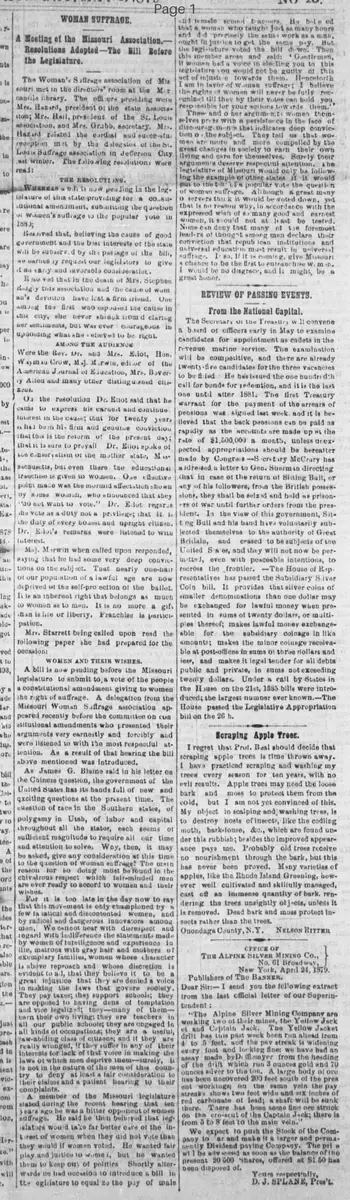
Meeting of the Missouri Association.-
Resolutions Adopted-The Bill Before
the Legislature.
The Woman's Suffrage association of Missouri
met in the directors' room at the Mercantile
library. The officers presiding were
Mrs. Hazard, president of the state associa-
tion; Mrs. Hall, president of the St. Louis
association, and Mrs. Grubb, secretary. Mrs.
Hazard related the cordial and successful
reception met by the delegates of the St.
Louis Suffrage association in Jefferson City
last winter. The following resolutions were
read:
THE RESOLUTIONS.
Whereas a bill is now pending in the leg-
islature of this state providing for a consti-
tutional amendment, submitting the question
of woman's suffrage to the popular vote in
1880;
Resolved that, believing the cause of good
government and the best interests of the state
will be subserved by the passage of the bill,
we earnestly request our legislators to give
it an early and favorable consideration.
Resolved that in the death of Mrs. Stephen
did this association and the cause of wom-
an's devotion have lost a firm friend. One
among the first who espoused the cause in
this city, she never shrank from declaring
her sentiments, but was ever courageous in
upholding what she believed to be right.
AMONG THE AUDIENCE
Were the Rev. Dr. and Mrs. Eliot, Hon.
Wayman Crow, Maj. Marvin, editor of the
American Journal of Education, Mrs. Bever-
ly Allen and many other distinguished cit-
izens.
On the resolution Dr. Eliot said that he
could not express his earnest and continued
interest in the cause; that for twenty years
it had been his firm and genuine conviction
that this is the reform of the present day;
that it is sure to prevail Dr. Eliot spoke of
the conservatism of the mother state, Mas-
sachusetts, but even there the educational
franchise is given to women. One effective
point made was the morbid affectation shown
by some women, who announced that they
do not want to vote." Dr. Eliot regards
the vote as a duty not a privilege; that it is the
duty of every honest and upright citizen.
Dr. Eliot's remarks were listened to with
interest.
Maj. Marvin when called upon responded,
saying that he had some very deep convic-
tions on the subject. That nearly one-half
of our population of a lawful age are now
depived of the self-protection of the ballot.
It is an inherent right that belongs as much
to women as to men. It is no more a gift
than is life or liberty. Franchise is partici-
pation.
Mrs. Starrett being called upon read the
following paper she had prepared for the
occasion:
WOMEN AND THEIR WISHES.
A bill is now pending before the Missouri
legislature to submit to a vote of the people
a constitutional amendment giving to women
the right of suffrage. A delegation from the
Missouri Woman Suffrage association ap-
peared recently before the committee on con-
stitutional amendments who presented their
arguments very earnestly and forcibly and
were listened to with the most respectful at-
tention, As a result of that hearing the bill
above mentioned was introduced.
As James G. Blaine said in his letter on
the Chinese question, the government of the
United States has its hands full of new and
exciting questions at the present time. The
question of race in the Southern states, of
polygamy in Utah, of labor and capital
throughout all the states, each seems of
sufficient magnitude to require all our time
and attention to solve, Why, then, it may
be asked, give any consideration at this time
to the question of Woman suffrage? The main
reason for so doing must be found in the
chivalrous respect which fair-minded men
are ever ready to accord to women and their
wishes.
For it is too late in the day now to say
that this movement is only championed by a
few fanatical and discontented women, and
by radical and dangerous innovators among
men, We cannot hear with disrespect and
regard with indifference the statements made
by women of intelligence and experience in
life, matrons with gray hair and mothers of
exemplary families, women whose character
is above reproach and whose discretion is
evident to all, that they believe it to be a
great injustice that they are denied a voice
in making the laws that govern society.
They pay taxes; they support schools; they
are opposed to having dens of temptation
and vice legalized; they-many of them
earn their own living: they are teachers in
all our public schools; they are engaged in
all kinds of occupations; they are a useful,
law-abiding class of citizens; and if they are
really wronged, if they suffer in any of their
interests for lack of that voice in making the
law of which men deprive them--surely, it
is not in the nature of the men of this coun-
try to deny at least a fair consideration to
their claims and a patient hearing to their
complaints.
A member of the Missouri legislature
stated during the recent hearing that ten
years ago he was a bitter opponent of women
suffrage. He said he then believed that leg-
islators would take far better care of the in-
terest of women when they did not vote than
they would if women voted. He wanted fair
play and justice to women, but he wanted
them to keep out of politics Shortly after-
wards he had occasion to introduce a bill in
and female school teachers, He believed
that a woman who taught just as many hours
and did precisely the same work as a man.
ought in justice to get the same pay. But
the legislature voted the bill down. Then
this member arose and said: Gentlemen,
if women had a voice in electing you to this
legislature you would not be guilty of this
act of injustice towards them. Henceforth
I am in favor of woman suffrage; I believe
the rights of woman will never be fully rec-
ognized till they by their votes can hold you
responsible for your actions towards them.'
These and other arguments, women them-
themselves press with a persistence in the face of
discouragement from men that indicates deep convic-
tion on the subject. They tell us that wom-
en are more and more compelled by the
great changes in society to earn their own
living and care for themselves. Surely their
arguments deserve respectful attention. The
legislature of Missouri would only be follow-
ing the example of other states if it would
put to the test of a popular vote the question
of woman suffrage. Although a great many
observers think it would be voted down, yet
that is no reason why, in accordance with the
expressed wish of so many good and earnest
women, it should not at least be tested.
None can deny that many of the foremost
leaders of thought among men declare their
conviction that republican institutions and
universal education must result in universal
suffrage. If so, if it is coming, give Missouri
a chance to be the first to enfranchise wom-
en. It would be no disgrace, and it might be a
great honor.
What sub-type of article is it?
What themes does it cover?
What keywords are associated?
What entities or persons were involved?
Where did it happen?
Story Details
Key Persons
Location
St. Louis, Missouri
Event Date
Last Winter; Pending For 1880
Story Details
The Missouri Woman's Suffrage Association holds a meeting in St. Louis, reports on successful lobbying in Jefferson City, adopts resolutions supporting a constitutional amendment bill for women's suffrage vote in 1880, mourns the loss of Mrs. Stephen, and hears supportive speeches from Dr. Eliot and Maj. Marvin. Mrs. Starrett reads a paper arguing for women's right to vote based on justice, societal changes, and respect for women's wishes.