Thank you for visiting SNEWPapers!
Sign up free
The Voice Of Freedom
Montpelier, Brandon, Washington County, Rutland County, Vermont
What is this article about?
A letter from Jacksonville, East Florida, responds to a New York Sun query about the region's prospects for settlers. It describes the delightful winter climate but harsh summers, poor quality of cattle and hogs, limited agricultural yields for cotton, corn, and potatoes, challenges with frost and insects for oranges, and the detrimental impact of slavery on poor white laborers and small farmers.
Clipping
OCR Quality
Full Text
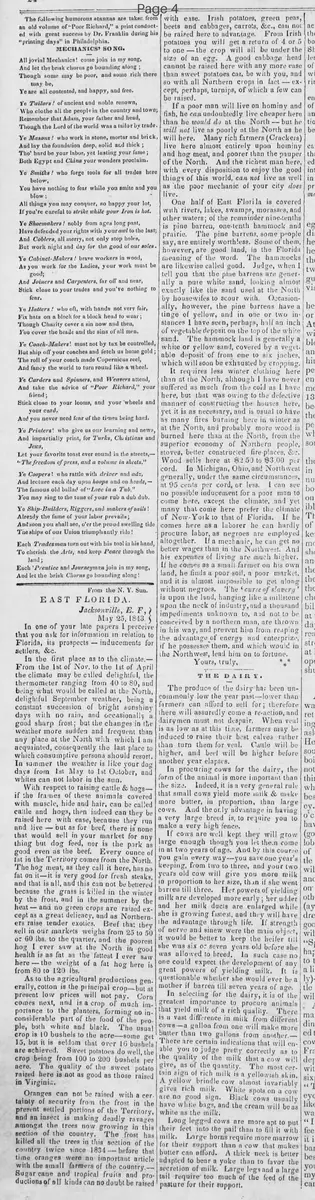
EAST FLORIDA.
Jacksonville, E. F.,
May 25, 1843.
In one of your late papers I perceive that you ask for information in relation to Florida, its prospects—inducements for settlers, &c.
In the first place as to the climate.—From the 1st of Nov. to the 1st of April the climate may be called delightful, the thermometer ranging from 40 to 80, and being what would be called at the North, delightful September weather, being a constant succession of bright sunshiny days with no rain, and occasionally a good sharp frost; but the changes in the weather more sudden and frequent than any place at the North with which I am acquainted, consequently the last place to which consumptive persons should resort.
In summer the weather is like your dog days from 1st May to 1st October, and whites can not labor in the sun.
With respect to raising cattle & hogs—if the frames of these animals covered with muscle, hide and hair, can be called cattle and hogs, then indeed can they be raised here with ease, because they run and live—but as for beef, there is none that would sell in your market for any thing but dog feed, nor is the pork as good even as the beef. Every ounce of fat in the Territory comes from the North.
The hog meat, as they call it here, has no fat on it; it is very good for fresh steaks, and that is all, and this can not be bettered because the grass is killed in the winter by the frost, and in the summer by the heat—and no green crops are raised except as a great delicacy, and as Northerners raise tender exotics. Beef that they sell in our markets weighs from 25 to 50 or 60 lbs. to the quarter, and the poorest hog I ever saw at the North in good health is as fat as the fattest I ever saw here—the weight of a fat hog here is from 80 to 120 lbs.
As to the agricultural productions generally, cotton is the principal crop—but at present low prices will not pay. Corn comes next, and is a crop of much importance to the planters, forming no inconsiderable part of the food of the people, both white and black. The usual crop is 10 bushels to the acre—some get 15, but it is seldom that over 16 bushels are achieved. Sweet potatoes do well, the crop being from 100 to 200 bushels per acre. The quality of the sweet potato raised here is not as good as those raised in Virginia.
Oranges can not be raised with a certainty of security from the frost in the present settled portions of the Territory, and an insect is making deadly ravages amongst the trees now growing in this section of the country. The frost has killed all the trees in this section of the country twice since 1834—before that time oranges were an important article with the small farmers of the country.—
Sugar cane and tropical fruits and productions of all kinds can no doubt be raised with ease. Irish potatoes, green peas, beets and cabbages, carrots, &c., can not be raised here to advantage. From Irish potatoes you will get a return of 4 or 5 to one—the crop will all be under the size of an egg. A good cabbage head cannot be raised here with any more ease than sweet potatoes can be with you, and so with all Northern crops in fact—except, perhaps, turnips, of which a few can be raised.
If a poor man will live on hominy and fish, he can undoubtedly live cheaper here than he would do at the North—but he will not live as poorly at the North as he will here. Many rich farmers (Crackers) live here almost entirely upon hominy and hog meat, and poorer than the pauper of the North. And the richest man here, with every disposition to enjoy the good things of this world, can not live as well as the poor mechanic of your city does live.
One half of East Florida is covered with rivers, lakes, swamps, morasses, and other waters; of the remainder nine-tenths is pine barren, one-tenth hammock and prairie. The pine barrens, some people say, are entirely worthless. Some of them, however, are good land, in the Florida meaning of the word. The hammocks are likewise called good. Judge, when I tell you that the pine barrens are generally a pure white sand, looking almost exactly like the sand used at the North by housewifes to scour with. Occasionally, however, the pine barrens have a tinge of yellow, and in one or two instances I have seen, perhaps, half an inch of vegetable deposit on the top of the white sand. The hammock land is generally a white or yellow sand, covered by a vegetable deposit of from one to six inches, which will soon be exhausted by cropping.
It requires less winter clothing here than at the North, although I have never suffered as much from the cold as I have here, but that was owing to the defective manner of constructing the houses here, yet it is as necessary, and is usual to have as many fires burning here in winter as at the North, and probably more wood is burned here than at the North, from the superior economy of Northern people, stoves, better constructed fire places, &c. Wood sells here at $2.50 to $3.00 per cord. In Michigan, Ohio, and Northwest generally, under the same circumstances, at 95 cents per cord, or less.
I can see no possible inducement for a poor man to come here, except the climate, and yet many that come here prefer the climate of New-York to that of Florida. If he comes here as a laborer he can hardly procure labor, as negroes are employed altogether. If a mechanic, he can get no better wages than in the Northwest. And his expenses of living are much higher.
If he comes as a small farmer on his own land, he finds a poor soil, a poor market, and it is almost impossible to get along without negroes. The curse of slavery is upon the land, hanging like a millstone upon the neck of industry, and a thousand impediments unknown to, and not to be conceived by a northern man, are thrown in his way, and prevent him from reaping the advantage of energy and enterprize, if he possesses them, and which would in the Northwest, lead him on to fortune.
Yours, truly,
THE DAIRY.
What sub-type of article is it?
What themes does it cover?
What keywords are associated?
What entities or persons were involved?
Letter to Editor Details
Author
The Dairy
Recipient
N. Y. Sun
Main Argument
east florida offers few inducements for poor settlers due to extreme climate, poor soil and agricultural yields, inferior livestock, high living costs, and the hindering effects of slavery on white labor and small farming.
Notable Details