Thank you for visiting SNEWPapers!
Sign up free
Editorial
April 10, 1821
The Rhode Island American, And General Advertiser
Providence, Providence County, Rhode Island
What is this article about?
An editorial criticizes the Republican Convention in Rhode Island for nominating General Gibbs with minimal initial support (13 votes on first ballot, rising to 38 via coercion), questioning if freemen will endorse this unrepresentative choice over James Fenner.
Clipping
OCR Quality
96%
Excellent
Full Text
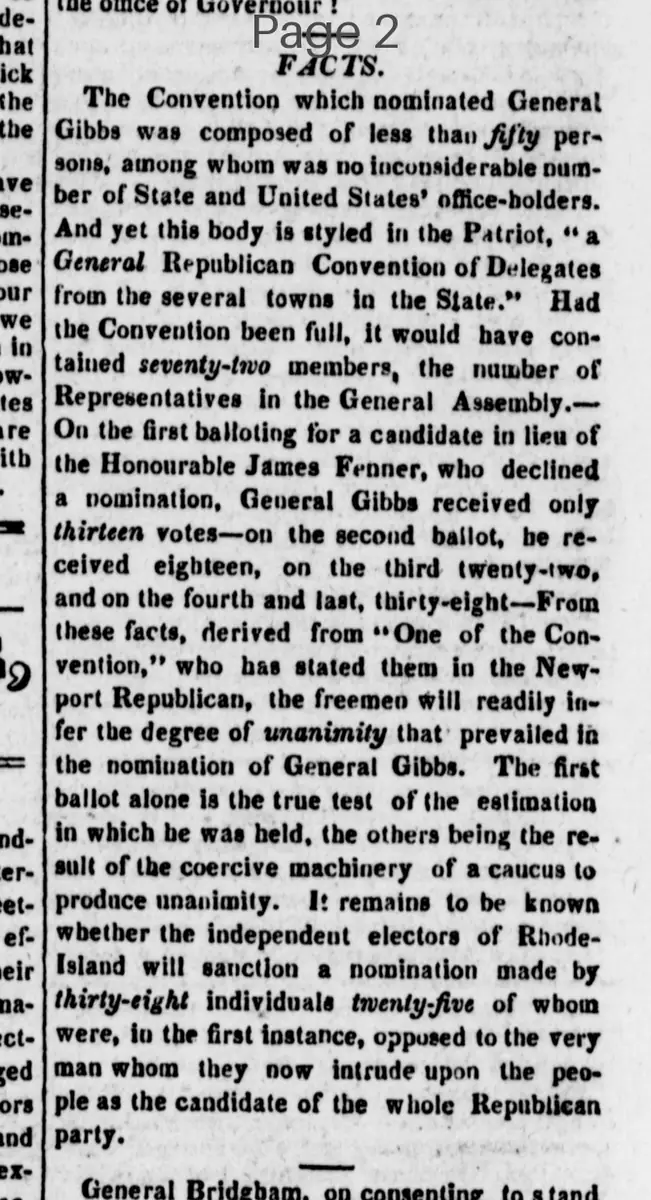
FACTS.
The Convention which nominated General Gibbs was composed of less than fifty persons, among whom was no inconsiderable number of State and United States' office-holders.
And yet this body is styled in the Patriot, "a General Republican Convention of Delegates from the several towns in the State." Had the Convention been full, it would have contained seventy-two members, the number of Representatives in the General Assembly.
On the first balloting for a candidate in lieu of the Honourable James Fenner, who declined a nomination, General Gibbs received only thirteen votes--on the second ballot, he received eighteen, on the third twenty-two, and on the fourth and last, thirty-eight--From these facts, derived from "One of the Convention," who has stated them in the Newport Republican, the freemen will readily infer the degree of unanimity that prevailed in the nomination of General Gibbs. The first ballot alone is the true test of the estimation in which he was held, the others being the result of the coercive machinery of a caucus to produce unanimity. It remains to be known whether the independent electors of Rhode-Island will sanction a nomination made by thirty-eight individuals, twenty-five of whom were, in the first instance, opposed to the very man whom they now intrude upon the people as the candidate of the whole Republican party.
The Convention which nominated General Gibbs was composed of less than fifty persons, among whom was no inconsiderable number of State and United States' office-holders.
And yet this body is styled in the Patriot, "a General Republican Convention of Delegates from the several towns in the State." Had the Convention been full, it would have contained seventy-two members, the number of Representatives in the General Assembly.
On the first balloting for a candidate in lieu of the Honourable James Fenner, who declined a nomination, General Gibbs received only thirteen votes--on the second ballot, he received eighteen, on the third twenty-two, and on the fourth and last, thirty-eight--From these facts, derived from "One of the Convention," who has stated them in the Newport Republican, the freemen will readily infer the degree of unanimity that prevailed in the nomination of General Gibbs. The first ballot alone is the true test of the estimation in which he was held, the others being the result of the coercive machinery of a caucus to produce unanimity. It remains to be known whether the independent electors of Rhode-Island will sanction a nomination made by thirty-eight individuals, twenty-five of whom were, in the first instance, opposed to the very man whom they now intrude upon the people as the candidate of the whole Republican party.
What sub-type of article is it?
Partisan Politics
What keywords are associated?
Republican Convention
General Gibbs
Nomination Process
Caucus Coercion
Rhode Island Electors
Political Unanimity
What entities or persons were involved?
General Gibbs
Honourable James Fenner
Republican Convention
State And United States' Office Holders
Freemen Of Rhode Island
Editorial Details
Primary Topic
Criticism Of The Republican Convention's Nomination Of General Gibbs
Stance / Tone
Opposition To Coerced Nomination And Lack Of Genuine Support
Key Figures
General Gibbs
Honourable James Fenner
Republican Convention
State And United States' Office Holders
Freemen Of Rhode Island
Key Arguments
Convention Composed Of Less Than Fifty Persons, Including Many Office Holders
Misrepresented As A Full General Republican Convention Of Delegates
Full Convention Would Have Seventy Two Members
Gibbs Received Only Thirteen Votes On First Ballot, Increasing To Thirty Eight On Fourth Due To Coercion
First Ballot Shows True Estimation; Others Result Of Caucus Machinery
Questions Whether Independent Electors Will Sanction Nomination By Thirty Eight, Twenty Five Initially Opposed