Thank you for visiting SNEWPapers!
Sign up free
National Gazette
Philadelphia, Philadelphia County, Pennsylvania
What is this article about?
Reports from European papers detail General Dumourier's defection in April 1793, including letters announcing arrest of commissioners, plans to restore monarchy, and march on Paris. He describes army betrayal and flees to Austrians. National Convention declares him traitor, offers reward, and reports military successes and defenses on northern frontiers.
Merged-components note: Continuation of the 'FOREIGN AFFAIRS' article on Dumourier's defection across pages 2 and 3, as the text directly connects with the incomplete sentence at the end of the first part.
Clippings
1 of 2
OCR Quality
Full Text
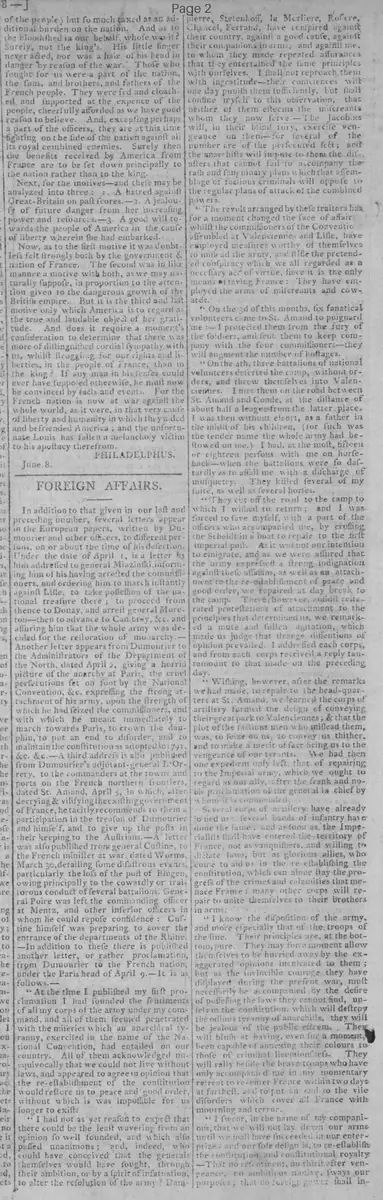
In addition to that given in our last and preceding number, several letters appear in the European papers, written by Dumourier and other officers, to different persons, on or about the time of his desertion. Under the date of April 1, is a letter by him addressed to general Miazinski, informing him of his having arrested the commissioners, and ordering him to march instantly against Lisle, to take possession of the national treasure there; to proceed from thence to Douay, and arrest general Moreton—then to advance to Cambray, &c. and assuring him that the whole army was decided for the restoration of monarchy.—Another letter appears from Dumourier to the Administrators of the Department of the North, dated April 2, giving a horrid picture of the anarchy at Paris, the cruel persecutions set on foot by the National Convention, &c. expressing the strong attachment of his army, upon the strength of which he had seized the commissioners, and with which he meant immediately to march towards Paris, to crown the dauphin, to put an end to disorder, and to maintain the constitution as adopted in 1791, &c. &c.—A third address is also published from Dumourier's adjutant-general L. Orrery, to the commanders at the towns and ports on the French northern frontiers, dated St. Amand, April 5. in which, after decrying & vilifying the existing government of France, he tacitly recommends to them a participation in the treason of Dumourier and himself, and to give up the posts in their keeping to the Austrians.—A letter was also published from general Custine, to the French minister at war, dated Worms, March 30, detailing some disastrous events, particularly the loss of the post of Bingen, owing principally to the cowardly or traitorous conduct of several battalions. General Poire was left the commanding officer at Mentz, and other inferior officers in whom he could repose confidence: Custine himself was preparing to cover the entrance of the departments of the Rhine.—In addition to these there is published another letter, or rather proclamation, from Dumourier to the French nation, under the Paris head of April 9.—It is as follows.—
"At the time I published my first proclamation I had sounded the sentiments of all my corps of the army under my command, and all of them seemed penetrated with the miseries which an anarchical tyranny, exercised in the name of the National Convention, had entailed on our country. All of them acknowledged unequivocally that we could not live without laws, and appeared to agree in opinion that the re-establishment of the constitution would restore us to peace and good order, without which it was impossible for us longer to exist.
"I had not as yet reason to expect that there could be the least wavering from an opinion so well founded, and which also passed unanimous; and, indeed, who could have conceived that the generals themselves would have sought, through their ambition, or by a spirit of infatuation, to alter the resolution of the army? Dampierre, Stenenlo. la Merliere, Rosere, Chancel, Ferrand, have conspired against their country, against a good cause, against their companions in arms, and against me. to whom they made repeated assurances that they entertained the same principles with ourselves. I shall not reproach them with ingratitude—their consciences will one day punish them sufficiently, but shall confine myself to this observation, that neither of them esteems the miscreants whom they now serve—The Jacobins will, in their blind fury, exercise vengeance on them—for several of the number are of the persecuted sect; and the anarchists will impute to them the disasters that cannot fail to accompany the rash and insane sanguinary plans which that assembly of factious criminals will oppose to the regular plans of attack of the combined powers.
"The revolt arranged by these traitors has for a moment changed the face of affairs whilst the commissioners of the Convention assembled at Valenciennes and Lisle, have employed measures worthy of themselves to mislead the army, and to use the pretended conspiracy which we all regarded as a necessary act of virtue, since it is the only means saving France: They have employed the arms of miscreants and cowards.
On the 3d of this month, six fanatical volunteers came to St. Amand to poniard me:—I protected them from the fury of the soldiers, and sent them to keep company with the four commissioners—they will augment the number of hostages.
On the 4th. three battalions of national volunteers deserted the camp, without orders, and threw themselves into Valenciennes. I met them on the road between St. Amand and Conde. at the distance of about half a league from the latter place. I was then without escort, as a father in the midst of his children, (for such was the tender name the whole army had bestowed on me.) I had, at the most, fifteen or eighteen persons with me on horseback—when the battalions were so dastardly as to assail me with a discharge of musketry. They killed several of my suite, as well as several horses.
They cut off the road to the camp to which I wished to return: and I was forced to save myself, with a part of the officers who accompanied me, by crossing the Scheldt in a boat to repair to the first imperial post. As it was not our intention to emigrate, and as we were assured that the army expressed a strong indignation against these assassins, as well as an attachment to the re-establishment of peace and good order, we repaired at day break to the camp. There, however, amidst reiterated protestations of attachment to the principles that determined us, we remarked a mute and sullen agitation, which made us judge that strange dissensions of opinion prevailed. I addressed each corps, and from each corps received a reply tantamount to that made on the preceding day.
"Wishing, however, after the remarks we had made, to repair to the head-quarters at St. Amand. we learned the corps of artillery formed the design of conveying their great park to Valenciennes; & that the plot of the factious men who mislead them, was, to seize on us, to convey us thither, and to make a merit of acting us to the vengeance of our tyrants. We had then one expedient only left, that of repairing to the Imperial army. which we ought to regard as our ally, after the frank and noble proclamation of the general in chief by a whom it is commanded
Several corps of artillery have already joined us: several bands of infantry have done the same, and as soon as the Imperialists shall have entered the territory of France, not as vanquishers. and willing to dictate laws, but as glorious allies, who come to aid us in the re-establishing the constitution, which can alone stay the progress of the crimes and calamities that menace France: many other corps will repair to unite themselves to their brothers in arms.
"I know the disposition of the army. and more especially that of the troops of the line. Their principles are, at the bottom, pure. They may for a moment allow themselves to be hurried away by the exaggerated opinions inculcated to them; but as the invincible courage they have displayed during the present war, must necessarily be accompanied by the desire of possessing the laws they cannot find, unless in the constitution. which will destroy the odious tyranny of anarchists, they will be jealous of the public esteem. They will blush at having, even for a moment, been capable of annexing their colours to those of criminal licentious. They will rally before the brave troops who have only accompanied me in my momentary retreat to re-enter France within two days at farthest, and to put an end to the vile disorders which cover all France with mourning and terror.
"I swear, in the name of my companions, that we will not lay down our arms until we shall have succeeded in our enterprize: and our sole design is, to re-establish the constitution and constitutional royalty —That no resentment, no thirst after vengeance. no ambitious motive, sways our purpose, that no foreign power shall influence our opinion; that wherever anarchy shall cease at the appearance of our arms, and those of the combined armies, we will conduct ourselves as friends and brothers; that wherever we shall meet with resistance we shall know how to select the culpable, and spare the peaceable inhabitants, the victims of the wiles of the jacobins of Paris, from whom have arisen the horrors and calamities of the war; that we shall in no way dread the poignards of Marat and the Jacobins; that we will destroy the manufacture of these poignards, as well as that of the scandalous writings by which an attempt is made to pervert the noble and generous character of the French nation; and, finally, in the name of my companions in arms, I repeat the oath, that we will live and die free.
The General in Chief of the French army.
"DUMOURIER."
Conduct of the National Convention on hearing of General Dumourier's defection, and attempt to re-establish royalty in France. &c.
The first step they took, (April 4th sitting) was, to summon the executive council to the bar, in order to preserve the peace of Paris. The commandant general of the city, Santerre, was sent for, and ordered to concert with the civil magistrate in all measures which circumstances might require. The Convention then decreed that the executive council should instantly nominate a general to succeed general Dumourier, whom they declared a traitor, and forbade him to be obeyed on pain of death and confiscation, and offered a reward of 300,000 livres to any person that should bring him dead or alive to Paris. A deputy from Valenciennes announced at this day's session, that a truly patriotic spirit reigned in that city, notwithstanding the efforts of Dumourier; that there were ten thousand determined men in the camp at Maubeuge, and six thousand at Conde. Session of April 8. It was announced that general Sahudet had entered Spain with two columns of French troops, and had taken possession of the valley of Aran in the Pyrenees: 80 prisoners were taken from the Spaniards, with 60 muskets and 6000 cartridges, with the loss of only two chasseurs killed and four wounded. The following particulars were laid before the Convention, that on the 5th of April at 1 in the morning, general Deveaux entered the city of Lille, with an order from Dumourier, for the troops under general Miziereski, then stationed before Lille, to repair to his (Dumourier's) camp, under Deveaux' charge. In reply to which the administrators of Lille produced the Convention's proclamation declaring Dumourier a traitor to his country; upon which Deveaux and his attendant were arrested -that 34,000 lbs. wt. of gunpowder had arrived safe into Lille from Cassel -desertions were daily taking place from Dumourier's camp, but those who continued faithful had been incorporated with the presented to the Convention, in which were Austrians and Imperialists -a trunk was found many papers disclosing Dumourier's plans of treachery and connexion with the enemy -a Tyrolian captain was presented to the Convention, who had sworn to devote himself to the defence of the republic of France. On the 3d of February he deserted from the Imperialists, and announced were advancing against Roermond, and if to general Stingen, that 5 Prussian battalions the siege of Maestricht was not carried on with considerable forces, the French would soon be obliged to raise it. Stingen replied that he never trusted a deserter -the latter asked him, why the French army furnished provisions and forage to the enemy? Stingen said, it was a falsehood. When he went to Aix-la-Chapelle, he announced the same facts to Miranda, who paid no more regard to him than Stingen. It was moved that the Tyrolian captain should enjoy the benefit of the law which grants a pension to all foreign deserters. Referred to the military committee. The state of the northern frontiers was described to the Convention, in a letter from the commissioners Carnot and Le Sage, who represented the zeal and celerity employed in providing the most efficacious means of defence. They added, that Dumourier was abandoned by his army, and would soon be left without a companion. Upon his flight from St. Amand, several battalions had fired on him, and shot his horse from under him, and had arrested the progress of his aid-de-camp, who was unhorsed. All the heavy artillery, &c. had been safely conveyed to Valenciennes.
What sub-type of article is it?
What keywords are associated?
What entities or persons were involved?
Where did it happen?
Foreign News Details
Primary Location
French Northern Frontiers
Event Date
April 1 9, 1793
Key Persons
Outcome
dumourier defects to austrians; convention declares him traitor, offers 300,000 livres reward; arrests of commissioners and officers; desertions from dumourier's camp; french capture valley of aran with 80 prisoners, minimal losses; loss of bingen post; several killed in ambush on dumourier.
Event Details
European papers publish letters from Dumourier detailing his arrest of commissioners, plans to restore monarchy by marching on Paris, and army's support. He describes betrayal by generals and volunteers, ambush leading to his flight across Scheldt to Imperial post. Proclamation vows to re-establish 1791 constitution with Austrian aid. Custine's letter reports loss of Bingen. National Convention summons council, declares Dumourier traitor, nominates successor, reports patriotic defenses, successes in Pyrenees, arrests in Lille, and army abandonment of Dumourier.