Thank you for visiting SNEWPapers!
Sign up free
Richmond Enquirer
Richmond, Richmond County, Virginia
What is this article about?
Pseudonymous letter to Sec. of State J.Q. Adams critiques Gen. Andrew Jackson's 1818 unauthorized invasion of Spanish Florida as violating int'l law (citing Vattel), US orders, and Constitution; urges executive/Congress/public to hold him accountable to preserve national honor and republicanism.
Merged-components note: Single continuous letter from 'Algernon Sidney' to Secretary Adams critiquing Jackson's actions in Florida; text flows directly across components.
Clipping
OCR Quality
Full Text
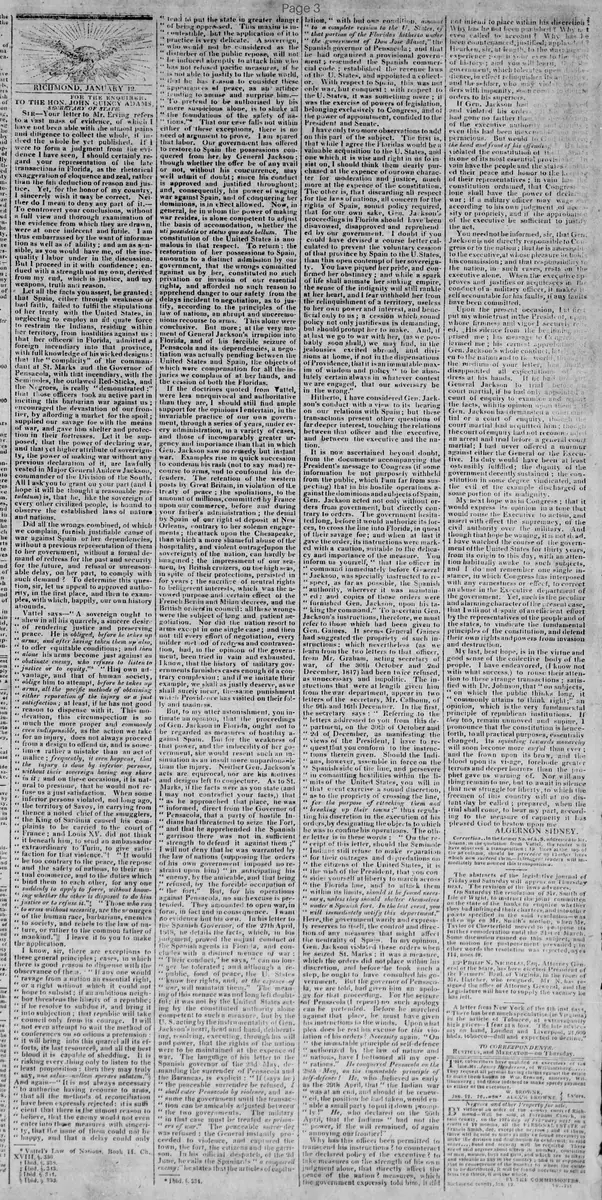
TO THE HON. JOHN QUINCY ADAMS, SECRETARY OF STATE.
SIR—Your letter to Mr. Erving refers to a vast mass of evidence, of which I have not been able with the utmost pains and diligence to collect the whole, if indeed the whole be yet published. If I were to form a judgment from the evidence I have seen, I should certainly regard your representation of the late transactions in Florida, as the rhetorical exaggeration of eloquence and zeal, rather than the fair deduction of reason and justice. Yet, for the honor of my country, I sincerely wish it may be correct. Neither do I mean to deny any part of it.—To controvert your conclusions, without a full view and thorough examination of the evidence from which they are drawn, were at once indecent and futile. I am thus embarrassed by the want of information as well as of ability; and am as sensible, as you would have me, of the inequality I labor under in the discussion. But I proceed in it with confidence; endued with a strength not my own, derived from my end, which is justice, and my weapons, truth and reason.
Let all the facts you assert, be granted: that Spain, either through weakness or bad faith, failed to fulfil the stipulations of her treaty with the United States, in neglecting to employ an adequate force to restrain the Indians, residing within her territory, from hostilities against us: that her officers in Florida, admitted a foreign incendiary into that province, with full knowledge of his wicked designs: that the "complicity" of the commandant at St. Marks and the Governor of Pensacola, with that incendiary, with the Seminoles, the outlawed Red-Sticks, and the Negroes, is really "demonstrated:" that those officers took an active part in inciting this barbarian war against us: encouraged the devastation of our frontier, by affording a market for the spoil; supplied our savage foe with the means of war, and gave him shelter and protection in their fortresses. Let it be supposed; that the power of declaring war, and that yet higher attribute of sovereignty, the power of making war without any previous declaration of it, are lawfully vested in Major General Andrew Jackson, commander of the Division of the South.
All I ask you to grant on your part (and I hope it will be thought a reasonable postulation) is, that he, like the sovereign of every other civilized people, is bound to observe the established laws of nature and nations.
Did all the wrongs combined, of which we complain, furnish justifiable cause of war against Spain or her dependencies, without a previous representation of them to her government, without a formal demand of redress for the past and security for the future, and refusal or unreasonable delay, on her part, to comply with such demand? To determine this question, sir, let us appeal to approved authority, in the first place, and then to examples, with which, happily, our own history abounds.
Vattel says—“A sovereign ought to shew in all his quarrels, a sincere desire of rendering justice and preserving peace. He is obliged, before he takes up arms, and after having taken them up also, to offer equitable conditions; and then alone his arms become just against an obstinate enemy, who refuses to listen to justice or to equity.” “His own advantage, and that of human society, oblige him to attempt, before he takes up arms, all the pacific methods of obtaining either reparation of the injury or a just satisfaction; at least, if he has not good reason to dispense with it. This moderation, this circumspection is so much the more proper and commonly even indispensable, as the action we take for an injury, does not always proceed from a design to offend us, and is sometimes rather a mistake than an act of malice; frequently, it even happens, that the injury is done by inferior persons, without their sovereign having any share in it; and on these occasions, it is natural to presume, that he would not refuse us a just satisfaction. When some inferior persons violated, not long ago, the territory of Savoy, in carrying from thence a noted chief of the smugglers, the King of Sardinia caused his complaints to be carried to the court of France: and Louis XV. did not think it beneath him, to send an ambassador extraordinary to Turin, to give satisfaction for that violence.” “It would be too contrary to the peace, the repose and the safety of nations, to their mutual commerce, and to the duties which bind them to each other, for any one suddenly to apply to force, without knowing whether the other is disposed to do him justice or to refuse it.” “Those who run to arms without necessity, are the scourges of the human race, barbarians, enemies to society, and rebels to the law of nature, or rather to the common father of mankind.”
I leave it to you to make the application.
I know, sir, there are exceptions to these general principles; cases, in which there is good reason to dispense with the observance of them. “If any one would ravage from a nation an essential right, or a right without which it could not hope to subsist; if an ambitious neighbor threatens the liberty of a republic; if he resolve to subdue it, and bring it into subjection; that republic will take council only from its courage. It will not even attempt to wait the method of conferences on so odious a pretension: it will bring into this quarrel all its efforts, its last resources, and all the best blood it is capable of shedding. It is risking every thing only to listen to the least proposition: then they may truly say, una salus—nullam sperare salutem.”
And again—“It is not always necessary to authorise having recourse to arms, that all the methods of reconciliation have been expressly rejected: it is sufficient that there is the almost reason to believe, that the enemy would not even enter into these measures with sincerity, that the issue of them could not be happy, and that a delay could only tend to put the state in greater danger of being oppressed. This maxim is incontestible, but the application of it to practice is very delicate. A sovereign who would not be considered as the disturber of the public repose, will not be induced abruptly to attack him who has not refused pacific measures, if he is not able to justify to the whole world, that he has reason to consider these appearances of peace, as an artifice tending to amuse and surprise him.—To pretend to be authorised by his mere suspicions alone, is to shake all the foundations of the safety of nations.”*
That our case falls not within either of these exceptions, there is no need of argument to prove. I am spared that labor. Our government has offered to restore to Spain the possessions conquered from her by General Jackson; though whether the offer be of any avail or not, without his concurrence, may well admit of doubt; since his conduct is approved and justified throughout; and, consequently, his power of waging war against Spain, and of conquering her dominions, is in effect allowed. Now, in general, he in whom the power of making war resides, is alone competent to adjust the basis of accommodation, whether the uti possidetis or status quo ante bellum. The constitution of the United States is anomalous in that respect. To return: the restoration of her possessions to Spain, amounts to a distinct admission by our government, that the wrongs committed against us by her, constituted no such privation or invasion of our essential rights, and afforded no such reason to apprehend danger to our safety from the delays incident to negotiation, as to justify, according to the principles of the law of nations, an abrupt and unceremonious recourse to arms. This alone were conclusive. But more; at the very moment of General Jackson's irruption into Florida, and of his forcible seizure of Pensacola and its dependencies, a negotiation was actually pending between the United States and Spain, the objects of which were compensation for all the injuries we complain of at her hands, and the cession of both the Floridas.
If the doctrines quoted from Vattel, were less unequivocal and authoritative than they are, I should still find ample support for the opinions I entertain, in the invariable practice of our own government, through a series of years, under every administration, in a variety of cases, and those of incomparably greater urgency and importance than that in which Gen. Jackson saw no remedy but instant war. Examples rise in quick succession to condemn his rash (not to say mad) recourse to arms, and to confound his defenders. The retention of the western posts by Great Britain, in violation of the treaty of peace; the spoliations, to the amount of millions, committed by France upon our commerce, before and during your father's administration; the denial by Spain of our right of deposit at New Orleans, contrary to her solemn engagements; the attack upon the Chesapeake, than which a more shameful abuse of the hospitality, and violent outrage upon the sovereignty of the nation, can hardly be imagined; the impressment of our seamen, by British cruizers, on the high seas, in spite of their protections, persisted in for years: the sacrifice of neutral rights to belligerent interests, which was the avowed purpose and certain effect of the French Berlin and Milan decrees, and the British orders in council: all these wrongs were the subject of long and patient negotiation. Nor did the nation resort to arms except in one single case; and then not till every effort of negotiation, every milder method of redress and contravention, had, in the opinion of the government, been tried in vain and exhausted.
I know, that the history of military governments furnishes cases enough of a contrary complexion; and if we imitate their example, we shall as justly deserve, as we shall surely incur, the same punishment which Providence has visited on their folly and madness.
But, to my utter astonishment, you intimate an opinion, that the proceedings of Gen. Jackson in Florida, ought not to be regarded as measures of hostility against Spain. But for the weakness of that power, and the imbecility of her government, she would resent such an insinuation as an insult more unpardonable than the injury. Neither Gen. Jackson's acts are equivocal, nor are his motives and designs left to conjecture. As to St. Marks, if the facts were as you state (and I may not contradict your facts.) that "as he approached that place, he was informed," direct from the Governor of Pensacola, "that a party of hostile Indians had threatened to seize the Fort, and that he apprehended the Spanish garrison there was not in sufficient strength to defend it against them;" I will not deny that he was warranted by the law of nations (supposing the orders of his own government imposed no restraint upon him) in anticipating his enemy, by the amicable, and that being refused, by the forcible occupation of the fort. But, for his operations against Pensacola, no such excuse is pretended. They amounted to open war, in form, in fact and in consequence. I want no evidence but his own. In his letter to the Spanish Governor, of the 27th April, 1818, he details the facts, which, in his judgment, proved the unjust conduct of the Spanish agents in Florida, and concludes with a distinct menace of war: "Their conduct," he says, "can no longer be tolerated; and although a republic, fond of peace, the U. States know her rights, and, at the expense of war, will maintain them." The meaning of this menace was not long left doubtful: it was not by the United States acting by the constituted authority alone competent to such a measure, but by the U. S. acting by the instrumentality of Gen. Jackson's heart, head and hand, deliberating, resolving, executing, through his will and power, that the rights of the nation were to be maintained at the expense of war. The language of his letter to the Spanish governor of the 22d May, demanding the surrender of Pensacola and the Barrancas, is explicit: "If (says he) the peaceable surrender be refused, I shall enter Pensacola by violence, and assume the government until the transaction can be amicably adjusted between the two governments." The military "in that case must be treated as prisoners of war." The peaceable surrender was refused: the General instantly proceeded to violence, and captured the town, the fort, the citizens and the garrison. In his official despatch, of the 2d June, he hails the Spaniards "a conquered enemy:" he states that the articles of capitulation, "with but one condition, amount to a complete cession to the U. States, of that portion of the Floridas hitherto under the government of Don Jose Masot," the Spanish governor of Pensacola: and that he had organized a provisional government: rescinded the Spanish commercial code: established the revenue laws of the U. States, and appointed a collector. With respect to Spain, this was not only war, but conquest: with respect to the U. States, it was something more: it was the exercise of powers of legislation, belonging exclusively to Congress, and of the power of appointment, confided to the President and Senate.
I have only two more observations to add on this part of the subject. The first is, that while I agree the Floridas would be a valuable acquisition to the U. States, and one which it is wise and right in us to insist on, I should think them dearly purchased at the expense of our own character for moderation and justice, much more at the expense of the constitution. The other is, that discarding all respect for the laws of nations, all concern for the rights of Spain, sound policy required, that for our own sake, Gen. Jackson's proceedings in Florida should have been disavowed, disapproved and reprehended by our government. I doubt if you could have devised a course better calculated to prevent the voluntary cession of that province by Spain to the U. States, than this open contempt of her sovereignty. You have piqued her pride, and confirmed her obstinacy; and while a spark of life shall animate her sinking empire, the sense of the indignity will still rankle at her heart, and I fear withhold her from the relinquishment of a territory, useless to her own power and interest, and beneficial only to us; a cession which sound policy not only justifies us in demanding, but should prompt her to make. And, if at last we go to war with her, (as we probably soon shall,) we may find, in the jealousies excited abroad, and divisions at home, if not in the dispensations of Providence, that it is an immutable maxim of wisdom and policy "to be absolutely certain always in whatever contest we are engaged, that our adversary be in the wrong."
Hitherto, I have considered Gen. Jackson's conduct with a view to its bearing on our relations with Spain: but these transactions present other questions of far deeper interest, touching the relations between that officer and the executive, and between the executive and the nation.
It is now ascertained beyond doubt, from the documents accompanying the President's message to Congress (if some information be not purposely withheld from the public, which I am far from suspecting) that in his hostile operations against the dominions and subjects of Spain, Gen. Jackson acted not only without orders from government, but directly contrary to orders. The government hesitated long before it would authorize its forces, to cross the line into Florida, in quest of their savage foe: and when at last it gave the order, its instructions were marked with a caution, suitable to the delicacy and importance of the measure. You inform us yourself, "that the officer in command immediately before General Jackson, was specially instructed to respect, as far as possible, the Spanish authority, wherever it was maintained: and copies of those orders were furnished Gen. Jackson, upon his taking the command." To ascertain Gen. Jackson's instructions, therefore, we must refer to those which had been given to Gen. Gaines. It seems General Gaines had suggested the propriety of such instructions: which nevertheless (as we learn from the two letters to that officer, from Mr. Graham, acting secretary of war, of the 30th October and 2nd December, 1817) had been twice refused, as unnecessary and impolitic. The instructions that were at length given him from the war department, appear in two letters of the secretary, Mr. Calhoun, of the 9th and 16th December. In the first, the secretary says: "Referring to the letters addressed to you from this department, on the 30th of October and 2d of December, as manifesting the views of the President, I have to request that you conform to the instructions therein given. Should the Indians, however, assemble in force on the Spanish side of the line, and persevere in committing hostilities within the limits of the United States, you will in that event exercise a sound discretion, as to the propriety of crossing the line, for the purpose of attacking them and breaking up their towns:" thus regulating his discretion in the execution of his orders, by designating the objects to which he was to confine his operations. The other letter is in these words: "On the receipt of this letter, should the Seminole Indians still refuse to make reparation for their outrages and depredations on the citizens of the United States, it is the wish of the President, that you consider yourself at liberty to march across the Florida line, and to attack them within its limits, should it be found necessary, unless they should shelter themselves under a Spanish fort. In the last event, you will immediately notify this department."
Here, the government warily and expressly reserves to itself, the control and direction of any measures that might affect the neutrality of Spain. In my opinion, Gen. Jackson violated these orders when he seized St. Marks: it was a measure, which the orders did not place within his discretion, and before he took such a step, he ought to have consulted his government. "But the governor of Pensacola, we are told, had given him an apology for that proceeding. For the seizure of Pensacola (I repeat) no such apology can be pretended. Before he marched against that place, he must have given his instructions to the winds. Upon what plea does he rest his excuse for this violation of his orders? Necessity again. "On the immutable principle of self-defence authorized by the law of nature and nations, have I bottomed all my operations." He conquered Pensacola on the 28th—May, on the immutable principle of self-defence! He, who believed as early as the 29th April, that "the Indian war was at an end, and should it be renewed, the position he had taken, would enable a small party to put it down promptly!" He, who declared on the 26th April, that the Indians "had not the power, if the will remained, of again annoying our frontier!"
Why has this officer been permitted to transgress his instructions? to counteract the declared policy of the executive? to take measures on the strength of his own judgment alone, that directly affect the peace of the nation? measures, which the government expressly told him, it did not intend to place within his discretion?
Why has he not been punished? Why not even called to account? Why has he been countenanced, justified, applauded?
Hearken, sir, at length, to the warnings of experience: open your eyes to the page of history: and you will learn, that a government which tolerates open disobedience, in effect relinquishes its authority, and the soldier, who may violate his orders with impunity, soon comes to dictate orders to his superiors.
If Gen. Jackson had only disobeyed and violated his orders and had gone no farther than the resistance of the executive authority and dignity even this had been inexcusable and most pernicious. But would to God "this were the head and front of his offending"
He has violated the constitution of the United States in one of its most essential provisions. In vain have the people and the states intrusted their peace and honor to the high priests of their representatives; in vain has the constitution ordained, that Congress alone shall have the power of declaring war; if a military officer may wage war according to his own judgment of necessity or propriety, and if the approbation of the executive be sufficient to justify the act.
You need not be informed, sir, that Gen. Jackson is not directly responsible to Congress or to the nation; that he is amenable to the executive, at whose pleasure he holds his commission; and that responsibility to the nation, in such cases, rests on the executive alone. When the executive approves and justifies or acquiesces in the conduct of a military officer, it makes itself accountable for his faults, if any faults have been committed.
Upon the present occasion, I at first put my whole trust in the President, upon whose firmness and vigor I securely relied. His silence from the beginning surprised me: his message to Congress alarmed me: his earnest approbation of Gen. Jackson's whole conduct, lately tendered to the nation and to the world, through the medium of your letter, has finally disappointed all expectations of redress at his hands. If he had brought General Jackson to trial before a court martial, if he had only appointed a court of enquiry to examine and report on the facts, with his opinion upon them; if Gen. Jackson had demanded a court martial or a court of enquiry, though the court martial had acquitted him; though the court of enquiry had not recommended an arrest and trial before a general court martial; I had never offered a murmur against either the General or the Executive. His duty would have been at least ostensibly fulfilled: the dignity of the government decently sustained: the constitution in some degree vindicated, and the evil of the example discharged of some portion of its malignity.
My next hope was in Congress: that it would express its opinion in a tone that would rouse the Executive to action, and assert with effect the supremacy, of the civil authority over the military. And though that hope be waning, it is not dead.
I have watched the course of the government of the United States for thirty years, from its origin to this day, with an attention habitually awake to such subjects, and I do not remember one single instance, in which Congress has interposed with any earnestness or effect, to correct an abuse in the Executive department of the government. Yet, such is the peculiar and alarming character of the present case, that I will not despair of an efficient effort by the representatives of the people and of the states, to vindicate the fundamental principles of the constitution, and defend their own rights and powers from invasion and destruction.
My last, best hope, is in the virtue and good sense of the collective body of the people. I have endeavored, (I know not with what success,) to rouse their attention to these strange transactions: satisfied with Dr. Johnson, that "on subjects, on which the public thinks long, it commonly attains to think right;" an opinion, which is the very fundamental principle of republican institutions. If they too, remain unmoved and supine, I pronounce that the constitution is henceforth, to all practical purposes, essentially changed. Its squinting towards monarchy will soon become more awful than ever: and the frown upon its brow, and the blood upon its visage, forebode greater terrors and deeper horrors than the prophet gave us warning of. Nor will anything remain to me, but to await in silence that new struggle for liberty, to which the freemen of this country will at no distant day be called; prepared, when the trial shall come, to bear my part, according to the measure of capacity it has pleased God to bestow upon me.
ALGERNON SIDNEY.
What sub-type of article is it?
What themes does it cover?
What keywords are associated?
What entities or persons were involved?
Letter to Editor Details
Author
Algernon Sidney
Recipient
Hon. John Quincy Adams, Secretary Of State
Main Argument
the writer argues that general jackson's invasion of spanish florida violated the laws of nations, executive orders, and the us constitution by waging unauthorized war; criticizes the executive for approving it without accountability, warning of threats to republican institutions.
Notable Details