Thank you for visiting SNEWPapers!
Sign up free
Letter to Editor
January 2, 1817
Richmond Enquirer
Richmond, Richmond County, Virginia
What is this article about?
H. A. S. Dearborn explains the superiority of using woad in indigo vat fermentation for permanent blue dyes, critiques historical secrecy in dyeing, praises chemical advancements in European arts, and sends woad seeds. Addresses Samuel L. Mitchell.
Clipping
OCR Quality
95%
Excellent
Full Text
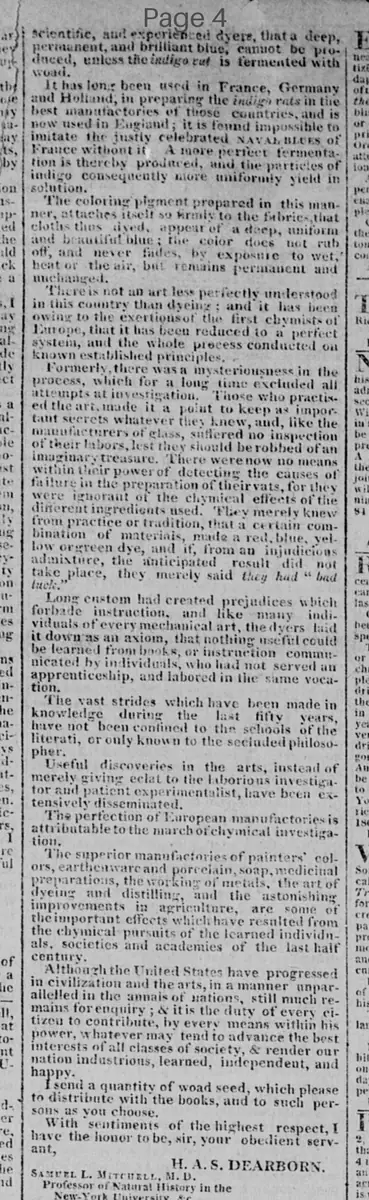
Scientific, and experienced dyers, that a deep, permanent, and brilliant blue, cannot be produced, unless the indigo vat is fermented with woad.
It has long been used in France, Germany and Holland, in preparing the indigo vats in the best manufactories of those countries, and is now used in England; it is found impossible to imitate the justly celebrated naval blues of France without it. A more perfect fermentation is thereby produced, and the particles of indigo consequently more uniformly yield in solution.
The coloring pigment prepared in this manner, attaches itself so firmly to the fabrics, that cloths thus dyed, appear of a deep, uniform and beautiful blue: the color does not rub off, and never fades, by exposure to wet, heat or the air, but remains permanent and unchanged.
There is not an art less perfectly understood in this country than dyeing: and it has been owing to the exertions of the first chemists of Europe, that it has been reduced to a perfect system, and the whole process conducted on known established principles.
Formerly, there was a mysteriousness in the process, which for a long time excluded all attempts at investigation. Those who practiced the art, made it a point to keep as important secrets whatever they knew, and, like the manufacturers of glass, suffered no inspection of their labors, lest they should be robbed of an imaginary treasure. There were now no means within their power of detecting the causes of failure in the preparation of their vats, for they were ignorant of the chemical effects of the different ingredients used. They merely knew from practice or tradition, that a certain combination of materials, made a red, blue, yellow or green dye, and if, from an injudicious admixture, the anticipated result did not take place, they merely said they had "bad luck."
Long custom had created prejudices which forbade instruction, and like many individuals of every mechanical art, the dyers laid it down as an axiom, that nothing useful could be learned from books, or instruction communicated by individuals, who had not served an apprenticeship, and labored in the same vocation.
The vast strides which have been made in knowledge during the last fifty years, have not been confined to the schools of the literati, or only known to the secluded philosopher.
Useful discoveries in the arts, instead of merely giving eclat to the laborious investigator and patient experimentalist, have been extensively disseminated.
The perfection of European manufactories is attributable to the march of chemical investigation.
The superior manufactories of painters' colors, earthenware and porcelain, soap, medicinal preparations, the working of metals, the art of dyeing and distilling, and the astonishing improvements in agriculture, are some of the important effects which have resulted from the chemical pursuits of the learned individuals, societies and academies of the last half century.
Although the United States have progressed in civilization and the arts, in a manner unparalleled in the annals of nations, still much remains for enquiry; & it is the duty of every citizen to contribute, by every means within his power, whatever may tend to advance the best interests of all classes of society, & render our nation industrious, learned, independent, and happy.
I send a quantity of woad seed, which please to distribute with the books, and to such persons as you choose.
With sentiments of the highest respect, I have the honor to be, sir, your obedient servant,
H. A. S. DEARBORN.
SAMUEL L. MITCHELL, M. D.
Professor of Natural History in the New-York University, &c.
It has long been used in France, Germany and Holland, in preparing the indigo vats in the best manufactories of those countries, and is now used in England; it is found impossible to imitate the justly celebrated naval blues of France without it. A more perfect fermentation is thereby produced, and the particles of indigo consequently more uniformly yield in solution.
The coloring pigment prepared in this manner, attaches itself so firmly to the fabrics, that cloths thus dyed, appear of a deep, uniform and beautiful blue: the color does not rub off, and never fades, by exposure to wet, heat or the air, but remains permanent and unchanged.
There is not an art less perfectly understood in this country than dyeing: and it has been owing to the exertions of the first chemists of Europe, that it has been reduced to a perfect system, and the whole process conducted on known established principles.
Formerly, there was a mysteriousness in the process, which for a long time excluded all attempts at investigation. Those who practiced the art, made it a point to keep as important secrets whatever they knew, and, like the manufacturers of glass, suffered no inspection of their labors, lest they should be robbed of an imaginary treasure. There were now no means within their power of detecting the causes of failure in the preparation of their vats, for they were ignorant of the chemical effects of the different ingredients used. They merely knew from practice or tradition, that a certain combination of materials, made a red, blue, yellow or green dye, and if, from an injudicious admixture, the anticipated result did not take place, they merely said they had "bad luck."
Long custom had created prejudices which forbade instruction, and like many individuals of every mechanical art, the dyers laid it down as an axiom, that nothing useful could be learned from books, or instruction communicated by individuals, who had not served an apprenticeship, and labored in the same vocation.
The vast strides which have been made in knowledge during the last fifty years, have not been confined to the schools of the literati, or only known to the secluded philosopher.
Useful discoveries in the arts, instead of merely giving eclat to the laborious investigator and patient experimentalist, have been extensively disseminated.
The perfection of European manufactories is attributable to the march of chemical investigation.
The superior manufactories of painters' colors, earthenware and porcelain, soap, medicinal preparations, the working of metals, the art of dyeing and distilling, and the astonishing improvements in agriculture, are some of the important effects which have resulted from the chemical pursuits of the learned individuals, societies and academies of the last half century.
Although the United States have progressed in civilization and the arts, in a manner unparalleled in the annals of nations, still much remains for enquiry; & it is the duty of every citizen to contribute, by every means within his power, whatever may tend to advance the best interests of all classes of society, & render our nation industrious, learned, independent, and happy.
I send a quantity of woad seed, which please to distribute with the books, and to such persons as you choose.
With sentiments of the highest respect, I have the honor to be, sir, your obedient servant,
H. A. S. DEARBORN.
SAMUEL L. MITCHELL, M. D.
Professor of Natural History in the New-York University, &c.
What sub-type of article is it?
Informative
Persuasive
Reflective
What themes does it cover?
Science Nature
Commerce Trade
What keywords are associated?
Dyeing
Indigo
Woad
Blue Dye
Chemical Investigation
Manufactories
Scientific Progress
What entities or persons were involved?
H. A. S. Dearborn
Samuel L. Mitchell, M. D.
Letter to Editor Details
Author
H. A. S. Dearborn
Recipient
Samuel L. Mitchell, M. D.
Main Argument
advocates the use of woad in fermenting indigo vats to produce a deep, permanent, and brilliant blue dye that attaches firmly to fabrics and does not fade, emphasizing the historical secrecy and recent chemical advancements in dyeing that have improved manufactories.
Notable Details
References Practices In France, Germany, Holland, And England
Highlights Impossibility Of Imitating French Naval Blues Without Woad
Discusses Evolution From Secretive Trade To Scientific Principles
Mentions Sending Woad Seed For Distribution