Thank you for visiting SNEWPapers!
Sign up free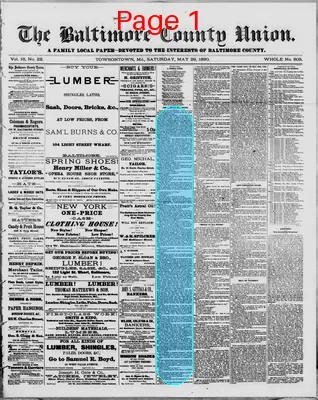
Literary
May 29, 1880
Event 1 of 2
The Baltimore County Union
Towson, Baltimore County, Maryland
What is this article about?
Paul Ross, orphaned heir to a million-dollar estate, falls into dissipation. His uncle orchestrates the apparent loss of his fortune via agent Lamb to reform him. Paul takes a clerkship at Wildwood mills, regains health, marries Delia Gray, and upon fortune's return, develops 'Eden of Wildwood' as healthful homes for city toilers.
Clipping

OCR Quality
88%
Good
Full Text
This is Event 1 of 2. The full text below covers all events in this component.
THE EDEN OF WILDWOOD.
Paul Ross was thunderstruck. For once in his life he was aroused to something like consideration of a subject in hand.
Paul was four-and-twenty. At the age of eighteen he had been left an orphan, and heir to an estate worth a million; and his uncle—his mother's brother—had been appointed his guardian. This uncle was Abijah Betts, an enterprising merchant and a true-hearted man. After Paul came of age, and became master of his property, through the advice of his uncle he employed a lawyer named Lamb to act as his agent—to look after rents, and so on—and gradually this Lamb, who proved to be an apt and ready man of business, had gotten into his hands the entire control of the whole property: and so implicitly had Paul trusted him that he had not even demanded vouchers for his bank transactions.
In fact, Paul Ross had degenerated into a listless, aimless being. His natural abilities, of the very highest order, had been prostituted to the most useless of all pursuits—the mere seeking of pleasure for the purpose of killing time. At first he had lived moderately: his youthful vigor had held him aloof from the need of stimulants: but of late a long-continued round of dissipation—parties, balls, clubs and billiards, in which was appropriated to wakefulness and the day to sleep—had so reduced his physical vim that without stimulant he found no comfort.
And now Abijah Betts had come to inform him that Lamb had left the country with every available scrap of his property.
"Do you mean," gasped Paul, when he could breathe, "that he has taken all?"
"Yes—everything. You had allowed him such unlimited sway that he found no difficulty in getting every dollar into his hands."
"And I am penniless?"
"You know best whether you had any of your property invested in business."
"Not a penny."
"Then I fear that you have little at hand which you can call your own."
"In Heaven's sake, Uncle Abijah, what shall I do? Pray tell me?"
"Really, Paul, I see but two ways open to you. You can lie down, and wither and die under the stroke, or you can do as thousands of others have done in misfortune—arouse yourself, put on the armor of true manhood, and fight the battle bravely."
"I must earn my own living?"
"It would seem so."
"And how?"
"I can give you a place in my store."
"No, no, I cannot commence the battle here—not here in the city, where I have led the van of folly and dissipation. Let me have time to think."
"All right, my boy; and meantime I will be thinking too."
On the following day Mr. Betts called again: but Paul had not thought what he would do.
"What have you thought, uncle?"
"I'll tell you what I have thought, my boy.—Back in the country—and yet not very far from the city—are the mills owned by my friend Somes. They are in a quiet, secluded village, the inhabitants of which are mostly his own operatives. Mr. Somes will give you a clerkship there, and the pay will be ample for your support."
"But," said Paul, "may we not find Lamb?"
"As yet we have been unable to gain any clue to his whereabouts. He is a man not easy to be entrapped. But we can try further, if you please. I will go up and look at the mills."
And so Paul Ross went up to Wildwood, as Mr. Somes had named his settlement, and he found it rural and retired enough. But it was a beautiful spot, nevertheless, and he had a strong inclination to accept the proffered situation. He returned to the city on the day of the evening of Mrs. Salom's grand party. He was wondering if he had better go, when he learned from a servant of the house that no invitation had been sent him. On that very afternoon he met the Misses Salom on the avenue, and they did not acknowledge his salutation.
"So, so!" he muttered. "And that is all I am worth to them!"
For a little time his heart sunk, but he soon rallied again.
"Come, come, my boy," he exclaimed, smiting himself upon the breast, "there may be something in life yet. Be brave!"
And on the very next day he accepted the clerkship at the Wildwood mills, and entered at once upon his duties. For a time he found it dull, hard work: but gradually his health improved, and the vigor of youth came back to him; and under simple living his muscles grew and strengthened, and his whole frame came into perfect tune of manly beauty and elasticity. And now his duties became light and cheering and he sung and whistled at his work: his natural buoyancy was returning.
The overseer of the mills was Mr. Gray, and with him Paul found a home. Mr. Gray's daughter, Delia, was a healthful, light-hearted, true-spirited girl of nineteen. She was one of those blonde beauties whose whole presence is sunshine, and her merry laugh rippled like the music of dancing waters in the pebbly brooklet. The student of human nature who heard that laugh would unhesitatingly declare that only a heart of native purity and gentleness could underlie it.
At first Delia Gray, when she saw that Paul Ross was weak and dejected, sought to cheer and entertain him. She had heard the story of his great loss, and she pitied him. She played for him upon the harp and upon the piano, and she sang to him and talked with him.
But, by-and-by, when he had grown strong and vigorous, and when his innate manhood had manifested itself, she grew shy and taciturn, and finally sought to avoid him.
And then, for the first time in his life, Paul knew what true love was. For the first time he experienced that sense of devotion which leads the heart to offer itself upon the altar of faith in the woman loved. He asked Mr. Gray if he might seek his daughter's love. The overseer did not object.
And Delia? Had Paul been as versed in reading the human heart in its native truth as he had been in translating the siren song of flattery, he might have known that the love of the beautiful girl was all his own.
So, when Paul Ross had been a year at Wildwood Delia became his wife, and he was happy—happier far than he had ever been. And he was advanced in the mill from a clerkship to a responsible agency: and thus he had frequent occasion to visit the city, but there was nothing in its din and glare attractive to him, and he always came home with deeper and more abiding love for his own home hearthstone Wildwood.
During the first year of Paul's marriage, a branch railroad was built to Wildwood, and thus they were within an hour of the city; and the mill property was greatly enhanced in value.
Ah," said the young man one day, as he stood upon the piazza of his cottage, and looked off upon the rolling landscape of hill and dale that stretched away beyond the river, "if I only owned that sweep of land!"
"It is certainly a pleasant prospect," said his Uncle Betts, who had come up to pay him a visit.
"Ay," added Paul, "and how it must increase in value now that the railroad has opened this way."
At this juncture Delia came out and called them in to tea. She took Uncle Abijah by the arm, and told him he was her prisoner. And he bent over and kissed her, and said it would be a most blessed imprisonment.
"Don't you find it so, Paul?"
"It is, indeed, heaven where she is!" was Paul's answer.
And upon that she left Uncle Abijah, and threw her arms about her husband's neck.
"Dear Paul! you are a Messiah she lovingly murmured.
Shortly afterward the old merchant said to his nephew—
"Paul, do you ever find yourself longing for the life in the city?"
"Does the saved mariner look back with longing upon the fearful death he has escaped, and willingly return to storm and wreck?"
"I think not, my boy."
"And can a man, in his full senses, long for the dazzle and glare of the empty life that brings only pain and unrest, when a bright spirit like this holds watch and ward for him over an earthly heaven?"
He held his wife by the hand as he spoke, and his eye was radiant with a light supernatural.
It was on the following day—a beautiful day in early autumn—that Paul and Delia walked out upon the gentle hill that sloped up from the cottage. And again he looked off upon the grand spread of landscape beyond the river.
"Ah," he said, "if I owned that land I would do a great work, Delia."
"What would you do, Paul?" asked a voice behind him.
He turned, and beheld his uncle.
"If you were the owner of that land, what would you do with it?"
"I would make it bloom with life!" replied the youth, eloquently. "Think, now that the railroad is laid, how near it is to the city. Think of the toilers there who might find light and comfort in these healthful shades. If I owned that land, I would invite capital to open it to the life that ought to occupy it. I would lay out streets, and portion off lots for dwellings, each with its garden; and I would call it the Eden of Wildwood."
"And suppose you had the capital of your own my boy?"
"The Eden Wildwood an actual verity."
A shadow passed over the old man's face, and then came a shining light. He reached out and took his nephew's hand.
"Paul, the capital is yours—the land is yours, also."
Paul would have laughed if his uncle had not looked so solemnly upon him while he spoke. As it was, he simply exhibited bewilderment.
"I heard you express an earnest wish to own the land, and secured it for you," continued Betts.
"Uncle! This is a serious jest."
"It is no jest, Paul. In one word—Lamb has returned."
"Lamb—returned!"
"Yes, and your fortune is safe."
Paul Ross was not sure that he was in his waking senses. His uncle was not the man to utter such language jestingly.
"It is true, my boy. Lamb has returned, and every dollar that he ever had of yours is not only safe, but the amount is well-nigh doubled."
"Uncle Abijah—what is this?"
"Do you not guess?"
"I dare not. Tell me."
Again the old man took his nephew's hand, and, after a brief pause, he answered—
"Paul, you may blame me if you please—you may heap wrath upon my head if you like—but you must know that Lamb has only acted at my bidding. I sent him away, and he stayed away until I called him back. I saw you failing and sinking, my boy. I saw my sister's son wasting and dying of a disease which could not be cured except he could be lifted up from the pit into which he had fallen. I saw his young manhood—so full of native power and goodness—bowed and—"
"Stop! stop!" said Paul, raising his other hand.
"I see it all."
"And do you blame me?"
"Blame you!"
"Ay, do you blame for the hard, harsh remedy I applied?"
"Blame you, uncle! Shall I blame you for my salvation? Shall I blame you for my manhood's health and strength and vigor? Shall I blame you for—this?" And he let go his uncle's hand, and drew his wondering wife to his side. "I only pray to God that the return of the lost wealth may not cause my wife to love me less. It can never overshadow with its bulk these other joys which have grown up from the better life."
It was all as Uncle Betts had said.
Lamb had gone away at his order, having first secured the property so that no harm could befall it—and it had all been done that Paul might be thrown upon his own resources, and thus saved from the sloth that was eating away his young life. And it had worked very well.
And when Paul Ross had received back his great fortune, he was true to the promise he had made concerning the beautiful tract of land beyond the river: and this is the true story of how the toilers of the city came to be blessed with those pleasant, healthful homes in the Eden of Wildwood.
Paul Ross was thunderstruck. For once in his life he was aroused to something like consideration of a subject in hand.
Paul was four-and-twenty. At the age of eighteen he had been left an orphan, and heir to an estate worth a million; and his uncle—his mother's brother—had been appointed his guardian. This uncle was Abijah Betts, an enterprising merchant and a true-hearted man. After Paul came of age, and became master of his property, through the advice of his uncle he employed a lawyer named Lamb to act as his agent—to look after rents, and so on—and gradually this Lamb, who proved to be an apt and ready man of business, had gotten into his hands the entire control of the whole property: and so implicitly had Paul trusted him that he had not even demanded vouchers for his bank transactions.
In fact, Paul Ross had degenerated into a listless, aimless being. His natural abilities, of the very highest order, had been prostituted to the most useless of all pursuits—the mere seeking of pleasure for the purpose of killing time. At first he had lived moderately: his youthful vigor had held him aloof from the need of stimulants: but of late a long-continued round of dissipation—parties, balls, clubs and billiards, in which was appropriated to wakefulness and the day to sleep—had so reduced his physical vim that without stimulant he found no comfort.
And now Abijah Betts had come to inform him that Lamb had left the country with every available scrap of his property.
"Do you mean," gasped Paul, when he could breathe, "that he has taken all?"
"Yes—everything. You had allowed him such unlimited sway that he found no difficulty in getting every dollar into his hands."
"And I am penniless?"
"You know best whether you had any of your property invested in business."
"Not a penny."
"Then I fear that you have little at hand which you can call your own."
"In Heaven's sake, Uncle Abijah, what shall I do? Pray tell me?"
"Really, Paul, I see but two ways open to you. You can lie down, and wither and die under the stroke, or you can do as thousands of others have done in misfortune—arouse yourself, put on the armor of true manhood, and fight the battle bravely."
"I must earn my own living?"
"It would seem so."
"And how?"
"I can give you a place in my store."
"No, no, I cannot commence the battle here—not here in the city, where I have led the van of folly and dissipation. Let me have time to think."
"All right, my boy; and meantime I will be thinking too."
On the following day Mr. Betts called again: but Paul had not thought what he would do.
"What have you thought, uncle?"
"I'll tell you what I have thought, my boy.—Back in the country—and yet not very far from the city—are the mills owned by my friend Somes. They are in a quiet, secluded village, the inhabitants of which are mostly his own operatives. Mr. Somes will give you a clerkship there, and the pay will be ample for your support."
"But," said Paul, "may we not find Lamb?"
"As yet we have been unable to gain any clue to his whereabouts. He is a man not easy to be entrapped. But we can try further, if you please. I will go up and look at the mills."
And so Paul Ross went up to Wildwood, as Mr. Somes had named his settlement, and he found it rural and retired enough. But it was a beautiful spot, nevertheless, and he had a strong inclination to accept the proffered situation. He returned to the city on the day of the evening of Mrs. Salom's grand party. He was wondering if he had better go, when he learned from a servant of the house that no invitation had been sent him. On that very afternoon he met the Misses Salom on the avenue, and they did not acknowledge his salutation.
"So, so!" he muttered. "And that is all I am worth to them!"
For a little time his heart sunk, but he soon rallied again.
"Come, come, my boy," he exclaimed, smiting himself upon the breast, "there may be something in life yet. Be brave!"
And on the very next day he accepted the clerkship at the Wildwood mills, and entered at once upon his duties. For a time he found it dull, hard work: but gradually his health improved, and the vigor of youth came back to him; and under simple living his muscles grew and strengthened, and his whole frame came into perfect tune of manly beauty and elasticity. And now his duties became light and cheering and he sung and whistled at his work: his natural buoyancy was returning.
The overseer of the mills was Mr. Gray, and with him Paul found a home. Mr. Gray's daughter, Delia, was a healthful, light-hearted, true-spirited girl of nineteen. She was one of those blonde beauties whose whole presence is sunshine, and her merry laugh rippled like the music of dancing waters in the pebbly brooklet. The student of human nature who heard that laugh would unhesitatingly declare that only a heart of native purity and gentleness could underlie it.
At first Delia Gray, when she saw that Paul Ross was weak and dejected, sought to cheer and entertain him. She had heard the story of his great loss, and she pitied him. She played for him upon the harp and upon the piano, and she sang to him and talked with him.
But, by-and-by, when he had grown strong and vigorous, and when his innate manhood had manifested itself, she grew shy and taciturn, and finally sought to avoid him.
And then, for the first time in his life, Paul knew what true love was. For the first time he experienced that sense of devotion which leads the heart to offer itself upon the altar of faith in the woman loved. He asked Mr. Gray if he might seek his daughter's love. The overseer did not object.
And Delia? Had Paul been as versed in reading the human heart in its native truth as he had been in translating the siren song of flattery, he might have known that the love of the beautiful girl was all his own.
So, when Paul Ross had been a year at Wildwood Delia became his wife, and he was happy—happier far than he had ever been. And he was advanced in the mill from a clerkship to a responsible agency: and thus he had frequent occasion to visit the city, but there was nothing in its din and glare attractive to him, and he always came home with deeper and more abiding love for his own home hearthstone Wildwood.
During the first year of Paul's marriage, a branch railroad was built to Wildwood, and thus they were within an hour of the city; and the mill property was greatly enhanced in value.
Ah," said the young man one day, as he stood upon the piazza of his cottage, and looked off upon the rolling landscape of hill and dale that stretched away beyond the river, "if I only owned that sweep of land!"
"It is certainly a pleasant prospect," said his Uncle Betts, who had come up to pay him a visit.
"Ay," added Paul, "and how it must increase in value now that the railroad has opened this way."
At this juncture Delia came out and called them in to tea. She took Uncle Abijah by the arm, and told him he was her prisoner. And he bent over and kissed her, and said it would be a most blessed imprisonment.
"Don't you find it so, Paul?"
"It is, indeed, heaven where she is!" was Paul's answer.
And upon that she left Uncle Abijah, and threw her arms about her husband's neck.
"Dear Paul! you are a Messiah she lovingly murmured.
Shortly afterward the old merchant said to his nephew—
"Paul, do you ever find yourself longing for the life in the city?"
"Does the saved mariner look back with longing upon the fearful death he has escaped, and willingly return to storm and wreck?"
"I think not, my boy."
"And can a man, in his full senses, long for the dazzle and glare of the empty life that brings only pain and unrest, when a bright spirit like this holds watch and ward for him over an earthly heaven?"
He held his wife by the hand as he spoke, and his eye was radiant with a light supernatural.
It was on the following day—a beautiful day in early autumn—that Paul and Delia walked out upon the gentle hill that sloped up from the cottage. And again he looked off upon the grand spread of landscape beyond the river.
"Ah," he said, "if I owned that land I would do a great work, Delia."
"What would you do, Paul?" asked a voice behind him.
He turned, and beheld his uncle.
"If you were the owner of that land, what would you do with it?"
"I would make it bloom with life!" replied the youth, eloquently. "Think, now that the railroad is laid, how near it is to the city. Think of the toilers there who might find light and comfort in these healthful shades. If I owned that land, I would invite capital to open it to the life that ought to occupy it. I would lay out streets, and portion off lots for dwellings, each with its garden; and I would call it the Eden of Wildwood."
"And suppose you had the capital of your own my boy?"
"The Eden Wildwood an actual verity."
A shadow passed over the old man's face, and then came a shining light. He reached out and took his nephew's hand.
"Paul, the capital is yours—the land is yours, also."
Paul would have laughed if his uncle had not looked so solemnly upon him while he spoke. As it was, he simply exhibited bewilderment.
"I heard you express an earnest wish to own the land, and secured it for you," continued Betts.
"Uncle! This is a serious jest."
"It is no jest, Paul. In one word—Lamb has returned."
"Lamb—returned!"
"Yes, and your fortune is safe."
Paul Ross was not sure that he was in his waking senses. His uncle was not the man to utter such language jestingly.
"It is true, my boy. Lamb has returned, and every dollar that he ever had of yours is not only safe, but the amount is well-nigh doubled."
"Uncle Abijah—what is this?"
"Do you not guess?"
"I dare not. Tell me."
Again the old man took his nephew's hand, and, after a brief pause, he answered—
"Paul, you may blame me if you please—you may heap wrath upon my head if you like—but you must know that Lamb has only acted at my bidding. I sent him away, and he stayed away until I called him back. I saw you failing and sinking, my boy. I saw my sister's son wasting and dying of a disease which could not be cured except he could be lifted up from the pit into which he had fallen. I saw his young manhood—so full of native power and goodness—bowed and—"
"Stop! stop!" said Paul, raising his other hand.
"I see it all."
"And do you blame me?"
"Blame you!"
"Ay, do you blame for the hard, harsh remedy I applied?"
"Blame you, uncle! Shall I blame you for my salvation? Shall I blame you for my manhood's health and strength and vigor? Shall I blame you for—this?" And he let go his uncle's hand, and drew his wondering wife to his side. "I only pray to God that the return of the lost wealth may not cause my wife to love me less. It can never overshadow with its bulk these other joys which have grown up from the better life."
It was all as Uncle Betts had said.
Lamb had gone away at his order, having first secured the property so that no harm could befall it—and it had all been done that Paul might be thrown upon his own resources, and thus saved from the sloth that was eating away his young life. And it had worked very well.
And when Paul Ross had received back his great fortune, he was true to the promise he had made concerning the beautiful tract of land beyond the river: and this is the true story of how the toilers of the city came to be blessed with those pleasant, healthful homes in the Eden of Wildwood.
What sub-type of article is it?
Prose Fiction
What themes does it cover?
Moral Virtue
Love Romance
What keywords are associated?
Redemption
Dissipation
Rural Life
Marriage
Fortune
Moral Reform
Literary Details
Title
The Eden Of Wildwood.