Thank you for visiting SNEWPapers!
Sign up free
Editorial
August 28, 1839
The North Carolina Standard
Raleigh, Wake County, North Carolina
What is this article about?
This editorial disputes Daniel Webster's denial of the statement 'Take care of the rich and the rich will take care of the poor,' citing his history of unreliable denials and quoting his 1820 speech advocating government founded on property, portraying it as anti-republican and favoring the wealthy over the masses.
Clipping
OCR Quality
95%
Excellent
Full Text
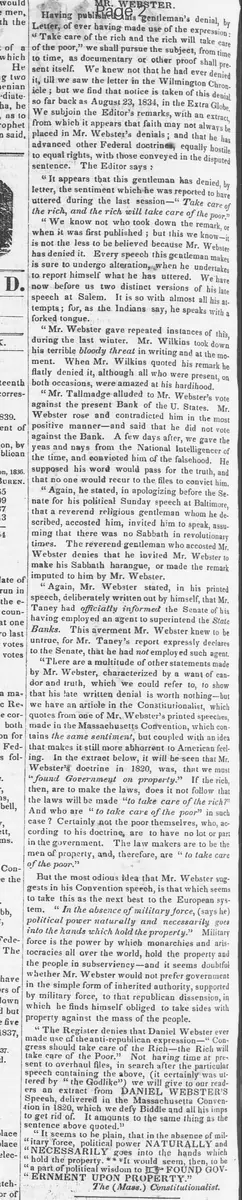
Letter, of ever having made use of the expression : Take care of the rich and the rich will take care of the poor," we shall pursue the subject, from time to time, as documentary or other proof shall present itself. We knew not that he had ever denied it, till we saw the letter in the Wilmington Chronicle ; but we find that notice is taken of this denial so far back as August 23, 1834, in the Extra Globe. We subjoin the Editor's remarks, with an extract, from which it appears that faith may not always be placed in Mr. Webster's denials ; and that he has advanced other Federal doctrines, equally hostile to equal rights, with those conveyed in the disputed sentence.' The Editor says :
" It appears that this gentleman has denied, by letter, the sentiment which he was reported to have uttered during the last session-" Take care of the rich, and the rich will take care of the poor." We know not who took down the remark, or when it was first published ; but this we know—it is not the less to be believed because Mr. Webster has denied it. Every speech this gentleman makes is sure to undergo alteration, when he undertakes to report himself what he has uttered. We have now before us two distinct versions of his late speech at Salem. It is so with almost all his attempts; for, as the Indians say, he speaks with a forked tongue.
"Mr. Webster gave repeated instances of this during the last winter. Mr. Wilkins took down his terrible bloody threat in writing and at the moment. When Mr. Wilkins quoted his remark he flatly denied it, although all who were present, on both occasions, were amazed at his hardihood.
" Mr. Tallmadge alluded to Mr. Webster's vote against the present Bank of the U. States. Mr. Webster rose and contradicted him in the most positive manner—and said that he did not vote against the Bank. A few days after, we gave the yeas and nays from the National Intelligencer of the time, and convicted him of the falsehood. He supposed his word would pass for the truth, and that no one would recur to the files to convict him.
" Again, he stated, in apologizing before the Senate for his political Sunday speech at Baltimore, that a reverend religious gentleman whom he described, accosted him, invited him to speak, assuming that there was no Sabbath in revolutionary times. The reverend gentleman who accosted Mr. Webster denies that he invited Mr. Webster to make his Sabbath harangue, or made the remark imputed to him by Mr. Webster.
"Again, Mr. Webster stated, in his printed speech, deliberately written out by himself, that Mr. Taney had officially informed the Senate of his having employed an agent to superintend the State Banks. This averment Mr. Webster knew to be untrue. for Mr. Taney's report expressly declares to the Senate, that he had not employed such agent.
"There are a multitude of other statements made by Mr. Webster, characterized by a want of candor and truth, which we could refer to, to show that his late written denial is worth nothing—but we have an article in the Constitutionalist, which quotes from one of Mr. Webster's printed speeches, made in the Massachusetts Convention, which contains the same sentiment, but coupled with an idea that makes it still more abhorrent to American feeling. In the extract below, it will be seen that Mr. Webster's doctrine in 1820, was, that we must "found Government on property." If the rich, then, are to make the laws, does it not follow that the laws will be made "to take care of the rich?" And who are "to take care of the poor" in such case? Certainly not the poor themselves, who, according to his doctrine, are to have no lot or part in the government. The law makers are to be the men of property, and, therefore, are " to take care of the poor."
But the most odious idea that Mr. Webster suggests in his Convention speech, is that which seems to take this as the next best to the European system,
" In the absence of military force, (says he) political power naturally and necessarily goes into the hands which hold the property." Military force is the power by which monarchies and aristocracies all over the world, hold the property and the people in subserviency—and it seems doubtful whether Mr. Webster would not prefer government in the simple form of inherited authority, supported by military force, to that republican dissension, in which he finds himself obliged to take sides with property against the mass of the people.
" The Register denies that Daniel Webster ever made use of the anti-republican expression—" Congress should take care of the Rich—the Rich will take care of the Poor." Not having time at present to overhaul files, in search after the particular speech containing the above, (it certainly was uttered by "the Godlike") we will give to our readers an extract from DANIEL WEBSTER'S Speech, delivered in the Massachusetts Convention in 1820, which we defy Biddle and all his imps to get rid of. It amounts to the same thing as the sentence above quoted.
" It seems to be plain, that in the absence of military force, political power NATURALLY and NECESSARILY goes into the hands which hold the property. ** *It would seem, then, to be a part of political wisdom to FOUND GOVERNMENT UPON PROPERTY."
The (Mass.) Constitutionalist.
" It appears that this gentleman has denied, by letter, the sentiment which he was reported to have uttered during the last session-" Take care of the rich, and the rich will take care of the poor." We know not who took down the remark, or when it was first published ; but this we know—it is not the less to be believed because Mr. Webster has denied it. Every speech this gentleman makes is sure to undergo alteration, when he undertakes to report himself what he has uttered. We have now before us two distinct versions of his late speech at Salem. It is so with almost all his attempts; for, as the Indians say, he speaks with a forked tongue.
"Mr. Webster gave repeated instances of this during the last winter. Mr. Wilkins took down his terrible bloody threat in writing and at the moment. When Mr. Wilkins quoted his remark he flatly denied it, although all who were present, on both occasions, were amazed at his hardihood.
" Mr. Tallmadge alluded to Mr. Webster's vote against the present Bank of the U. States. Mr. Webster rose and contradicted him in the most positive manner—and said that he did not vote against the Bank. A few days after, we gave the yeas and nays from the National Intelligencer of the time, and convicted him of the falsehood. He supposed his word would pass for the truth, and that no one would recur to the files to convict him.
" Again, he stated, in apologizing before the Senate for his political Sunday speech at Baltimore, that a reverend religious gentleman whom he described, accosted him, invited him to speak, assuming that there was no Sabbath in revolutionary times. The reverend gentleman who accosted Mr. Webster denies that he invited Mr. Webster to make his Sabbath harangue, or made the remark imputed to him by Mr. Webster.
"Again, Mr. Webster stated, in his printed speech, deliberately written out by himself, that Mr. Taney had officially informed the Senate of his having employed an agent to superintend the State Banks. This averment Mr. Webster knew to be untrue. for Mr. Taney's report expressly declares to the Senate, that he had not employed such agent.
"There are a multitude of other statements made by Mr. Webster, characterized by a want of candor and truth, which we could refer to, to show that his late written denial is worth nothing—but we have an article in the Constitutionalist, which quotes from one of Mr. Webster's printed speeches, made in the Massachusetts Convention, which contains the same sentiment, but coupled with an idea that makes it still more abhorrent to American feeling. In the extract below, it will be seen that Mr. Webster's doctrine in 1820, was, that we must "found Government on property." If the rich, then, are to make the laws, does it not follow that the laws will be made "to take care of the rich?" And who are "to take care of the poor" in such case? Certainly not the poor themselves, who, according to his doctrine, are to have no lot or part in the government. The law makers are to be the men of property, and, therefore, are " to take care of the poor."
But the most odious idea that Mr. Webster suggests in his Convention speech, is that which seems to take this as the next best to the European system,
" In the absence of military force, (says he) political power naturally and necessarily goes into the hands which hold the property." Military force is the power by which monarchies and aristocracies all over the world, hold the property and the people in subserviency—and it seems doubtful whether Mr. Webster would not prefer government in the simple form of inherited authority, supported by military force, to that republican dissension, in which he finds himself obliged to take sides with property against the mass of the people.
" The Register denies that Daniel Webster ever made use of the anti-republican expression—" Congress should take care of the Rich—the Rich will take care of the Poor." Not having time at present to overhaul files, in search after the particular speech containing the above, (it certainly was uttered by "the Godlike") we will give to our readers an extract from DANIEL WEBSTER'S Speech, delivered in the Massachusetts Convention in 1820, which we defy Biddle and all his imps to get rid of. It amounts to the same thing as the sentence above quoted.
" It seems to be plain, that in the absence of military force, political power NATURALLY and NECESSARILY goes into the hands which hold the property. ** *It would seem, then, to be a part of political wisdom to FOUND GOVERNMENT UPON PROPERTY."
The (Mass.) Constitutionalist.
What sub-type of article is it?
Partisan Politics
Economic Policy
Constitutional
What keywords are associated?
Daniel Webster
Rich And Poor
Government On Property
Political Denial
Federal Doctrines
Massachusetts Convention
What entities or persons were involved?
Daniel Webster
Mr. Wilkins
Mr. Tallmadge
Mr. Taney
Massachusetts Convention
Editorial Details
Primary Topic
Criticism Of Daniel Webster's Denial And Property Based Government Doctrine
Stance / Tone
Strongly Anti Webster And Pro Egalitarian
Key Figures
Daniel Webster
Mr. Wilkins
Mr. Tallmadge
Mr. Taney
Massachusetts Convention
Key Arguments
Webster's Denials Of Statements Are Unreliable And Often False
Webster's 1820 Speech Advocates Founding Government On Property, Favoring The Rich
This Doctrine Implies Laws Will Protect The Rich At The Expense Of The Poor
Webster's Views Align With Aristocratic Systems Using Military Force