Thank you for visiting SNEWPapers!
Sign up free
Alexandria Daily Advertiser
Alexandria, Virginia
What is this article about?
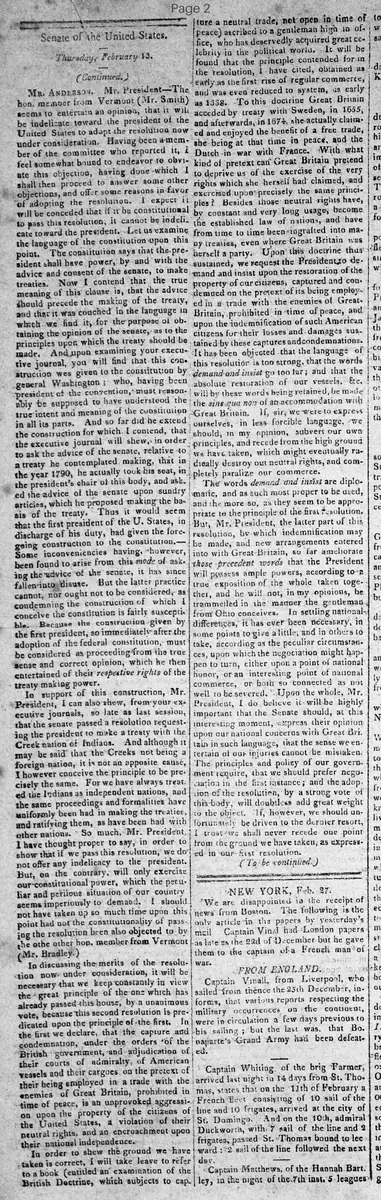
US Senate debate on February 13 where Mr. Anderson defends a resolution requesting the President to demand restoration of American vessels captured by Britain for trading with enemies during peace, citing constitutional treaty-making powers, Washington's precedents, and established neutral rights principles.
Clipping
OCR Quality
Full Text
Thursday, February 13.
(Continued.)
Mr. Anderson. Mr. President—The
hon. member from Vermont (Mr. Smith)
seems to entertain an opinion, that it will
be indelicate toward the president of the
United States to adopt the resolution now
under consideration. Having been a mem-
ber of the committee who reported it, I
feel somewhat bound to endeavor to obvi-
ate this objection, having done which I
shall then proceed to answer some other
objections, and offer some reasons in favor
of adopting the resolution. I expect it
to pass; this resolution cannot be indeli-
cate toward the president. It will be conceded that if it be constitutional
it cannot be indelicate toward the president. Let us examine
the language of the constitution upon this
point. The constitution says that the pre-
sident shall have power, by and with the
advice and consent of the senate, to make
treaties. Now I contend that the true
meaning of this clause is, that the advice
should precede the making of the treaty,
and that it was couched in the language in
which we find it, for the purpose of ob-
taining the opinion of the senate, as to the
principles upon which the treaty should be
made. And upon examining your execu-
tive journal, you will find that this con-
struction was given to the constitution by
general Washington; who, having been
president of the convention, must reason-
ably be supposed to have understood the
true intent and meaning of the constitution
in all its parts. And so far did he extend
the construction for which I contend, that
the executive journal will show, in order
to ask the advice of the senate, relative to
a treaty he contemplated making, that in
the year 1790, he actually took his seat, in
the president's chair of this body, and ask-
ed the advice of the senate upon sundry
articles, which he proposed making the ba-
sis of the treaty. Thus it would seem
that the first president of the U. States, in
discharge of his duty, had given the fore-
going construction to the constitution.—
Some inconveniences having, however,
been found to arise from this mode of ask-
ing the advice of the senate, it has since
fallen into disuse. But the latter practice
cannot, nor ought not to be considered, as
condemning the construction of which I
conceive the constitution is fairly suscepti-
ble. Because the construction given by
the first president, so immediately after the
adoption of the federal constitution, must
be considered as proceeding from the true
sense and correct opinion, which he then
entertained of their respective rights of the
treaty making power.
In support of this construction, Mr.
President, I can also show, from your ex-
ective journals, so late as last session,
that the senate passed a resolution request-
ing the president to make a treaty with the
Creek nation of Indians. And although it may be said that the Creeks not being a
foreign nation, it is not an apposite case,
I however conceive the principle to be pre-
cisely the same. For we have always treat-
ed the Indians as independent nations, and
the same proceedings and formalities have
uniformly been had in making the treaties.
and ratifying them, as have been had with
other nations. So much, Mr. President,
I have thought proper to say, in order to
show that if we pass this resolution, we do
not offer any indelicacy to the president.
But, on the contrary, will only exercise
our constitutional power, which the pecu-
liar and perilous situation of our country
seems imperiously to demand. I should
not have taken up so much time upon this
point had not the constitutionality of pass-
ing the resolution been also objected to by
the other hon. member from Vermont
(Mr. Bradley.)
In discussing the merits of the resolu-
tion now under consideration, it will be
necessary that we keep constantly in view
the great principle of the one which has
already passed this house, by a unanimous
vote, because this second resolution is pre-
dicated upon the principle of the first. In
the first we declare, that the capture and
-condemnation, under the orders of the
British government, and adjudication of
their courts of admiralty, of American
vessels and their cargoes on the pretext of
their being employed in a trade with the
enemies of Great Britain, prohibited in
time of peace, is an unprovoked aggressi-
the United States, a violation of their
on upon the property of the citizens of
neutral rights, and an encroachment upon
their national independence.
In order to show the ground we have
taken is correct, I will take leave to refer
to a book (entitled an examination of the
British Doctrine, which subjects to cap-
Iture a neutral trade not open in time of
peace) ascribed to a gentleman high in of-
fice, who has deservedly acquired great ce-
lebrity in the political world. It will be
found that the principle contended for in
the resolution, I have cited, obtained as
early as the first rise of regular commerce,
and was even reduced to system, as early
as 1338. To this doctrine Great Britain
acceded by treaty with Sweden, in 1665.
and afterwards, in 1674, she actually claim-
ed and enjoyed the benefit of a free trade,
she being at that time in peace, and the
Dutch in war with France. With what
kind of pretext can Great Britain pretend
to deprive us of the exercise of the very
rights which she herself had claimed, and
exercised upon precisely the same princi-
ples? Besides those neutral rights have,
by constant and very long usage, become
the established law of nations, and have
from time to time been ingrafted into ma-
ny treaties, even where Great Britain was
herself a party. Upon this doctrine thus
sustained; we request the President to de-
mand and insist upon the restoration of the
property of our citizens, captured and con-
demned on the pretext of its being employ-
ed in a trade with the enemies of Great-
Britain, prohibited in time of peace, and
upon the indemnification of such American
citizens for their losses and damages sus-
tained by these captures and condemnations.
It has been objected that the language of
this resolution is too strong, that the words
demand and insist go too far; and that the
absolute restoration of our vessels. &c.
will by these words being retained, be made
the sine qua non of an accommodation with
Great Britain. If, sir, we were to express
ourselves, in less forcible language. we
should, in my opinion, subvert our own
principles, and recede from the high ground
we have taken, which might eventually ra-
dically destroy our neutral rights, and com-
pletely paralyze our commerce.
The words demand and insist are diplo-
matic, and as such most proper to be used,
and the more so, as they seem to be appro-
priate to the principle of the first resolution.
But, Mr. President, the latter part of this
resolution, by which indemnification may
be made, and new arrangements entered
into with Great-Britain, so far ameliorate
those precedent words that the President
will possess ample powers, according to a
true exposition of the whole taken toge-
ther, and he will not, in my opinion, be
tramelled in the manner the gentleman
from Ohio conceives. In settling national-
differences, it has ever been necessary, in
some points to give a little; and in others to
take, according as the peculiar circumstan-
ces, upon which the negotiation might hap-
pen to turn, either upon a point of national
honor, or an interesting point of national
commerce, or both so connected as not
well to be severed. Upon the whole, Mr.
President, I do believe it will be highly
important that the Senate should, at this
interesting moment, express their opinion
upon our national concerns with Great Bri-
tain in such language, that the sense we en-
tain of our injuries cannot be mistaken.
The principles and policy of our govern-
ment require, that we should prefer nego-
ciation in the first instance; and the adop-
tion of the resolution, by a strong vote of
this body, will doubtless add great weight
to the object. If, however, we should un-
fortunately be driven to the dernier resort,
I trust we shall never recede one point
from the ground we have taken, as expres-
sed in our first resolution.
(To be continued.)
What sub-type of article is it?
What themes does it cover?
What keywords are associated?
What entities or persons were involved?
Where did it happen?
Story Details
Key Persons
Location
Senate Of The United States
Event Date
Thursday, February 13
Story Details
Mr. Anderson argues in favor of a Senate resolution requesting the President to demand and insist on the restoration of captured American vessels and indemnification from Britain for violations of neutral rights, defending its constitutionality based on Washington's precedents and historical principles of international law.